


Previous articles in the Frantifada symposium are at the bottom of the article. Today we hear from Political Economy Correspondent Oded Faran (of Jacob’s Ledger Substack) who re-updates Edmurd Burke’s reflections on the first French Revolution to current events. He asks those important questions: What is belonging? Is Frenchness what is inherited or what is made anew? When you’ve had French revolution(s) before, will not the impulse to remake the Republic be a consistent bug in the constitutional system? And are current events precisely what Burke predicted all the way back in 1790? Read on to find out more! - Daniel Clarke-Serret (Editor, Guerre and Shalom)

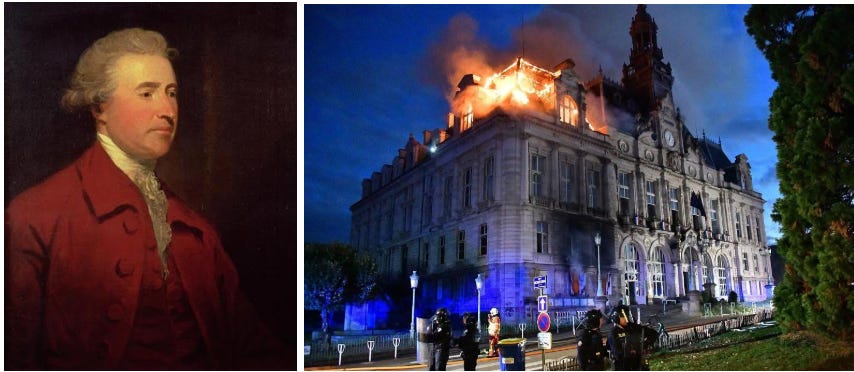
Edmund Burke published his Reflections on the Revolution in France in 1790. After two hundred and thirty-six years, another set of reflections seems overdue.
The French have been generous with material; since Burke wrote, they have worked through five republics, two empires, a restored monarchy, a July Monarchy and Vichy, while keeping the original revolution in daily use. Their national holiday commemorates a crowd forcing its way into a royal fortress. Their anthem is a marching song of 1792. A visitor could be forgiven for concluding that in France the overthrow of inherited institutions has become an inherited institution, with its own calendar, its own repertoire and, every few years, its own weekend.
What happened in Limoges?
The latest weekend began on Saturday 17 October. About 550,000 people marched across France by the Interior Ministry’s count, 800,000 by the organizers’, against the price of fuel, a draft budget that froze benefits and civil servants’ pay, and the state of the schools [1, 2]. Most marched peacefully [3]. Some did not. In Limoges, late in the afternoon, a group broke the windows of the hôtel de ville, went in and set fire to the ground floor. By half past eight the belfry had collapsed, and the prefect was saying that the building was largely lost [4, 5].
That building had a considerable biography. Its construction began in 1879, and it replaced a modest town hall of 1811, which insurgents had invaded in April 1871 to proclaim a commune of their own. Its architect took as his model the old Hôtel de Ville of Paris, burned by the Communards that same spring. The new town hall of Limoges was inaugurated on 14 July 1883 [5, 6, 7]. The Third Republic opened it on the anniversary of the storming of the Bastille; in 2026 it was stormed on the anniversary of nothing in particular.
On Sunday evening several thousand people, seven thousand by the city’s estimate, gathered in Limoges’s own place de la République. Mayors had come from across the conurbation and beyond, and residents came with them. They walked from a pharmacy the rioters had attacked to the ruin, kept a minute’s silence in front of it and sang the Marseillaise [8, 9]. “C’est le symbole de la République qu’on a détruit,” one woman told franceinfo: it is the symbol of the Republic that has been destroyed [10]. Both crowds belong to the France of 2026. The first used methods that would not have looked out of place in 1789; the second defended a municipal office with a war song of 1792.
Elsewhere the pattern repeated with mild variations. A tourist office burned in Lyon, and intruders had reportedly forced their way into the city hall of Marseille. In Paris the base of the monument on the place de la République, Marianne and all, was partly dismantled [1, 3]. By 19 October the Interior Ministry had counted nearly 2,400 arrests and almost a thousand police officers injured, and several cities had imposed curfews [11, 12].
Burke’s Theory of Change & The Issue of Belonging
It would be easy to call Burke as a witness for the prosecution and leave it there. But his quarrel in 1790 was never with change as such; he held that a state unable to reform itself could not conserve itself either, and he admired the English settlement of 1688 as a change made in order to preserve.
What he did reject was the conviction that one generation of clever men could ever take a society apart and reassemble it from first principles, as though nothing they had received contained knowledge they lacked. Society, for him, was a partnership in which no generation held a controlling interest, “a partnership not only between those who are living, but between those who are living, those who are dead, and those who are to be born“ [13]. The living hold the country as tenants for life. They may repair it and improve it. They may not squander it, because it was never only theirs.
The fire in Limoges raises Burke’s question, two centuries on: whether belonging to France still carries a shared understanding of what one owes to what one has inherited.
He had, after all, defended rebels before. In 1775 he urged the Commons to keep the American colonies by conciliating them, because the colonists loved liberty as Englishmen understood it and pleaded the rights of Englishmen against a Parliament that seemed to have mislaid them [15]. The National Assembly of 1789 pleaded the rights of man, which belonged to everyone and were therefore, by his lights, anchored nowhere. The Americans kept their common law and their colonial assemblies; the French abolished their provinces.
That abolition provoked his most confident prediction: nobody, he wrote, would ever take pride in belonging to a numbered square on a map [13]. About the affection he was too pessimistic. The Haute-Vienne, the department Limoges landed in, is now the 87, a number people put on their license plates by choice. About the centralizing ambition behind the map he was nearer the mark.
On Sunday the mayor of Limoges asked the state for a “pluie de millions,” a rain of millions, to rebuild his town hall, and the prime minister promised that it would be rebuilt [9, 16]. The little platoon still needs Paris to restore its house.
Membership of the Nation
Geometry did not make the departments lovable. The Third Republic did, by means Burke would have recognized. It restored the Marseillaise as the national anthem in 1879, made 14 July the national holiday in 1880 [17], and sent a schoolmaster into every village to turn peasants who often spoke little French into Frenchmen. Not always gently: children caught speaking Breton or Occitan could be punished for it in class [18]. It built town halls with the same intent. Limoges’s was one of them.
This is the irony that interests me more than the familiar one. Republican universalism is usually presented as Burke’s opposite: belonging by principle rather than by descent, a nation joined by assent to a creed. In practice the Third Republic did not trust the creed to do the work alone, but manufactured an inheritance and furnished it with anniversaries, a building in every commune and a teacher in every village, because its founders understood (whether or not they had read him) that affection has to be housed somewhere. The Revolution survived in France by being conserved. Burke lost the prediction and won the argument.
Which brings us to the question the October weekend in fact raises. The Third Republic expected its citizens to become heirs, and it was not shy about insisting. What does France expect now?
Of newcomers it expects a good deal, on paper. The Civil Code already requires a candidate for naturalization to prove his “assimilation à la communauté française“ [19], and since January he must also show French at the advanced B2 level and pass a forty-question civic examination [20]. Neither requirement is unreasonable. They measure grammar and a working knowledge of the institutions. They cannot measure whether a person has come to regard those institutions as his own to keep and to hand on. The native-born, for their part, are never examined at all.
That is the distinction the law cannot draw and a political community cannot do without. A residence permit admits someone to the territory. Citizenship admits him to the administrative Republic, with its rights, its ballots and its tax returns. Neither admits him to the partnership, which is joined less formally: by coming to feel that the town hall and the school were left to you by people you never met, and that you owe them to people not yet born. The woman outside the ruin on Sunday had joined it. She felt the loss, and that is the fundamental credential the partnership cares about.
Who can Receive an Inheritance?
Can anyone join a partnership he did not help to create? Burke’s answer is, perhaps surprisingly, generous. Nobody creates an inheritance. Everyone receives it, the native-born included, and the test of an heir is conduct toward the estate. By that test some families who have lived in the Limousin since Léonard Limosin painted his enamels there will fail, and some who arrived last decade will pass. The French argument about immigration, seen this way, concerns attachment rather than origin, which makes it no less serious.
The obligation runs in two directions. A newcomer who asks for French nationality is asking to be made an heir, and an heir accepts the estate with its debts as well as its rents: the language, a laïcité that may be unfamiliar, the memory of wars his grandparents did not fight, a town hall he did not build. A France that mistakes the examination of belonging for belonging itself risks confusing a partnership with a residence. The native-born are bound in the same way, though nobody has ever asked them to accept anything.
The state is bound too. “To make us love our country, our country ought to be lovely,” Burke wrote [13]. A Republic that wants heirs has to keep the estate in a condition worth inheriting, and has to offer it, as the Third Republic did, rather than merely regulate access to it.
The schools were always its chief instrument for turning residents into heirs, which is why the pupils who blockaded them this autumn deserve a hearing before a lecture. Their grievances were unglamorous: too few teachers, dilapidated buildings, overloaded classes [21]. The blockades had their own share of violence, which should not be prettified [22]. But nobody in those schools proposed to abolish the lycée. They wanted one with a teacher in every classroom.
A crowd demanding that an institution work is expressing attachment to it, however clumsily. The fire in Limoges belongs to another category. A town hall is not a lycée short of teachers, and nobody has yet explained what the people who broke its windows wanted. On present evidence nobody can.
The interior minister blamed several thousand far-left individuals, joined by delinquents who came to loot; the mayor of Limoges held La France Insoumise largely accountable for the chaos; the party has dismissed earlier accusations of the kind as conspiracy talk [8, 21, 23]. These are accusations. A suspect in the arson has been arrested, and the investigation continues [5].
Burke thought the revolutionaries monstrous, but they had a program. They wrote a declaration of rights, drafted a constitution and redrew the map; they meant to replace one France with another, and they said so at length. The people who burned the town hall of Limoges have published no declaration and made no demand. If they had a program, they have kept it to themselves.
The looting that weekend, in Limoges and elsewhere, offered little further enlightenment, beyond an apparent interest in whatever could be carried away [24]. That tells us nothing certain about the arsonists’ motives. It does tell us something about the distinction. Destruction in the service of a rival idea of the country is still, perversely, a way of caring what the country becomes. Destruction that proposes nothing looks more like the condition Burke feared most: an inheritance that has become nobody’s.
There may be one further irony. Whatever the radicals in the streets meant to achieve, the political profit may accrue elsewhere [25]. Marine Le Pen entered the weekend at 36 percent in a YouGov survey of first-round voting intentions, conducted between 12 and 15 October, before a single window was broken [26]. The day after the riots she spoke of a crisis of confidence and blamed the far left and a President “without credibility or authority“ [27]. Whether the violence moves a single vote remains to be seen. But there is something peculiarly French about a movement associated with the Left supplying the Right with its most vivid illustrations.
The Problem with Revolution
France does, of course, distinguish in law between the crowd of 1789 and a crowd that burns a town hall today, and commemorating a revolution is a different thing from licensing the next one. The 14 July the Republic chose in 1880 was a double anniversary: the storming of the Bastille, but also the Fête de la Fédération of 1790, when the new nation celebrated its own unity [17]. The difficulty is moral nonetheless.
The Republic honors among its origins an assault on a state building, and condemns, rightly, the burning of a town hall today. Regimes born of revolution live with that contradiction by insisting that theirs was the last revolution anyone needed, and the insistence holds only while citizens share a sense of which buildings belong to everyone.
On 14 July 1789 the Bastille held seven prisoners. The town hall of Limoges recorded the births, marriages and deaths of the city. Burke warned that a generation which treated its inheritance as raw material would teach its successors to treat its own creations the same way [13]. The town hall of Limoges was a revolutionary creation in exactly that sense, and it stood for 143 years before somebody treated it the way 1789 treated the Bastille. That is either a refutation of Burke or a vindication delivered very late. I incline to the second, with a thoughtful qualification: for 143 years, and again on Sunday evening, most of the people of Limoges respected it.
Burke’s fear was that one generation would leave the next “a ruin instead of an habitation“ [13]. Limoges now has the ruin, and the state has promised the habitation. Stone and slate are the easy part; the French rebuilt the Hôtel de Ville of Paris after 1871 and Notre-Dame after 2019. What no ministry can commission is the conviction that brought thousands of people to a burnt building on a Sunday evening: that it had been left to them, and that they owed it to someone not yet born.
That conviction is the real inheritance. It must be handed on to the children of old families and new ones alike. A France in which belonging no longer implies a duty to preserve would retain its territory, its constitution and an excellent heritage service. It would have ceased to be a partnership.
When the new town hall of Limoges opens, I suspect they will choose the fourteenth of July.
References
Associated Press. “French police arrest more than 1,800 people after violent protests erupt across country.” CBS News, 18 October 2026. https://www.cbsnews.com/news/protests-france-rising-living-costs-students/
franceinfo. “Mouvement du 17 octobre : entre 200 et 300 actions attendues samedi dans tout le pays contre la vie chère.” 15 October 2026. https://www.franceinfo.fr/economie/greve/mouvement-du-17-octobre-entre-200-et-300-actions-attendues-samedi-dans-tout-le-pays-contre-la-vie-chere_8238583.html
Al Jazeera. “Paris left reeling as student-led protests turn chaotic.” 18 October 2026. https://www.aljazeera.com/news/2026/10/18/paris-left-reeling-as-student-led-protests-turn-chaotic
France 3 Nouvelle-Aquitaine. “Mobilisation du 17 octobre à Limoges : la mairie de Limoges toujours en feu, le campanile, emblème de la ville, s’est effondré.” 17 October 2026. https://france3-regions.franceinfo.fr/nouvelle-aquitaine/haute-vienne/limoges/mobilisation-du-17-octobre-des-manifestants-mettent-le-feu-a-la-mairie-de-limoges-3435198.html
franceinfo. “VIDEO. Un incendie ravage l’hôtel de ville de Limoges en marge de la mobilisation du 17 octobre, le campanile et une partie du toit se sont effondrés.” 17 October 2026 (updated). https://www.franceinfo.fr/economie/greve/video-un-incendie-ravage-l-hotel-de-ville-de-limoges-en-marge-de-la-mobilisation-du-17-octobre_8242054.html
Ministère de la Culture. “Hôtel de ville et Fontaine,” Limoges. Base Mérimée, notice PA00100361 (inscription aux monuments historiques, 15 January 1975). https://pop.culture.gouv.fr/notice/merimee/PA00100361
Châtain, Georges. “4 avril 1871, la brève Commune de Limoges.” Les Amies et Amis de la Commune de Paris 1871, Bulletin no. 37. https://www.commune1871.org/la-commune-de-paris/histoire-de-la-commune/dossier-thematique/les-communes-en-province/604-4-avril-1871-la-breve-commune-de-limoges
franceinfo. “A Limoges, 7 000 personnes se sont rassemblées pour une marche après l’incendie de l’hôtel de ville en marge de la mobilisation du 17 octobre.” 18 October 2026. https://www.franceinfo.fr/societe/mobilisation-du-17-octobre/sept-mille-personnes-se-sont-rassemblees-a-limoges-pour-une-marche-apres-l-incendie-de-l-hotel-de-ville-en-marge-de-la-mobilisation-du-17-octobre_8243089.html
ICI (Radio France), Limoges. “Plusieurs milliers de personnes à la marche des élus après l’incendie de l’Hôtel de Ville de Limoges.” 18 October 2026. https://www.ici.fr/nouvelle-aquitaine/haute-vienne-87/limoges/plusieurs-milliers-de-personnes-a-la-marche-des-elus-apres-l-incendie-de-l-hotel-de-ville-de-limoges-1312844
franceinfo. “’C’est le symbole de la République qu’on a détruit’ : à Limoges, des élus et des habitants en colère après l’incendie de la mairie.” 18 October 2026. https://www.franceinfo.fr/france/nouvelle-aquitaine/haute-vienne/c-est-le-symbole-de-la-republique-qu-on-a-detruit-a-limoges-des-elus-et-des-habitants-en-colere-apres-l-incendie-de-la-mairie_8243773.html
CNBC. “France hit by worst unrest in years as attempts to rein in government spending meet citizen ire.” 19 October 2026. https://www.cnbc.com/2026/10/19/france-protests-worst-in-years-unrest-macron-.html
CNN. “Several French cities impose curfews after weekend of chaos and protests spreading to parts of Europe.” 19 October 2026. https://www.cnn.com/2026/10/19/europe/france-protests-violence-wwk-intl-hnk
Burke, Edmund. Reflections on the Revolution in France (1790). In The Works of the Right Honourable Edmund Burke, vol. 3. Project Gutenberg eBook #15679. https://www.gutenberg.org/ebooks/15679
ICI (Radio France), Limoges. “Mobilisation du 17 octobre : à Limoges, l’heure du premier bilan après l’incendie de la mairie.” 18 October 2026, 20:23. https://www.ici.fr/nouvelle-aquitaine/haute-vienne-87/limoges/mobilisation-du-17-octobre-a-limoges-l-heure-du-premier-bilan-apres-l-incendie-de-la-mairie-6878192
Burke, Edmund. Speech on Conciliation with the Colonies, House of Commons, 22 March 1775. In Philip B. Kurland and Ralph Lerner, eds., The Founders’ Constitution, vol. 1, ch. 1, doc. 2. University of Chicago Press. https://press-pubs.uchicago.edu/founders/print_documents/v1ch1s2.html
France 3 Nouvelle-Aquitaine. “Incendie de la mairie de Limoges : ‘Nous attendons surtout que les responsables soient trouvés et condamnés’, la marche des élus rassemble des centaines de personnes.” 18 October 2026. https://france3-regions.franceinfo.fr/nouvelle-aquitaine/haute-vienne/limoges/en-direct-a-limoges-la-marche-des-elus-rassemble-des-centaines-de-personnes-apres-l-incendie-qui-a-ravage-l-hotel-de-ville-3435507.html
Assemblée nationale. “La Marseillaise : hymne national.” Historical dossier. https://www2.assemblee-nationale.fr/decouvrir-l-assemblee/histoire/dossier-historique-la-marseillaise/la-marseillaise-hymne-national
Weber, Eugen. Peasants into Frenchmen: The Modernization of Rural France, 1870-1914. Stanford: Stanford University Press, 1976.
Code civil, article 21-24, as quoted in Ministère de l’Intérieur, circular to prefects on naturalization (NOR INTK2513256J), 2 May 2025. https://gisti.org/IMG/pdf/circ_2025-05-02_intk2513256j.pdf
Assemblée nationale. Written question no. 11488 (Paul Christophle) on the civic examination, and the Interior Ministry’s answer. Journal officiel, 9 December 2025 and 11 August 2026. https://www.assemblee-nationale.fr/dyn/17/questions/QANR5L17QE11488
Rivière, Lucie. “Revendications locales, vidéos virales, soutien de LFI... Comment le blocage de quelques lycées s’est transformé en un mouvement d’ampleur.” franceinfo, 1 October 2026; republished by RTBF, 2 October 2026. https://www.rtbf.be/article/revendications-locales-videos-virales-soutien-du-parti-la-france-insoumise-comment-le-blocage-de-quelques-lycees-s-est-transforme-en-un-mouvement-d-ampleur-en-france-11794146
Al Jazeera, with AFP, AP and Reuters. “School protests spread as fires, blockades deepen unrest in France.” 1 October 2026. https://aljazeera.com/news/2026/10/1/school-protests-spread-as-fires-blockades-deepen-unrest-in-france
BBC News. “Macron calls for ‘calm and order’ after riots across France.” 19 October 2026; republished by Citi Newsroom. https://www.citinewsroom.com/2026/10/macron-calls-for-calm-and-order-after-riots-across-france/
ICI (Radio France), Limoges. “Emeutes à Limoges : 17 gardes à vue dont sept mineurs, quatre policiers sérieusement blessés et des pillages constatés.” 18 October 2026. https://www.ici.fr/nouvelle-aquitaine/haute-vienne-87/limoges/emeutes-destructrices-a-limoges-19-gardes-a-vue-en-cours-4-policiers-serieusement-blesses-et-des-pillages-constates-7755802
Meichtry, Stacy. “Marine Le Pen Seizes on French Chaos to Present Herself as Leader in Waiting.” The Wall Street Journal, 20 October 2026. https://www.wsj.com/world/europe/marine-le-pen-seizes-on-french-chaos-to-present-herself-as-leader-in-waiting-80549c0a
YouGov for Le HuffPost. “Intentions de vote à l’élection présidentielle 2027.” Fieldwork 12-15 October 2026, 1,094 respondents; notice filed with the Commission des sondages. https://www.commission-des-sondages.fr/notices/files/notices/2026/octobre/10323-pres-iv-yougov-le-huffpost-18-octobre.pdf
Euronews. “Marine Le Pen warns of ‘threat to democracy’ and blasts ‘exhausted Macronist power’.” 18 October 2026. https://www.euronews.com/2026/10/18/marine-le-pen-warns-of-threat-to-democracy-and-blasts-exhausted-macronist-power
Previously entries in the Frantifada Symposium:
Jens Heycke on the French economy, youth unemployment and multiculturalism:

Daniel Clarke-Serret on the two nations inside France:

Khaled Salih on the contradictions implicit in the French Open Society:

Richard Neat (French-trained Michelin-starred chef) on how statism is reducing creativity:

Daniel Clarke-Serret on how French postmodernist intellectuals betrayed the Enlightenment and its promise/reality of progress:
More reflections on France to come. Continue to submit your articles!
