


Jens Heyke was educated in Economics and Near Eastern Studies at the University of Chicago, the London School of Economics, and Princeton University. He has since worked as an executive in several successful technology startups, investigated global tax evasion schemes and worked as a writer and independent researcher, all the while being an internationally competitive masters cyclist. Importantly for this article, he is the author of Out of the Melting Pot, Into the Fire: Multiculturalism in the World’s Past and America’s Future. We thank Jens for this timely reflection on the state/State of modern France. - Daniel Clarke-Serret (editor, Guerre and Shalom)
The Latest Chapter of The Genocide of Truth. Support this work financially to end The Great Genocide Blood Libel:


“But is it in destroying and pulling down that skill is displayed? Your mob can do this as well at least as your assemblies.”
— Edmund Burke, Reflections on the Revolution in France (1790)
Imagine starting a fire and then standing by and filming with your mobile phone while a firefighter is engulfed in flames. That is one of the scenes emerging from France’s latest wave of unrest. Elsewhere, rioters have doused a teacher in petrol, looted businesses, and set vehicles and schools on fire. The fact that many of the rioters are looting while waving Algerian and Palestinian flags is just a symptom of a much larger, unspoken failure.
The ostensible grievance is the condition of French education. The proposed remedy, apparently, is fewer teachers and more ashes.

France is once again supplying footage of burning vehicles, smashed businesses, and streets full of tear gas1. Allianz counted 5,517 protests and riots in France in 2024, more than three times the U.S. rate per capita. At some point, recurring riots stop being a series of unfortunate incidents and start looking like a national operating system.
The latest unrest in France offers an occasion to examine a country whose political habits are precisely those American progressives keep urging us to adopt: expensive barriers to hiring, immigration without a serious demand for assimilation, and a government expected to pay for nearly everything.
Why no jobs for young people?
France’s unemployment rate for ages 15 to 24 is a staggering 21.6%, versus only 9.1% in the U.S. That is a lot of young people with afternoons free for “improving” education with a cigarette lighter and a crowbar.
When I studied and worked in Europe, I was struck by how many young people I met who had literally never worked a day in their lives. Working with Alcatel and other local companies, I learned part of the reason: if you hire somebody in France, you’re practically married to them. Except in marriage, a spouse occasionally leaves voluntarily.
So employers make sure they desperately need someone before taking the plunge. When a bad hire can become a lengthy legal ordeal, “let’s give the kid a chance” loses much of its appeal.
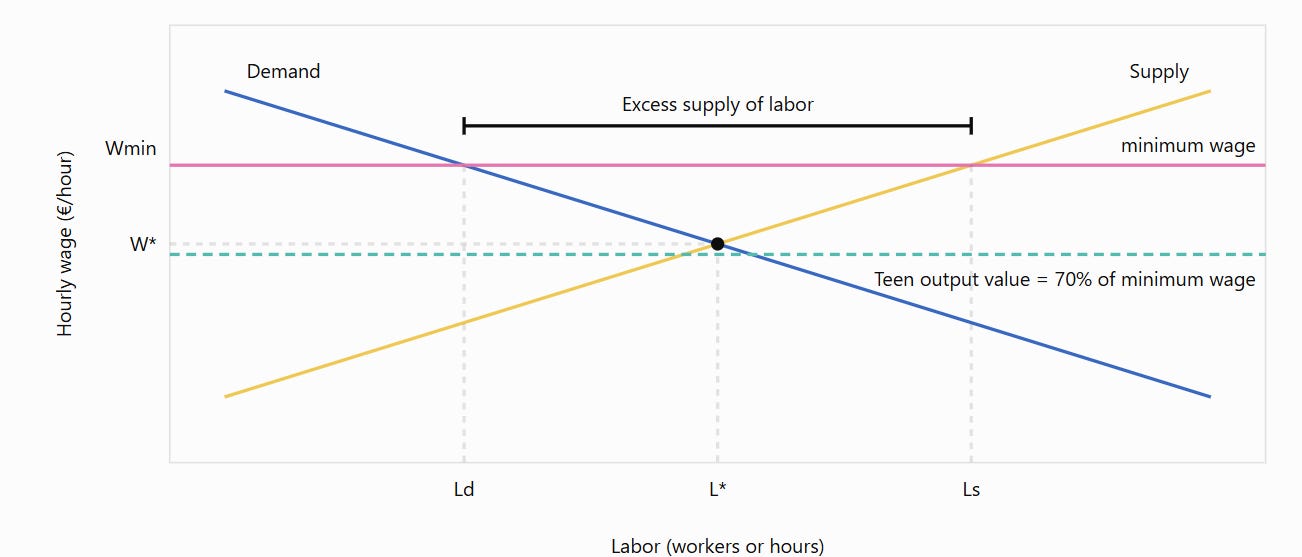
France’s astronomical minimum wage makes it all the worse. It stands at over 62% of the median wage, versus roughly 25% for the federal minimum in the U.S. This is really basic Econ 101: if a rookie’s work is worth less than €12.31 an hour plus onerous mandatory benefits, the rookie doesn’t get hired.2
Faced with those labor costs, businesses do what any rational enterprise would do: they automate. I spotted fast-food kiosks in France years before I saw them in the U.S.3 Minimum wage laws should be renamed “kiosk proliferation laws.” They have certainly accomplished that in France and California (see article here).
Youth employment matters for more than just its contribution to GDP. A job gives a young person a sense of belonging, responsibility, purpose, and, crucially, something to do. If they’re working, they’re not rioting.
Assimilation: apparently an unreasonable request
A country needs more than a labor market. It needs enough agreement about its basic rules to keep disagreements from becoming street battles. That is no longer a given in France.
Over 34% of France’s under-18 population is of first-, second-, or third-generation immigrant origin. Two thirds of the immigration comes from the Third World, and 44% arrives from Muslim-majority countries (compared to only 4% in the U.S.).
Many of these newcomers do not share commonly held French values and feel no affinity for French society. Fewer than a quarter of foreign-born residents “feel French.”
Of the major Muslim-majority countries sending immigrants to France, only one (Senegal) is a democracy. A large percentage of these immigrants flatly reject laïcité, the strict tradition of secular government that France has cherished for more than a century. A country that hosts millions who feel no affinity for its traditions or its people is ripe for civil unrest.
The polling is not subtle. A 2025 survey found that 38% of French Muslims approve of some or all Islamist positions, twice the share that held comparable views in 1998. Among Muslims aged 15 to 24, 57% say Sharia rules outrank French law, and 32% express sympathy for the Muslim Brotherhood. This is not a story of steady convergence. The younger generation is more hardline than its parents.
The gap also shows up in practices that have nothing to do with headscarves and everything to do with whether two populations can share a street. In the 2021 French national perinatal survey, about 0.9% of women giving birth had undergone female genital mutilation, a practice France has criminalized but which remains common in several of the countries supplying its immigrants. A culture that cuts little girls does not slot neatly into a culture that jails people for doing it.
Elite commentary still treats this as a manners problem. It is not. Cultures that already agree on law, sex, authority, and the place of religion assimilate. Cultures that treat those questions as settled by revelation do not, at least not on any timetable a democracy can survive. As I’ve noted in another article, classical Islamic jurists were often clearer on this than modern European ministries: permanent settlement in a non-Muslim polity was widely regarded as a bad idea, if not forbidden outright. French policy could do worse than take the hint.


Big government: big problems, small incomes
France’s third problem is a government expected to provide for and handle practically everything. French government spending as a percent of GDP is a whopping 57% (versus only 37% in the U.S.).
All that government has bought abysmal growth and stagnant incomes. In the 1980s, France’s per capita GDP was roughly 93% of America’s. Today it is only 72%, and the median American has about 50% more disposable income than the median Frenchman, after taxes, cash benefits, and differences in purchasing power.
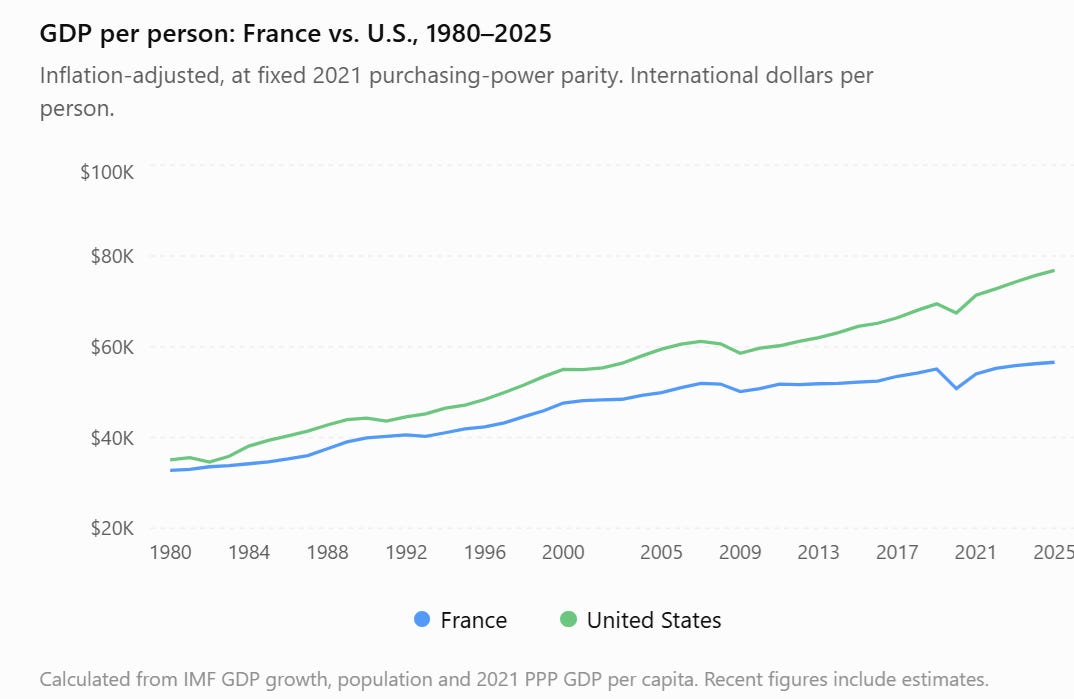
When the government is the largest allocator of resources, people focus their productive energy on persuading it to allocate in their favor. The wealthy and connected do their persuading with lobbyists (or bribes). Everyone else does it in the street. Hence the French pattern: farmers, rail workers, and students always seem to be protesting something.
In a freer economy, people get ahead by focusing their productive energy on providing goods and services that others want. When the state allocates less, there is less to gain by setting buses on fire.
Want to be like France? You know how to vote
Three policies are driving France’s slow-motion collapse:
Punitive minimum wage laws that price the young out of work.
Unchecked immigration that ignores cultural compatibility and assimilation.
An overgrown, suffocating state that crushes economic dynamism.
Curiously, these happen to be the crown jewels of the American progressive left. Roughly 90% of all Democrats support doubling the minimum wage. More than 70% of “strong liberals” support removing ALL immigration restrictions. And 79% of Democrats want bigger government, a share that has climbed steeply for 30 years.
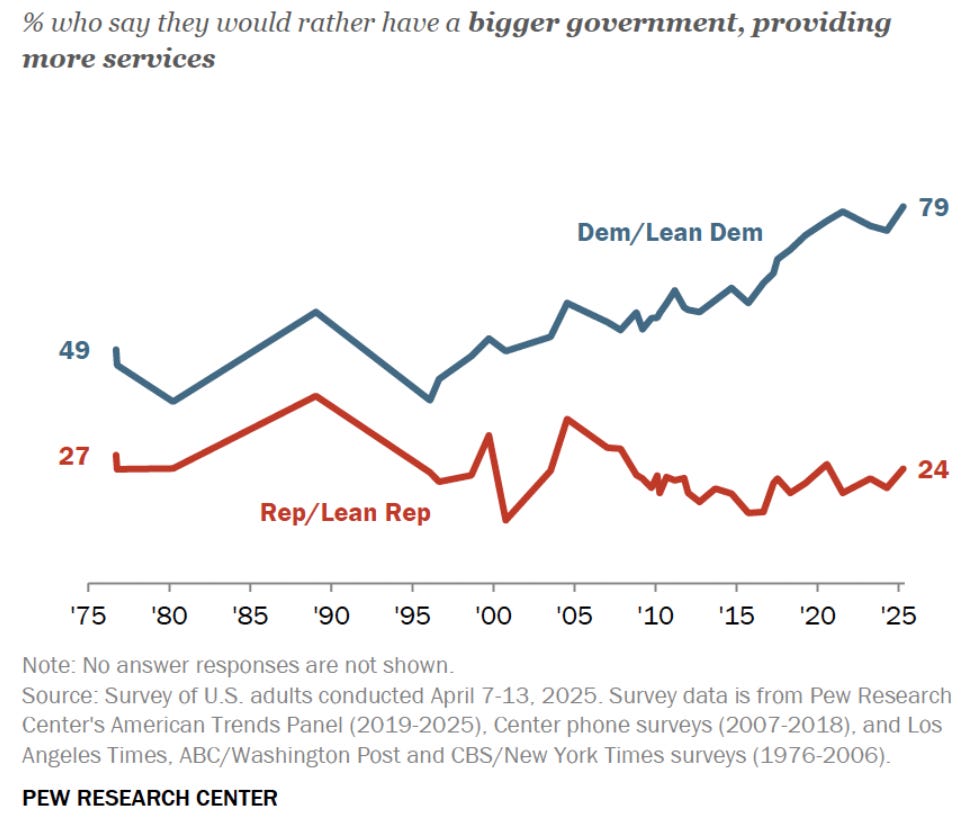
In short, the progressive left would love nothing more than for the U.S. to become France. So if you’ve been pining for double the youth unemployment, a third less take-home income, and a whiff of smoke and tear gas in the streets, you know how to vote.
Assume the average youth’s productivity is €8.60/hour (70% of the minimum wage). That leads to the excess labor supply shown below.
Kiosk use in supermarkets rose from 57% in 2020 to 71% in 2023.

When Scruton asked his activist friends what they hoped to achieve or build to replace the society they despised, he felt he received only empty, slogan-driven Marxist and post-structuralist rhetoric. Nothing has changed every since.
Here are some great reads that I think both Jens’ and Daniel’s audiences would enjoy reading and are essential at this moment in time:
• The Strange Death of Europe: Immigration, Identity, Islam by Douglas Murray
• The Parasitic Mind: How Infectious Ideas Are Killing Common Sense by Gad Saad
• Suicidal Empathy: Dying to Be Kind by Gad Saad
• Against Empathy: The Case for Rational Compassion by Paul Bloom
• The Right Side of History: How Reason and Moral Purpose Made the West Great by Ben Shapiro
• Rationality: What It Is, Why It Seems Scarce, Why It Matters by Steven Pinker
• Fortress Europe: Dispatches from a Gated Continent by Matthew Carr
• While Europe Slept: How Radical Islam is Destroying the West from Within by Bruce Bawer
• Poisoned Ivies: The Inside Account of the Academic and Moral Rot at America's Elite Universities by Elise Stefanik
• Prey: Immigration, Islam, and the Erosion of Women's Rights by Ayaan Hirsi Ali
• Heretic: Why Islam Needs a Reformation Now by Ayaan Hirsi Ali
• Unveiled: How the West Empower Radical Muslims by Yasmin Mohammed
• Islam, Israel and the West: A Former Muslim's Analysis by Danny Burmawi
• Israel on Trial: Examining the History, the Evidence, and the Law by Roy K. Altman
• The Hidden Hand: The Information War and the Rise of Antisemitic Propaganda by Warren Kinsella