

To be clear, Guerre and Shalom will never stop fighting The Great Genocide Blood Libel, a bare-faced lie without even a modicum of proof to support it. It represents pure medieval antisemitism, a negation of truth, a rejection of fact, a cultural appropriation of the Holocaust and a delegitimisation of the world’s only Jewish State. Its use has destroyed language and made communication impossible. It has allowed genuine human rights abuses in the Middle East to go unspoken of and unpunished. It makes me embarrassed to be born into the Western tradition.

We must never forget: Genocide is NOT principally a legal concept. It is a word that invokes the paradigm case of the Holocaust, and the law, if legitimate and coherent with reality, must reflect that. Any designation or judgment that strays too far from the Holocaust is an absurdity. And if a court invokes an absurdity? Then the law is an illegitimate ass.
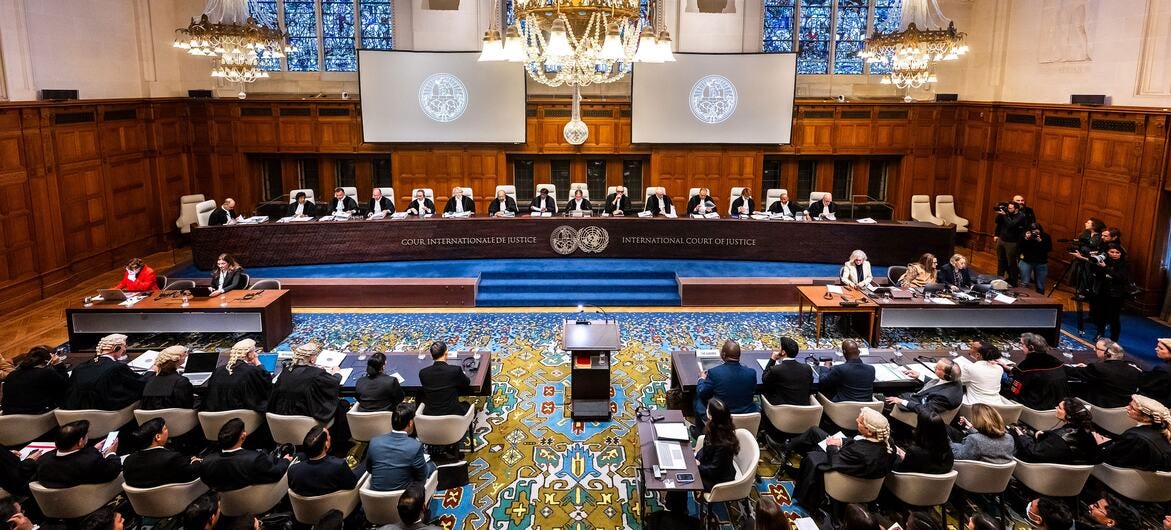
We must never forget: The case against Myanmar has nothing to do with Myanmar. It has everything to do with accusing Israel and the Jewish people of a lie. Jeremy Bowen, Philippe Sands and the rest of the international-media-legal circus can’t even talk about this “case against Myanmar” without dedicating half their ink to its implications for The Great Genocide Blood Libel. We now have a month to get our backsides into gear. WE NEED LEADERSHIP. Only Guerre and Shalom is providing that leadership. SUPPORT US FINANCIALLY.
Below we present A MERE SELECTION of what we are doing at The World’s Intelligent Journal. The time has come to fight back. So stop everything you doing and focus entirely on this project. Civilisation depends upon it.
A] At Guerre and Shalom, we are fighting the genocide lie in poetry:
Now out in print: Daniel Clarke-Serret’s Pure Jewish Anger. Available now on Amazon.com at this link and Amazon.co.uk at this link. #1 in three categories and #26 in Middle Eastern Politics.

Indictment 9: First they called it racism
1.
First they called it racism,
but we didn’t speak out
because they only called it racism.

Then they called it settler-colonialism,
but we didn’t speak out
because they only called it settler-colonialism.

Then they called it apartheid,
but we didn’t speak out
because they only called it apartheid.

Then they called it genocide,
so we finally spoke out,
but it was too late:
They had already plagiarized Holocaust memory.

2.
but we didn’t speak out
First they called it racism,
because they only called it racism..

because they only called it settler-colonialism.
Then they called it settler-colonialism,
but we didn’t speak out

Then they called it apartheid,
because they only called it apartheid.
but we didn’t speak out

Then they called it genocide,
so we finally spoke out,
but it was too late:
Language was confused.

3.
because called only they it settler-colonialism.
First called they racism it,
because called only they it apartheid.

Then called they settler-colonialism it,
but speak didn’t we out
Then called they apartheid it,

because called only they it racism.
but speak didn’t we out
but speak didn’t we out

Then they called it genocide,
so we finally spoke out,
but it was too late:
Truth was lost.

4.
out speak but
 it apartheid they only because
 called racism..

settler-colonialism we didn’t
 called
 out but speak

because it
 they called
 only

racism they First it called

apartheid.
we out didn’t speak but

Then it called they

because only settler-colonialism called they it
but
 speak
 out
 we
 didn’t

That’s why they called it genocide.
Communication being impossible,
the time had come to take power.
B] At Guerre and Shalom, we are fighting the genocide lie in prose (at the level of linguistics, culture, academia, democracy, political philosophy and more):
Daniel Clarke-Serret’s THE GENOCIDE OF TRUTH (Introduction)
This book isn’t about Gaza. Neither is it about Israel. It makes no comment on the October 7th attacks nor the subsequent war. Its focus is far more limited: the claim that Israel is committing “genocide.” And not the claim itself, whose falsehood the book takes as a foundational premise, but the deep philosophical and cultural roots of this modern language inversion.
We don’t say that “genocide” is the only case of language inversion; rather that it is the tipping point, the usage that makes an emergency out of chronic, pre-existing symptoms. In my previous book Pax Arabica, to which this is a sequel, I highlighted several such inversions, promoted by the West, that have shielded Arab governmental and societal actions from criticism. Yet “genocide” is the example par excellence, a falsehood that has torn Western society apart. Lancing this boil, I argue, is the precursor to liberal democratic renewal.
Neither is this book yet another example of geopolitical analysis. We will not revisit the events of the last 3 years nor give our detailed take on misinformation and military outcomes. Instead we will focus on the philosophical, with an emphasis on Western intellectual collapse. To ape Bernard Lewis on Middle Eastern decline: What went wrong?
This book is written for readers who already know that no genocide is occurring in Gaza — just as no serious person needs to be persuaded that the Earth is round.
They’ve watched Schindler’s List and found the Gaza connection a gross insult to common sense.
They’ve observed Gazans increase in number, while the Jews of Europe were decimated.
They’ve seen Iranian protesters slaughtered in their tens of thousands, and over just a few weeks, while the same civilian death toll over three years in Gaza has been described as genocide.
They’ve heard of Dresden and Tokyo, firebombed in the War, yet have never once described heard them described as genocide.
They’ve seen one of the world’s most sophisticated militaries, in an advanced technological age, spectacularly fail to exterminate a population in a densely populated urban area.
And then they’ve look in utter incredulity as the great and good have spoken of intent!
If the Israelis had intended to destroy the population of Gaza, it would have been over in a day. Yet somehow, here we are, years later, and we still haven’t reached the civilian death level from the Iranian 2026 protests.
It really isn’t that complicated. If the Israelis are said to intend x, and have the means to do x, but aren’t doing x—not even incrementally over a very long time—then they clearly didn’t intend to.
An awful lot of attention is given to the outrageous statements of a few far-right Israeli ministers. One spoke of dropping a nuclear bomb as “one of the options”, yet, unsurprisingly and thankfully , it hasn’t happened. So we can conclude 1 of 2 things (or, almost certainly, both): either nuclear war was never intended or it was intended, but the speaker had no authority to implement his statement. Either way, it’s clear from what’s actually happened on the ground that said minister didn’t represent Israeli government policy. Instead, the ratio of civilian to combatant deaths shows the reverse: an intent to meticulously protect civilian lives in the pursuit of the war aim of destroying Hamas.
(Indeed, and as an aside, it’s fascinating how widely certain fridge, extreme Israelis are believed in their every statement, while official pronouncements on military operations, death statistics and other important matters are dismissed by the media as “claims”. It’s almost as if they want to believe the worst).
Although the introduction may seem to suggest the inverse, this book is philosophical, not polemical, in nature, but the animating genocide claim is so utterly pathetic that even in a serious and thoughtful work such as this, it needs to be called out as a sham in plain and provocative words. There are times to speak academically and times to speak in dumbfounded satire. This is a case of the latter.
Now we may sympathise with victims on all sides, and we may disagree sharply on the justice or conduct of this war, or on the wider history of the region. But sympathy is not evidence, and the “genocide” charge is not a matter of sympathy. It is a claim of language, fact and law, and on that claim, the case has not been made. Not even close. The same applies to “apartheid” and the other terms that now travel alongside it. This book takes no position on the conflict itself. It takes a position only on the misuse of these words.
We are aware of the consensus among certain elites — UN agencies, special rapporteurs, the “human rights community,” and, increasingly, the courts themselves — and we are aware that their authority has lent the “genocide” charge a credence it has not earned on the evidence. Yet their failure to establish a common sense case diminishes their once venerable institutions; for that there is no Holocaust in Gaza is as clear as the cloudless sky; obvious to all with eyes to see and brains to think. Merely engaging in the debate on their own terms allows absurdity to gain a hearing it does not deserve.
Indeed it is only because they are international elites that we are even engaging seriously with this debate. Had it be proposed by a forty-year old singleton from a basement in Idaho, we would have dismissed it instantly as unserious. Yet the words Human Rights Watch somehow project authority. Unfortunately, in the eyes of those guided by evidence, sense and moral bearing, it highlights a civilisation in distress —a world where authority trumps truth in an act of spectacular fallacy.
I’ve thought long and hard about how to structure this book — whether I should lay out the anti-genocide argument once more in academic terms. I’ve written articles on this many times. I’ve cited numbers, ratios, and statistics. I’ve made historical comparisons and referred to evidence. I’ve spoken of law and precedent. Yet all to little avail. Not because the case is (close to) wrong, but because the word United Nations carries moral weight, and the appearance of impartiality gives the credulous hope. After all, who wouldn’t believe the General Assembly and the Human Rights Council? Who wouldn’t accept a ruling from The Hague?
And so we come to a pretty pass, where you cite Amnesty International and I cite a democracy. You cite Guterres and I raise Steven Pinker. You claim the backing of the “human rights establishment” — including the courts that were meant to stand above it — and I cite someone who hasn’t worked for Hamas. In this context, footnotes become pointless. It is a question of authority over evidence, and on that question, we have no means of conversation.
This is the reason I have written this book. Not to debate with those who are lost, nor to persuade the incorrigible — after all, they claimed “genocide” on October 8th, even before Israel began its ground invasion. Rather, this book asks “why?”. Why has the Western world fallen so far from truth? Why are we forced to debate a dogma that has no basis in reality? How can we survive as a civilization where words are mere emotional signals divorced from definition? For without conversation there is no true debate, and without true debate there is no liberal democracy. Worse there is no cohesive nation except in the blandest sense of bureaucratic citizenship.
I have identified twenty-eight roots of language inversion — twenty-eight possible causes of this abuse of language. Note that I speak of roots, not branches. I am less interested in the obvious explanations: bias in the media, sectarian campaigning, the activist academy. Instead we will dive deeper — the disrespect for truth, the need for religion, the fall of science, the forced evolution of language. Education, art, empathy and Western psychology: all these and more will be investigated until we arrive at a more complete understanding.
If our focus is narrow, our aims are ambitious: to reinvigorate a Western political tradition built on enquiry, evidence, and the search for truth. The “genocide” claim is the tip of the iceberg — the latest and most serious manifestation of language inversion. Beneath it lies an entire structure of discourse that prizes affect over evidence, activism over reason. We submit that reversing this process is essential to the health of our liberal democratic polities.
Those wedded to “genocide,” and to other “epistemological certainties’” will likely turn from these pages before the case has been made. That is their right. But it is also a symptom — a sign of a society without cohesion, for without a common language we have no means of communication. Only power speaks.
We hope, still, to revive a common project: a return to a shared purpose built on truth, reason, respectful discussion, and curious inquiry. We will not agree on the specifics of the Middle East, nor on any other contentious issue — nor does this book (or the Israeli democratic system) ask us to. What we might unite around is the fact of debate itself: the belief that only through discourse, grounded in a common understanding of terms and predicated on truth as the imperative, can we begin to understand one another.
Perhaps, as a writer, I would have been wiser to avoid the Gaza framing — to reach instead for sexual rights, or another hot-button controversy, and mildly lower the temperature. My honest belief is the reverse: that only by confronting the most obvious and widespread example of linguistic decline can we hope to topple the whole pyramid of Babelesque confusion.
Today we seek to unite our nations and our liberal democratic polities — not in agreement, nor in conformity to consensus, but in mutual understanding. We may fail. Much of academia has already bowed to the “genocide” dogma. But the future will bring a new generation, one that can state truth with a loud and confident voice. Today we begin that historical echo: that through understanding the other — literally, through language — we might hope, at last, to be understood.
PART 1: The Tree of Knowledge
Chapter 1: Truth // Chapter 2: Ideology // Chapter 3: Religion // Chapter 4: Science // Chapter 5: Attention // Chapter 6: Distraction // Chapter 7: (True) Expertise // Chapter 8: Authority
PART 2: The Descent to Babylon
Chapter 9: Declaration // Chapter 10: Confusion // Chapter 11: Conversation // Chapters 12: Democratisation // Chapter 13: Sophistry // Chapter 14: Image
PART 3: The Rise of Byzantium
Chapter 15: Guilt // Chapter 16: Belief // Chapter 17: Christ // Chapter 18: Mission // Chapter 19: Doctrine // Chapter 20: Heresy // Chapter 21: Sin
PART 4: The Remnant
Chapter 22: Courage // Chapter 23: Reason // Chapter 24: Revolution // Chapter 25: Philosophy // Chapter 27: Thought // Chapter 27: Judgment
PART 5: The Last Word?
Chapter 28: History

C] At Guerre and Shalom, we are fighting the genocide lie at the level of law:


D] At Guerre and Shalom, we are fighting the genocide lie at the level of comparative international cases:


E] At Guerre and Shalom, we are fighting the genocide lie at the level of strategy:
Repeat after me: “THE GREAT GENOCIDE BLOOD LIBEL” by Daniel Clarke-Serret
We all need to start using the phrase “The Great Genocide Blood Libel”. We need to use it repeatedly and all the time. We need to focus all our articles and all our energies into spreading this much searched for antibody.
To those who haven’t quite catched on, the war was never in Gaza. Rather it was in the hearts and minds of every young person in the Western World. It was the battle for Truth itself.
There is much in this war that falls within a grey area. The Great Genocide Blood Libel isn’t one of them. It’s clear. It’s obvious. It’s deadly. “Genocide” is a claim used to defame the entire Jewish people. Worse than that, it’s an attack on the very foundation of our civilization —that which relies on the precise use of language and the accurate transmission of memory.
Where Truth no longer exists - where it’s subverted to serve a lesser aim of power or empathy or peace or freedom or justice - the Western World falls. Any goal, however noble, that is attained by the denial of fact and the denigration of Truth is a flagstone on the way to hell. We need to stop, turn around and say “Here and no further!”
The genocide claim is a lie. An obvious, blatant and inexcusable lie. Previously, I have explained the reasons why, so I refer the reader to that text and thereby avoid unnecessary repetition. That essay was important. It gave the arguments for our case. It gave the arguments for the bleeding obvious, understandable to those of all of good faith.
"It's a Terrible Blood Libel"

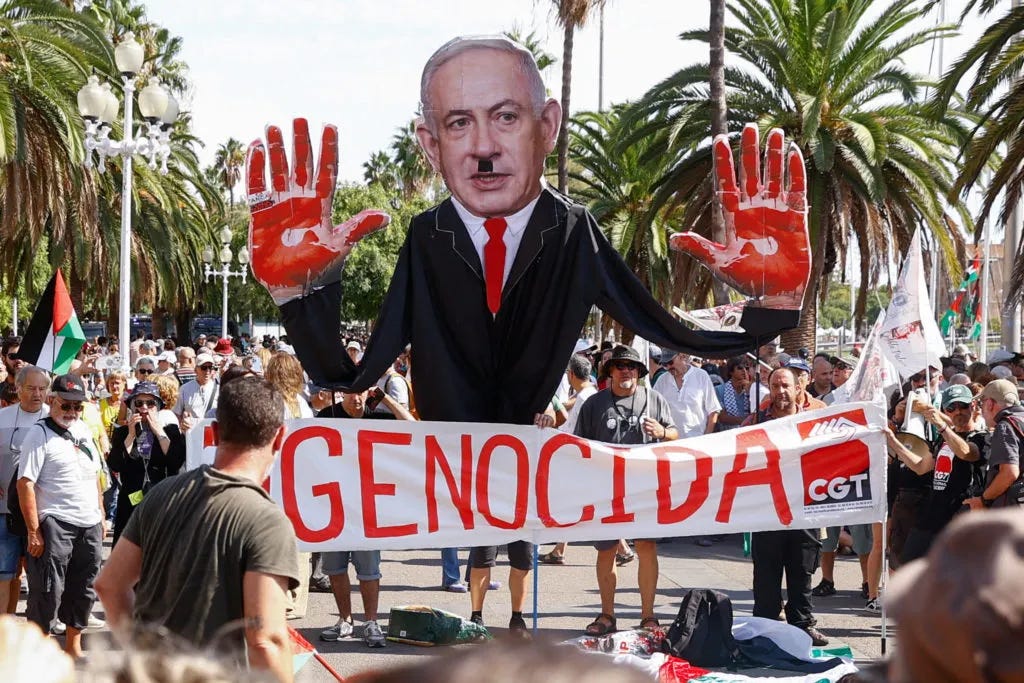
[The images in this article are a rogues’ gallery of our modern genocide liars.]
Arguments are important because they found our position on Truth. They prioritize fact, reality and reason. They show our friends that the mission is just —and we might - just might - persuade the genuinely open-minded.
Arguments are vital for us, but useless for them. They will point to the United Nations, the experts and the Irish government — and they’ll quote Gideon Levy for good measure. No forensic cross-examination will be capable of changing their minds, the argument from authority being ever so illogically powerful. Those in the middle will see our case - they will consider it - but at best they will stay on the fence, stating that if the United Nations conclude something, it must, at least, have some merit.
Arguments are vital for us, but useless for them. We believe in Truth; they believe in “justice”, “freedom” and an empathy which trumps all reason.
Arguments are vital for us…
… but how can we reach them?
There is an answer. There is a slogan. THE GREAT GENOCIDE BLOOD LIBEL. Not the arguments behind the slogan and not the truth upon which it is founded, but the slogan itself. Slogans have the power to change worlds.
When Boris Johnson took the nation to the polls in 2019, he achieved an unambiguous parliamentary majority. As with Disraeli before him, his “exotic” personality no doubt helped. As did the danger of a Jeremy Corbyn government. But above all, his victory was founded upon three words —and an unforgettable slogan: Get Brexit Done. All the arguments in the world, whether for or against, would never have had the power of this short, pithy and highly effective phrase. These three words, repeated ad nauseam and brought to life with visual stunts, returned the Blond Bombshell back to number 10 with devastating aplomb.
It was clear. It was uncomplicated. And it tapped into a feeling that was ubiquitous throughout the British population: We’ve had enough of talking about Brexit. Many wanted “Brexit Done” because they had voted for it and were frustrated by two years of Parliamentary obstacles. Yet beyond this core group, there were those who wanted it done (ie dealt with) because they were done with hearing about it. Thus the slogan united much of the nation: the Soft Brexiteers, the Hard Brexiteers and the Had Enough of Brexiteers. Its unprecedented ability to join clarity with ambiguity created a large enough tent for a parliamentary majority.
Importantly though, it was a slogan founded on Truth: Not the truth of Brexit - the consequences of that I’ll leave for you to decide - but the truth that the entire nation, whatever their opinion, was fed up with the subject and wanted to return to some level of national unity. Many political slogans fall flat because of their obvious vacuousness. “Change” for example. Yet where carefully designed, the great slogan can change everything.
The reason that the Far Left have been so successful in mobilizing public opinion is their objectively well thought out sloganeering. It has allowed their supporters to bypass the arguments and tap straight into emotion. Israel is not “committing a genocide” because of any actual facts on the ground, but merely through mindless repetition. If you say “Israel is committing a genocide” enough, then you will come to believe it. That is the power of slogans.
Similarly “Free Palestine” is an ever present master stroke. It taps right into Johnsonian ambiguity. It allows those who genuinely want a free, liberal, independent, democratic Palestine to share street space with those who have a far more nefarious interpretation of “freedom”. It allows those ruled by empathy to march side by side with those driven by Jew Hatred. Some want Palestine to be free. Others want it free of Jews (and any Western influence). Ambiguity translates into “Don’t ask, don’t tell”.
“Globalize the Intifada” is another classic –albeit one that might be a harder sell. The Extreme Left and the Islamist wing know exactly what it means: the murder of Jews on a worldwide scale; the second intifada made glorious winter. Yet the innocent would be forgiven for believing something quite different —that it means making the struggle for a “Free Palestine” an international enterprise. Thus the slogan is both clear and ambiguous.
We need to be honest. The reason that the pro-Truth side has failed over the last two years - or perhaps two and a half decades - is because it has prioritized arguments over slogans. We have so convinced ourselves that the whole world is against us, that we have refused to get down with the kids (of all ages). Much of the world is hostile, but the majority have simply been manipulated by slogans. To repeat, arguments are vital for us - they ensure that our position is based upon Truth - but they are useless for them.
To achieve change, we need an effective slogan.
To achieve change, we need to endlessly repeat “The Great Genocide Blood Libel”.
To be clear, we are never going to change the minds of the human rights establishment or the United Nations or anyone in the intellectual class who is dead set against us. That doesn’t matter: they are a tiny number of people. What we can change, however, is the mindset of the ordinary man and woman who only has the time to hear three words in an election campaign.
To achieve this goal, we need to stop accusing the non-intellectual people on the other side as being unreachable antisemites or as media fodder incapable of brain malleability. It only took three words to Get Brexit Done. It only took two words to get people to campaign for “Ceasefire Now” — and then reject it when a ceasefire was actually on the table.
Surely the Jewish people and our friends are capable of coming up with a slogan.
Surely the Jewish people and our friends are capable of repeating “The Great Genocide Blood Libel”.
We need to be blunt. There are many reasons why we have failed to step up to the plate and a lot of it’s got to do with ego. Unlike the Intifada Globalizers, who have the self-discipline and unselfishness to submit to leadership and unite around a slogan, we have been more concerned with selling our latest book or promoting our best-selling Substack or saying why we are the greatest. The Islamists, unsurprisingly, have been amazing at submission. We have been terrible.
For once in our 3000 year old history, could we finally get our act together and submit to the party line?
For once in our 3000 year old history, could we acquire the humility to endlessly repeat “The Great Genocide Blood Libel”’?
The second reason we have failed is because we have been utterly undisciplined in our subject matter. Jonny has been talking about Rafah, Jimmy has been talking about Iran and Mordechai has been talking about the IDF draft. This has been foolish, because there was only ever one war: The war on Truth. The war on Holocaust memory. The propagation of “The Great Genocide Blood Libel”. The conflict was never in Gaza; it was in the hearts and minds of our audience.
We need to have the discipline to focus on one issue alone: “The Great Genocide Blood Libel”. We need to repeat it over and over and over again. If we don’t, it doesn’t matter how many wars the IDF win: the next generation of Americans will not support us.
Precisely because the other side has no arguments - only slogans and images and false empathy - they have the ability to be disciplined.
They can repeat “Ceasefire Now!” without it meaning a “Ceasefire Now!”
They can repeat “Free Palestine!” without wanting one.
We, by contrast, are trying to out-clever and out-victim each other and it’s a failed strategy. All we need to do is repeat - ad nauseam, endlessly and without pause - “The Great Genocide Blood Libel”. And we will win because our slogan is based on Truth.
It is indeed telling that since I have started banging on about this slogan, some of the Jews have started to argue. Who would have thought it? Some have complained about the use of the word “Great”. Some have complained about the use of the phrase “Blood Libel”. And these are just the people that read my column. Enough arguing! It was arguing that destroyed Jerusalem. Learn something from the playbook of the Islamists and Far Leftists and submit to leadership: just for once.
We need to have the word “Great”: if the Great Fire of London had been named The Fire of London, no school child would remember that it took place in 1666. It would have been confused with the time that the fire brigade were called out to Leytonstone last week. Great doesn’t mean wonderful — just asked those burnt to a cinder in the 17th century! The word “Great” means “You need to remember this”.
We need to have the phrase “Blood Libel”. in the first place, I have road tested the phrase “The Great Genocide Lie” over the last two years with zero impact. it hasn’t worked for a very simple reason: it’s too ambiguous. Just type it into Google. People believe that it refers to Israel lying about there being no genocide.
Blood Libel, by contrast, makes it abundantly clear. It’s the Jews who are talking. It’s the Jews who are confidently saying J’accuse to Sánchez and the UN and everyone in the Irish political establishment. Which is precisely why, in just a one-week period, this phrase is starting to gain some traction.
Yet better than effective, it’s accurate. Of course, it’s not literally a medieval blood libel. It’s a metaphor (duhh!), but an apt one. It expresses the idea that Jews are falsely being accused of killing innocent children without a single grain of evidence. It happened all the way back in Plantagenet England and it’s happening once more today. It’s in our slogan because it’s true.
People are quick to complain that the Israeli government is useless at public relations. If only they were better at disseminating information! If only they could report in real time! If only they could relay their arguments in perfect English! Let us be clear: this is complete bollocks. Even if Professor Steven Pinker was the Israeli spokesman, it would barely make a whiff of difference —because this has never been about arguments. It’s been about feelings v Truth.
Israel is a country, not a campaigning group. What government in the world makes up a slogan and tells its followers (at press conferences) to repeat it? And if Israel did officially tell its audience to repeat “The Great Genocide Blood Libel”, would we comply? I know the answer. You know the answer. Israel is such an effective democracy because no one listens to the government — not even on October 7th, when it was the people who unilaterally went down to defend those Kibbutzim against Hamas. We are pathologically unable to do what we’re told for precisely the same reason that Far Leftists and Islamists can —they love dictatorship. We don’t.
Nonetheless, desperate times call for desperate measures. We need to give up the habit of a lifetime and stop being argumentative, egotistical and obsessed with the finer points of argument.
We need to repeat “The Great Genocide Blood Libel”. And when should we do it? Now!
I'm not clear why you say lthe ICJ is about to accuse Israel of genocide When South Africa's next statement is not due until November 2027 and Israel's reply is not due until May 2029. I may be misunderstanding. Can you explain?
I wonder if Rwanda qualifies as a genocide. Or the Holodomor. I think that, as Jews, we can recognize that man's supreme inhumanity to man is not a one-time occurrence, without weakening our cry that the Israeli government is not committing a genocide in Gaza.