


Our International Law Correspondent Shlomo Levin continues his series on “genocide” under the international legal system. This vitally important article seriously makes us question the ICJ as a ‘court’ and the authority of its decisions. A must read! - Daniel Clarke-Serret (Guerre and Shalom).
In October of 2024, Jordan’s Ambassador to the United Nations, Mahmoud Hmoud, told the Security Council, “What Israel is doing today in northern Gaza, in full view of the international community, is ethnic cleansing and genocide. Israel is brutally killing innocent civilians and systematically targeting residential areas. Those are all war crimes and crimes against humanity.”
On November 3rd, he was elected to a full nine-year term on the International Court of Justice (ICJ), where he will take part in rendering a verdict on whether Israel has violated the Genocide Convention.
In February of 2024, Phoebe Okowa represented Namibia in ICJ proceedings related to its advisory opinion on Israel’s occupation. She told the court that Israel is guilty of apartheid, commits inhumane acts towards Palestinians and carries out the arbitrary killings and mass incarceration of Palestinians, including children. She was just elected to a full nine-year term on the ICJ as well.
The International Court of Justice, which is the principal judicial organ of the United Nations, is supposed to be non-political and impartial. But its weak recusal policies, politicized judicial selection process, and inadequate restraints on potential conflicts of interest mean it operates in a way that raises serious concerns about its independence.

Recusal
It’s hard to imagine the court’s fifteen judges, who are supposed to be renowned legal scholars, never having voiced opinions on any of the myriad legal matters that come before the court. So a clear policy for recusals would seem to be essential. If a judge had made prejudicial statements about a particular case, they could simply sit that particular case out.
But while it might seem like common sense that the two above named judges should not be part of hearing the genocide case against Israel, it’s likely that they will still participate. This is because of a precedent set in 2004 regarding the court’s advisory opinion regarding Israel’s separation barrier, and the refusal to recuse an Egyptian judge named Nabil Elaraby.
Before being elected to the court, Elaraby had served as Egypt’s UN ambassador, and in that role had criticized Israel harshly. Even after leaving that position, he continued to make anti-Israel statements to the media. Because of this, Israel asked that he not be allowed to participate in rendering a decision about the separation wall.
An overwhelming majority of judges rejected Israel’s request. Their first rationale was that while Elaraby had been harshly critical of Israel, he had never made statements specifically about the separation barrier. Therefore, his views were not prejudiced regarding precisely this topic. Okowa might be permitted to participate on similar grounds, since her accusations of apartheid and arbitrary killings did not specifically address genocide.
The second reason Elaraby was not forced to recuse is that many of his statements were made while he served as Egypt’s UN ambassador. According to the ICJ, that means that they were attributable to the Egyptian government, and so they may not represent his own personal views.
But should a judge’s prior declaration that a country is guilty of genocide be disregarded simply because he made it while representing his government? The ICJ’s reasoning in the Elaraby case suggests that Hmoud may be permitted to participate even though he publicly accused Israel of the very crime the Court must now determine whether it committed.

Why are politicians serving as judges at all?
While the General Assembly and Security Council are openly political, the ICJ is supposed to be judicial and impartial. So one might wonder why ambassadors to these two political organs are being elected to serve on the ICJ at all?
The ICJ statute says only that judges may not hold political positions at the same time. But there is no mandatory cooling off period; someone serving as a country’s ambassador can switch to become an ICJ judge, and an ICJ judge can return to politics right after finishing on the court.
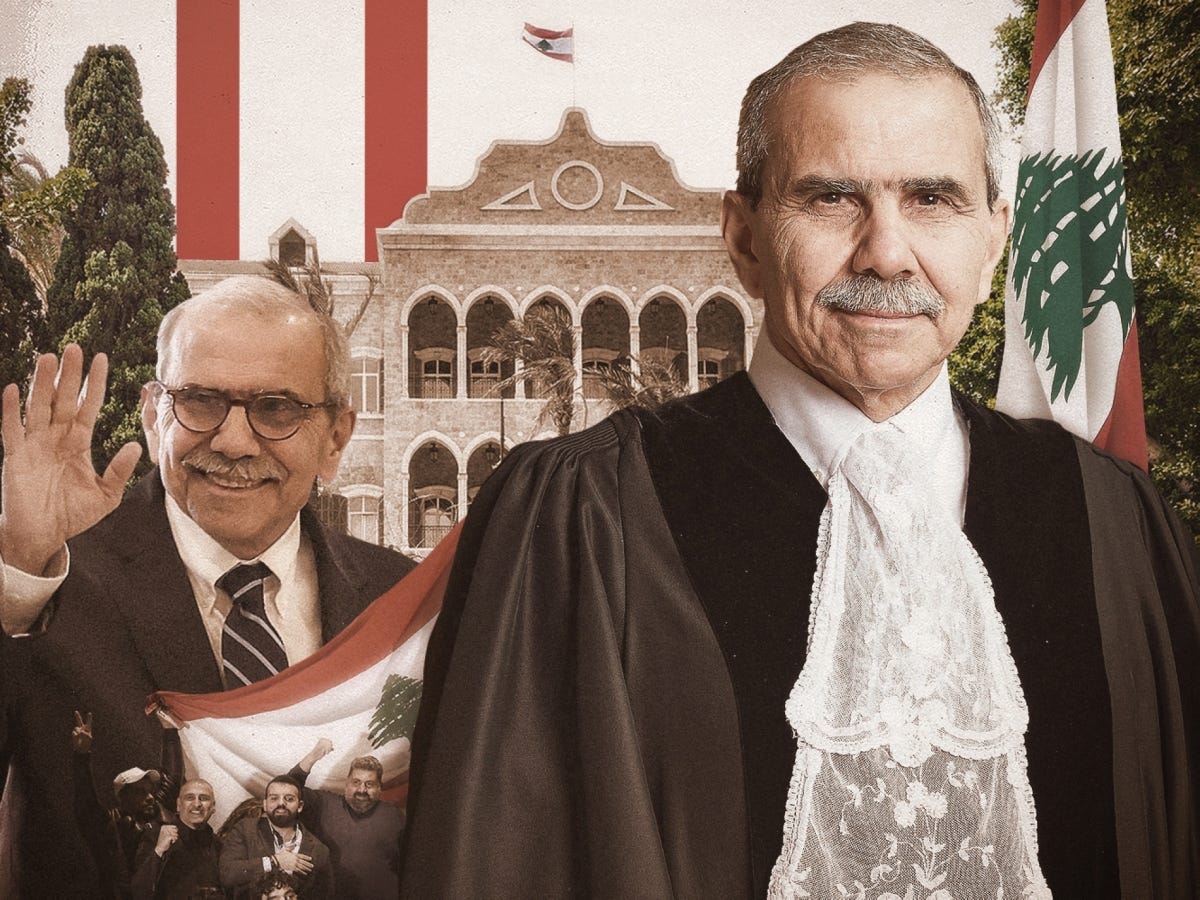
This happened recently, when Nawaf Salam, ICJ President and the judge Hmoud was originally appointed to replace, resigned in January 2025 to become Prime Minister of Lebanon. This was just months after he presided over proceedings that resulted in an order imposing provisional measures against Israel.
While still serving as ICJ president, he already had many contacts with Lebanese political leaders, had openly considered running for office, and had been nominated for Prime Minister several times. As soon as he arrived in Lebanon from The Hague, he referred to Israel as an enemy, saying that he would work “to impose the complete withdrawal of the enemy from the last occupied inch of our land.”
But nothing in the ICJ rules prevented Salam from participating in a case concerning Israel while eyeing a position of political leadership in a country with which Israel was at war. When ICJ judges can pursue political ambitions in countries involved in the very conflicts they are adjudicating, how can anyone trust that the court is truly separate from politics?

The Politics of Judicial Selection
The ICJ statute says that the judges as a whole should represent the main forms of civilization and of the principal legal systems of the world, and this has resulted in a tradition of geographic diversity. According to longstanding UN custom, a set number of judges are selected from each of the globe's various regions.
In spite of this, however, another tradition is that the five permanent members of the Security Council always have one judge from their country on the ICJ. This has been broken only a few times, such as a lengthy period from the 60s through the 80s when China did not have a judge.
Since 2024 Russia hasn’t had a judge, and the UK did not have one from 2018 through now, although that will change now that, along with Hmoud and Okowa, a new British judge was also elected. But France and the United States have had an uninterrupted presence on the court since its founding.
The longstanding expectation that the five permanent Security Council members would each have a judge has historically left only ten seats available for the rest of the world, further restricting representation. For example, the Asia-Pacific region, home to approximately 60% of the world’s population, is ordinarily allotted only two of those ten spots.
While it is tempting to complain about the obvious unfairness, it’s also important to ask why this matters at all. Since judges must swear to act in their own personal capacity, based only on their understanding of the facts and law, and not as representatives of their government, why should the nationality of the judges make a difference?
The hotly contested nature of how seats are divvied up by geography and nationality suggests that countries themselves believe that judges’ backgrounds may make a difference in how they interpret and apply the law.
That judges’ national affiliations may influence decisions is not merely a matter of conjecture; there is also academic evidence. In a 2005 study, University of Chicago law professor Eric Posner and political scientist Miguel de Figueiredo found significant evidence that ICJ judges favored their home countries. A 2025 study by legal scholar Arthur Dyevre similarly found that ICJ judges’ voting patterns closely reflect their home countries’ geopolitical alignments.
Furthermore, the selection process itself is highly political. ICJ judges are selected by the Security Council and General Assembly, requiring a majority in both chambers. UN missions and foreign ministries mount elaborate campaigns, with dedicated election teams hosting receptions and arranging interviews in an effort to get a citizen of their countries chosen. The governments campaigning to elect these judges are themselves potential parties to disputes before the Court. This raises an obvious question about whether judges can remain entirely independent of the countries responsible for securing their election.

Moonlighting as Arbitrators
Political allegiances are not the only potential source of conflicts of interest at the ICJ. The Court has also faced questions about judges’ outside financial interests.
In 2017, a report from the International Institute for Sustainable Development found that numerous ICJ judges were also working as arbitrators, deciding cases between states and investors. These arbitration appointments can be extremely lucrative.In just nine cases, the total fees paid to ICJ judges surpassed $1 million USD. This raises obvious concerns about conflict of interest, as judges may be influenced by the prospect of lucrative arbitration appointments from countries whose cases they are hearing at the ICJ.
In response, the ICJ created new policies to strictly limit outside arbitration work by sitting judges. Yet moonlighting as an arbitrator is not banned entirely, and the 2020 appointment of ICJ Judge Peter Tomka to an investor–state arbitration raised questions about compliance with the new policy. All this serves to throw the court’s impartiality and integrity further into question.

The Eventual Decision
Eventually, the ICJ will rule on the genocide case. Should they find Israel guilty, many governments and human rights organizations will undoubtedly rush to insist that this must be accepted as an authoritative finding, since it was issued by the world’s most independent, prestigious and diverse legal body.
But when the Court tolerates questionable conflicts of interest, allows judges to move freely between judicial and political positions, and relies on an overtly political selection process, it forfeits much of its claim to independence and impartiality.
Israel deserves better. And so does the rest of the world.


Gee, I wonder what they'll decide!
LOL
Israel is Alice in Wonderland and the UN and its NGOs are the Queen of Hearts: "Sentence first—verdict afterwards!"
It's not really a secret at this point that much of the West, especially our progressives and their campuses, the NGOocracy, and various global media orgs (not to mention almost the entire Arab world), wants to deliver a death sentence to the hated Zionist entity.
The pretexts might change, as well as the actors and events, but the underlying goal remains the same.
"Israel is Evil" is now a major revenue stream, moral crusade, reigning ideology, Disneyland ride, Hollywood blockbuster, and a career path for aspiring bureaucrats, jihadists and other Jew haters. Everyone wants a piece of the action and a nice bloody slice of fresh Jewish scapegoat.
Reason, logic, history, facts are irrelevant, this is mass mania we're dealing with...
The fix is in…….