

Help us defeat The Great Genocide Blood Libel. Please support this work with a paid subscription, - Daniel Clarke-Serret (editor, Guerre and Shalom; author, the Genocide of Truth)
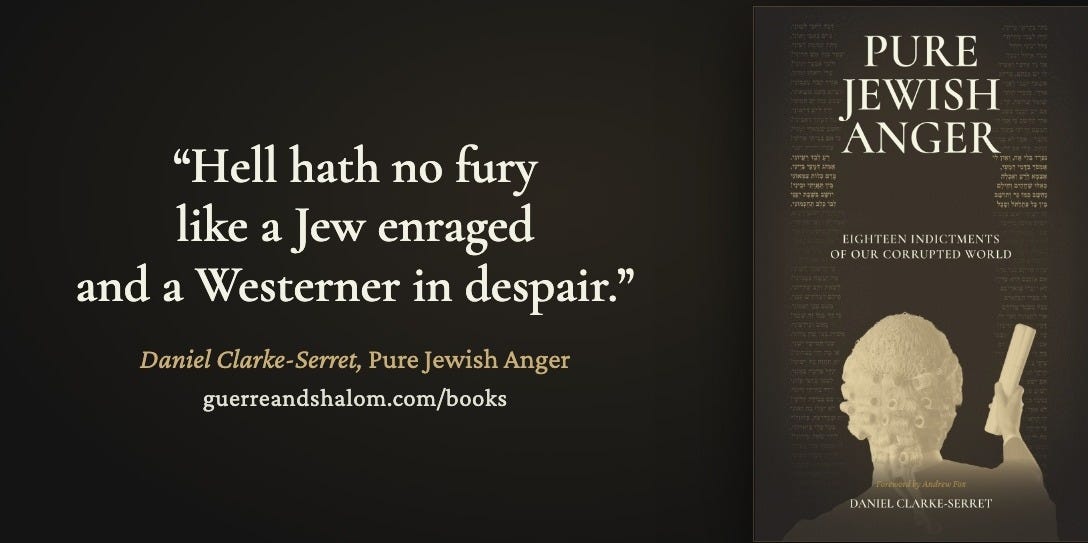
Now out in print: Daniel Clarke-Serret’s Pure Jewish Anger. Available now on Amazon at this link. #3 on Amazon UK for Political Protest Books. #9 on Amazon.com for the same. Just behind Orwell’s 1984….
THE GENOCIDE OF TRUTH: The Deep Roots of a Modern Blood Libel
by Daniel Clarke-Serret
Introduction: The Genocide of Truth
PART 1: The Tree of Knowledge
Chapter 1: Truth // Chapter 2: Ideology // Chapter 3: Religion // Chapter 4: Science // Chapter 5: Attention // Chapter 6: Distraction // Chapter 7: (True) Expertise // Chapter 8: Authority
PART 2: The Descent to Babylon
Chapter 9: Declaration // Chapter 10: Confusion // Chapter 11: Conversation // Chapters 12: Democratisation // Chapter 13: Sophistry // Chapter 14: Image
PART 3: The Rise of Byzantium
Chapter 15: Guilt // Chapter 16: Belief // Chapter 17: Christ // Chapter 18: Mission // Chapter 19: Doctrine // Chapter 20: Heresy // Chapter 21: Sin
PART 4: The Remnant
Chapter 22: Courage // Chapter 23: Reason // Chapter 24: Revolution // Chapter 25: Philosophy // Chapter 27: Thought // Chapter 27: Judgment
PART 5: The Last Word?
Chapter 28: History
Chapter 24: Revolution
Hope dies one funeral at a time
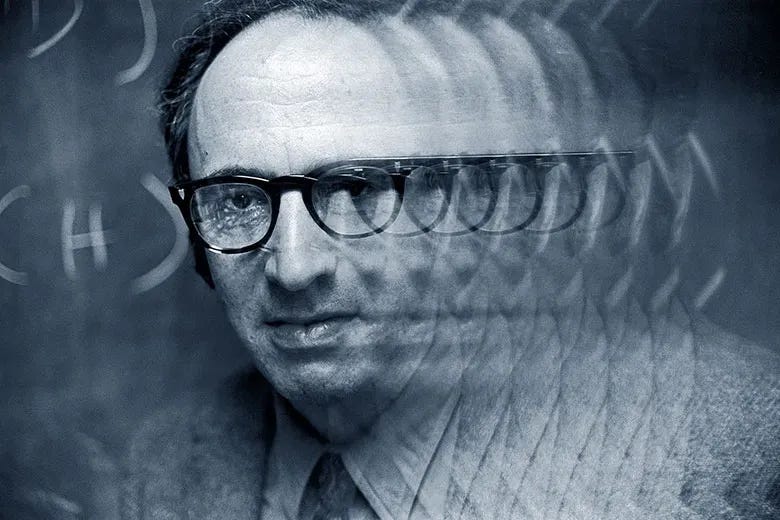
"Science advances one funeral at a time" (Max Planck)
“So does the definition of genocide, but it’s a regression to hell.” (Daniel Clarke-Serret)
Whereof one cannot speak, thereof one must act. But how –and why?
Acting seems pathetically tokenistic in a world where “experts” have authority, and the true experts face excommunication. Writing a polemic may feel cathartic, but it’s a drop of released pressure in an ocean of invective. Writing a book - even a philosophical book - may well have the same result: swimming against the tide and drowning anyway.
So why write? Is it simply a line in the sand - a way marker to signify your presence - or is it something far more profound?
Civilization requires common language and without it we are lost: so much has been established in the previous chapter. Yet the assumption in the reader’s mind may be false; that the perpetrators are unaware of consequences; that they are ignoramuses who just happened to secure tenure in the academy. That would be incorrect. They are professors for a reason. The aim of our civilisational adversaries is not chaos but revolution: Turning the blessed status quo upside down so that the whole edifice can be rebuilt from scratch. By creating a new common language they hope to create a new civilisation.
This explains the somewhat curious distinction I made in chapter 19 between postmodernists and postlingualists. Despite this being a philosophical work, that isn’t a distinction without a difference. Jacques Derrida was not so much trying to create a new world, but a chaotic one; where literary texts could be interpreted without the author’s intention, their authorial authority no longer impeding the “free play” of the reader. It was a typical late-1960s French rebellion where anarchism was the plat du jour. Whether such chaotic free play is justified in the field of literary criticism is a debate this book is too short to enter, yet it is a recipe for societal breakdown in politics writ large.
Postlingualism is the logical continuation of postmodernism, although it be of a quite different essence. It is the move from the chaos of “free play” to the totalitarianism of Robespierre’s Terror.
Without the anarchy of the postmodernist “French Revolution”, the new nightmare could not have taken place. Indeed many of the original rebels would have hoped for a different dispensation. Yet the (liberal democratic) ancien régime having been toppled, the postlinguists have moved quickly, but insidiously, to impose order: the doctrine of the new postlinguistic religion.
Thus the counter-revolutionary standard bearers face two distinct but equally serious problems. The immediate issue is the chaos of revolution, whereby the “ancient” language has been dissolved and national conversation has become impossible. The postlinguists are fighting the liberal democratic “reactionaries” to retain control of the dictionary.
The long-term issue will come when the old-guard have died out - I am 43 - and all that is left are the intellectual followers of postlingualism. In that accursed era to come, some form of civilisation will have been restored - all will speak the language of the new religion - yet it will come at a heavy price: the ethical terminology of the new dictionary will be divorced from the moral forms. Their essence will be warped forgeries, not imitations. “Genocide” will be nonsensical newspeak. “Apartheid” will come straight from 1984. But the new book, scribed by an Orwell in hiding, will be named 2050.
The remnant will have hope – just as Havel had hope ante-Gorbachev. Yet we will have to endure the hell of “Communism” once more; all that suffering before we taste the nectar of freedom once again. And this time there will be no iron curtain. Terror will embrace the entire Western world.
