


Guerre and Shalom (The World’s Intelligent Journal) is a coalition of all those fed up with the Palestinianist religion and its endless demand for ideological conformity. Many of us are pro-Israel. ALL of us are anti-Palestinianist. We refuse to see every issue and every world problem through the “intersectionalist” lens of the Jews.
Instead we wish for re-enlightenment, democratic debate and a return to the search for objective truth. We don’t have to agree about any concrete policy proposal, but we emphasise the need for true debate under the ground rules of a common language. And so instead of joining together and speaking 24 hours a day about Israel alone, we use the common foundation of our Anglo-Hebraic Civilisation to speak about any issue we choose, knowing that all our readers and participants accept the principle of evidence before verdict. In this endeavour, we prioritise true expertise. We are everything that universities should be, but are not.
In this mission of re-enlightenment, the World’s Intelligent Journal has invited our new Economics Correspondent Professor Walter Block to speak about road accidents from a libertarian perspective. As Argentinian President Javier Milei’s economic mentor, his ideas are having profound, real-world effects in South America.
Some will agree Walter’s views. Some will be intrigued by them. Some will utterly reject them. Guerre and Shalom has no position. For it is the debate itself that is the point, and the very foundational of our civilisational future. - Daniel Clarke-Serret (Editor, Guerre and Shalom)
Previously from Prof Block:

Previously from Guerre and Shalom:


“Roads should be Private” by Professor Walter Block
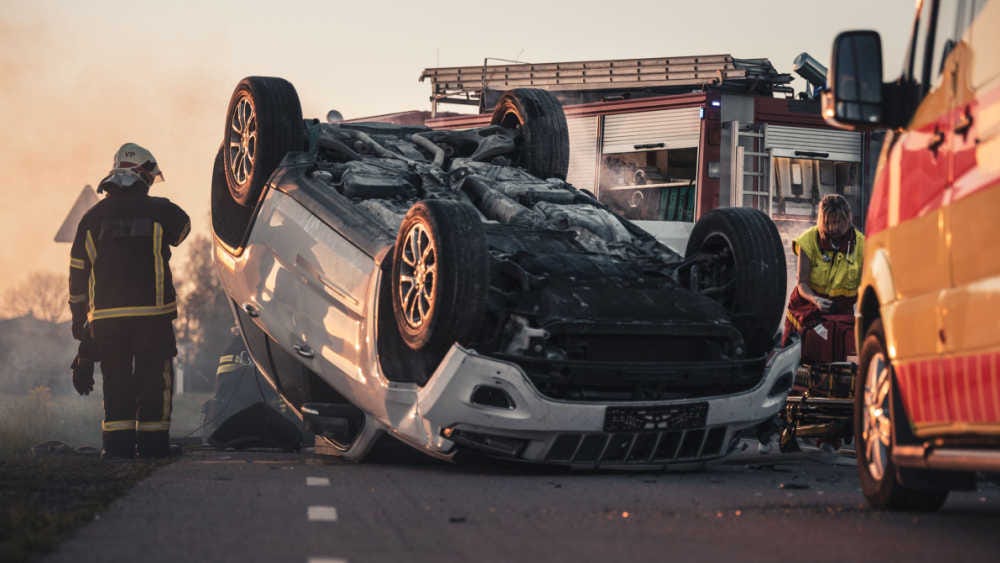
Traffic fatalities are the best hidden secret of the modern era. They amount to roughly 40,000 annually. In addition, several hundreds of thousands of people are hospitalized with serious injuries every year.
To put this into perspective, 50,000 US servicemen died in the Vietnam war; but this was spread over several years. The death toll for 9-11 was a mere 3,000. Only 1,900 people perished in the New Orleans area during Katrina.
In sharp contrast, the death toll, is 40,000 every year. Let me repeat that: 40,000 road deaths annually. Probably, there is not a single adult in the US who does not know someone, who knows someone, who perished from this very serious malady.
Is this page one news on the front of every periodical? It is not. Perhaps that is because people die in single digit episodes. There are no mass deaths, as in the forementioned tragedies. Yet, this is insidious.
What are the explanations for this appalling state of affairs. Most popular are speeding, drunken driving, bad weather conditions, vehicle failure and driver inattention.
But these can only be considered proximate causes. What is the ultimate cause?
It is road socialism. The government owns and manages the nation’s streets and highways. Does a single bureaucrat lose any money when such a fatality occurs? Does he lose his job? Maybe, suffers a reduction in pay? No, no and no. Thomas Sowell wisely stated: “It is hard to imagine a more stupid or more dangerous way of making decisions than by putting those decisions in the hands of people who pay no price for being wrong.”
There is a reason we have pretty good spinach, shirts and shoes, and just about everything else supplied by private enterprise. It is due to competition. Entrepreneurs compete with one another for profits for consumer satisfaction; they suffer losses when they fail to provide goods and services at competitive prices.
Not so with regard to avenues and roadways. Nor is there anything unique about these transportation arteries that renders them unfit for privatization. There were private roads when our nation was founded. They charged fees on the basis of how many axles a wagon featured, total weight, number of horses. Prices even ranged based upon the width of the wheel. More for very thin wheels, think ice-skates, and the wagon would tear up the dirt road; less for wide wheels, think steam roller, and it would level out the potholes.
What specific alterations might save lives? At present, the minimum speech on the nation’s highways is 40 miles per hour, maximum, 70 miles per hour. This applies to all three lanes. True, slow traffic is urged to stay to the right, but tickets are never given out to a motorist slowing down traffic by doing 70 in the left lane. Meanwhile, others are zigging and zagging around this slow poke. Maybe lane-changing is deadly?
Would it be safer if, instead, each lane had not the same identical minimum and a maximum speed limit, but an exact speed requirement (within a mile or two per minute)? For example, reading from left to right lanes: 80, 70 and 60? Perhaps, 85, 75 and 65 would be better? Maybe, 75, 65 and 55 would save more lives?
The point is, we do not know. We will never know, given a system of one set of rules of the road emanating from Washington DC. Imagine if other goods and services were unable to try different things? To experiment? Our economic well-being would plummet.
What about driving while under the influence of alcohol and drugs, driver error, vehicle malfunction? There are fines for this sort of behavior, to be sure, but, obviously, they do not suffice. Quite probably, private road owners would compete with one another to impose more draconian penalties, so as to save lives. Ditto with excessive speeding.
One objection to this modest proposal is that the poor would suffer if they had to pay for road usage. Au contraire, they could car-pool. Most of the very poor do not own vehicles in the first place. Further, their lives, too, would be safeguarded by highway privatization. If road socialism was really the friend of the poor, perhaps we should employ communism for the entire country in their behalf? Tell that to the occupants of the USSR, East Germany, North Korea and Cuba.
A minor benefit of highway and street privatization would be peak load pricing. This would end traffic congestion which chokes most American cities. Charge a high enough price for road usage during rush hours (which nowadays pretty much covers all daylight hours), and traffic will move smoothly.
Our economy is poorer when so many people have to spend so much time in bumper to bumper traffic.
For further reading on this topic see:
Block, Walter E. 2009. The Privatization of Roads and Highways: Human and Economic Factors; Auburn, AL: The Mises Institute
Pegs - Sowell, Thomas: http://www.jewishworldreview.com/cols/sowell081800.asp
Sources:
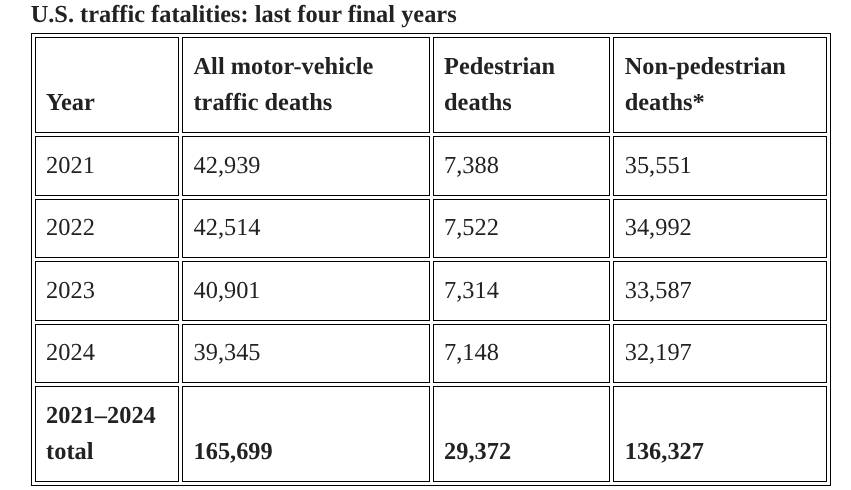
*“Non-pedestrian deaths” is total traffic deaths less pedestrian deaths. It includes vehicle occupants, motorcyclists, pedalcyclists and other non-motorists; it is not limited to motorists in the ordinary sense.
Important clarification:
If by “motorists plus pedestrians” one means every person killed in traffic crashes, refer to the all motor-vehicle traffic deaths column: 165,699 deaths over 2021–2024.
If one wants an exact subtotal of only motor-vehicle occupants plus pedestrians—excluding motorcyclists, cyclists, and other road users—that requires extracting the occupant category separately from NHTSA’s FARS tables for each year. The official FARS system defines traffic fatalities as deaths occurring within 30 days of a crash on a public roadway.
Underlying Source:
The underlying source is the U.S. National Highway Traffic Safety Administration’s Fatality Analysis Reporting System (FARS), the national census of fatal motor-vehicle crashes. The FARS Encyclopedia provides tables by year and road-user/person type. NHTSA’s pedestrian-safety material also reports annual pedestrian counts.
Citable source:
U.S. Department of Transportation, National Highway Traffic Safety Administration, Fatality Analysis Reporting System (FARS) Encyclopedia, annual traffic-fatality and person-type tables, accessed October 8, 2026.

