

Allow me to introduce our new Cinema and The Arts Correspondent Neil Turitz. Neil has spent three decades working in and writing about Hollywood, so it’s fair to say that he is eminently qualified for the role! He is an award-winning screenwriter, filmmaker and journalist, as well as an author and essayist. On his Substack, he writes exclusively about Jewish issues and antisemitism (which you can find here). Here on Guerre and Shalom, however, Neil will be focusing squarely on his professional speciality. In his debut article, he will be reviewing the new and controversial documentary film Naza —or should I say the idea of the film. - Daniel Clarke-Serret (Editor, Guerre and Shalom)
Buy Daniel Clarke-Serret’s PURE JEWISH ANGER today from Amazon (link). #5 in Political Protest & Poetry.
“Naza and The Inconvenience of Truth” by Neil Turitz
I’m sort of fascinated by the controversial documentary NAZA, which arrived to great fanfare, but has hardly set the world on fire at the American box office. To be more precise, it’s the concept of it that is more interesting to me than the movie itself. It is exactly what you would expect it to be. That is, a useful piece of propaganda, no matter on which side of the issue you reside.
For those who hate Israel, and look for any reason to vilify and undermine it, the movie acts as a confirmation that their biases are correct and they are on the right side of history, whatever that means. For those who support Israel, and believe it is fighting a just war of existence that is doing more to spare the Palestinian people than their own leaders are, then it’s confirmation that people will do anything, and resort to any means, to attack Jews. Even if the people doing the attacking are, themselves, Jewish.
In that regard, the movie is utterly compelling. It becomes about the idea of the film, rather than the film itself, to the point that the content almost doesn’t matter.
You’re going to have your mind made up before you buy your ticket, and nothing you see is going to change that, for better or worse. Two people whose opinions I used to respect — one a film critic, the other a journalist who writes about warfare and genocide — are Exhibit A in this regard, as they both went into the movie with the notion that Israel was either committing genocide or, lacking that extreme, was committing unforgivable war crimes in Gaza. Not only did the movie fail to disavow this misconception, it reinforced it, especially if the viewer is indifferent to basic sourcing.
Filmmaker Jonathan Glazer, he of the inflammatory Oscar acceptance speech for his film The Zone of Interest, was “shocked into silence,” because of course he was. The extreme leftist Israeli newspaper Haaretz — whose existence pundit Uri Kurianchik has described as being “for one purpose only: so Jew Haters have an ‘Israeli’ source to quote” – responded orgiastically to the film, because of course it did.
Obviously, I had the opposite reaction, and believe the movie is the cinematic equivalent of a hate crime, but that also is sort of beside the point. It’s as if the movie is more interested in your reaction to it than its own message.
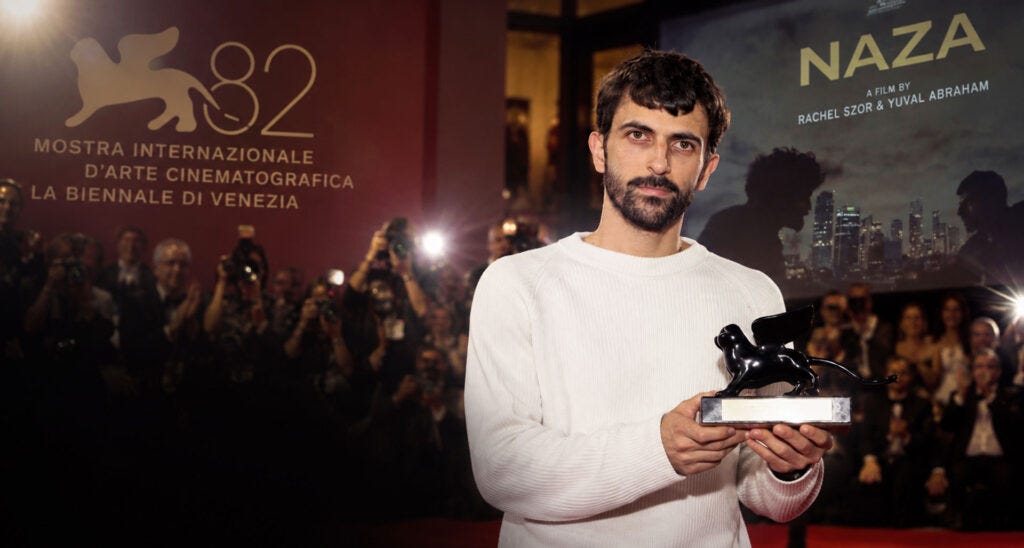
In that vein, one of the indelible images burned in my mind is more about the movie than from the movie, which does nothing to back up or justify its horrific claims about Israeli barbarity. The image I mean is the widely circulated photo of the film’s directors, Israeli quislings Yuval Abraham and Rachel Szor, as they stand stoically in the audience at their project’s Venice Film Festival premiere. As the audience around them dutifully applauds for their film, egged on by a festival director who wanted the standing ovation to break a festival record, and thus make some kind of a point in the process, it’s clear that neither director is enjoying a second of it. In fact, they both look miserable.
The argument could be made that they are trying to reflect the tone of the film, which calls out their countrymen in a way that I think most right-thinking people would consider vile and unforgivable. It could also be that they see the applause for the soulless farce that it is, as everyone in the audience there knows what is happening. That is also visible on the faces around them, people applauding without enthusiasm or energy, but rather by rote because they were told to do so.
Or, it could be that these two Israelis, both of whom have histories of anti-Israel behavior, realize that with this cinematic act, they are severing some kind of connection with their homeland. The fact that they both seemed somewhat shocked by the visceral-bordering-on-violent response speaks to this, though that could also be by design.
It’s probably some combination of the three, with the public display of their lack of integrity – both the professional kind for unleashing this unsupported work into the world, and the personal kind for going along with the ovation facade — dawning on them in real time. Even a publication as rapturous in its affection for the film as Haaretz has acknowledged the lack of dates, locations, or factual cross-references, but, again, this is nothing more than an inconvenience for those who view the movie as the affirmation of IDF criminality they have so desperately sought.
For all the furor around the film upon its initial arrival in September, the financial result has not been nearly as enthusiastic as a film this provocative might suggest. The domestic gross has cleared $1.3 million, which is certainly solid, but not remotely earth shattering for a documentary. The international gross has cleared $8 million, which is a bit more alarming, though it is interesting that nearly three-fourths of this comes from Italy, for some reason.
The concern with a movie like this is that it’s going to further inflame a bad situation. I think it’s fair to say that this is at least partly the reason it exists at all —to find a way to shame the people the filmmakers feel should be shamed, but without the concrete factual backing to solidify said shaming. That works against the film, certainly, but is obviously by no means a disqualifier. At least, not to those who believe in the film’s central conceit. On the contrary, none of that annoying factual basis is needed to further the propaganda and fulfill its purpose.
That part is pretty clear. What is less so, and this is perhaps a lesson to be learned and something about which to be hopeful, is the appeal this kind of thing has to the general populace. No more of a whirlwind has been raised in the six weeks since the film debuted in theaters than previously occurred, nor has there been much further in the way of coverage.
In other words, You Can See Everything it ain’t, in more ways than one. That the documentaries showing the events of October 7, the ones that demonstrated true and factual barbarity, also failed to catch on says more about the subject matter than the quality of the projects in question.
In short, it’s entirely possible that not nearly as many people care about what’s happening in the Middle East as we like to think. That those who do are the most vocal, especially on social media, can give the impression that the situation is paramount for a vast majority of people. What is entirely possible — probable, even – is that they, and we, are vastly outnumbered by those whose interest doesn’t extend that far, either geographically or psychologically.
I’m honestly not convinced this is a bad thing. It might actually be the opposite.


Well done, Mr. Turitz. I have to say that, just as I have not seen this "documentary" and have no intention of doing so, I had little desire to read another review of it, and thought I'd only scan a graph. But you had me, and I read through. Were I to see the film, I would no doubt concur. Although I am a Jew and an Oscar nominee in screenwriting, for adapting IB Singer, no less, I have less than zero interest in spending my time watching this pretentious crap, even if to prove it is crap. So what? I also agree that it is heartening the American public is largely disinterested.