



This is undoubtedly my favourite chapter of Kurdistani Azad. It is not simply a call for freedom. It is an explanation of what freedom really is. And once you read it, and cleared the tears from your eyes, you will wish that we could be free too. [See my review linked below for more analysis.] - Daniel Clarke-Serret (Editor, Guerre and Shalom)

Kurdistanî Azad: The Long Dream of Kurdish Self-Rule
by Ann-Catrin Emanuelsson & Khaled Salih
Previous parts and sections of the book can be found here (work from the bottom of the list).
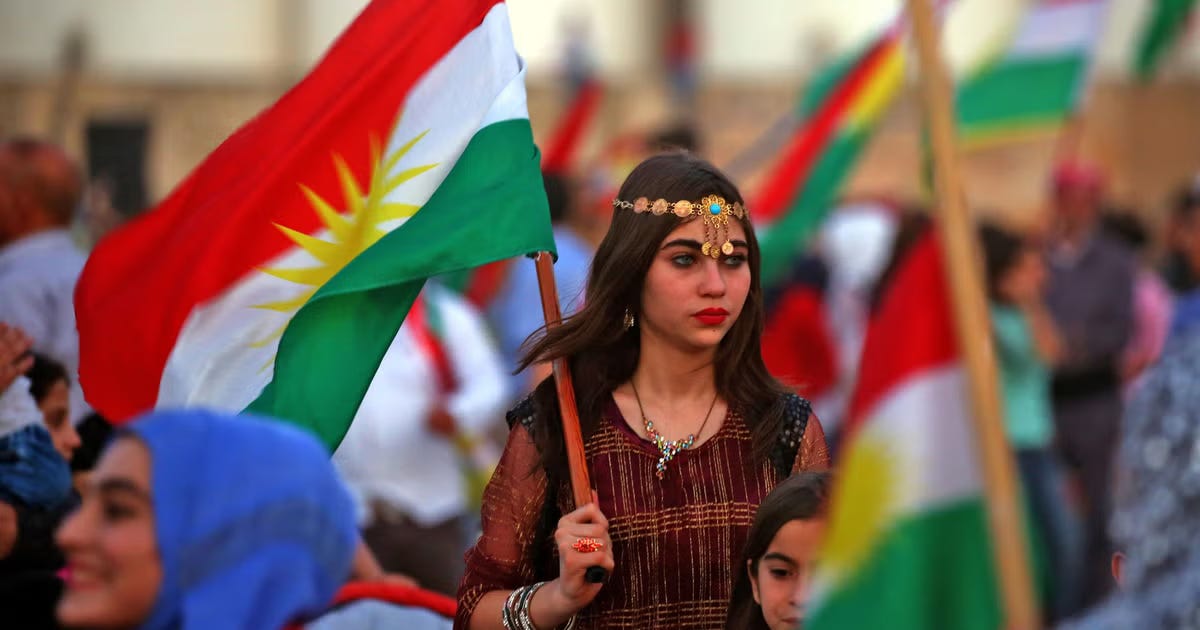
Chapter 19: The Dream in the Twenty-First Century
Federalism, self-rule, independence, confederal ideas, diaspora, language, economy, women, ecological politics and youth
The Kurdish dream has changed form many times, but it has not disappeared.
At one moment it spoke through tribal self-rule. At another through religious leadership. At another through the kingly claim of Sheikh Mahmud, the republican dignity of Mehabad, the guerrilla sacrifice of Barzanis, the revolutionary language of the PKK, the federal architecture of the Kurdistan Region, the democratic confederal vocabulary of Rojava, the diaspora’s lobbying networks, the women fighters of Kobani, the mourning mothers of Anfal, and the young people demanding salaries, dignity, clean government, and a future at home.
This is one of the most important facts about Kurdish history: the dream survives because it is not one single institutional formula. It is older than any party and larger than any map. It is the demand that Kurds should not live as tolerated fragments inside states that deny, manipulate, or condition their existence. It is the demand for dignity, language, land, security, memory, and political agency. Sometimes that demand takes the name independence. Sometimes federalism. Sometimes self-rule. Sometimes democratic confederalism. Sometimes cultural rights. Sometimes women’s liberation. Sometimes the right not to leave home in order to have a future.
The form changes because the conditions change. The core remains.
This is formula anti-fungibility. The Kurdish dream must not be made interchangeable with any single institutional form: independence, federalism, autonomy, democratic confederalism, cultural rights, armed struggle, diaspora advocacy, women’s liberation, or diplomatic recognition. Each form may carry the dream under certain conditions, but none owns it. The core is not a formula. The core is the refusal that Kurdish life be administered entirely by others, and the demand that Kurds possess enough political room to speak, govern, criticize, repair, and flourish.
The twenty-first century has shown that Kurdish ideas can travel farther than Kurdish political recognition. Jin, Jiyan, Azadî became one of the most powerful slogans of the age because it spoke beyond Kurdistan. It named woman, life, and freedom in a form that could be understood by peoples who had never studied Kurdish history. But this universality carried a danger. Once the slogan entered Persian, English, European, and global activist language, it could be detached from the Kurdish struggle that produced it. The world could repeat the words while forgetting the women, prisons, mountains, parties, funerals, and forbidden names behind them.
This is one of the cruelest patterns in Kurdish history: Kurdish suffering becomes visible when it can be made useful to others, and Kurdish ideas become universal when their Kurdish origin can be softened. A slogan born in Kurdish resistance becomes a democratic slogan. A Kurdish woman becomes a national martyr. A Kurdish wound becomes an Iranian, Middle Eastern, or global symbol. None of these translations is wrong by itself. The wrong begins when translation becomes replacement.
A wound becomes dangerous in a second way when too many actors can spend it without repairing it. The Kurdish wound must not become symbolic capital for regimes, parties, activists, journalists, academics, diplomats, or outside powers that gain moral language from Kurdish suffering while leaving Kurdish agency unprotected. To honor Kurdish suffering is not to circulate it endlessly as an image. It is to ask whether the people who suffered gained more power to govern, criticize, remember, and correct.
The task, then, is not to keep Kurdish ideas small. It is to prevent their theft. A Kurdish idea may become universal without ceasing to be Kurdish.
Universalization becomes theft when translation becomes replacement. Jin, Jiyan, Azadî may speak to the world, but the world must not detach the words from the Kurdish women, prisoners, mothers, fighters, teachers, graves, forbidden names, and political struggles that carried them. A Kurdish slogan can become universal without becoming ownerless.
The point is not to imprison the slogan inside one people; it is to prevent others from spending its moral force while leaving Kurdish agency unprotected. Indeed, that is the dignity of universality: it allows a truth born in one place to illuminate many places. But if the source is erased, universality becomes another form of domination. The river is praised while the spring is buried.
Previously from The Guerre and Shalom Publishing House. Daniel Clarke-Serret’s The Genocide of Truth and Nachum Kaplan’s The Greatest War:


One of the deepest signs of that core is the recurring Kurdish reflex of cross-border rescue. The states divided Kurdistan into north, south, east, and west. They gave each part different passports, armies, school systems, prisons, parties, economies, and diplomatic realities. But in moments of existential danger, the imposed map has repeatedly weakened. One part of Kurdistan calls, and another part answers.
Mehabad showed this in 1946, when Mustafa Barzani and thousands of Pêşmerge from southern Kurdistan went east to defend Qazi Muhammad’s fragile republic.
Kobani showed it again in 2014 and 2015, when a Kurdish city in Rojava was defended by the YPG and YPJ and assisted by Pêşmerge from the Kurdistan Region.
The politics were different. The parties were different. The military cultures were different. But the deeper pattern was the same: a Kurdish opening came under existential attack, and Kurds from another part of the divided homeland crossed the border to help defend it.
The pattern returned again during the Rojava crisis of 2026. People in the Kurdistan Region collected aid, sent trucks, donated money, gathered food, medical supplies, winter provisions, and other necessities, and in some cases crossed from sympathy into direct risk.
Ahmed Hemin, a young Kurdish volunteer from Kirkuk, was killed after going to Rojava to defend Kurds under attack. His death belonged first to his family, but its meaning crossed the map. It became another small scene in the long history of Kurds crossing imposed binary borders to protect one another.
