


A Review of Khaled Salih and Ann-Catrin Emanuelsson’s Kurdistanî Azad: The Dream of Kurdish Self-Rule
Read the entire book from the beginning here. Only Chapters 19 and 20 are still to be released.
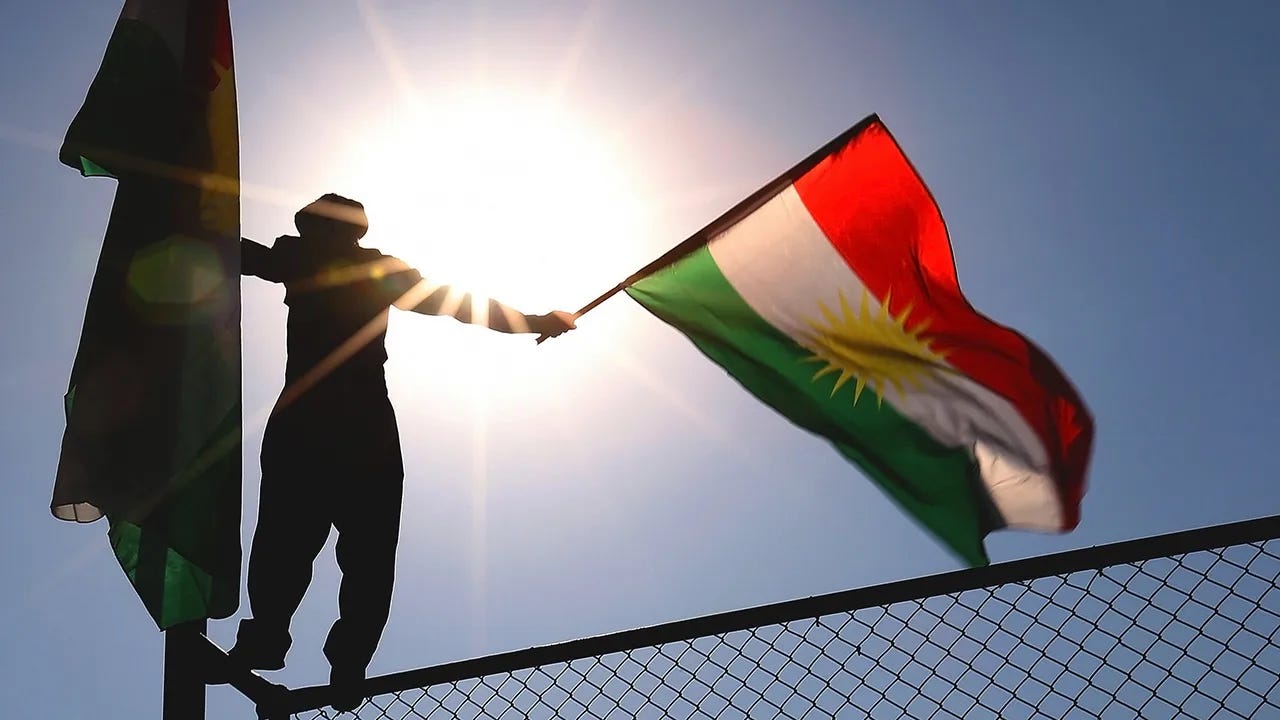
Khaled Salih and Ann-Catrin Emanuelsson’s Kurdistani Azad is a work of many layers. On the surface level, it is a detailed account of Kurdish history and their long march to freedom. It contains stories, names and places unfamiliar to even the most cultured, geopolitical analyst and it uncovers a historical injustice excruciatingly far from resolution.
Yet the chronicle, original, detailed and scholarly as it is, forms only part of the story. For Kurdistani Azad wasn’t written by phantoms or a machine soullessly writing in response to commands. It was scribed by two human beings with a broken soul and an unquenched agony; yet their emotions are magnificently betrayed by an unforgettably restrained text. You see, humans don’t live in a vacuum. They live and breathe a past of traumas and disappointments that only rarely, in their fortuna, bend towards justice.
To be a Kurd is to be invisible. Surrounded by empires, past and present, yours is a nation designated as an obstacle; a threat and an outrage to other peoples’ hegemony. You are appealed to where necessary and rejected soon after with equal haste. Yours is not a people worthy of protection nor a citizenry blessed with recognition. You are a walking shadow, a poor player, that struts and frets his hour upon the stage and then is heard no more. You are a footnote in the dramas of others.
The cage which surrounds you is unceasing and unrelenting. Four states that know nothing of freedom are your jailers. Their tools are various: constitutionalism, cultural denial and physical obliteration. They are the violent husband that take everything you have; to whom you must plead for existence; with which you must trade to partake of bread. Your referendums and military aid mean nothing to them. They are the vultures that feed on hope.
In this conspiracy of oppression, foreign powers are nakedly complicit. From the British who bombed your mountains to the Americans that betrayed their brother, you have no friends in the world that defines itself by freedom. For yours is the inconvenient freedom; the freedom of the world’s largest stateless population.
And within that cage, where lost hope turns into anger and rage, the Kurd turns on his own. From the party to the fighter, each is divided, the man against his brother, the prisoner who begs to live. From whence the future is an illusion, despair and corruption are the tools that hold sway. Such is the life of those who fought for everything just to be denied dignity.
This is the hell that the Kurds present to you: the legacy of Helabja and Sinjar and Anfal; the true reality of Turkish civilizational destruction. And it is from this hell, that the authors emerge - traumatised, but resolute - to reconstruct a life of dignity based on liberalism, constitutionalism and reason.
They have stripped every ounce of anger from their hearts so that they can lift up their heads as the intellectual descendants of Karl Popper. They speak not in rage nor polemic though that is what we deserve and what the Middle East has done to them. Instead, to their credit and our geopolitical shame, they speak in the detached, scholarly tones of those that wish to reclaim reasoned sanity from the heart of darkness.
Not a hint of polemic rises from these treasured pages. Instead it is falsification and truth that are the blessed order of the day. There are counterclaims and responses, waymarks for clarity, and a sincere effort to have their arguments tested by the academic light of history. Far from a determination to be right, there is a humble acquiescence to the right that only argument can reveal.
Each page feels as if it has been scribed with barely-repressed tears. Rage at genocide and cultural annihilation make way for balanced, immaculately detached prose. Each line is a struggle up Sisyphus’s mountain with the courageous resistance of a voice that says “we will not lose control”. In our calm, we will personify defiance.
It is in this way the book does that most delicate of dances: it constructs its argument through the very act of restrained writing.
And what is the argument? The title, in its vague eloquence, provides the clue, shining like a gem, but only for those that seek objective truth. It speaks of “the dream of Kurdish self-rule” which is as deceptive as it is magnificently illuminating. For it is the definition of this term that sits at the heart of the text. Are they referring to independence, full autonomy, federal constitutionalism or something else entirely?
Although the constitutional preference of the authors cannot be doubted, that dream-like realisation is far from the overriding concern of the book, which is less concerned with the precise mechanics of self-rule, but its fact: the right of every human being as their inheritance to live in autonomous dignity.
Kurdistan, as these academics understand it, is not merely a country, but the test case for Popperianism and the liberal desire that all individuals be treated as persons qua persons.
And so even if Kurdistan were independent that alone would not guarantee freedom —for freedom isn’t a banner, an anthem or the fact of government. It’s the right of the person to live.
A Kurdistan dominated by a party or partisan militia would not be free. A Kurdistan of male domination would not be free. A Kurdistan where the Kurds lorded it over Arabs and Turkmen would not be free. A Kurdistan of environmental desolation would be a body without a soul.
Only a Kurdistan where all persons of every ethnicity, religion and gender are ends not means would live in a free state worthy of its name. For independence of state without independence of person is, in the authors’ view, a meaningless oxymoron that denies the purpose of independence its meaning: genuine, individual self-determination.
For the right of Kurdistan to be free is not merely national justice, but the soul-pained call for a space; to breathe, to live, to self-determine; where Middle Easterners of all backgrounds can bring up their children in freedom.
It is indeed the children to which Salih and Emanuelsson call with the most eloquent passion. A Kurdistan where the youth can no longer live is a Kurdistan of desolation, its constitutional arrangements be damned. The youth, the women, the Kurd will only stay in their mountains of home where citizenship comes before party and person comes before violent sacrifice. Freedom, they argue, is a human inheritance. That was the message of their trauma. That was a gift denied to them by their three civilisational adversaries: the anti-freedom imperiums of Pax Arabica, Persia and Turkey.
This is why constitution plays second-fiddle to protected space in the reckoning of the authors. Independence may be the gold standard, but self-determination is the goal. The former without the latter would be an unworthy inheritance, while a lesser arrangement with freedom would at least grant dignity.
And thus the world’s failure to free Kurdistan is not merely a question of referendums and historical unresolutions. It’s the failure to provide a protected space for freedom or to grant the Kurds the right to protect it themselves. Where promises are made and broken, from Syria to Iran, from Britain to Russia, from Turkey to America, the rupture is not merely moral. It is the destruction of protected space. The right to flourish unmolested in a place one calls home.
This is the heart of the text’s multi-layered plea for rational sanity. We want independence, but we want self-determination more. We want promises kept, but we want protection more. We want a state like the rest, but we want personhood above all.
And more, we want dignity. Real dignity. And to those that deny us, we pity you. We stand in defiance of you. We write a book of dignity where you deserve only rage. And we reclaim individual freedom in our act of defiance.

Daniel, I find it difficult to express how much your review means to Ann-Catrin and me.
You have read Kurdistanî Azad with extraordinary sensitivity—not only to the history we tried to reconstruct, but to the human and philosophical problem that runs through it.
What moved me most was your recognition that the book is not simply about the Kurdish struggle for a state. It is about what freedom must mean for the people who would live in that state. Independence matters profoundly, but it cannot be the final measure of freedom. A Kurdistan in which people cannot question their rulers, disagree without fear, or shape their own futures would leave something essential unresolved.
You also recognized something deeply personal: the effort to write about historical suffering without allowing suffering to become an authority beyond criticism. Ann-Catrin and I did not want anger, however justified, to do the work of explanation. Nor did we want our hopes for Kurdistan to become immune to the very criticism we believe makes progress possible.
Your beautiful observation that the book constructs its argument through the act of restrained writing touched me especially.
There is something else I value enormously. You have treated Kurdistan not merely as a tragedy deserving sympathy, but as a serious problem in political philosophy—one through which the wider world might learn something about its own principles, contradictions, and possibilities.
Thank you, Daniel, for the generosity, intellectual seriousness, and humanity of this remarkable reading. You have given us something every author should hope for: not merely praise, but the experience of being understood—and an invitation to think further.