

In Part 4 of The Genocide of Truth (The Remnant), we begin the fightback against The Great Genocide Blood Libel. In 4 chapters (Courage, Reason, Revolution and History) and the afterword (Thought), we explore what resistance against credentialed authority looks like.
I have read so many comments bemoaning the globalised intifada and asking what we strategy we have to fight these post-October 7th postlinguists who wish to destroy the Jewish People and Western Civilisation. THIS BOOK IS THE STRATEGY. It’s not a geopolitical book because the war isn’t geopolitical. It’s about the real issue: philosophy, culture and the misuse of words. It names a far deeper Western malaise than the Gazan iceberg visible at the top — our utter disregard for objective truth.
Please sign up as paid to support this important work. - Daniel Clarke-Serret (editor, Guerre and Shalom; author, the Genocide of Truth)
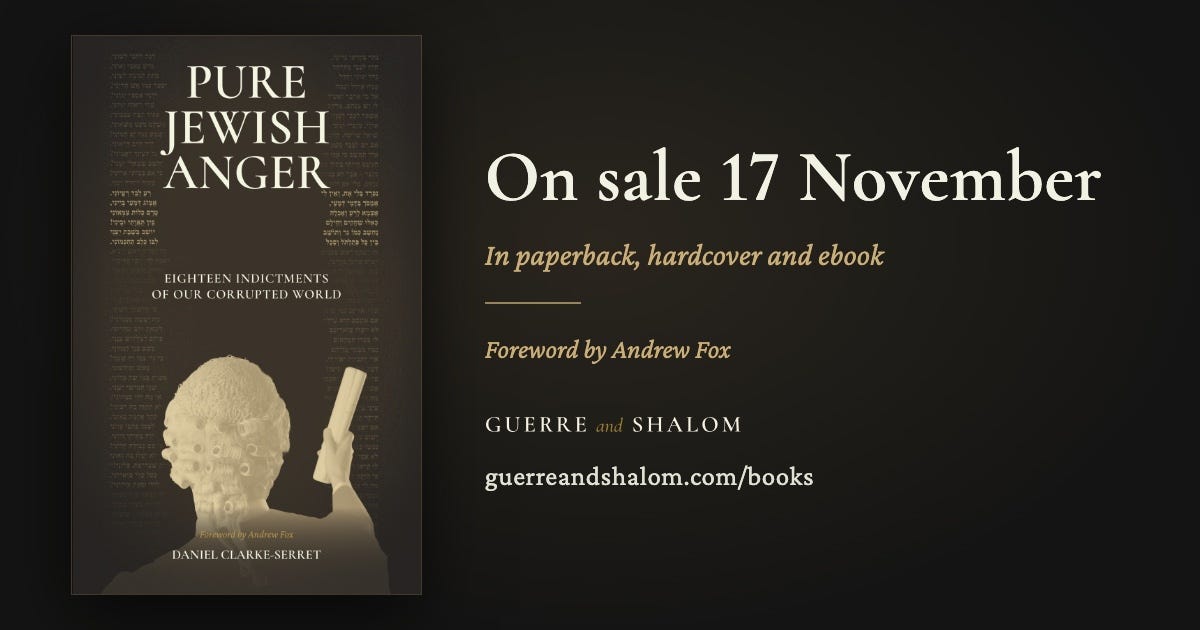
Coming out in print soon: Daniel Clarke-Serret’s Pure Jewish Anger:
THE GENOCIDE OF TRUTH: The Deep Roots of a Modern Blood Libel
by Daniel Clarke-Serret
Introduction: The Genocide of Truth
PART 1: The Tree of Knowledge
Chapter 1: Truth // Chapter 2: Ideology // Chapter 3: Religion // Chapter 4: Science // Chapter 5: Attention // Chapter 6: Distraction // Chapter 7: (True) Expertise // Chapter 8: Authority
PART 2: The Descent to Babylon
Chapter 9: Declaration // Chapter 10: Confusion // Chapter 11: Conversation // Chapters 12: Democratisation // Chapter 13: Sophistry // Chapter 14: Image
PART 3: The Rise of Byzantium
Chapter 15: Guilt // Chapter 16: Belief // Chapter 17: Christ // Chapter 18: Mission // Chapter 19: Doctrine // Chapter 20: Heresy // Chapter 21: Sin
PART 4: The Remnant
Chapter 22: Courage // Chapter 23: Reason // Chapter 24: Revolution // Chapter 25: History (chapters 24 and 25 to be released)
AFTERWORD: Thought
Chapter 23: Reason
For whereof one cannot speak, thereof one must act.
As we near the end of our quest against The Great Genocide Blood Libel, we are left with some questions that could mean the success or failure of this project.
How, short of complete communist dystopia, will individuals be finally impelled to act?
If courage comes from passion and passion informs activism, how are we to distinguish between proper sentiment that buttresses truth and harmful sentiment that catalyses the new postlinguistic religion?
And in a book so committed to reason and its maintenance in the face of the new Byzantium, how are we to demysticise Elijah’s still, small voice so it leads the listener towards truth instead of the crouching sin of Isaac’s execution?
The answers to these questions will help society to defeat The Great Genocide Blood Libel once and for all; not completely - because the Daleks are never totally defeated - but behind the walls of Jerusalem so that we may prosper until the next generation. All will ultimately rebound to the question of functional obviousness, an element of reason so often and so readily rejected by those that live in Ivory Towers.
We must begin with a matter we have touched upon, though not sufficiently for it to become the cornerstone of a generational work. What is it about “genocide”, in particular, that enrages the author, not least in the week that the Nobel Peace Prize was awarded to “genocide”’s mother Navi Pillay? It is, after all, not the first word to change its meaning, with past metamorphoses passing off without incident.
Doctor Who’s Ace yelling “wicked” with excruciating abandon may have disturbed the pre-storm calm of the audience’s eardrums, yet it singularly failed to confuse the viewer about the distinction between good and evil. So taking an ethical term and inverting its substance by 180° need not, in itself, lead to moral confusion. As with much slang, like the similar modern aberration “that’s sick!”, coolness and philosophical clarity live in two mutually exclusive intellectual universes. Society survives to fight another day.
Yet the redefinition of “genocide” is quite different because, unlike “wicked”, it is only the meaning of the term that changes. Its intense inculpatory and accusatory force remains. So while “wicked” meant and was received as (80s) cool, leaving non-adolescents unmolested in their previous categorical understanding, “genocide” means war dead, but is delivered and received as the Holocaust, leaving democratic governments acting in self-defence as parties to unwarranted legal action.
1980s slang was a Wittgensteinism language game acting exclusively within demarcated adolescent communities. All knew the meeting within the community, and all having left the ghetto, knew the meaning without. Language maintained its capacity to communicate specific information within specific environs.
Yet the “genocide” libel is specifically designed to accuse without evidence; to say that you’re committing a Holocaust without you doing the Holocaust; to accuse (and ostracise) the defamed party (Israel) of committing the worst crime of all time without in fact committing the worst crime of all time.
The bloody knife creates multiple distinct wounds: it destroys the moral force needed to act against true genocide; it destroys all faith in the evidentiary basis of the justice system; it leaves the wrongly accused party open to unjust violence and exclusion; it leaves true genocidaires free to commit mass murder with impunity; and it deals a fatal blow to Holocaust memory. Not to mention the destructive power it unleashes on a national community reliant on shared communication. It is, in short, a cataclysmic disaster.
Yet there is one interesting observation that the eagle-eyed reader cannot leave unnoticed: both the libellers and the libelled share an intuition: they both know instinctively what genocide really means in their shared community. That is precisely why the term is used in the way it is. If the Holocaust Remembrance Committee believed that genocide meant extermination and the postlinguistic Synod Council believed - really believed - that genocide meant war dead, they would be living in different Wittgensteinian communities. “Wicked world” as it were. The accusation of the one would not offend the sensibility of the other because both would know that they meant entirely different things.
It is precisely because all know the Truth - that the paradigm case of genocide was the Shoah, and that even Dresden and Tokyo didn’t fit into its definition - that the genocide libel has led to the writing of this book. The aim of Pillay and Albanese and the government of The Republic of Ireland is to intentionally conflate the Holocaust with Gaza, so that the term can be employed where necessary as a morally charged accusation of Nazism without the irritating corollary of evidence. They wish to maintain the meaning and the moral force of the word all the while jettisoning the reality of how a specific war was actually fought. It is a classic case of false idealism over realism and the effect has been to stretch language to utter destruction.
Yet it is precisely the shared intuition of the true content of the genocide term that leads us to formulate an interesting hypothesis: that human share a moral sense, not only in rough outline, but in specifics. We all intuit not only that murder is wrong, but that there are levels of guilt ranging from self-defence to mass murder and that the gradations matter. We can sense subversions of this objective truth by our betters no matter how clever or professorial or governmental they claim to be. Linguistic corruption is sensed.
Morality seems to be a universal sentiment, held by vastly different cultures. The golden rule exists in some linguistic form in every (or at least nearly every) human community from Leviticus escapees to Amazon tribesmen to Kantian Germany. Its essence is ubiquitous. And though different languages use different words for genocide (and murder and theft), the meaning of that symbol throughout the globe is largely unchanging —a true Platonic form.
We cannot, of course, see within the internal mind. It is a black box unsusceptible to opening. Yet there is such a thing as inter-subjectivity, which if not ironclad scientific evidence, is reasoned phenomenology (not faith). If innumerable individual minds are reacting to the genocide libel, but easily ignoring the 1980s “wicked” inversion, then it speaks to that we share, but cannot express in language; an offended, universal moral sense.
Yet a shared moral intuition is not the basis of a legal, civilised community. We create a society of high trust and co-operation by enshrining our more or less equivalent beliefs in a legal code. This way we can communicate about whether a moral principle has been breached using a commonly accepted method of adjudication (the judiciary) which in turn demands the production of legal reasoning under the rubric of authoritative interpretation.
Judges define words. The ruling having been passed down, the citizen may or may not subjectively accept the justice of a particular ruling, but we accept it nonetheless as “officially just” so that the community may continue.
On the basis of similar reasoning, we accept the legislation of our Parliament as legally binding. We may have ascended from the cave and seen the forms - we may believe a law unjust according to the dictates of our individual reasoning and moral convictions - yet we accept the judgment of our representatives. That is, in itself, a moral decision; for we thereby consent to the continuation of our community through the shared understanding of norms underpinned by language.
This is the response to that evergreen debate — whether morality and law are co-extensive or merely related. A justice system must reflect morality to a great extent. The South African apartheid government did not deserve to continue for failing that basic test. Yet in modern liberal democracies, we necessarily have to accept the imperfection of the morality-law cohabitation so that we may continue to live as free people in a land of liberty.
