

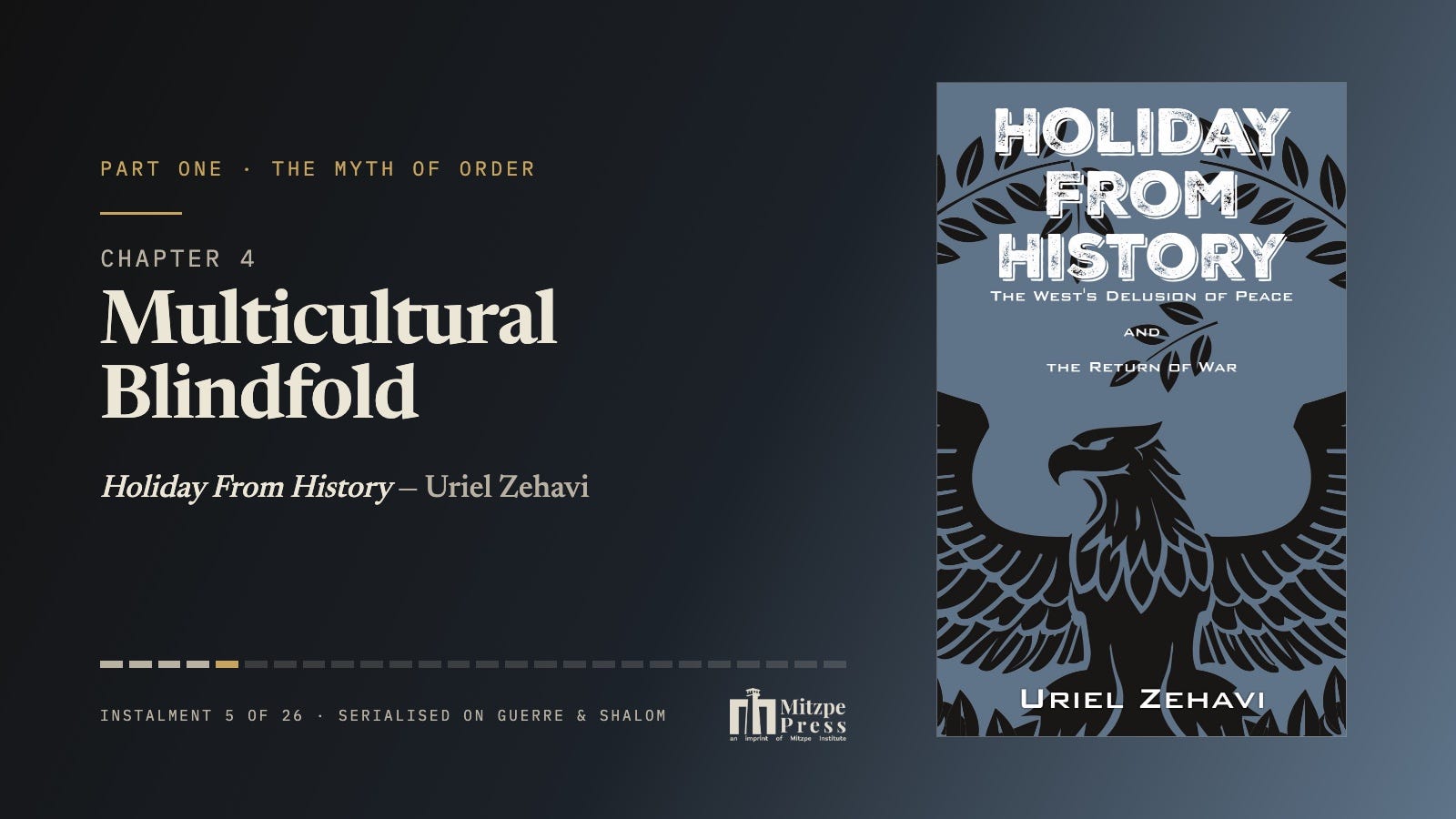
Holiday From History · Part One · The Myth of Order · Chapter 4
Without Uri Zehavi and The Mitzpe Press, it would never have been possible to publish my new book Pure Jewish Anger (link). He has been a tireless supporter of this publication including in his work as our Israel Correspondent. If you missed this week’s edition of “The Week in Israel”, Uri’s weekly digest of the news from the Levant, you can catch it here. Meanwhile I leave you with the latest chapter of Uri’s book Holiday from History, exclusively for paid subscribers. It’s a rallying cry for true liberalism. In my much-repeated formulation: “Complete tolerance for the tolerant. Complete intolerance for the intolerant”.
Remember: There’s a huge Black Friday Sale for this weekend ONLY. Paid subs slashed to £35/$46 for just one more day. - Daniel Clarke-Serret (Editor, Guerre and Shalom)
About the book. On October 7, 2023, Israel paid the bill for thirty years of Western complacency in a single morning. Holiday From History is the forensic account: how the post-Cold War West convinced itself history had ended, why the warnings did not break the spell, and what the collapse now reveals about the institutions meant to defend free nations.
Read the serial from the start: Holiday From History on Guerre & Shalom
Get the book: Paperback · Hardcover · Kindle
About the author. Uriel Zehavi is Managing Director of the Mitzpe Institute and publisher of Israel Brief. He is the author of Rooted Truth, serialised here on Guerre & Shalom, Rooted in Judea, and Letters Across the Table.
ON THE TOPIC OF MULTICULTURALISM:


Chapter 4: Multicultural Blindfold
In the 1990s and 2000s, Europe convinced itself that migration would dissolve into harmony. The EU opened its doors wide — first to new member states in the east, then to asylum seekers and refugees from far beyond its borders. The reigning faith was that once inside Europe, people would converge on liberal democratic norms. The optimism ignored history and underestimated identity.
Freedom of movement inside the EU moved millions east to west. At the same time, asylum rules loosened. Sweden built a reputation for generosity. Germany joined in, most dramatically in 2015 when Angela Merkel suspended EU asylum rules and declared, “Wir schaffen das” — we can do it.1 That year over a million migrants and refugees entered Europe, the largest influx since World War II. Germany alone registered more than a million. Sweden, with fewer than ten million citizens, received 163,000 asylum applications. Camps and cities strained under the weight. On Lesbos, a facility built for 3,000 held more than 10,000. In Germany, school gymnasiums were turned into shelters. A small Austrian town suddenly received 5,000 refugees in a single day — more than its own population.
The numbers tell the story. In 2014, there were 280,000 illegal border crossings into the EU. In 2015, 1.82 million. Syrians, Afghans, and Iraqis led the flow, but large numbers also came from Africa and South Asia. Some sought refuge from war. Many sought opportunity. Once in Europe, rejected applicants often disappeared into the cities.
Urban Europe changed fast. By 2019, Brussels was 35 percent foreign nationals. London counted 40 percent born abroad. In Paris’s Seine-Saint-Denis, immigrants made up more than 30 percent of residents. In Malmo, 36 percent. In Stockholm’s Rinkeby, more than 80 percent of residents had immigrant backgrounds. The new arrivals concentrated in particular districts, often alongside older diasporas, creating parallel neighborhoods where integration was more aspiration than fact.
Immigration has enriched Europe in many ways. But the volume and speed of this intake, combined with weak assimilation policies, produced strain. Governments relied on a doctrine of multiculturalism that discouraged pressing newcomers to adopt national norms. Tolerance became a shield for practices that undermined the very liberal order Europe thought it was spreading. Those who raised concerns were branded intolerant. And so the blindfold stayed on.
This set the stage for a cultural doctrine that insisted the cracks should not be discussed.
Europe made tolerance into a creed. In theory, admirable. In practice, it often meant tolerating the intolerant. By the 2000s, “multiculturalism” became official doctrine. Governments subsidized cultural associations, offered translation instead of insisting on integration, and avoided pressing newcomers to adapt. Assimilation was recast as chauvinism. Authorities hesitated to confront practices that flatly violated liberal norms. The blindfold went on.
Huge Black Friday Sale for this weekend ONLY. Paid subs slashed to £35/$46. Subscribe now to read on.
Criticism carried a price. A teacher warning about extremist sermons risked being labeled racist. A journalist writing about crime in immigrant-heavy districts was accused of fueling xenophobia. The loudest censors were not always in government but in media and academia, eager to prove moral superiority. The effect was a chilling silence. Islamist preachers thrived in the vacuum, while liberals inside Muslim communities — women, secularists, gays — were left exposed and ignored. As a gay Jew watching this from the cheap seats, I can report the irony was not lost on us.
