

Today is the 22nd anniversary of the murder of Theo van Gogh who paid with his life for protecting freedom of speech. On the solemn day, we have invited Dutch academic Professor Emeritus Paul Cliteur to speak on the subject of “Dutch Islamism versus the Democratic Rule of Law”. This is perhaps my favourite Guerre and Shalom contribution to date.
Paul was the Academic Director of the Institute of Interdisciplinary Study of the Law from 2002-2010 at Leiden University in the Netherlands. His research focus is in the field of ethics, the philosophical foundations of the law, and more, in particular, moral dilemmas around our multicultural society, fundamental rights and the relationship between law and worldviews. His work and university are linked with the life of well-known Somali-born refugee, former Dutch politician and now American free speech writer-activist-Substacker Ayaan Hirsi Ali.
We thank Paul for his crucial intervention that reminds us of the need to defend Western Civilisation. For those with limited time, Part III of the article is particularly recommended. This is the kind of work that gives the “The World’s Intelligent Journal” its name. - Daniel Clarke-Serret (Editor, Guerre and Shalom)
Introduction email to Theo van Gogh Memorial Fortnight:

“Twenty-two years after Van Gogh († November 2, 2004): Dutch Islamism versus the Democratic Rule of Law” by Prof Paul Cliteur
[Abstract in the footnotes.1]
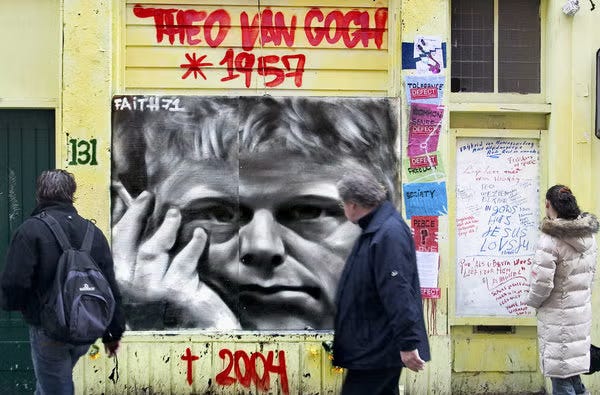
November 2, 2026, marks the 22th anniversary of the deadly attack on Dutch filmmaker and columnist Theo van Gogh (1957-2004) by a Dutch jihadist Islamist, Mohammed B. (b. 1978). That attack was the culmination of a discussion that had been going on in Dutch society since 9/11, 2001. In a sense, November 2, 2004, was a Dutch 9/11.
What happened in the Netherlands between 9/11, 2001, and November 2, 2004, is crucial because it was the stepping stone for later attacks in other European countries that followed an identical pattern. So, there is much to learn from the events leading up to November 2, 2004. This is true for the Netherlands and countries such as Germany, the United Kingdom, France, and the United States of America.
The murderer of Van Gogh (I will refer to him as B.) was convicted of murder (art. 289 Dutch Penal Code) with a terrorist motive (art. 83a Dutch Penal Code). After all, with B. and other members of the Hofstad group, the motive existed to “cause serious fear to the population or a part of the population.” Also, there was (and still is, in the case of jihadist Islamists who are still active today, possibly at home but indeed abroad) the plan “of seriously disrupting or destroying the fundamental political, constitutional, economic or social structures of a country.”
What that political and constitutional structure consists of is usually less highlighted. I will try to show that the attack on Van Gogh can be seen as an attack on Art. 18 Universal Declaration of Human Rights (freedom of thought, belief, and religion, in an identical sense reproduced in Art. 9 European Convention on Human Rights), more specifically on the right to change one’s faith (heresy), abandonment of belief (apostasy) and religious criticism (blasphemy) protected there. That second sentence of Article 18 could be called the “apostasy clause.”
This means that we can best see November 2, 2004, as a huge clash of worldviews, a clash of religiopolitical ideologies: the clash between the liberal-democratic worldview, as we can find it in constitutional declarations such as Art. 18 UDHR (Art. 9 ECHR) or Art. 2 TEU, and the worldview of institutional and jihadist Islamism, as we find it articulated by radical ideologues such as the people of the Hofstad Group.
In other words, Art. 9 ECHR (Freedom of thought, conscience, and religion) states: “Everyone has the right to freedom of thought, conscience and religion; this right includes freedom to change his religion or belief and freedom, either alone or in community with others and in public or private, to manifest his religion or belief, in worship, teaching, practice and observance” (Italics added). The freedom to “change his religion or belief” implies the legalization of blasphemy, apostasy, heresy. This is unacceptable for Islamists. So, Islamism will always be at loggerheads with Art. 9 ECHR (art. 18 UDHR) and with Article 2 Treaty on European Union.
The November 2, 2004 murder of Van Gogh in the Netherlands marked the beginning of a series of related or identical terrorist assassinations in other countries, such as the attempted assassinations of Danish cartoonist Kurt Westergaard (1935-2021), the actual murder of French teacher Samuel Paty (2020), the collective murder of Charlie Hebdo cartoonists (2015) and the (preparations for) assassinations of Geert Wilders (2019). The events in the Netherlands between 2002 and 2004 are of great significance. Stefan Zweig would say that the murder of Van Gogh belongs to the Sternstunden der Menschheit.
Bernard Lewis on the need to understand terrorists
What can be learned from events in the Netherlands is succinctly summarized by British historian Bernard Lewis (1916-2018), who specializes in Middle Eastern history:
“Terrorism requires only a few. Obviously, the West must defend itself by whatever means will be effective. But in devising means to fight the terrorists, it would surely be useful to understand the forces that drive them.”
Lewis speaks wise words here. He emphasizes that terrorists can do significant damage with modest means (a knife, a gun, a car; it does not always have to be a plane, as on 9/11). Also, the number of perpetrators involved in an attack need not be huge to be effective (“only a few”). Lewis also points out the need to face terrorism with a strategy for combating it (“to fight the terrorists”). But he also points to a necessary condition for the fight against Islamist terrorism and the terrorists to be successful, which is to understand the forces that drive these terrorists (“understand the forces that drive them”).
Among Dutch politicians and administrators, the ambition to fathom the worldview they were confronted with on Nov. 2, 2004, was minimal to entirely non-existent. What they did was minimize the meaning of “ideology,” “religious ideology,” “worldview.” B. had committed a “barbaric act.” A “terrible murder.” But it was generally not considered helpful to pay much attention to the ideas that B. himself presented as the justification. As will become clear in the remainder of this article, I consider that a mistake. I will assume that ideas have consequences, which also applies to the killer’s ideas. This is all in the spirit of the quote from Bernard Lewis with which I began this article.
Of course, one or two things can be said to excuse the fact that policymakers, politicians, and administrators did not know how to diagnose the events of November 2, 2004. We did not know what hit us. The prime minister at the time of the attack, the minister of justice, the minister of the interior, the mayors of the cities of The Hague and Amsterdam, where the members of the Hofstad Group developed their activities - almost no one referred to the religious-ideological motivation of the attacker after November 2, 2004. However, information about it was poured in. The events and statements of the murderer of Van Gogh, which I will discuss in detail below, were well-known. The Dutch administrators, however, could not or did not dare give any interpretation to these.
This is surprising because, on May 6, 2002, just over two years before Van Gogh’s murder, Dutch politician Pim Fortuyn (1948-2002) was assassinated, not by a jihadist, but by a far-left activist, Volkert van der G.
Van Gogh’s writings and views may have been known to a small audience, but Fortuyn was better known. Fortuyn’s party was on enormous gains for the upcoming elections in 2002. Moreover, in that election campaign, Fortuyn, like Geert Wilders later, made great efforts to warn against radical Islam. He caused a stir with an interview on Feb. 9, 2002, in which he called Islam a “backward culture.” Fortuyn published a book, Against the Islamization of our Culture: Dutch Identity as a Foundation (1997). Four years later, after 9/11 2001, Fortuyn was seen as someone who had foreseen 9/11. He developed in certain circles into a cult figure, a charismatic leader.
After Fortuyn’s death, Islam criticism was formulated in Dutch politics by Ayaan Hirsi Ali and Geert Wilders. They also collaborated briefly within the context of the Dutch conservative-liberal party “Voor Vrijheid en Democratie” (VVD, For Freedom and Democracy). In 2003, they jointly wrote, “It is time for a liberal jihad,” in which, entirely in the spirit of Fortuyn, they warned against the advance of radical Islam in Europe, including the Netherlands.
I will now elaborate on this, dividing what follows into six sections.
Part I provides a first characterization of the three leading figures in the confrontation between the values of the democratic rule of law and Islamism, namely Ayaan Hirsi Ali, Theo van Gogh, and Mohammed B.
Part II addresses how to explain and approach (seemingly) religion-related criminal behavior.
Part III addresses the question: What is religion? What is an ideology? What is a religious ideology?
Part IV takes a closer look at the political theology of the Hofstad Group.
Part V gives an overview of the values of the democratic rule of law, including those formulated in Article 18 UDHR and Article 2 TEU.
Part I] Three main characters: Ayaan Hirsi Ali, Theo van Gogh, and Mohammed B.
1. Ayaan Hirsi Ali
It is enlightening to elaborate further on Hirsi Ali’s work because she became the face of Dutch Islam criticism after 9/11. Between November 2001 and May 2006, about five years hence, Hirsi Ali gave a massive boost to what has been called the “Islam debate” or “Islam criticism.” A highlight of that criticism of Islam was the film Submission, a product of collaboration with the filmmaker Van Gogh. In May 2006, she left the Netherlands for a job in the United States.
This film, Submission, was shown on Dutch television on August 29, 2004. On November 2, 2004, Hirsi Ali’s coauthor, Theo van Gogh, was murdered by the Dutch Islamist Mohammed B. (born 1978).
The “work” of B., I mean his posts on the Internet expounding his views, are of interest because they give an idea of the worldview of a consistent and highly dangerous jihadist. Moreover, B. “grew into a hero in radical Muslim circles shortly after his act,” write Janny Groen and Annieke Kranenberg. Mindful of Lewis’ exhortation to understand Islamists (“it would surely be useful to understand the forces that drive them”, according to Lewis quoted before), one can hardly ignore B., nor the group to which he belonged, the so-called Hofstad Group.
Ayaan Hirsi Ali (born 1969) came to the Netherlands in 1992. She quickly learned to speak the language and completed a degree in political science at Leiden University. In 2001, she began her career as a public intellectual with Islam-critical articles. For example, a few weeks after the 2001 attacks, she wrote the piece “Give us a Voltaire” in the daily newspaper Trouw.
“Anyone following the debates in newspapers, on TV, and in debate since Sept. 11 can hardly conclude otherwise than that criticism of Islam has increased sharply both in the Netherlands and in the rest of the Western world. Again and again, the question arises of whether Islam in its present form is compatible with democracy and the rule of law as we know it in the Netherlands. Or is an Enlightenment and modernization of Islam needed?”
The title and outline of the article are cleverly conceived. Why? Western politicians, intellectuals, and public administration people generally praise Voltaire. Religious criticism is not a problem. They consider it a perennial achievement of Western culture.
Christians with “long toes” who took offense at the mocking of their religion were put down as a petty backwater. Nevertheless, when it came to Islam, those critics of the religion were suddenly of a very different opinion. Criticism of Islam was taboo. Criticism of Islam was dismissed as offensive, polarizing, racist, stereotyping, haughty, and, above all, unnecessary. In contrast, Islam was seen as a religion of “poor pitiful people”: “La religion des faibles,” as the French author Jean Birnbaum aptly put it.
Hirsi Ali does not conform to that pattern. And that was a big problem for some. After all, Ayaan is a black woman, a refugee from Somalia, fleeing an arranged marriage to a cousin she had never seen, and thus a victim of what Fortuyn and Van Gogh called “backward” cultural practices. It was somewhat challenging to disqualify her as “extreme right-wing.”
How can you deny a woman who is herself a victim of female circumcision the right to express critical views on Islamic culture? With “Grant us a Voltaire,” Hirsi Ali addressed the Dutch Sprachherrschaftsklasse. Why do you begrudge “us,” the people of Islamic culture, a Voltaire?
A debate on Voltaire and Islam occurred at the De Balie Debate Center in Amsterdam on November 13, 2001. We were then in a time of total disillusionment with what had happened with the attacks in America.
In My Freedom (2006), Hirsi Ali looks back on the events of this evening. The evening centered on the question, “The West or Islam, who needs a Voltaire?” Hirsi Ali writes:
“One speaker after another defended the thesis that the West needed a new Voltaire. They discussed everything wrong in the West: the arrogance to invade other countries, the neocolonialism, and the decadence of a culture in which people only want to consume. And so on. The usual rants.”
None of this impressed Hirsi Ali. She felt something fundamentally wrong with this analysis of 9/11. She raised her hand to ask a question, got the microphone, and then said this:
“Look how many Voltaire’s the West has. Do not deprive us of the right to have our Voltaire’s. Look at our women and look at our countries. Look at how we are all fleeing and seeking asylum here and how people, in their madness, are now drilling planes into buildings. Grant us our own Voltaire, for we still live in the Middle Ages.”
She received no support from the audience. People were even angry. She tried to elaborate on her position in an article. However, her employer, the director of the Wiardi Beckman Foundation (the scientific bureau of the “Partij van de Arbeid,” a social democratic party), did not permit publication. This director, Paul Kalma, “was irritated.” Ayaan could not say these things because they harmed the party’s interests. As a reason, Kalma advanced that if a Muslim published these things (Hirsi Ali was still a Muslim at the time), “all the racists and Islamophobes would jump on it.” Hirsi Ali persisted, “But that does not matter, does it? If something is true, it is true.”
Journalists Jutta Chorus and Ahmet Olgun also sketch the atmosphere of the evening in their book The Martyrs (2024). “When political scientist Van Gunsteren argued that evening that multicultural society should leave room for the ideas and customs of Islam, Ayaan stood up. No one had ever seen her,” Chorus and Olgun write.
Prof. Dr. H.R. van Gunsteren (born 1940) was an authoritative professor at Leiden University. He was 61 years old at the time. Ayaan, who was 32 years old and had studied political science at Leiden University, harshly contradicted her own university’s authoritative professor: “You have no understanding of Islam,” Hirsi Ali replied to Van Gunsteren. Don’t abandon us. Give us a Voltaire.”
So, Hirsi Ali did not receive support from the Social Democratic Foundation, for which she was working, nor from prominent figures at Leiden University, where she had graduated, or at any other Dutch university.
The fact that Hirsi Ali did not receive support from the PvdA nor from the university from which she graduated is not entirely surprising, for these cultures are highly overlapping. The journalists Sara Berkeljon and Hans Wansink put it this way in their book on Ayaan The Hurricane Ayaan: Report of a Political Career (2006):
“In the same year that Hirsi Ali was naturalized, in 1997, she registered as a member of the Labor Party. She studied political science in Leiden, where all her teachers, except the conservative Andreas Kinneging and the liberal Paul Cliteur, were social democrats.”
At Leiden University at the time, two professors of Jurisprudence explicitly supported Hirsi Ali in her critique of religion (one who, like her, came from an Islamic country, Iran, viz., Afshin Ellian). Her message on Islam was further supported by one professor of Arabic studies, Hans Jansen (1942-2015), and by one professor of philosophy who, incidentally, limited his criticism of religion to religion in general, not specifically applicable to Islam, as was the case with Hirsi Ali.
Nor did Hirsi Ali, Theo van Gogh, or any other critic of Islam encounter any support in political circles. The party of Geert Wilders (PVV), currently the largest party in the Netherlands (37 out of 150 seats in the Dutch parliament), did not yet have any influence.
As we have seen, Hirsi Ali worked for the scientific bureau of the PvdA (“Partij van de Arbeid”). The chairman of that party, Prof. Dr. R.A. Koole, later also a professor of political science at Leiden University, said to Ayaan about 9/11 2001, “Surely that attack has nothing to do with real Islam.” However, Koole received the same answer from the rebellious newcomer from Somalia that Van Gunsteren had received: “That [attack] has everything to do with real Islam.”
In 2001, she began her political career with the PvdA, the Dutch social democratic party mentioned above. Given Van Gunsteren and Koole’s reactions to her stance on 9/11 and on Islamic culture in general, it can hardly be surprising that Hirsi quickly alienated herself from the social democratic vision. This is unsurprising because social democrats explain the world by looking at social deprivation and inequality, not by analyzing cultural differences. I will come back to this when I say something about the work of French Islam scholar Oliver Roy.
Hirsi Ali moved from the PvdA to the VVD, a liberal party. 2002, Hirsi Ali entered the House of Representatives for the VVD. There, she develops into a very critical member of parliament with a very particular style of politics (critical also towards her own party), dealing with integration issues and radical-violent Islamism, of which she becomes the target of criticism and threats of violence. She becomes one of the most heavily guarded politicians in the Netherlands.
She and the filmmaker and columnist Theo van Gogh made the film Submission (2004) about the position of women in Islamic culture. On November 2, 2004, Theo van Gogh was murdered in Amsterdam by a jihadist. Hirsi Ali decided to leave the Netherlands in 2006. Or rather, to flee. This is also how it is perceived abroad. The New York Times wrote an editorial entitled “A Victory for Intolerance in Holland.”
2. Theo van Gogh
Theo van Gogh was a Dutch filmmaker, columnist, and television interviewer. He was notorious for his provocative ideas and his columns. Those columns were compiled in 2003 under the title Allah Knows Better.
In it, we find his pieces between 2000 and 2003, the years preceding his death, a year later, in other words. Van Gogh was feared in circles of mainly left-wing politicians and participants in the public debate because of his harsh, often insulting, but also humorous characterizations. He broke the monopoly of left-wing journalists on offensive criticism. He also competed with left-wing icons such as Hugo Brandt Corstius (1935-2014), Jan Blokker (1927-2010), and many other representatives of the left-progressive Dutch opinion climate.
Van Gogh also sympathized with the politician Pim Fortuyn, who, like Van Gogh himself in 2004, had been murdered by a fanatic (not a Muslim) two years earlier, in 2002.
3. Mohammed B. and the Hofstad Group
Jihadist Islamism was represented in the Netherlands by the “Hofstad Group.” This brings us to the group based on which I want to analyze and explain Dutch Islamism, as I have announced in the title of this piece.
The Hofstad Group is the name of an Islamist terrorist network. The General Intelligence and Security Service AIVD coined the name. It is a code name for the group of radical youths who met mainly in Amsterdam in 2002 and shared their enthusiasm for the ideology of radical Islam or jihadist Islamism.
The young people themselves (although some were also born in Holland) and their parents often came from the Rif region in Morocco. The meetings often took place in the home of Mohammed B., the later murderer of Theo van Gogh. The Dutch prosecutor’s office did not speak of a “Hofstad Group” but of a “terrorist organization.” That is an organization to commit terrorist crimes (art. 140a Penal Code).
Part II] How can one explain religion-related behavior?
1. Three types of explanations of violent behavior
That the youth of the Hofstad Group were (or some may still be) under the spell of committing acts of violence (attacks, murder, death threats, usually anonymous) against what they perceive to be infidels or enemies of Islam, the prophet of Islam or Muslims in general, is beyond dispute. Also, the radical members of that group approved violent attacks such as the one on Van Gogh. However, much confusion exists about the nature of the ideology by which these perpetrators of violence were inspired.
Is that “Islam as such”? So, “all of Islam”? Islam as a world religion? (See Hirsi Ali’s answer to Ruud Koole, as cited above). Or is it a special kind of interpretation given to Islam? And if so, which one? Or should we say that ideology, religion, a way of thinking, and a philosophy of life have little to do with this? Is it perhaps about disappointed or frustrated youth who are radicalized in a particular state of mind that does not have much to do with a systematized set of ideological beliefs?

