

Once upon a time, I was a student at University College London studying law. I visited Speakers’ Corner by foot every Sunday —a British tradition. But now I find that the corner of free speech and freedom has been overrun by Islamists and the law of England is no more. This Theo Van Gogh Memorial Week, we praise Cohesion Correspondent Jens Heycke for exposing the climate of fear that has overcome Europe, particularly in the wake of events 22 years ago. We demand the right to speak and the right to criticise Islam just as every other religion, ideology and human practice may be criticised in a free country.
Above all, we demand that the law be enforced by our police and justice system. An Islamist who stabs a citizen must be imprisoned for life and ideally exiled to a penal colony in a deserted British overseas territory near the Antarctic. (I’m not being sarcastic.)
A person who speaks against Islam (or anything else) must have their rights as an Englishman protected. A Jew who goes to synagogue or a faith school must have their rights as an Englishman protected. The failure to do so once caused a revolution in the colonies and the failure to do so again today may lead to a similar outcome on our own island. Enough of the tyranny that takes our rights away in the name of “tolerance”. Enough. - Daniel Clarke-Serret (Editor, Guerre and Shalom)
Previously on Theo Van Gogh Memorial Week:


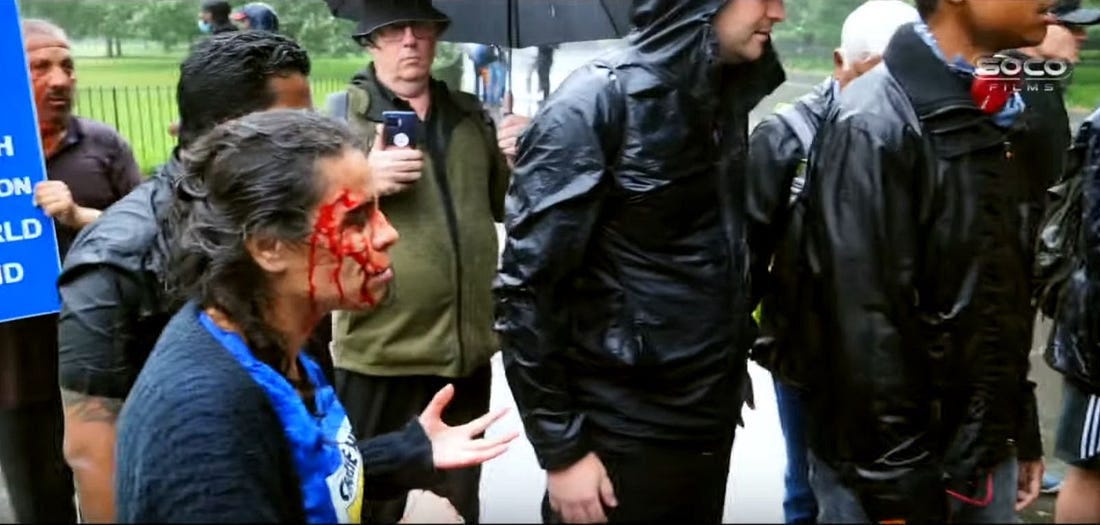
“I can burn a Bible, I can spit on a Bible, I can stamp on a Bible, and I’ll go about my day. If I burn a Quran, the law might not even be on my side, as we saw with the Turkish asylum seeker.” —Ada Akpala
British commentator Ada Akpala recently surprised a GB News panel with a forthright critique of Britain’s free speech double standard: you can criticize any person or any religion, except the Prophet Muhammad and Islam. If you do that, you risk prosecution and possibly losing your life.¹
The recording went viral, garnering hundreds of thousands of views on social media. Akpala didn’t say anything that isn’t already well known. It’s just that she had the courage to speak out and declare what others are too timid to say.
The specter of Islamophobia accusations and violent attacks now looms so ominously over public discourse that it silences not only those who might criticize Islam, but even those who defend the right to criticize Islam.
Akpala cites the example of a Turkish-born immigrant, Hamit Coskun, who burned a Quran near the Turkish consulate to protest Turkish President Erdogan’s policies. A bystander, Moussa Kadri, attacked Coskun, kicking him, stomping on him, and slashing at him with a large bread knife.
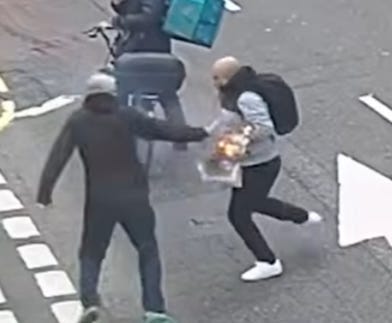
After the attack, a judge sternly scolded Coskun (the victim) for having a “deep-seated hatred of Islam and its followers” and convicted him of a “religiously aggravated” public order offence.² Prosecutors had originally charged him with causing distress to “the religious institution of Islam” (as if a religion could be a crime victim) before quietly rewording the charge. Coskun was eventually cleared on appeal.
Coskun’s knife-wielding attacker, on the other hand, walked out of court without serving a day behind bars.
Kadri, the Muslim attacker, didn’t serve a day in jail for what, by any common-sense reading, was attempted murder. The judge appeared to be making excuses for him, saying, “you were clearly deeply offended.”³ The lesson: offend a Muslim, and the courts will treat violence against you as understandable. You face prosecution; your attacker faces a slap on the wrist.
A bastion of free speech, demolished
This incident was no one-off. I can relate others, closer to me personally.
In 1872, the British Parliament recognized Speakers’ Corner as a free speech forum. At the northeast corner of London’s Hyde Park, speakers can hold forth on politics, philosophy, or anything they like; hecklers can challenge and debate them. Over the years, Karl Marx, George Orwell, and many other legends have spoken there.
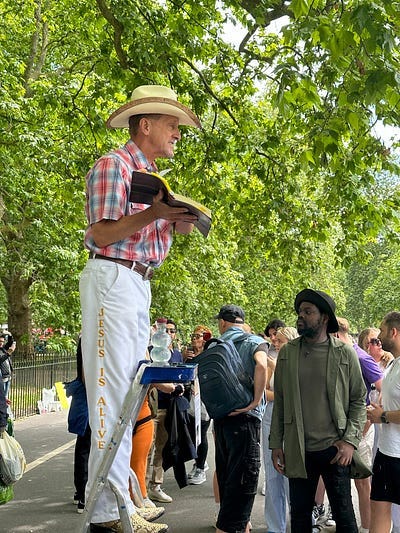
I became a Speakers’ Corner regular when I was an LSE student in the 1980s. I have continued to visit whenever I’m in London and have befriended many of the legendary regular speakers, from Lord Soper to Lord Barker.⁴
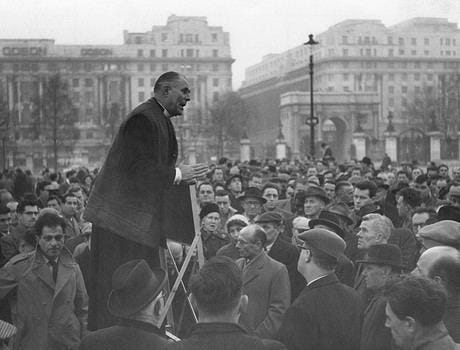
One of those regulars, Hatun Tash, is a convert from Islam to Christianity who speaks about her faith and occasionally criticizes Islam. Tash has been assaulted by outraged Muslims on multiple occasions. In 2021, she was viciously stabbed.
In December 2020, the police asked a Muslim mob surrounding Tash to leave. When they refused, the police asked Tash to leave. When she refused, they arrested her.⁵ The police also delivered Tash the following official notice:
Although Tash’s attackers were recorded on multiple videos, not a single one, including the stabber, has been charged with anything.
Hatun Tash has been violently attacked multiple times for criticizing Islam. She is the only person the police have ever arrested in these attacks.
I spoke with my friend Steve, a Speakers’ Corner legend, about the environment at the Corner. As a regular speaker for over 20 years, he is a good barometer of the deterioration of free speech. Over the years, he has watched the crowds dwindle and become increasingly Muslim. In the past, he faced vituperative heckling; now he increasingly gets threats, which the police just shrug off.
Steve has spent decades standing in the one place in Britain set aside for unpopular opinions. In the last few years, he told me, the police seem to treat the unpopular opinion, not the threat, as the problem.
It can’t happen here…
The First Amendment should not lull Americans into insouciance. Politicians and private institutions have ways of doing end-runs around free speech protections.
In 2012, the Obama administration initially blamed the deadly attack on the US consulate in Benghazi on a YouTube trailer called Innocence of Muslims. Its creator, a Coptic Christian, couldn’t be prosecuted for the film itself; the First Amendment saw to that.
So federal authorities found another way to get him. He was on probation for a fraud conviction and barred from using aliases or going online without permission. Within weeks of the uproar, he was arrested, held without bail, and sentenced to a year in federal prison.
The court insisted none of the violations concerned the film, and technically that’s true. But, as law professor Jonathan Turley noted, violations like his rarely bring prison time at all.
Universities also suppress free expression about Islam. In 2022, an art history professor at Hamline University made the mistake of showing images of Islamic art depicting the Prophet Muhammad. The professor was sternly rebuked by the university president, and her contract was not renewed. To be clear: the professor displayed Islamic art created by a Muslim, and even provided a trigger warning that it might offend some. Nevertheless, she was penalized for it.⁶
Beyond the institutional threats, those who contemplate criticizing Islam can’t help but recall the violent attacks on others who have done so: Theo van Gogh, murdered; Charlie Hebdo, 12 people murdered; Avijit Roy, murdered; Kurt Westergaard, barely escaped an axe attack; Salman Rushdie, barely survived a knife attack; and so on.
A while back, I spoke with Flemming Rose, the editor who published drawings of Muhammad in Jyllands-Posten, earning him a place on Islamist death lists. He pointed out how the most strident critics of other religions are curiously silent when it comes to Islam. Some of these critics openly confess this:
“I know what keeps me from critiquing Islam on my blog is just fear. I’ve got three kids. So I know I can say anything about Christianity or Mormonism, and I’m not living in fear, which is a testament to Christianity and Mormonism, and that’s wonderful.” —Phil Zuckerman, atheist professor of secular studies (at Pitzer College)
No blasphemy law required
Quran-burner Hamit Coskun was eventually cleared on appeal, and Hatun Tash collected her settlements from the police. Defenders of the system might call that proof it works. It isn’t. Coskun was branded a criminal and dragged through three courts for burning a book he owned, while the man who came at him with a knife never spent a day in prison. Tash was repeatedly attacked, and the police responded by advising her to stop expressing her beliefs and stay away.
Neither Britain nor America has a blasphemy law. Neither needs one. A violent attack and a public order charge here, a probation violation there, and the message gets through: criticize Islam at your own risk. Most people will simply stay silent. That is how free speech dies in a liberal democracy: not by statute, but by intimidation that the authorities choose to tolerate. The First Amendment can stop Congress from outlawing blasphemy. It can’t stop officials who would rather find another way.
Ada hosts a podcast for the Equiano Project, an organization devoted to open discussion about race, culture, and politics. Full disclosure: she previously hosted me on her podcast for a discussion of my book, Out of the Melting Pot, Into the Fire.
Coskun was fined £240 plus a £96 surcharge. He appealed the conviction, which the appeal judge at Southwark Crown Court set aside. The Crown Prosecution Service then appealed that ruling, but the High Court dismissed the appeal, finding the Southwark court had not left any material factor out of account or relied on an immaterial one.
The sentencing remarks in Kadri’s case are worth reading if you want to get furious. The judge noted that Kadri said he was going to kill Coskun, went and got a knife, and then slashed at Coskun with it. To top it off, he tried to mislead investigators, claiming that he only had a dull palette knife. Nevertheless, the judge noted, “you were clearly deeply offended” and let him walk free with some unpaid work and a few days of rehabilitation.
Lord Soper was an actual peer of the realm. Despite his signature bowler hat and pinstripes, Michael “Lord” Barker was no lord at all. He ran a newspaper stand on Oxford Street. Lord Barker and some other notable hecklers are featured in this video.
Tash subsequently won settlements from the Metropolitan Police. They apologized and paid her £10,000 in compensation and costs for the December 2020 and May 2021 arrests. After a June 2022 arrest, she was awarded another £10,000 in damages and costs.
In 2024, the university settled a lawsuit filed by the professor for an undisclosed sum.

Here are some resources on related to this topics article:
• Islam and Free Speech by Andrew McCarthy
• Lights Out: Islam, Free Speech And The Twilight Of The West by Mark Steyn
• Sharia Versus the U.S. Constitution: Why Americans Must Choose Freedom by A.S. Ibrahim
• A Battle for the Soul of Islam: An American Muslim Patriot's Fight to Save His Faith by A. Zuhdi Jasser
• No Compulsion in Religion ― No Exceptions: Islamic Arguments for Religious Freedom by Mustafa Akyol
• Islam Without Extremes: A Muslim Case for Liberty by Mustafa Akyol
• Murder in Amsterdam: Liberal Europe, Islam, and the Limits of Tolerence by Ian Buruma
• Reflections on the Revolution In Europe: Immigration, Islam and the West by Christopher Caldwell
• Suicidal Empathy: Dying to Be Kind by Gad Saad
• Suicide of a Nation: Immigration, Islam, Identity by Matt Goodwin
• Free Speech Generation: The Civil Libertarians Who Saved the First Amendment and Transformed America by Nico Perrino
• The War On Words: 10 Arguments Against Free Speech—And Why They Fail by Greg Lukianoff & Nadine Strossen
• HATE: Why We Should Resist it With Free Speech, Not Censorship by Nadine Strossen
• The Indispensable Right: Free Speech in an Age of Rage by Jonathan Turley
• Free Expression Under Fire: Defending Free Speech and Free Press Across the Political Spectrum by Stuart N. Brotman
Comments can boost the engagement with a post, so I thought I’d include some of my famous nuance examples. 😉 Read those below 👇
Let’s say I’m living in Australia in the 1800s. I would be a proud Australian settler, start a ranch on the frontier and live there with my family, be happy to see the expansion of free settlements, celebrate the 1851 Gold Rush, welcome the waves of immigration from Britain, Europe, China, and North America, be excited by the rapid growth of cities like Sydney and Melbourne, support the introduction of the secret ballot in 1856, support the introduction of women’s suffrage in Southern Australia in 1894 and Western Australia in 1899, and be glad to hear about the end of the transportation of convicts to the eastern colonies. But at the same time, I would support the Rum and the Eureka Rebellions, oppose violence on the frontier against the Aboriginal people, oppose the systemic dispossession of Aboriginal land, publicly denounce massacres perpetrated by Australian colonists against the Aboriginal people, oppose anti-Chinese immigration laws, and fight against the blackbirding or kidnapping of Pacific Islanders from the South Pacific for use as forced labor.
Let’s say I lived in South Vietnam during its existence from 1955-1975. I would be proud to be South Vietnamese, fly the South Vietnamese flag, celebrate independence from France, be grateful to have the United States as our ally, be glad to live in the capitalist South rather than the Communist North, I would be a staunch anti-Communist, enlist in the ARVN, detest the North Vietnamese and the Viet Cong, admire Ngo Dinh Diem and Ngo Dinh Nhu, welcome the American and Free World Forces who arrived in South Vietnam to fight the Communists, and celebrate North Vietnam recognizing South Vietnam in the 1973 Paris Peace Accords. All that being said, I would lobby for the French to continue to have a military presence in South Vietnam for the protection of my people, seek to build peaceful relations between Catholics and Buddhists, be shocked by the assassinations of Diem and Nhu, would not support any of Diem’s corrupt and incompetent successors, criticize the American government for how they were waging the Vietnam War, call out atrocities by the American military and the ARVN, be appalled by the 1968 My Lai Massacre, have sympathy for North Vietnamese civilians killed as collateral damage in U.S. bombing campaigns, and would help as many of my people to get to safety as I could before fleeing to America with my family with the Fall of Saigon in 1975.
Let’s say I’m living in Kenya in the 1950s. I would be a proud Kenyan, call out British atrocities and injustices, fight racism against my people, protest the expropriation of our land by white settlers, advocate for greater self-autonomy and eventual independence for Kenya, oppose my people being held in detention camps during the Mau Mau Uprising, and denounce the rape of our women by British and allied Kenyan soldiers. But at the same time, I would support Kenya remaining part of the British Empire, be proud to be a citizen of the empire, tout the benefits of the British colonialism, befriend white settlers, advocate for a democratic, capitalist and multicultural Kenya where whites, blacks, mulattos, and Asians would all live together as equals, work to convince British settlers, Greek and Italian immigrants and Boer farmers to stay, protect civilians black and white alike from the Mau Mau, join the Kikuyu Home Guard and fight alongside the British, detest the Mau Mau and be appalled by their crimes, and detest Jomo Kenyatta and consider him a con artist.