


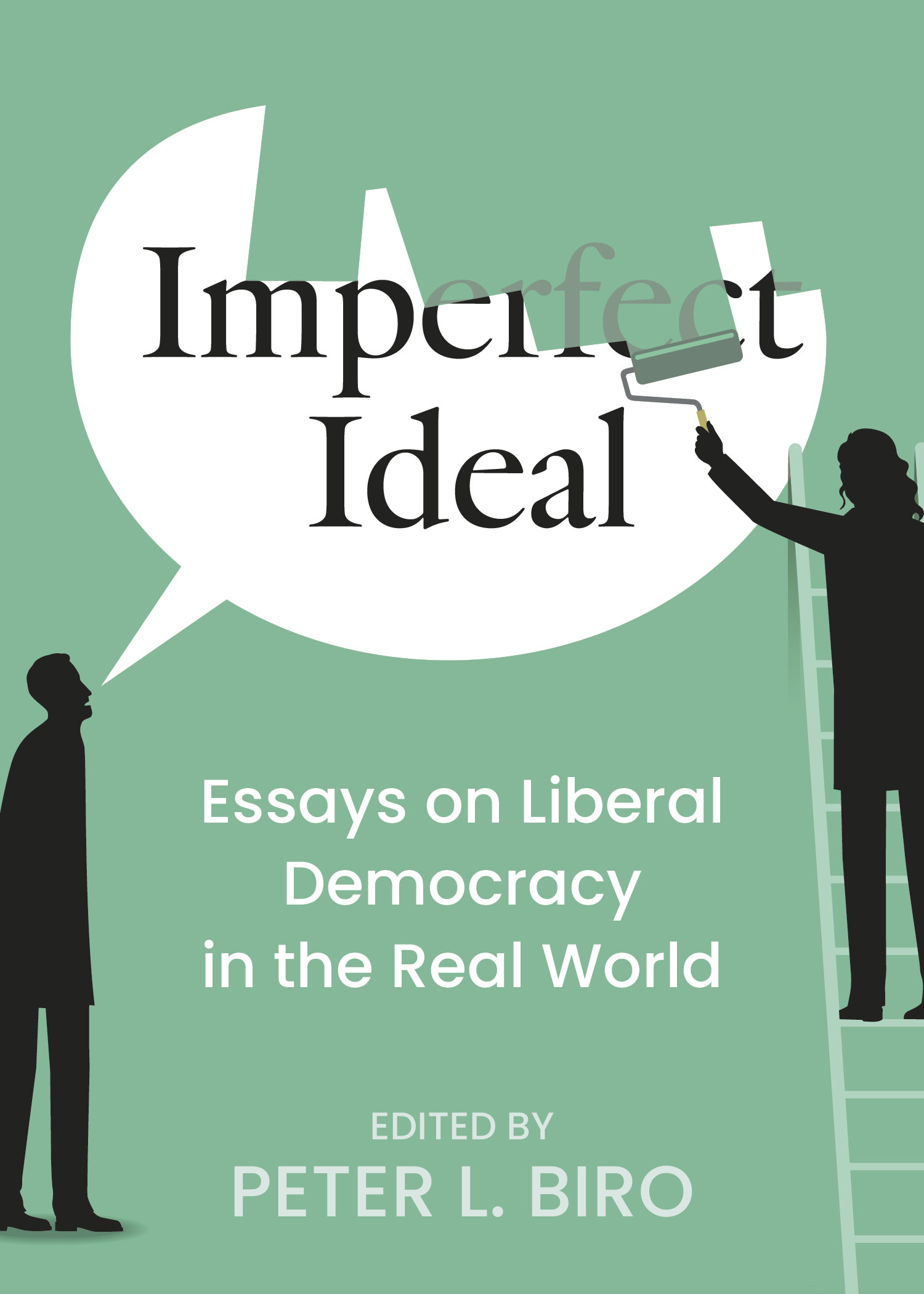
Chris Hall is a Canadian academic and specialist in specialist in constitutional theory and geopolitics. Currently a professional consultant and commentator, he served as a campaign director for the 2006, 2008 and 2011 Canadian federal elections and as an export consultant from 2010 to 2014. Most importantly (!), he is Guerre and Shalom’s new “Constitution Correspondent”. Today he reviews Imperfect Ideal: Essays on Liberal Democracy in the Real World, edited by my friend, mentor and champion of liberal democracy, the Canadian academic Peter L Biro. Imperfect Ideal can be purchased here on Amazon and here from the publisher.
- Daniel Clarke-Serret [Editor, Guerre and Shalom; Author of Pure Jewish Anger (#15 on Amazon) and Pax Arabica]

“It is no secret that democracy is in decline, not only in the places in which liberal constitutionalism is giving way to populist, authoritarian politics, but also in Canada, where the discourse is increasingly defined and advanced in “narratives of justice” rather than by the principles of “fundamental justice.” The essays in this book address some of the intellectual, psychological, and political sources of democratic backsliding while offering hope and a path forward towards a renewed and more resilient liberal democratic civic culture. This important book meets our political moment!”
- Irwin Cotler, former Minister of Justice and Attorney General of Canada (and recipient of the 2026 G&S Peace Prize. See link above.)
Imperfect Ideal: Essays on Liberal Democracy in the Real World [Biro (ed.), 2026]
A review by Chris Hall
“The tyranny of a prince is not so dangerous to the public welfare as the apathy of a citizen in a democracy”.
Charles Louis de Secondat, Baron de Montesquieu, The Spirit of Laws
So reads the introductory quote of a new book edited by Peter L. Biro, dealing with the state of, and challenges facing, contemporary democracies. Or, more accurately, the state of liberal democracy. The book, titled ‘Imperfect Ideal’, introduces itself by suggesting that liberal democracy is in crisis.
The difference between the mere semblance of democracy and liberal democracy is an important argument that runs through the entire work. A common theme is that a number of democracies are backsliding, to use the word that’s regularly employed. This isn’t to say that voting is likely to end anytime soon nor that there aren’t multiple parties to choose from on the ballot. Instead, there’s a direct challenge as to whether that is all we should expect from a fully functional liberal democracy and what the characteristics of a healthy liberal democratic society are.
Editor Peter L. Biro is the founder of a democracy think tank, Section 1, and holds senior fellow positions with the Raoul Wallenberg Centre for Human Rights and the Aristotle Foundation for Public Policy. He’s an adjunct professor at the University of Toronto, where he teaches constitutional law. In all, the book has ten contributors — all experts in their respective fields of political science, philosophy, law, cultural institutions and diplomacy.
The difference between simple democracy and liberal democracy revolves as much around non-institutional mechanisms as formal structures. It’s not that the constitution, as a written document, or formal elections figure centrally in much of what the book discusses. Instead, liberal democracy has historically put a bigger emphasis on civic culture and societal components: whether freedom of speech is respected, whether people are allowed to disagree openly and express unhappiness with the current government, and whether there’s a robust societal cohesion that doesn’t require formal enforcement.
There’s something especially appropriate about this being a collection of writers, considering the emphasis in defining liberal democracy on the necessity of expressing differences of opinion. Liberalism presumed that citizens would naturally come to different orientations.
In fact, classical liberalism assumed that politics couldn’t fundamentally change the differences of opinion between various segments of society. Different individuals, because of their circumstances or natural dispositions, were destined to have disagreements. Politics’ purpose was to define ways in which people could converse over their disagreements and produce satisfactory answers so everybody could live in a common community. Liberal democracy presumed that a society would always be pluralistic.
Peter Biro’s Conference on Anti-Zionism:
One of the book’s primary arguments is that democracy as it is today in many countries, especially the United States, has morphed into something different. It is increasingly presented as something closer to an electoral autocracy.
Donald Trump is one of the central examples the book examines. The criticism isn’t the same as the one that many of the current US president’s typical opponents would make. In the opening essay, Biro points to Trump’s moves at the beginning of his second term to eliminate oversight offices, trying to remove various forms of restraint that are normally placed on a president. The argument is not about policy, or whether the ideas being pursued might have merit. Instead, the focus turns to the process, and to the motivations behind how politics is supposed to work in practice, through interaction between different people.
In a broader sense, this is similar to the argument that, in an increasing number of democracies, executives are becoming not simply central to the government’s operation but are increasingly operating outside of legislative oversight and producing policy directions usually reserved for legislatures to approve.
Legislatures having given away most of their authority and purpose is a popular topic in a number of current constitutional discussions. It’s very apt here, as legislatures weren’t simply a place where votes were taken. A legislature served fundamentally as the location where different representatives presented the viewpoints of the constituents who chose them. It is where the conversation between the different interest groups that liberal politics presumed would always exist was meant to take place.
Legislators becoming less important in politics, and executives becoming the central point of everything, sits at the center of the argument that liberal democracy is slowly receding and some form of electoral authoritarian government is taking its place. This is the evolution in a number of countries at the moment, where those who run for office increasingly see winning an election as an endorsement to enact policies without other parts of the political structure impeding them.
This approach is directly associated with the retreat of the liberal component that most liberal constitutions try to preserve: the idea that there is a separation of powers and that different elements of the government, both elected and unelected, are supposed to interact with each other and come to broader consensus, rather than one person winning an election and being able to behave as they see fit.
That interaction depends on a disposition within the broader political community and the population at large that having discussions with those who might disagree with you still carries merit. That is certainly open to debate in many Western countries today. Increasingly we see those of a different philosophical disposition as people to be defeated rather than interacted with.
Daniel Clarke-Serret on Freedom of Speech:

One of the most striking things is that the essays don’t all come from the same point of view. Not only are they on different topics, but it would be difficult to accuse the book of having a particular political perspective in terms of precise policy. It’s very liberal democratic in this way! Indeed it lacks a dispositional bias as far as whether there’s a particular ideal, the concept referenced in the title.
One contributor, Dennis Pilon, brings up the question of whether democracy is frequently a contested term, with a meaning open to different interpretations depending on who is responding. Pilon himself takes issue with that view, however; his essay points out that historically there’s always been a general understanding that democracy meant sharing as broadly as possible the ability to influence decisions.
This represents a much more participatory approach; a view of liberal democracy that is obviously much less legalistic and focuses far more on engagement. One of the more intriguing components of his argument is that mobilizing voters has become increasingly mechanized, through mediated forms of communication like advertising as opposed to direct interaction.
Another more original thought comes from a different contributor, Sascha Priewe, who places museums within the democratic infrastructure. This focuses on the civic culture outside the formal parts of democracy and looks at the cultural component. The use of museums as an educational tool and a bulwark against anti-liberal shifts is a unique point.
In another essay, Noa Mendelsohn Aviv explores one of the more obscure components of the Canadian constitution: section 33, frequently referred to as the notwithstanding clause, which allows elected governments to override certain legal rights within the Constitution for a five-year period. In recent years a number of the country’s provincial governments have started using it much more frequently. From this standpoint, the argument of too much democracy is explored, with elected governments not being sufficiently restrained by the legal mechanisms that most people take for granted.
A section I found particularly intriguing was the second essay by Michael Bonner, who explored the origins of liberalism itself. He opens with a hypothetical of an automated society where everything operates without human oversight. There’s simply a mechanical approach to everything, and those responsible for maintaining the system no longer understand its original construction or purpose. He presents this, in many respects, as the situation we find ourselves in today with regard to what it means to live in a liberal society in the first place.
Western liberalism originated in the belief in the pursuit of human freedom, but his argument turns to point out that a number of contemporary democracies increasingly focus on individual and collective identitarian concerns while ignoring a common sense of humanity and the moral equality of individuals. They have lost a sense of community as a result. This introduces the more complex origin of liberalism: a tension between the individual and the collective.
This is a truly unique argument that I found myself wishing was made far more frequently, considering how often I hear those who lament the breakdown of trust and social cohesion in modern societies.
There are also individual essays dealing with the transition to competitive authoritarianism, a term used by Lucan Way, which explains the concept of electoral gains by outsiders who attack the established order and attempt to overthrow state structures in order to produce a more populist approach to governing. An argument over new technology within a geopolitical framework is addressed by George S. Takach. The possibilities and possible pitfalls of artificial intelligence are addressed by Michel J. Paradis.
And a potential strategic framework for both understanding and developing the next approach is put forward by Thomas Homer-Dixon and Scott Janzwood. They map economic disparity, the ingenuity gap, message distortion, and the fragmentation of belief communities as parts of what needs to be considered in order to make that approach work.
One of the bigger questions that runs through many of the essays, and through much of the underlying premise of what they all have in common, is how committed current democracies remain to liberal concepts. At the beginning of the book, Biro sets out a point that might seem a little ominous in this regard:
In this constituent moment, I want to suggest that the popular commitment to liberal democracy is very much in doubt, partly because such a commitment does not come naturally to us, but also because forces antagonistic to liberal democracy actively undermine our basic competence to make such a commitment and to keep it. — Biro, pp. 2–3
It seems to be becoming a far more popular concern that liberalism itself is not a natural human trait. It requires us to do something we don’t like: listening to opinions we disagree with and being willing to accept that others will conduct their lives in ways different from what we would like.
Very often, elected democratic leaders view election victories as the ability to implement their own agenda, which fits into an inclination not to listen to an opposition they believe to have been vanquished. Elections get portrayed as solving questions permanently, as opposed to the conversation continuing.
Democracy has in some respects unleashed certain instincts, such as the belief that if I vote for something, I should get it. These give us almost a natural disposition to move toward what Biro and the other contributors are raising concerns over.
Also from Peter Biro (much recommended):

Democracy, for its virtues, also carries the potential to be dangerous. Aristotle was worried that democracy could easily descend into a form of despotism, with popular leaders becoming effectively tyrants with the legitimacy of having been installed by the public. In a system of democratic despotism, the shared preferences of the numerical majority effectively supersede the rule of legal constraints. What is variously called illiberal democracy, authoritarian democracy, or some variant of populism is in many cases exactly the type of outcome Aristotle would have worried about.
If there is one question I might raise, it concerns something the book avoids. It’s a popular criticism from the more intellectual questioners of liberalism: can pluralism be taken too far? A number of those who call themselves post-liberals have introduced the idea that political dispositions can simply be too far apart for any compromise to be reasonable. On this front, the argument for more raw authority from simply getting the most votes starts to echo.
The title, Imperfect Ideal, sets out this dynamic of trying to work through what liberal democracy is, while at the same time raising the question of whether it has ever been something that could be accomplished. Was Aristotle always right? In many respects, the hope is that the liberal component in liberal democracy can help prevent democracy from simply descending into the sort of authoritarian approach that many of the essays here are concerned about.
The book tackles a number of challenges facing liberal democratic institutions that frequently get overlooked. There were numerous times when I disagreed with the conclusions the essays sometimes pointed toward, but I had a hard time disagreeing with the questions being asked. That’s a big part of what makes this such a unique volume. It opens a number of conversations that haven’t been occurring and probably should.
That is why this work deserves to be celebrated. There are a lot of ideas here that should be considered and debated.
In the conclusion, Biro puts forward the thesis that there’s both optimism and concern in what the contributors are trying to present. The concern is the warning Montesquieu raised of an apathetic public. The optimism is the possibility of engaging the citizenry more fully and producing a much more dynamic political community. The question is whether an exhausted public can take up the challenge.

