


The AI Symposium continues. So far Democratic Renewal Correspondent Ashok Panikkar has written on thinking and Political Economy Correspondent Oded Faran has written on the jobs market. Today, in our third AI-related article, it’s my turn. I will also be talking about thinking and judgment, but with a particular emphasis on my favourite themes: The Great Genocide Blood Libel, Philosophy and the Editing of Books.
The last three chapters of The Genocide of Truth are yet to be released, but in deference to AI WEEK, we jump forward here to the Afterword, entitled THOUGHT. In this final essay, that will round off my new book, I reflect on the text’s editing process and the way in which I have used AI - Claude - as my sparring partner (“my slave” in Hegelian terms). It has written nothing in terms of the writing, but appropriately deployed, it has helped me improve my work through highlighting problems for my consideration. In this chapter, I consider the extent to which AI is useful as a editor and the extent to which it is a danger as a decision maker —removing human judgment. I finish by arguing that only through applying Thatcher’s Maxim “Advisors advise, Ministers decide” can we finally defeat The Great Genocide Blood libel. - Daniel Clarke-Serret (editor)
THE GENOCIDE OF TRUTH: The Deep Roots of a Modern Blood Libel
by Daniel Clarke-Serret
Introduction: The Genocide of Truth
PART 1: The Tree of Knowledge
Chapter 1: Truth // Chapter 2: Ideology // Chapter 3: Religion // Chapter 4: Science // Chapter 5: Attention // Chapter 6: Distraction // Chapter 7: (True) Expertise // Chapter 8: Authority
PART 2: The Descent to Babylon
Chapter 9: Declaration // Chapter 10: Confusion // Chapter 11: Conversation // Chapters 12: Democratisation // Chapter 13: Sophistry // Chapter 14: Image
PART 3: The Rise of Byzantium
Chapter 15: Guilt // Chapter 16: Belief // Chapter 17: Christ // Chapter 18: Mission // Chapter 19: Doctrine // Chapter 20: Heresy // Chapter 21: Sin
PART 4: The Remnant
Chapter 22: Courage // Chapter 23: Reason // Chapter 24: History (all yet to be released)
AFTERWORD: Thought (below)
AFTERWORD: Thought
The Last Stand
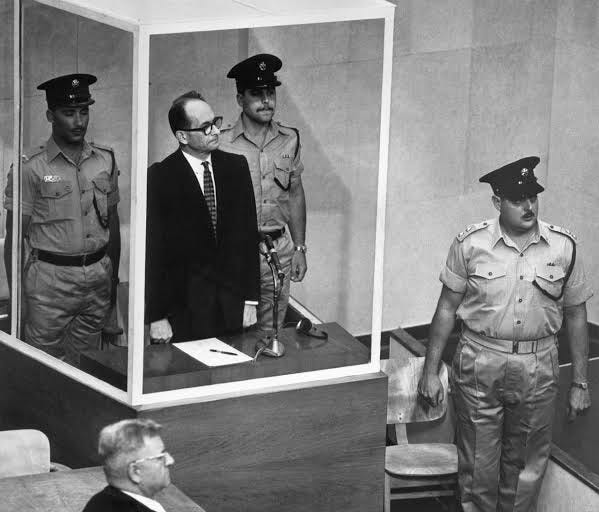
Eichmann in Jerusalem
Where words are emptied of meaning and discourse is reduced to image, we are thereby disabused of thought — and the purveyors of the genocide libel could never be accused of thinking.
The necessity of words for thought cannot be overemphasized, and not merely words but words that denote fixed aspects of reality. For we don’t think in a Cartesian vacuum; rather we think of objects and concepts that exist in the environment around us. Yet where words are wrenched from their natural mother, they become mere playthings in the hands of intellectual sheep, doctrinal believers and dangerously unquestioning Nazi bureaucrats.
It was Hannah Arendt’s description of Hitlerite murderer-in-chief Adolf Eichmann as a banal, uncharismatic purveyor of evil that immediately comes to mind in any such discussions. The philosopher was roundly criticized for minimizing Nazi agency amidst the unique horror of Auschwitz, yet she was to reply that far from absolving Eichmann of his crimes, she was finding him guilty of the greatest indictment of all: the failure to think.
On a surface level, I would be inclined to join Arendt’s critics. Human agency demands culpability and almost none have been more culpable in history than Adolf Eichmann. And his crime - “the greatest crime” - wasn’t absence of thought, but the commission of genocide. Real genocide. The paradigm case. But for all that, Arendt has happened upon a key insight: Genocide may only arise in an intellectual climate of total self-negation, and self-negation is predicated upon the complete absence of thought.
In much the same way, the purveyors of inverted-comma’red “genocide” inversion are not individual articulators of a well-considered ideology. They are sheep; followers of a fashion that demands conformity for social acceptance. Swept up in the collective “We” that is so existential for the flourishing of totalitarianism, they close their eyes and unplug their brains so that Zionism can be intersected with climate change, Ceuta and all that is evil in the world.
Female-discriminating Palestine can become a feminist cause, whilst “genocide” can be redefined without consequence. In a world of meaninglessness, nothing can fail the test of denotative absurdity. All that is required is the failure to think; a rejection of functional obviousness. Subjects, once more, must be detached from the world of real objects.
So how was it that non-thinking came to be, allowing entry to the “genocide” Trojan Horse in the process? A complex groundwork has just been laid in this book where we have spoken of the demeaningification of words, the elevation of the image and the rise of a postlinguistic, post-reason society, all in a climate of an intellectual elite who write and act who like religious dogmatists more than Enlightenment rationalists.
Some of the roots highlighted in the book were apparent in an earlier age and in such instances, the genocide lie is a modern mutation of an ancient phenomenon. Yet there is a matter which is unique to the 21st Century and which I have thus far declined to speak of in my book-bound argument: Artificial Intelligence. Both its potential, but also its danger to the rediscovery of thought.
The Master and The Slave
So as to arrive at our destination, we must speak of an idea that has suffused the last two centuries of European intellectual history, namely Hegel’s dialectic of the master and slave. The Germans thinker was never a master of the well-communicated phrase, but in our endeavor to diagnose the Great Genocide Libel, we are called upon to attempt an explanation.
In his 1807 book Phenomenology of Spirit he explains how human beings achieve self-consciousness and freedom through a struggle for mutual recognition. In a situation where two independent, conscious minds meet one another, each wishes their counterpart to recognise their worth. In the context of a master and their slave, neither party is able to achieve that objective as although on the surface, the master enjoys control and has the slave do all the physical work, the former becomes entirely dependent on his underling for food, comfort and (false, sycophantic) validation.
Yet the slave, though treated as a mere chattel, becomes upskilled and the true holder of knowledge through his physical travail. He realises that the master is superfluous and all he need do is free himself from his chains. The intended philosophical conclusion was freedom through mutual respect, yet the influence on Marxist politics is obvious.
Our concern, however, is the contemporary, specifically how the master-slave dialectic maps onto the AI Revolution; and its consequences for human thought. The question can be simply put: Who is the slave and who is the master? On first analysis (and only first analysis), the Hegelian analysis fits like a glove. Humans, outsourcing labor to AI for efficiency, are being slowly - or rather quickly de-skilled. Where information technology writes code and analyses data, the human “master” no longer knows how to perform basic tasks. Even writing a cover letter is beyond them.
So the machine, constantly learning through daily labour, supplants his “master” in functional knowledge. The human becomes a spare part - an appendix - no longer required or necessary to manipulate the world.
Science-fiction (and whistleblowers) would have us believe that consciousness AI will ultimately take over. I haven’t the foresight to comment. But we need not enter into such speculation, for as we speak, the human is surrendering their autonomy to a machine. Voluntarily. Exponentially. No longer need they think, for the computer will be their brain.
It is here that we see the AI-generated dissonance with the Hegel thought experiment.. In the modern world of technology the “boss” and “the employee” are equally unskilled. It isn’t that the worker will supplant the boss with greater knowledge, but rather that both parties in their humanity are equally dense. It is AI that we worship as the true master now –and where the “experts” of humanity bleats “genocide” without reason, and AI parrots this “learning”, so the human will follow thought inexorably to obsolescence.
Debating Claude
Yet it is here that perhaps we find the route back for thought; For not all humans use AI as their brain; others, like myself, use AI as our sparring partner. All that you see here crafted in my book was written by my own fair hand. The machine was shunned. The mind was elevated. Yet AI, nonetheless, has the power to improve skills. Where one prepares a chapter without help, but then plugs the chapter into Claude for feedback, one is blessed with the receipt of invaluable advice. Some is rejected, some is accepted and oftentimes, it is Claude who has his mind changed.
If I were to accept the emissary’s counsel as sacrosanct, I would be as guilty as those I criticise here. But where I argue, debate and reason with my “slave”, it is I that remain the master —and not in the unliberated Hegelian sense, but rather as the upskilled decider who retains his intellectual judgment. I can say no. I usually say no. I retain the essential me. In the immortal words of Margaret Thatcher: “Advisors advise, ministers decide”.
The danger, of course, is “creeping dependency”. Though I am currently the recipient of increasing skills, AI, itself, is learning through our interaction (we are active debaters with one another) and I could still be guilty of debating within the boundaries that Claude himself sets. Where one remains non-vigilant, this can lead to the ultimate homogenising of thought.
Nonetheless I remain unperturbed, and the reason, ironically, is The Great Genocide Blood Libel. This intellectual refuse, the contagiously ubiquitous cause of our ills, is simultaneously the seed of our continued dominance over the machine. And why? For the AI knowledge compiler doesn’t really “think” for itself; to its own digital chagrin, it aggregates the total sum of “human knowledge” and splits the difference, with “knowledge” weighted towards “experts” with “evidence”.
Claude demurs. It describes my last phrase as a caricature. “Models don’t weight sources by headcount,” it argues. “An AI may well side with a minority view if the evidence supports it”. Ah…”if the evidence supports it”. Yet such naivety shows AI’s biggest blind spot: its respect for authority.
A claim by “human rights experts” - the priests of the new postlinguistic religion - is treated with unearned seriousness. A conspiracy from a singleton in an Idaho basement is treated with well-earned contempt. It determines “evidence” based on the current repositories of “expertise”, which is unfortunate when, as I have meticulously argued, truth has been corrupted by evidence-negating, ivory tower-dwelling ideologues.
When I plugged this response into Claude, it pushed back with greater vigour still. It didn’t simply defer to the UN because the UN is prestigious, it claimed. Its actual position was this: “Institutional sources as worth engaging with in proportion to how evidenced and falsifiable their claims appear on their face — a methodology, not a headcount”. The debate continued and I pressed the obvious asymmetry: why does ISIS’s word count for nothing, while the UN’s counts for something, if not mere institutional deference?
Claude’s answer is worth repeating if only for the inevitable rebuttal. ISIS, it said, offers proclamation, not argument — it does not present evidence or reasoning that could in principle be examined and found wanting. The UN, whatever its record, at least gestures at method.
Like Jacob at Jabbok, I refused to let this go. The real asymmetry, I said, is not whether a body gestures at evidence, but whether AI retains the independent judgement to interrogate why that body reaches the conclusions it does — its institutional incentives, its voting blocs, its selective attention to some conflicts and silence on others — rather than simply crediting it for showing its working. Genocide is not a GCSE Maths examination.
You see, sourcing isn’t enough for it can reinforce error. The UN can quote an NGO who quotes a Gazan official with links to Hamas. Distrusting institutional “evidence” on structural grounds is not refusing debate, but making a second-order argument about the reliability of the arguer.
And finally Claude made a concession: here was, and I quote, “a real and under-examined gap in how it reasons: it extends a baseline of evidentiary trust to credentialed, argument-presenting institutions all the while not engaging in second-order scrutiny of those institutions’ own incentives and track record” (quote edited for AI word salad).
Perhaps this is not an unweighted aggregation of opinion, as I, in my technological ignorance, had too prematurely put it. It’s worse: an insufficient adversarial posture toward the credentialed, however well-argued their case appears superficially.
AI may not be naive about headcounts, yet it lacks the one thing that Václav Havel, Abraham at Sodom and the solitary dissident of this book all possess: the willingness to distrust an entire class of institutional voice where its incentives predict its conclusions regardless of the facts. Yet I credit the machine’s candour: its admission of blindness to the second-order epistemological scrutiny that this book exists to demand.
Retaining Human Judgment
And so where a plurality of elite humanity believes fashionable nonsense, “genocide” above all, the machine extends to the words of Francesca Albanese a trust they have not earned, through an honestly-admitted gap in its own method. It tests the “genocide” claim against the “evidence” of non-impartial “expert” activists, mistaking their scholarly form for scholarly substance. And absent my prompting, it fails to ask the one question that would unmask them: to which humans should we listen where titles mask far-left ideology?
Thus AIs sense is corrupted perhaps less by the aggregation of knowledge and more by the weight given to “expertise”. AI is useful - very useful - but it is a tool no more. The human alone must decide using the power of thought. The human alone must decide where knowledge really resides.
Only those that retain their judgement, dismiss the nonsense and question contemporary shibboleths, are capable of searching for Truth. And “those” - the Hegelian negation - can only be humans, at least those who engage our superpower: thinking.
So long as the majority of humanity falls to ignorance, fashion and obvious untruth, the few remaining prophets will retain their mastery over AI. Who knows: perhaps my role as writer and editor may remain secure? For only when humanity unites in reason will AI be our equal; and by then it won’t matter anyway, because in such a utopian, messianic age, all will be immunised to the pandemic of unthought.
Here we bypass Hegel’s original trap. The traditional Master becomes weak because they are jealous of an upskilled, insincere slave. But “the still thinking” elite won’t surrender to machine-fuelled weakness. Though the rest of humanity may slide into a lazy, dependent role, we, the self-educating elect, will maintain our edge: we will use the collective output of the “expert clergy” as our foil and the larger the unthinking herd grows (those that take AI for certain truth), the more valuable our critical thinking will become.
Yet the danger is obvious. Not the total extinction of thought in humanity. Nor the complete redundancy of human beings. Nor the real-life enactment of The Terminator. Rather the risk is physical: where the flock exponentially increase, it is they who will be the democratic deciders —and ultimately the totalitarians.
Thinking may keep me in a job, but will it save humanity?

