


TRAVEL WEEK, blown off course by Donald Trump, is back with two final articles.
ARTICLE 1 (Cymposium):

ARTICLE 2 (Richard Neat):

ARTICLE 3 (Daniel Clarke-Serret):

“The Insider’s Guide to Spain” by Daniel Clarke-Serret
Spain isn’t just Sun, sea and tapas. It’s more than throwing tomatoes at festivals and listening to Pedro Sánchez’s “genocide” lies . It’s a complex place with an intentionally short memory. And there are certain insights you need to know to understand this fascinating country. I have picked 10 below for you to feast upon; secrets that are only discoverable by those that live in the country, but have the perspective of having lived elsewhere. People like me in other words. Read on and enjoy my insider’s guide to Spain.
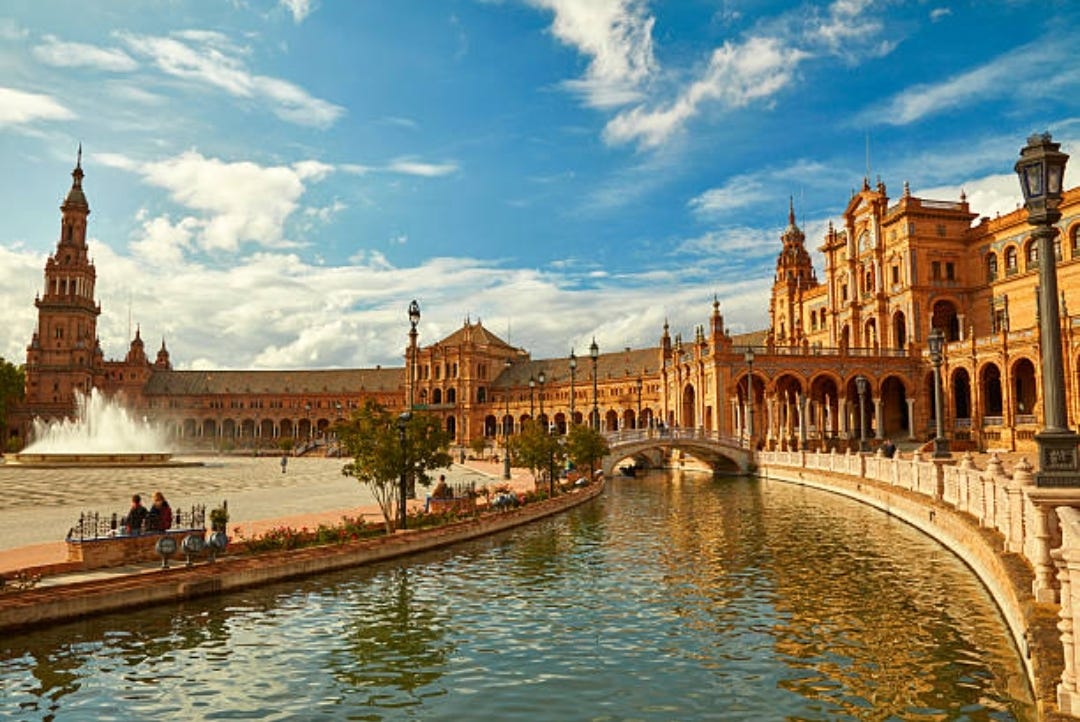
[Stereotypical Spain. Plaza de España, Sevilla. Creator: silverjohn | Credit: Getty Images/iStockphoto. Copyright: silverjohn]
CONTENTS:
Insight 1] Maths and money: Careful with your decimal points.
Insight 2] 17 countries in 1: An unsingle market
Insight 3] It’s empty. Really empty.
Insight 4] Competition as the answer to inflation.
Insight 5] Don’t look at the temperature. It doesn’t tell you the weather outside.
Insight 6] What the time, Mr Franco?
Insight 7] Is it worth buying a house?
Insight 8] The golden value: Health care for all.
Insight 9] Immigrants of the world: Welcome to Spain! [Not]
Insight 10] Spain: The land of cushy jobs….if you can get them.
Bonus insight 11] The first rule of fight club is that you don’t talk about fight club.
1)Maths and money: Careful with your decimal points.
There I was thinking that Maths is a universal. + is plus; - is minus; and so on. But it turns out that Spain has its own system. What is this number: 15.756? You’re thinking, no doubt, fifteen point seven, five, six. But you’d be wrong! Under the Spanish system, the dot is a thousands place marker meaning that 15.756 is in fact 15 thousand, 7 hundred and fifty-six. A huge difference if you’re going to buy an expensive item. So be careful!! The comma - to add to the confusion - is a decimal point; so to write fifteen point seven, five, six in numbers, you'll need to scribe 15,756. The exact opposite of the anglo system in other words.
The madness doesn’t end there. In the UK, 4:5 represents a ratio of 4 to 5, whereas in Spain that would mean 4 divided by 5. The sign “x” doesn’t show “multiplied by”, but the algebraic x. And to show 4 multiplied by 5 in a number sentence you would need to write 4*5. What a fine mess! I am all for individual national identities, but surely Maths should be universal…

2)17 countries in 1: An unsingle market
Officially Spain is a unitary State: The Kingdom of Spain. But in reality it is 17 different countries with their own health and education systems. And I am not just talking here about culturally distinct, linguistically-separate regions such as Catalonia. I’m talking about all the regions, including Castillian-speaking communities such as Aragon. A Spanish-born science teacher from Valencia may not be able to teach the exact same science subjects in neighbouring Aragon because the qualification requirements are different. And that’s before we even talk about the need to speak Euskera when teaching in the Basque Country and Catalan when working in Taragona. Spain is one country, but arguably not a single market.
Each region - or “autonomous community” - is its own little fiefdom with its own separate bureaucracy and laws; and they are responsible for spending a huge percentage of the tax take. This can lead to tiny La Rioja having huge autonomy and Aragon - a large area with very few cities - acting as if it were England. So whereas an English teaching professional from Kent can work in Cumbria, Cornwall or Camden, their Spanish opposite number would struggle to move freely around their Iberian homeland. There is a lot to be said for non-federal States and undevolved nations.

3)It’s empty. Really empty
It may not seem empty. It has 47 million citizens after all. But just how is the population distributed? The majority are close to the coast, with only two major cities outside of Andalucia - Madrid and Zaragoza - being located in the interior. These cities in turn are very densely populated with most residents being accommodated in Harlem-style blocks of flats. So whilst Zaragoza has a sizeable population of 700,000 inhabitants - and is soon to become Spain’s fourth city - it is really rather small in area. It wouldn’t be too difficult to walk across it from one side to another and the centre is highly accessible from most neighbourhoods. Which is great; because it means that the city is full of life. A buzzing fun zone. But it also means that it is barely a speck on the map.
If you looked at Spain from space, the interior, known as “Espana Vaciada”, would seem nearly void of human activity. Let’s take an example. The area between Zaragoza and Madrid takes only 1 hour and 15 minutes to traverse by fast train (3 hours, 15 minutes by car); and this makes Spain seem small and busy. But take a look out the window. Between Guadalajara and Calatayud, there is barely a village in sight. Let me say that again. The train is travelling at 310 km/h for over an hour and yet very few villages are to be seen. Mountains? Yes. Beautiful scenery? Yes. People? Hardly any. This part of Spain is in fact the second emptiest region in all of Europe, beaten only by Father Christmas’ backyard of Lapland. Even European Russia is significantly more populated than these areas of Southern Aragon and Northern Castilla La Mancha. Teruel province, with its fast-emptying villages, has many areas without Wifi connection such is the non-population. When I am in Zaragoza, I feel surrounded by activity, but the fact is I am in a semi-desert middle of nowhere and in a very empty land.
Sticking with trains…

4) Competition as the answer to inflation.
Ouigo. Iryo. Avlo. Never heard of them? Well they are three reasons why life is becoming ever-more cheap for Spanish commuters in this world of the cost-of-living crisis, the Ukraine War and spiraling costs.
Three years ago and beyond, when I regularly came on holiday to Spain, a return trip for 2 from Barcelona or Madrid to Zaragoza (located equidistant between the two major Spanish cities) cost a whopping 200 euros. By contrast, within the last year, I have booked two return journeys from Zaragoza to Madrid and not only have I covered the 320km distance in a handy 1h 15, but on both occasions at the rather impressive cost of roughly 70 euros.
70 euros! Down from 200 euros in the recent past. Now you do the Maths, but that is deflation alright. And all at a time of geopolitical tension and an energy squeeze.
It's not all rosy though. All the while, the price rises outside of the Barcelona - Zaragoza - Madrid rail corridor have been going through the roof. A return journey from Madrid to Seville (529 km) can easily reach 400 or 500 euros unless you book on the first day that the tickets are released, in which case you may purchase them for an unimpressive 300 euros. What used to be affordable is almost out of reach for the ordinary person. One might as well take a flight abroad instead.
So what is happening? One word. Competition! The national rail carrier RENFE has traditionally had a monopoly on the Spanish rail network and still does on the majority of the routes including from Madrid to Seville. Yet between Barcelona and Madrid, there is stiff competition from international rail companies and RENFE has even had to introduce its own Easyjet-style cheap rail franchise "Avlo" just to compete. The result? The consumer benefits. MASSIVELY.
I hear a lot of nonsense about economics and prices. Oh wouldn't we be better off if the UK government renationalised the railways! Oh what a boon for rail travellers that would be! Oh how energy costs mean that companies "are forced" to raise prices!
The reason that UK rail prices are so high is not because of privatisation and capitalism. It's because there ISN'T any competition. At all. Each train company has their own piece of track where they are forced to compete with....nobody. It's not privatisation in the least. It's an oligarchic monopoly that Yeltsin would be proud of.
If in Spain, the UK and elsewhere, train companies are forced to compete with each other on the same routes, the prices will tumble as they have between Madrid and Barcelona. And we would all be better off.
Competition. Competition. Competition. And an end to monopolies. That's the answer if we want to reduce prices for us all.
5) Don’t look at the temperature. It doesn’t tell you the weather outside.
If you’re in the UK and you read that it’s going to be 30 degrees, you know that you’re in for a scorcher. It may only happen 2 times a year, but when it happens, it isn’t pleasant. The houses are made for it. And air conditioning is a rarity. So Spain, where the mercury regularly exceeds 30 degrees is a living hell right? Well not really. It depends where you live of course, but in the great interior, no; it’s really rather pleasant. Accompanied by a gentle breeze, it’s a pleasure to stroll down the boulevards, sit in the al fresco cafés and lay down in the parks. Whereas coastal Salou is London-esque in 30 degree heat, arid Zaragoza feels like 24 degrees in Cornwall. It really has to reach 38 degrees here to feel that it’s best to stay off the streets in the midday Sun.
In England, to know what the weather’s like you look at the thermometer. In Spain, you need far more information. When it’s windy; when the Sun is hiding; when you are far from the sea, 20 degrees is cold frankly. But when the air is still and you are standing in the Sun, it’s quite a different story. So ignore the temperature and look at the wind: in my city, that is the key metric.

6) What’s the time, Mr Franco?
Look at a map. You’ll notice that Spain is directly below the UK. But when it’s 3pm in Spain, it’s 2pm in England. What’s going on? Geographically Spain exists in the wrong time zone. But no need to consult Doctor Who or Jean-Luc Picard; there is a historical reason for this anomaly. Under Franco’s dictatorship, he decided to align his country with his fascist buddy in Berlin. And the clocks haven’t changed since.
But geography is geography and against mother nature, no man can meddle. To be blunt, it feels wrong. The morning disappears in a heartbeat. The evening drags on endlessly. 11am doesn’t feel like 11am. And at 17:00, I can’t understand why I’m still at school. But the good news comes during those long summer holiday nights. The temperature maintain themselves long into the late hours and back in winter, darkness comes late to Iberian shores.
But beware! The mornings are cold. Just because the weather report says that today will be 26 degrees, it doesn’t mean that it is 26 degrees now. You’ll have to wait until 3pm. Upon leaving your apartment, you’ll be greeted by a stiff breeze and the unwelcome 11 degrees air. So take your coat. But enjoy your tapas al fresco later.

7) Is it worth buying a house?
We struggled to decide, but I am not sure it is. In the UK, the housing market is, rightly or wrongly, seen to be as safe as houses. If you are lucky enough to get on the housing ladder, and if you are really lucky enough to have a hefty inheritance to pay the deposit, you are seen as having it made. There are house price fluctuations for sure, but as time goes by, so does the value of your investment. Government after British government has seen this as a policy priority, especially the Conservatives, who see homeowners as their voting base.
In Spain the situation is far less clear cut. Obviously if you know that you are going to be living and working in the one city for 20 years or more, then it may seem like a safe bet. But otherwise? The Spanish housing market is notoriously unstable with wildly fluctuating house prices and with a return on your investment deeply uncertain. Add to that estate agent fees which are charged to both buyers and sellers and community charges for your block of flats and you may struggle to make a profit over time. Rent by contrast is remarkably affordable. You can live as we do near the centre of one of Spain’s biggest cities - in a street with all the amenities, bar and restaurants one could hope for - and pay a sum that would make you think twice about buying.
In the UK, the renovation of properties is seen as a surefire way of increasing the value of your property. The theory goes like this. Purchase a house from an elderly person decorated in an outdated style. Modernise it. Change the wallpaper. Repair the wiring. Create an open-plan kitchen-diner where you can see the kids play while you cook. And add some bi-fold windows that open onto the garden. Then hey presto! Your house has increased in value by 100,000 pounds. This. Won’t. Work. In. Spain. Even if you completely redo a poorly decorated property and modernise it to the hilt, it won’t increase the value of the flat. At the very least you won’t recoup the price of your substantial redecoration outlay. And reason is that according to the Spanish mindset you haven’t improved the property; you’ve merely redorated it to your liking. And the next person may want to redecorate it once again. Now if you are going to be living their for the rest of your life, that is worthwhile investment. But it is not a way to may money out of property.
And one more thing. You may be one of the unfortunate people to be left with a fantom property. During the Crisis of 2008-2013, property building projects were left unfinished and many unfortunate buyers were left with unsellable properties. On the outskirts of Zaragoza, there is an area called Arco del Sur. It looks like the Planet Mars. Or the Moon. The entire area was dug up in preparation for the building of housing estates, but only a few tower blocks had been built when the Crisis hit. Meaning that some families are living in tower blocks in the middle of an empty landscape with no amenities around and no chance of selling their properties ever. A total nightmare,
So there you have it. Property in Spain is an expensive business. And possibly a horrendous mistake. If you are buying in the centre of a city and you are certain that you are never going to move: Go for it. Otherwise, perhaps it’s best to think twice.

8) The golden value: Health care for all.
I’m not referring to the government’s health system which is clearly available for all (legal) residents. And I don’t have the data here to compare Spain’s “Salud” with the UK’s NHS. I’m referring to the private insurance-based health care system which is so relatively inexpensive that it is in reach for anyone who places immediate healthcare as a priority. OK not anyone. But compared to the UK, where private health care is a luxury for the rich, Spain’s private healthcare is in reach of even working class families depending on what they prioritise. I don’t personally use private health care. My wife does. But if I needed it, I wouldn’t rule it out on the basis of cost.
Health is clearly important for Spanish people. Although you may feel that your country does too, these things are relative. In even in the most depressing of neighbourhoods, the local pharmacy stands out as having an almost holy status. Sparkling, magisterial: these little shrines are beautifully designed and stand out amongst the grey housing projects. Dentists equally so. Now one may say that people of Spain are obsessed with health. Perhaps to an almost unhealthy extent. But if I had to choose between too much or too little, it’s a no-brainer. And it stands out as the great advantage of Spanish living.
However “all” doesn’t include immigrants as we shall see…
9) Immigrants of the world: Welcome to Spain! [Not]
It had been roughly half a year since I immigrated to Spain. I was in the least controversial category of migrant: I was married to a Spanish passport holder with a young dependant and I had moved to my wife's home city. I was degree-educated, an experienced professional and I hailed from a wealthier country. I spoke the language fluently and the (Sephardic) roots of my family were from Spain. So, it was easy right? Wrong!
An example. It took more than 7 and a half months of being on the Iberian Peninsula to become entitled to receive services from the public health provider. So what was the process that gave me the right to see a doctor if I was ill?
First I needed to have a social security number;
To receive a social security number, I needed a work contract with a salary from a Spanish employer;
To have such a contract, I needed the right to work here through having a VISA;
To get a VISA by way of marriage to a citizen, my Spanish wife needed to have a job first "to support me", despite herself being qualified in a foreign country which restricted her right to work here (which by the way is a massive, ongoing saga in and of itself)!;
And to get a VISA, I needed - you guessed it - full health coverage!!! A fantastic vicious circle.
So how to get health coverage without having a right to health care? You need to purchase private health insurance. Now how, one may ask, can the average impoverished immigrant afford to pay for private health insurance if they aren't allowed to work?!
I will leave that question hanging while it begins to register that the hostility towards immigrants that birthed this policy may actually be THE CAUSE of the huge amount of undocumented migrants that are working illegally in Europe. Furthermore, under what form of morality is it right that a human being - who cannot afford private insurance - is forced to live without health care?

10) Spain: The land of cushy jobs…if you can get them
You know if you’ve made it in Spain: You become a civil servant. The life of a functionary is the life of riley. You’ve won the lottery. The work day ends at 3pm. You get a substantial lunch break. And best of all, you’ve got a job for life. And, without the fear of losing your livelihood, you can throw customer service right out the window. Depending on how you feel in the morning, you can treat all-comers with kindness or contempt. You can be a jobsworth, obsessing about every pointless rule, or you can make the life of those you serve easier. Invariably, you will decide to be a complete idiot.
Applying for “cita previa” (advanced appointments) to make a bureaucratic application can be a stressful process; you need to navigate a complex website and you may need to wait a great deal of time to see an official. When you get to the office the last thing that you want to hear is that you can’t make the application because you need a photocopy of this document or a stamp on that document or an official translation of a third. You definitely don’t want to hear that your birth certificate is out of date even though your date of birth hasn’t changed. These functionaries have the ability to make your life easy or to make your life hell. And far too often they realise who has the power…and use it.
The same potential for cushiness pertains in the world of State education. But there is a huge bar to entry. A teaching qualification may give you the right to work in private schools or in semi-private church schools. But to work in the public sector - with its attendant benefits - you need to go through a process entitled “Oposiciones”. Essentially it consists of learning a huge manual off by heart and regurgitating it in test conditions. It’s very difficult. You need to learn lists of laws and other minutiae which even the charitable would struggle to believe will help you teach. But if you get through…happy days. You’re a teacher for life with the best of conditions and without the slightest motivation to improve your teaching practice. Nice work for those who can get it.
And of course the process is structured in such a way that it is impossible to reform. If you have gone through the hell of Oposiciones and come out with an ideal job for life, why would you want a change in the system? Why would any civil servant want to change a system that ensures a stable life for them and their families? Any hint of reform will be fought tooth and nail. It will never happen. And so it is that Spain is lumbered with a cumbersome State with inefficient processes, unnecessary jobs, poor outcomes for service users and a burden on tax-payers in the private sector. As Alberto Chicote (Spain’s Gordon Ramsey) would say, “Vaya tela”.
Bonus information: The first rule of fight club is that you never talk about fight club
Spain’s dictatorship ended a very short time ago. In 1975. And in order to move on from the trauma, a decision was made to focus on the future. It’s called “The Pact of Forgetting”. There were to be no prosecutions for crimes committed under the dictatorship and responsibility for the Civil War and its aftermath were not to be placed on any group within society. Spain was to forget and move on and difficult questions about the past were to be ignored in order to bring about a sense of national unity. This undoubtedly caused hatreds to be suppressed and a new society to be forged. But on a day-to-day basis, it means that you should be very cautious about idle political conversation. The average Spaniard won’t take too kindly to a casual chat about political history and this is something that all newcomers should be aware of. Perhaps it’s a good thing. Perhaps it’s a bad thing. But “The first rule of fight club is that you never talk about fight club”.
I hope that you’ve found this short guide to Spain interesting and useful. Please comment below on your thoughts. Is any of this the same or different in your country? What could you learn? What could you safely ignore? And what are your experiences of living in Spain? Thanks for contributing!

I enjoyed this read very much. I lived in Spain from 2002-2004 and then again in 2007-2008. I went back in late 2009 and remained until mid 2010. The back and forth is a long story. I lived in Madrid.
I have a love-hate relationship with the country.
I never understood the comma where there should be a decimal. I always thought it was a continental Europe thing. I lived in Rome for a year and they did it, too. But Spain is (most certainly) different.
Don’t get me started on Spanish funcionarios and its bureaucracy.
De perdidos al rio.
Excellent article