


Guerre and Shalom's new Britain Correspondent Tyrell Bowman discusses the wildlife-themed plans for the country's banknotes and what it tells us about the history and future of our national identity. If who we are is reduced to nature over historical continuity, how can we still claim to be a civilisation? - (Daniel Clarke-Serret, Editor)
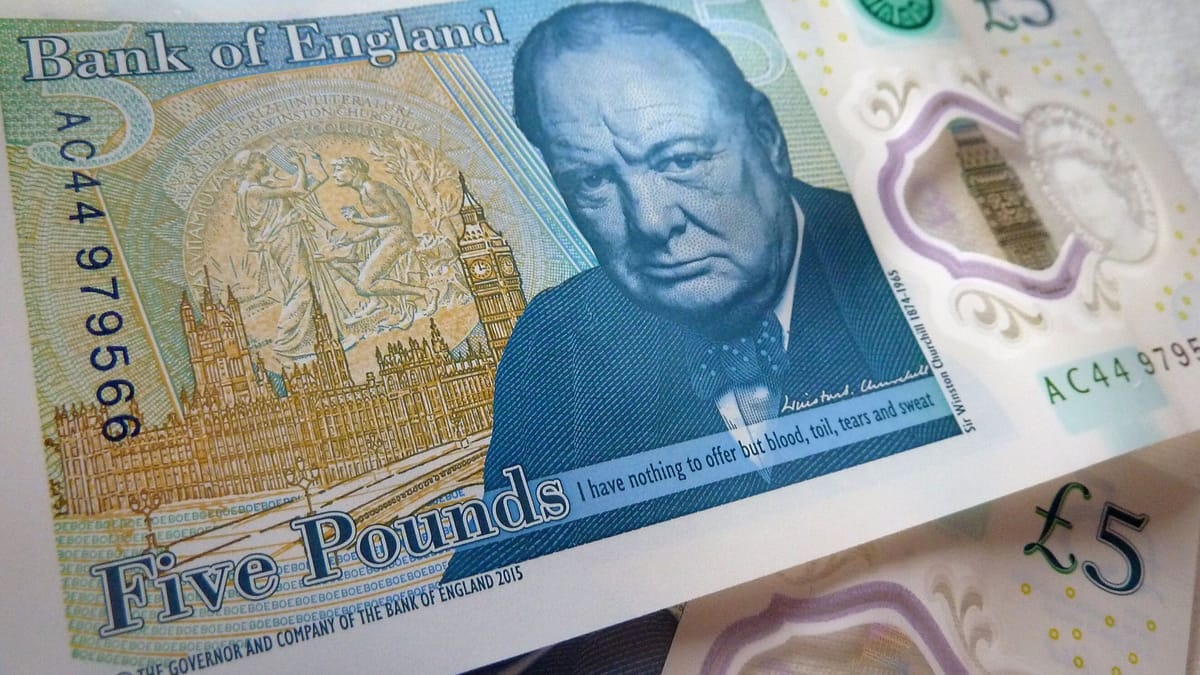
From the man who helped save Western civilisation to a puffin and a bumblebee. Britain’s latest banknote makeover raises a rather uncomfortable question: why are we so determined to replace the people who made our history?
There was a time when Britain celebrated its achievements, honoured its heroes and understood that national identity was something worth preserving. Today, apparently, Winston Churchill, Jane Austen, J.M.W. Turner and Alan Turing are to be replaced on our banknotes by a hedgehog, a barn owl, a puffin and a bumblebee. No, this isn’t a rejected Monty Python sketch. It is the latest announcement from the Bank of England, which has decided that the next generation of British currency should celebrate wildlife rather than the extraordinary individuals who helped shape our civilisation.
Now, I happen to love animals. I have considerably more respect for the average hedgehog than I do for most of Westminster, and I suspect a bumblebee could make a better job of running the Treasury. But this isn’t about wildlife. It’s about symbolism, national identity and the extraordinary ease with which we seem prepared to dispense with the visible reminders of our own history.
Churchill wasn’t simply a politician. He became the defining voice of British resistance during one of civilisation’s darkest hours. Austen helped shape English literature, Turner transformed British art, and Turing helped lay the foundations of modern computing while contributing to Britain’s wartime codebreaking effort. These are people whose achievements resonate far beyond our shores, whose names belong not merely to Britain but to the history of human progress. And yet, when it comes to the symbols of our national currency, apparently a puffin will do just as well.
The Bank of England insists that this is about celebrating nature and improving banknote security. Nearly half a million people responded to its wildlife consultation, while an earlier exercise found nature to be the most popular proposed theme. Fair enough. The public was consulted, and the new notes will still carry the monarch’s portrait. But that doesn’t make the broader question disappear. Why must celebrating one aspect of Britain mean removing another? Why couldn’t our wildlife share the notes with the remarkable men and women who made this country what it is?
And this is where the matter becomes rather more significant than the redesign of a five-pound note. National identity isn’t maintained exclusively through grand speeches, military parades or flags fluttering above government buildings. It lives in the ordinary things: our traditions, monuments, institutions, literature, architecture and currency. These are the everyday reminders of who we are, where we came from and what previous generations achieved. Remove enough of those reminders, however innocently each decision may be presented, and something important begins to disappear from public consciousness.
Of course, replacing Churchill’s portrait doesn’t erase him from the history books, and there is no evidence that the Bank’s decision was deliberately intended to suppress British history. But that is precisely why the debate matters. Cultural inheritance can be weakened without a grand conspiracy or an explicit campaign against it. Sometimes it happens through a thousand seemingly harmless administrative decisions, each perfectly reasonable when examined in isolation, but collectively changing the symbols through which a nation recognises itself.
Britain has an extraordinary history. We gave the world advances in parliamentary government, engineering, science, medicine, literature, industry and technology. Our achievements deserve recognition, just as our failures deserve honest examination. A mature country should be capable of doing both without becoming embarrassed by its own existence. National pride need not mean pretending the past was perfect. It means understanding that a nation’s inheritance is worth remembering, discussing and passing on.
The irony, of course, is that the Bank of England has been celebrating notable historical figures on its notes since 1970. More than half a century of recognising the individuals who shaped the country is now giving way to what might best be described as a beautifully illustrated wildlife collection. The new notes won’t appear immediately; their design and production will take several years. But the direction has been settled.
And perhaps the most telling thing is how easily we have arrived at this point. We have become accustomed to treating our national symbols as interchangeable decorations rather than expressions of a shared inheritance. A country’s currency is more than a means of payment. It is something that passes through millions of hands, carries the authority of the state and quietly tells a story about the nation that issued it. For decades that story celebrated British achievement. Soon, it will celebrate British wildlife instead.
I have nothing against hedgehogs, owls, puffins or bumblebees. They are wonderful creatures and deserve our protection. But there is a rather obvious difference between celebrating the natural world and honouring those whose courage, imagination and genius helped build the modern one.
Perhaps the real question isn’t why Churchill is disappearing from our banknotes. Perhaps it’s why we have become so comfortable with the idea that the people who shaped Britain no longer need to feature on them.
A nation that ceases to celebrate its history should not be surprised when future generations struggle to understand what it stands for.
* Source: Bank of England announcement, 8 October 2026. The Bank has not yet confirmed which animal will appear on each denomination.
From our International Law Correspondent:


We have the same currency problem in Australia. The monarch is supposed to be on the $5 note, but when QE2 passed, the decision was made to refuse King Charles' picture. Lefties infest every part of government.
Interesting that Canada did precisely the same thing with our new passport designs — a bunch of wildlife scenes and indigenous themed art replacing WW1 memorials, founding politicians, etc. I was outraged when I renewed my passport. All symptoms of the same cultural rot.