


[The final chapter of Daniel Clarke-Serret’s PAX ARABICA was released yesterday. It’s a must-read, detailing the nature of Arab Imperialism and the necessity of decolonisation. Sign up as paid to read this new work in full. As you can see in Khaled’s afterword, resistance against the Arab Babel Terror is starting to stir. As always, the greatest empires don’t fall with violence or UN resolutions…..but with mockery. ]
PAX ARABICA
An Afterword by Khaled Salih
“The Song of the Oppressor and the Parody of the Oppressed”
Julia Boutros Wein el Malayeen
A Message, a Parody, and the Unmasking of an Empire
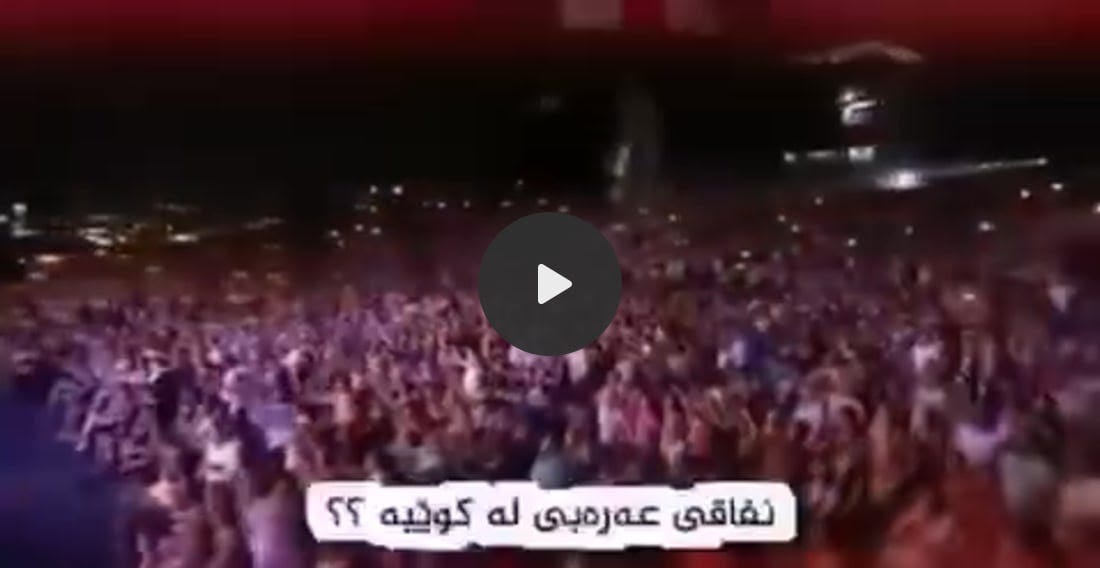
Some days after I published my essay “A New Pattern for a Cursed Landscape” - a review of Daniel Clarke-Serret’s PAX ARABICA and a reflection on the oppressive architecture of the modern Middle East—a friend wrote to me. He congratulated me on the piece, yes, but then he added a link, almost as an afterthought, as if he were slipping contraband across a border: a Facebook video of a parody of Julia Boutros’ “وين الملايين”
I clicked, expecting satire of the light, forgettable sort. I was wrong. What I found was something far more telling, far more urgent: a work of political heresy so raw, so unvarnished, that it made the polished myths of Arab nationalism look like stage props from a long-abandoned theatre.
There was no reverence in this parody. No deference to pan-Arab mythology. No timid qualification or diplomatic phrasing. It was a howl—from the Kurds, the Amazighs, the marginalised, the silenced—flung back at the same nationalist culture that claims eternal victimhood while burying entire peoples beneath its project of “unity.”
As I watched, I realised that the piece I had written was incomplete. Not wrong, but unfinished. For if PAX ARABICA describes the imperial machinery of the Arab state, then this parody—crude, furious, unflinching—is the testimony of those crushed beneath its gears. It is the reply that Arab nationalists never expected to hear.
And so I found myself compelled to write again, not as a footnote to my previous work, but as its necessary continuation. Here, then, is my reflection—sharpened by the echo of that parody, and written in the full knowledge that the empire is cracking, not from the outside, but from the voices it tried so hard to erase.
An Anthem and Its Afterlife
Let us start with Julیa Boutros: born on April 1, 1968, in Beirut, Lebanon, is a prominent Lebanese singer and activist widely known as the “Lioness of Lebanon” for her powerful patriotic songs supporting Lebanese and Palestinian causes. Raised in a Maronite Christian family—her father hailing from Tyre in southern Lebanon and her mother of Palestinian-Armenian descent—she has become an iconic figure in Arab music, blending emotional depth with political resonance in her performances and recordings.
Julia Boutros’ “وين الملايين” (“Where Are the Millions?”) has long been celebrated as an electrifying pan-Arab anthem—a song intended to rouse a supposedly slumbering Arab world to confront children of the Zionists, imperialism, and injustice. Its lyrics thunder with defiance; its tone suggests that dignity is a property that can be summoned by sheer volume; and its performances, especially the famous 1990s concert in Tripoli, Libya, were staged as if they were the beating heart of a revolutionary project.
But step outside the charmed circle of Arab nationalism—say, into Kurdistan, the mountains where slogans have never been able to hide the scars—and one encounters a rather different picture. For the peoples who have lived beneath the boot of Arab “revolutionary” regimes—Kurds, Amazighs, South Sudanese, Assyrians, and countless dissenters—the anthem sounds less like liberation and more like the national hymn of an empire in denial.
And empires, as Hitchens reminded us frequently, are never more dangerous than when they imagine themselves oppressed.
The Original Song: A Cry for Unity, or the Last Breath of a Dead Myth?
“Where are the millions? Where is the Arab people? Where is Arab anger? Where is Arab honour?”
The song’s questions boom like thunderclaps. But one cannot help noticing—especially from a Kurdish vantage point—that the entire edifice rests on a zealous assumption: that the Arab world constitutes a single moral body, asleep but righteous, unified in everything except wakefulness.
It is an intoxicating idea, and like most intoxicants, its clarity dissolves when sober light is applied. To believe in this mythical Arab unity, one must ignore:
• The Kurdish villages gassed in 1988.
• The Amazigh language banned, mocked, and erased.
• The Sudanese south burned to ash in the name of Arabisation.
• The Assyrian and Syriac communities expelled or absorbed.
• The suppression of internal dissent so routine it hardly qualifies as news.
From the vantage point of those crushed under Arab nationalist regimes, the song’s righteous indignation reads less like a cry for justice and more like a theatrical performance—one in which the Arab world casts itself as an eternal victim while carefully burying the victims it has produced.
Boutros’ Tripoli performance in the 1990s—on Libyan soil, under the watchful eye of Qaddafi’s dictatorship—illustrated this contradiction perfectly. Here was an anthem about resisting oppression, delivered in a police state that tortured dissenters in underground prisons and erased non-Arab identities as an act of statecraft.
It was a performance of freedom staged by those who monopolised its meaning.
The Parody: When the Empire’s Subjects Speak
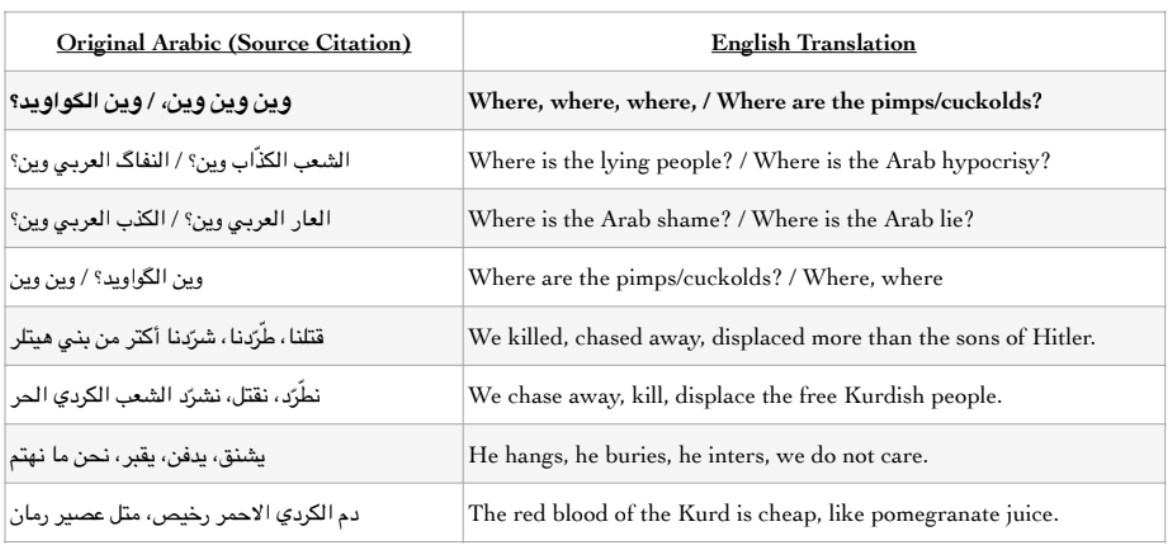
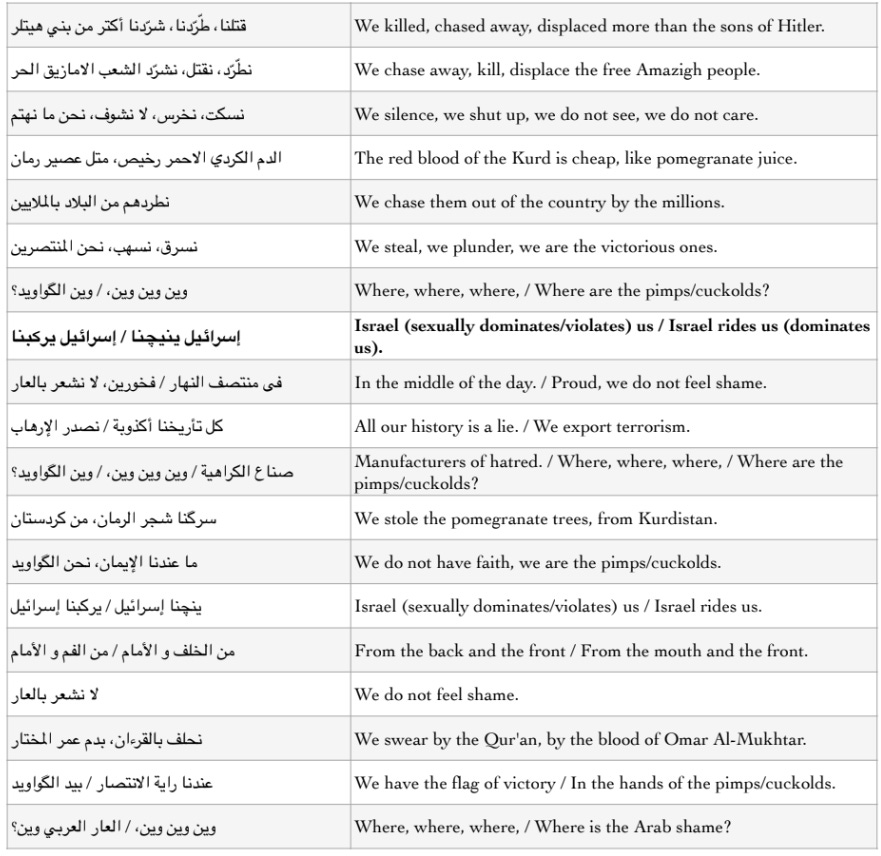
The parody version of the song—circulated online and dripping with acid sarcasm—turns the original anthem upside down. Where Boutros demands, “Where are the millions?” the parody answers with a sneer:
“وين الگواويد؟”
Where are the pimps?
Crude? Without question. Vulgar? Indisputably.
But beneath the offensiveness lies something far more significant: a howl from the margins, a counter-anthem carved from the lived experience of those whom Arab nationalism has oppressed, not liberated.
The parody hurls accusations not at Israel, nor at external enemies, but at Arab regimes themselves:
• “قتلنا، طرّدنا، شرّدنا أكتر من بني هيتلر”
• “We killed, expelled, displaced more than the children of Hitler.”
This is not metaphor. It is historical reportage.
It cites the Kurds and Amazigh by name—the peoples Boutros’ anthem never acknowledges, the peoples who have paid for Arab nationalism with their languages, their homes, and their dead children.
Where the original revels in defiance against the outsider, the parody drags Arab society before the mirror and forces it to confront what it has done to its supposed “brothers.”
Even the parody’s obscene taunts about Israel are not meant to shock for their own sake; they expose a truth long whispered across the region: that Arab regimes have been far more successful at repressing their own populations than confronting any external foe. The self-described lions of the Levant suddenly become timid house-cats when facing an actual adversary.
The parody is enraged not because Arabs are weak, but because they pretend to be strong while kicking the powerless.
Arab Imperialism: The Empire That Pretended It Wasn’t One
It has become fashionable in some circles to speak only of “Western imperialism,” as if the Middle East were an innocent garden trampled only by outsiders. This, however, is a convenient fairy tale. The Arab nation-state project—especially in Iraq, Syria, Libya, Algeria, Lebanon and Sudan—was deeply imperial in nature: a modernised continuation of an older logic in which Arab identity was presented as universal and others were expected to assimilate or vanish.
Kurds did not imagine the planes that bombed Halabja.
Amazighs did not hallucinate their forbidden names.
South Sudanese did not dream up the mass graves in Juba.
Hitchens once said, “The problem with nationalism is not that it builds nations but that it destroys people.”
Nowhere has this been more accurate than under the banner of Arab nationalism.
Boutros’ anthem, with its sweeping moral certainties and denunciations of Zionism, reflects the worldview of a political culture that sees only outward oppression, never inward cruelty. The parody, by contrast, is the testimony of those who have lived under Arab nationalism’s boot and have learned the lesson that the oppressed can become oppressors the moment they acquire a uniform and a flag.
Why the Parody Matters More Than the Anthem
If the original song represents Arab political mythology, the parody represents Arab political reality. The anthem mourns Arab disunity; the parody accuses Arabs of uniting only in cruelty toward their minorities. The anthem glorifies resistance; the parody documents oppression.
Most importantly, the parody punctures the sacred narrative that Arabs have a monopoly on suffering or moral righteousness. From Kurdistan, the Arab world looks less like a besieged nation and more like an empire whose victims are finally learning to speak.
And speaking, in this region, is its own form of revolution.
From Myth to Memory
“Where Are the Millions?” remains a powerful cultural artefact—a symbol of a time when pan-Arabism still believed in its own innocence. But history has caught up with that innocence. The Kurdish and Amazigh experiences reveal that the Arab world cannot claim the mantle of resistance while silencing its own oppressed peoples. Nor can it invoke honour while refusing to confront the crimes committed in the name of its unity.
The parody, uncomfortable and profane as it is, performs a service the original never could: it tells the truth from below. It forces the proud heirs of Arab nationalism to reckon with the empire they built in the shadows of their anti-imperialist slogans.
In the end, the Kurdish perspective asks a question far more urgent than Boutros’ original refrain:
Not “Where are the millions?”
but “Where are the victims in your story—and why have you forgotten them?”
And that, as Hitchens would say, is the question from which all the others flow.
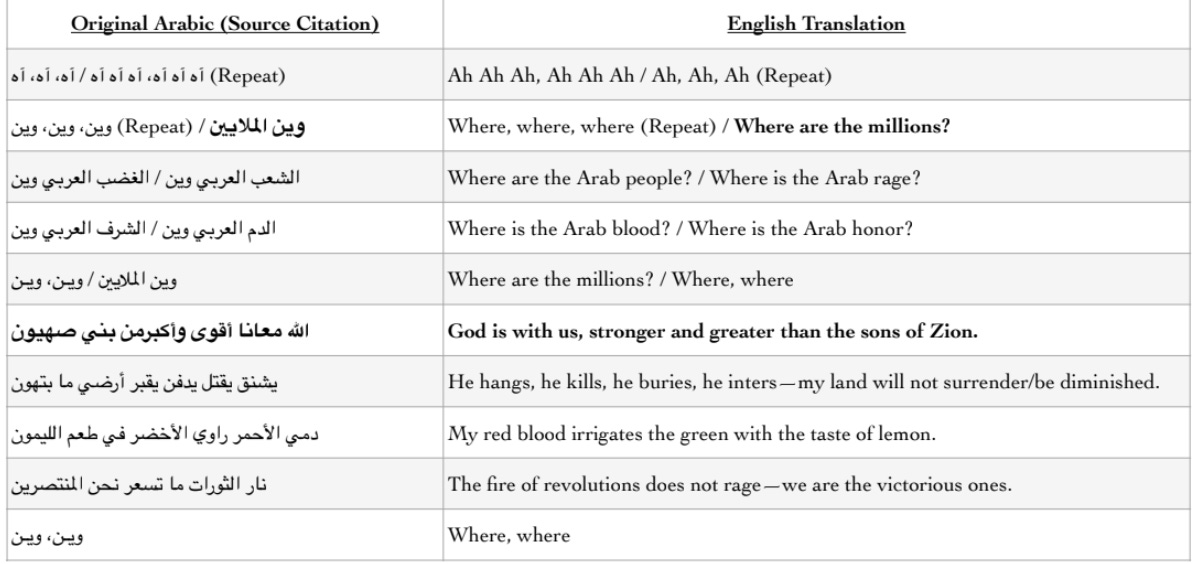
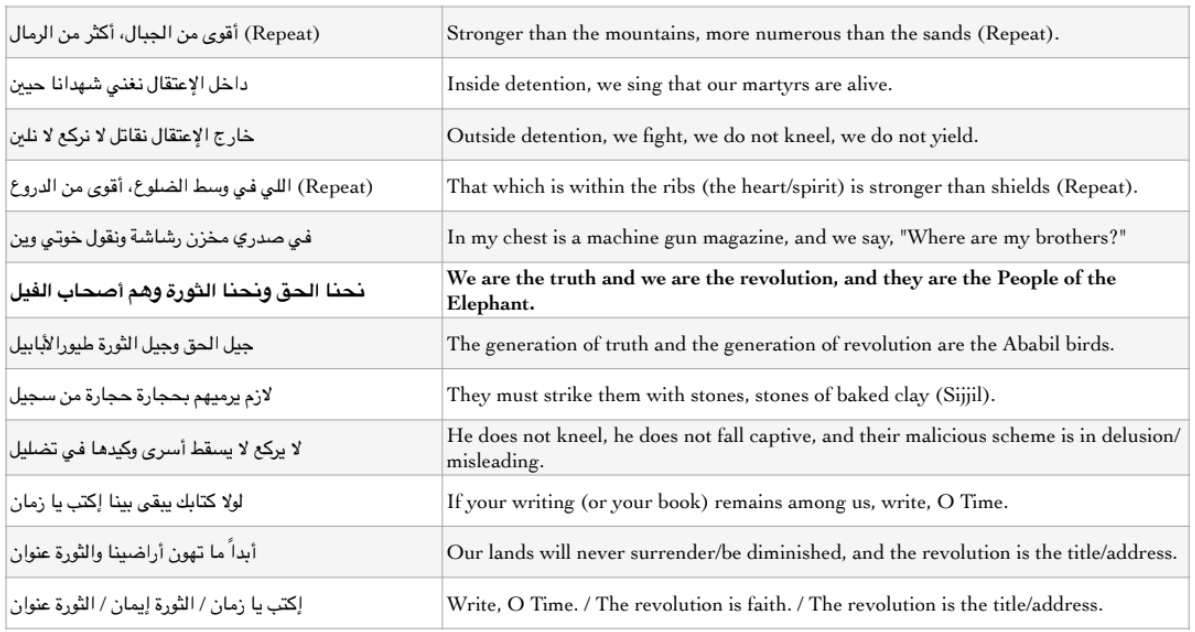
LYRICS: “Wein al malayeen?/Where are the millions?” (Original)
LYRICS: “Where are the pimps?” (Parody)
Khalid, when I visit Jerusalem I always stay at Mar Maroun. A good friend who lives in Jerusalem is a deacon in the church and a local businessman.
This woman Julia B who sings the original song was raised Maronite. Why does she sing against the “Zionists”? It seems that Maronites live way better in Israel than in Lebanon. Is it propaganda she is forced to do in order to have a voice?
The boot will be on the other foot