



Chapter 16 marks The Kurdish Moment, when the forces of the world’s largest stateless people stood firm. They fought like tigers against the black-dyed columns of ISIS and defended freedom on behalf of us all. Not only did they protect themselves, the Middle East and, arguably, the world, they fought for a pluralistic Middle East of minorities and self-determination. Where they succeeded, they raised the banner of justice. When they failed - in arriving too late to protect the Yazidi - ISIS showed us the true hell of caliphate. The West has already forgotten the Kurds, but here, at Guerre and Shalom, we erect an eternal monument for their sacrifice.
***
Please like and share this chapter. Don't let the Kurds disappear like the short-term memory of the West, continually under the unfortunate spell of Sultan Erdogan the Unjust. - Daniel Clarke-Serret (Editor, Guerre and Shalom)
Kurdistanî Azad: The Long Dream of Kurdish Self-Rule
by Ann-Catrin Emanuelsson & Khaled Salih
Parts I to IV of the book can be found here (work from the bottom of the list).
Part V — The Dream After 2011
After 2011, the world saw the Kurds more clearly; the question was whether visibility could become protection and protection could become home.
Part V Introduction: The Dream After 2011 // Chapter 15: Rojava and the Syrian Earthquake

Chapter 16: ISIS and the Kurdish Moment
Kobani, Sinjar, Pêşmerge, Yezidis, international legitimacy and moral authority
ISIS forced the Kurds into a terrible kind of visibility.
For decades, Kurdish suffering had been treated as local, tribal, separatist, inconvenient, or secondary to larger state interests. Anfal had been known but insufficiently answered. Helebje had shocked the world but not transformed the world’s treatment of Kurdish rights. The safe haven had protected Kurds in Iraq after catastrophe, but it had not resolved the Kurdish question. Rojava had emerged from Syria’s collapse, but it remained unrecognized. The Kurdistan Region had become a federal reality, but its disputes with Baghdad remained unresolved.
Then ISIS appeared as a force of naked extermination.
This chapter argues a limited claim: ISIS forced the world to see Kurdish courage, sacrifice, and military necessity, but visibility did not become protection unless it was converted into institutions, guarantees, minority safety, Kurdish unity, and accountable power.
This is moral-usefulness fungibility. The Kurdish person becomes visible when useful against a monster: fighter, rescuer, ground partner, woman with a rifle, guardian of minorities, defender of Kobani, witness to Sinjar, symbol of pluralism, or proof that ISIS could be defeated. These forms of visibility were deserved, but they were not enough. A people must not have to become militarily useful or morally photogenic before its rights are taken seriously. Kurdish legitimacy did not begin when the world needed Kurdish fighters; ISIS revealed a legitimacy that already existed.
The Islamic State did not hide its intentions. It enslaved, massacred, raped, beheaded, expelled, and destroyed. It was not merely an insurgency or a terrorist organization. It was a project of total domination: a death-state dressed in religious language, administrative ambition, theatrical cruelty, and genocidal intent. This is not a judgment on Muslim faith as lived by ordinary believers; it is a judgment on a totalitarian movement that turned sacred vocabulary into enslavement, execution, and rule by terror. It targeted Shi‘a, Christians, Yezidis, Kurds, dissenting Sunnis, secular activists, women, journalists, and anyone who resisted its rule. It turned ancient towns into killing grounds and human beings into property.
The Kurdish Moment
In that darkness, Kurdish and allied forces became one of the main barriers between ISIS and further catastrophe.
This was the brief Kurdish strategic opening.
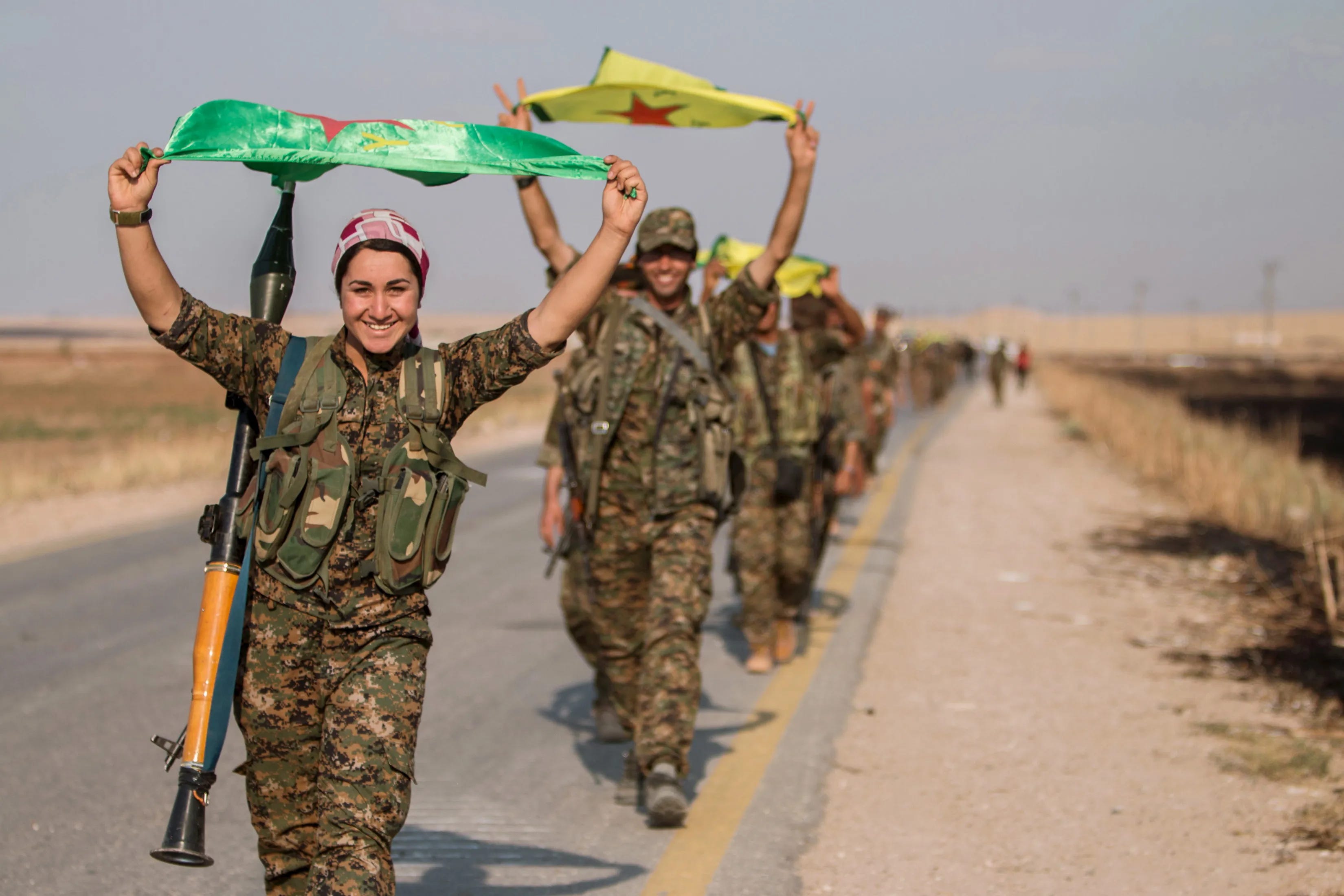
It did not come because the world finally understood Kurdish history in full. It came because ISIS made one fact impossible to avoid: Kurdish fighters stood between a genocidal movement and further catastrophe. Against ISIS, the Kurds appeared as protectors: Pêşmerge in Kurdistan Region, YPG and YPJ in Syria, PKK-linked fighters in the mountains, local Yezidi defenders, and Kurdish-led forces holding lines where state armies had collapsed. For a brief period, the Kurdish fighter became one of the most recognizable public images of resistance to Jihâdist barbarism.
This was both deserved and dangerous.
Deserved, because the sacrifice was real; dangerous, because admiration can become another temporary use of a stateless people.
The symbol must not consume the person. The Pêşmerge is not only the face of survival. The YPG fighter is not only a ground partner. The YPJ fighter is not only an icon of defiance. The SDF fighter is not only coalition utility. The Yezidi defender is not only proof of rescue. The Kurdish mother, refugee, prisoner, journalist, doctor, and child are not background to the fighter’s image. The brief Kurdish strategic opening becomes dangerous when the world sees Kurds clearly only in the form that makes them useful.
Objection: International admiration was not only cynical. It reflected real gratitude for Kurdish sacrifice and real fear of ISIS.
Correction: True. The criticism is not that admiration was false. The criticism is that admiration remained politically shallow when it did not become durable protection, recognition, justice for vulnerable communities, or enforceable guarantees.
It was deserved because Kurdish forces sacrificed enormously. They fought in Kobani, Sinjar, Makhmur, Kirkuk, Gwêr, Jalawla, Khanaqin, Mosul’s approaches, Raqqa, Manbij, and countless other fronts. They protected cities, opened escape routes, rescued civilians, guarded refugees, and gave the international coalition its most reliable ground partners in crucial areas. Kurdish women fighters, especially in the YPJ, became global icons of defiance against ISIS misogyny. The Pêşmerge became, once again, the face of a people standing between annihilation and survival.
It was dangerous because international admiration often comes without commitment. The world praises stateless fighters when they are useful, then hesitates when those fighters ask for political recognition. The Kurds were celebrated as heroes against ISIS, but heroism did not automatically become sovereignty, security guarantees, or justice for disputed territories. Kurdish and allied sacrifice created moral legitimacy; it did not guarantee rights.
Kobani: The Symbol of Resistance
Kobani was the first great symbol.
In 2014, ISIS advanced on the Kurdish city of Kobani in northern Syria. The town became surrounded. Many expected it to fall. ISIS had already seized vast territories in Syria and Iraq. It had captured Mosul, humiliated the Iraqi army, taken weapons, resources, and global attention. Its black flag had become a sign of terror. Kobani looked small against that machinery.
But Kobani resisted.
As the previous chapter showed, Kobani also revived the older Mehabad pattern: one part of Kurdistan under existential pressure, another part crossing an imposed border to help hold the line.
The YPG and YPJ fought street by street, under siege, under shelling, under the gaze of the Turkish border, where observers could literally watch the battle unfold. The city became both battlefield and theatre. The world saw Kurdish fighters holding ruins against an enemy that had terrified states. Women fighters became especially powerful symbols: armed Kurdish women resisting a movement that enslaved women and treated female bodies as spoils of war.
The War of Meanings
This symbolism mattered because war is not only fought with bullets. It is fought with meanings.
ISIS did not merely threaten Kurdish territory. It threatened the possibility of a plural Middle East. Its war was not only against Kurds, Yazidis, Christians, Shiʿa, dissenting Sunnis, women, and secular life. It was against ambiguity itself. It was against life itself. It sought a world in which every person had one authorized identity, every woman one legal status, every believer one permissible interpretation, every outsider one fate. In that sense, the Kurdish front line became more than a military line. It became a line between a closed world and an open one.
ISIS presented itself as inevitable, divinely sanctioned, masculine, apocalyptic, and terrifying. Kobani answered with a different image: ordinary people, including women, defending a town that should have fallen but did not. The Kurdish resistance punctured ISIS’s mythology. It showed that the Islamic State could be resisted, fixed in place, bombed, and defeated. The U.S.-led coalition’s air support was crucial, but airpower needed fighters on the ground. Kobani made the YPG visible as that ground force.
Kobani also exposed the contradictions of Turkey’s position. Turkey watched the rise of a PKK-linked Kurdish force along its border with alarm. For Ankara, the YPG’s success was not simply a victory against ISIS; it was a strategic threat. The Turkish state saw the possibility of a Kurdish-controlled belt in northern Syria connected ideologically to the PKK. This meant that while much of the world saw Kobani as heroic resistance, Turkey saw it through the logic of counterinsurgency and border security.
This contradiction would shape everything that followed. The Kurds could be indispensable to the anti-ISIS war and still be treated by a NATO state as a security enemy. The United States could arm and support Kurdish-led forces against ISIS while trying not to rupture relations with Turkey. Kurdish fighters could become global symbols while remaining diplomatically vulnerable. Kobani created international legitimacy, but not international protection in the full sense.
Objection: Turkey’s fear of a PKK-linked force on its border cannot be dismissed as imaginary.
Correction: Correct. The issue is not whether Turkey has security concerns. The issue is whether those concerns became a doctrine that treated Kurdish-led self-rule itself as intolerable, even when Kurdish forces were central to resisting ISIS.
Sinjar: The Deeper Wound
Sinjar was the deeper wound.
Sinjar must be treated with special care. The Yezidis are not merely a symbol within Kurdish history; they are a distinct religious community whose genocide, enslavement, displacement, and struggle for agency must not be absorbed into anyone else’s narrative.
This is Yezidi non-fungibility. The Yezidi woman is not only evidence of ISIS cruelty. The survivor is not only testimony. The abducted girl is not only a symbol of Kurdish suffering. The mountain is not only a scene of rescue. Sinjar is not only a Kurdish wound, a party arena, a security file, or a diplomatic problem. Yezidi agency must remain visible inside every narrative that invokes Yezidi catastrophe. To absorb Yezidi suffering into Kurdish legitimacy without protecting Yezidi voices would repeat, in softer form, the reduction the chapter is warning against.
If Kobani became the symbol of resistance, Sinjar became the symbol of abandonment, genocide, and rescue.
