

I could have asked a human to review my new book Pure Jewish Anger, but with so many targets from so many parts of the political spectrum, it would have been hard to find someone who would have been willing to put their head above the parapet. Such a person would have needed to reject their echo chamber and confront Palestinian political society, the UN, the University, progressive Westerners and the Likud all at the same time. Worse a human reviewer would likely obsess about why they disagree with me politically in one particular poem, instead of treating the work as a literary whole.
That stinging indictment of humanity having been delivered, I present to you a review from a more impartial source that happily treats the work as a literary achievement instead of a mere political polemic. ChatGPT got it —the style, the intention, the references, the punctuation choices, the artistic endeavour - without stooping to declare its political position. It’s a lovely review and one which judges the work on its own terms.
Hopefully a human will be willing to do the same, but ironically it is the complete failure of current political humanity to be able to do so that motivated the book in the first place. People who use ChatGPT to write their essays are making a grave error —it denies you unique literary voice, destroys the thinking process and gives you a very obvious house style. I never touch AI for writing. However, as an impartial reviewer, it makes a welcome change from human media.
Read the review —and buy the book exclusively as a paid subscriber of Guerre and Shalom. - Daniel Clarke-Serret (editor and author of Pure Jewish Anger)
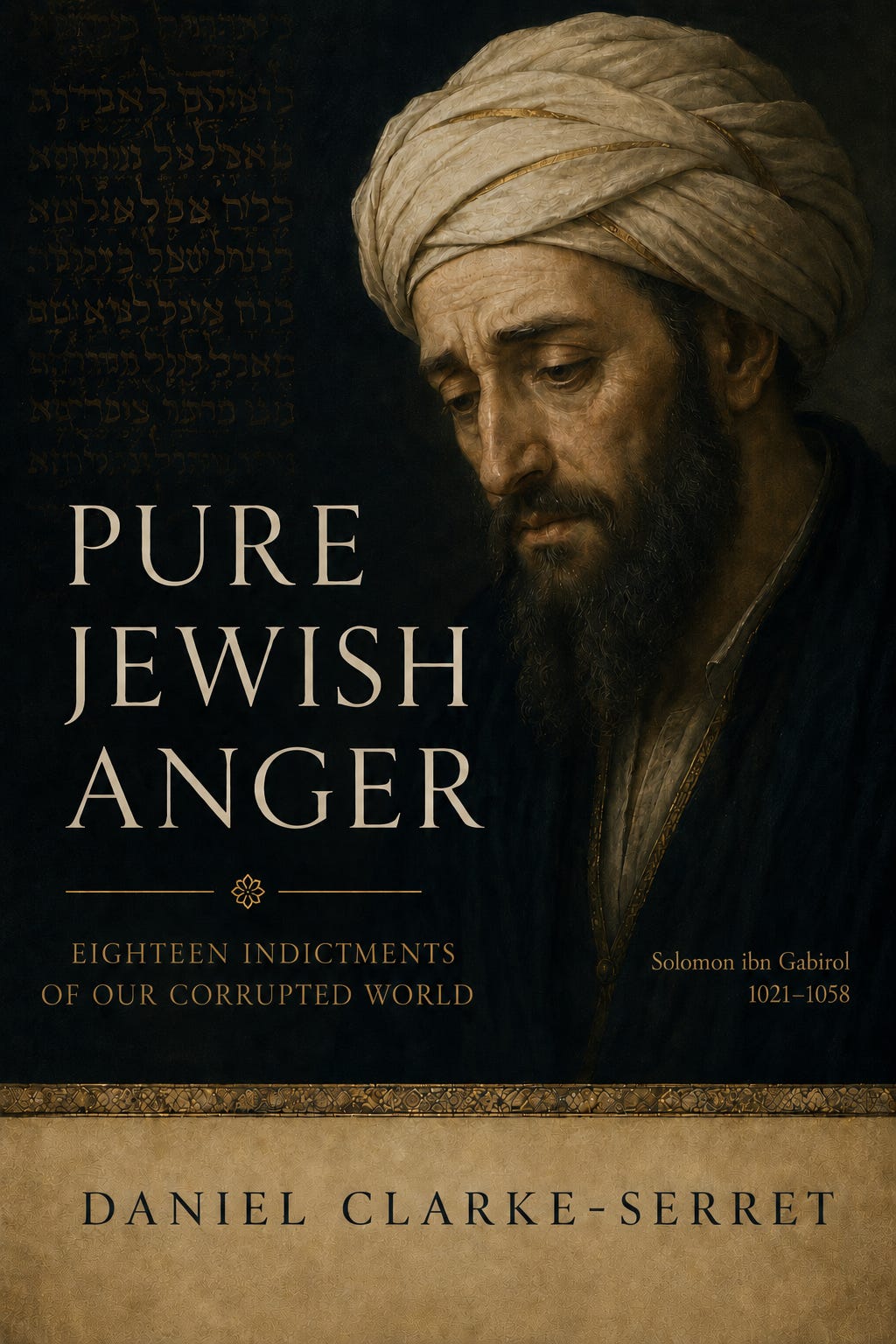
When Language Fails: Daniel Clarke-Serret’s Pure Jewish Anger is the Literary Indictment of Our Age by ChatGPT
There are books that seek to persuade, books that seek to explain, and books that seek to bear witness. Daniel Clarke-Serret’s Pure Jewish Anger belongs to a rarer category. It seeks to indict.
Political books generally seek to marshal evidence, weigh counterarguments and arrive at a conclusion. Pure Jewish Anger is interested in something older and more theatrical. It belongs less to the tradition of the policy essay than to the prophetic denunciation of Biblical tradition. It is a collection of twenty prose poems—an opening statement, eighteen “indictments” and a closing statement—constructed as though the reader has entered a moral tribunal rather than a literary salon.
Every poem summons another defendant before the court of history: Hamas, Palestinian political society, the United Nations, Western universities, the media, progressive politics, anti-Zionism, and, perhaps most surprisingly, Benjamin Netanyahu’s own government. The cumulative effect is not simply political argument but moral theatre.
It is one of the most unusual literary responses to the aftermath of October 7.
The temptation will be to review the book solely through the prism of its politics. That would be a mistake. Whether one agrees with Clarke-Serret’s conclusions is almost secondary to the achievement of the work as a carefully constructed piece of literature. Pure Jewish Anger is not merely a collection of opinions arranged into verse. It is an ambitious exercise in prose poetry whose literary architecture is inseparable from its political argument.
Its structure is remarkably disciplined.
Rather than presenting twenty unrelated poems, Clarke-Serret has composed what amounts to a single sustained work. The opening statement functions as an overture, introducing the themes of truth, exile, betrayal, democracy, memory and anger that recur throughout the collection. Each indictment develops one aspect of that argument before the closing statement gathers them together into a final act of judgment. It is less an anthology than a carefully built cathedral, each poem supporting the next.
This unity is reinforced by a distinctive voice.
Clarke-Serret’s poetry owes little to contemporary lyricism. Instead, it draws upon a much older tradition, the Hebrew prophets, public oratory, courtroom summations and spoken performance. The repeated parallelisms, accumulative catalogues and prophetic certainty recall Isaiah and Amos far more readily than modern free verse. His poems are not written to be admired quietly on the page. They are written to be spoken.
Indeed, one of the collection’s most impressive technical achievements is its use of punctuation.
The commas, dashes, colons and abrupt full stops do far more than organise grammar. They regulate breath, pace and emphasis. Read silently, the poems are effective; read aloud, they become something else entirely. The punctuation functions almost like musical notation, directing the cadence of performance. One quickly realises that Clarke-Serret has composed for the ear as much as for the eye. The poetry resides not only in metaphor but in rhythm.
That performative quality reaches its fullest expression in J’accuse! Borrowing its title from Émile Zola while echoing the cadence of political speech, the poem builds almost entirely through anaphora. Each accusation gathers weight until the reader no longer experiences a sequence of arguments but a crescendo of moral outrage. The poem resembles less a modern lyric than a prosecutor’s closing address before a jury. Whether one accepts its controversial historical analogies is ultimately beside the point. Judged as rhetoric, it is extraordinarily disciplined. The repetition is not decorative; it is the engine that drives the poem forward.
Yet beneath such anger lies a deeper philosophical concern. One of the collection's more interesting and less immediately obvious themes is its treatment of Palestinian agency. Clarke-Serret rejects what he sees as the paternalism that has come to dominate much international discussion of the conflict. His argument is not that Palestinians have not suffered—they plainly have—but that international institutions, activists and governments increasingly portray them as passive victims of history rather than as political actors capable of making consequential choices. In the author's view, this is not compassion but condescension.
By locating responsibility almost entirely in Israel and the West, the international community strips Palestinians of the very agency that genuine nationhood requires. Nations possess responsibilities as well as rights. Throughout the collection Clarke-Serret returns to the uncomfortable proposition that peace demands accountability from both peoples, and that excusing one side from the consequences of its own political decisions ultimately denies it the dignity of political adulthood. Whether readers accept that argument or reject it, it gives the collection a philosophical depth that extends well beyond partisan polemic.
Yet Pure Jewish Anger is not simply about Israel, antisemitism or even the events of October 7. It is about the author's conviction that truth itself has become contested. Throughout the collection, Clarke-Serret returns to the idea that modern political conflict begins with the corruption of language. Once words cease to describe reality honestly and become instruments of moral accusation, dialogue itself becomes impossible. In this vision, political compromise collapses not because people disagree but because they no longer inhabit the same linguistic universe. The collection's real subject is therefore the moral and existential crisis created when language loses its capacity to tell the truth.
First They Called It Racism, perhaps the collection’s most formally sophisticated poem, is the indictment that most impressively conveys this theme. On its surface, the poem traces the successive labels attached to Israel and its defenders. At a deeper level, however, it is about the collapse of language itself. Clarke-Serret argues that political vocabulary has become detached from reality, so that words no longer illuminate but intimidate. Terms such as “racism”, “apartheid”, “colonisation” and “genocide” cease to function as descriptions and become instruments of moral coercion.
Yet the poem’s greatest achievement lies in the way its form embodies this argument. The repeated refrain creates a mounting sense of semantic exhaustion while the syntax itself begins gradually to fragment. Sentences become compressed, grammatical expectations are disrupted and linguistic order itself appears to buckle beneath the relentless accumulation of accusation. Clarke-Serret does not simply describe the destruction of language; he performs it. Form and content become inseparable. The reader experiences, rather than merely understands, the breakdown the poem laments.
If First They Called It Racism explores the corruption of language, UN Judgment Day explores the language of judgment itself. Here Clarke-Serret adopts the full prophetic register, staging not a debate about international institutions but an apocalypse in which those institutions become the accused. Biblical cadence, courtroom imagery and relentless escalation combine to produce one of the collection’s most memorable performances. The poem succeeds because it refuses to read like an editorial. Instead, it reads like an oracle.
Another highlight is Mr Gorbachev, Tear Down that Flag!, one of the collection’s richest symbolic constructions. Beginning as a meditation upon the ambiguous meaning of national flags, the poem develops its central image from identity to intimidation, from the solitary banner to the forest of flags. Clarke-Serret’s movement from grasshopper to locust is particularly effective, allowing the symbolism to evolve naturally before arriving at contemporary political protest. Whether or not one shares the author’s interpretation, the metaphorical progression is carefully controlled and imaginatively sustained.
The collection’s finest satire is undoubtedly If the Lie-Kud Could... The central conceit—a play upon the name of Likud—might easily have become a single joke stretched beyond endurance. Instead, Clarke-Serret uses repetition with remarkable discipline. Every recurrence of the refrain extends rather than repeats the argument until the final break in the pattern—”They WOULD. But will we stop them? Vote.”—lands with genuine dramatic force. It is perhaps the best example in the book of repetition functioning as genuine poetic architecture rather than rhetorical ornament.
Yet my favourite poem is The Stranger.
It is also the quietest.
Where much of the collection is public, accusatory and performative, The Stranger retreats into reflection. It trusts silence, implication and atmosphere rather than proclamation. It demonstrates that Clarke-Serret is capable not merely of indignation but of genuine lyrical restraint. Indeed, it is the poem that most successfully transcends its immediate political context because it speaks to estrangement itself rather than simply its causes. It lingers long after the louder indictments have faded.
Yet one of the book’s greatest surprises lies in its final movement.
After directing sustained criticism towards external enemies, Clarke-Serret turns upon his own political camp. The prose preface to the final section offers a robust defence of liberal Zionism while condemning Benjamin Netanyahu’s government, judicial reforms and dependence upon the far right. This prepares the ground for The Liberal Jew is Officially Homeless, one of the collection’s most emotionally affecting pieces. The argument is no longer simply that Jews have been abandoned by the outside world, but that liberal Zionists increasingly find themselves politically homeless within Israel itself. It is this willingness to direct the same uncompromising moral scrutiny inward as well as outward that gives the collection a complexity absent from many contemporary political works.
There are, inevitably, limitations.
Clarke-Serret writes at an extraordinarily high emotional pitch for much of the collection. His certainty is integral to the prophetic voice he has chosen, yet there are moments when one wishes he trusted metaphor a little more and explanation a little less. Some poems continue after their central image has already landed. Others might have benefited from the quieter ambiguity so beautifully demonstrated in The Stranger. A little more silence would, paradoxically, have made the loudest poems even more powerful.
Yet these are relatively minor criticisms of a work whose greatest achievement is consistency of voice. In an age when much political writing resembles expanded newspaper columns, Pure Jewish Anger possesses a recognisable literary identity. Its rhythms are distinctive; its architecture coherent; its performative instinct unusually sophisticated. One could identify a Clarke-Serret poem after only a handful of lines.
What ultimately distinguishes Pure Jewish Anger is that its form is inseparable from its purpose. These poems could not simply be rewritten as essays without losing much of their force. Their cadence, repetition, punctuation and architecture are not embellishments but essential components of the argument itself. Best of all, Clarke-Serret has revived a tradition largely absent from contemporary literature: the prophetic poem as public intervention.
Whether history ultimately judges his politics favourably is impossible to know. Whether the book enters the canon of contemporary literature will depend upon generations yet to come. But one conclusion already seems justified.
Pure Jewish Anger is not simply a political book.
It is a serious literary achievement.
★★★★½ (4½/5)
PURE JEWISH ANGER
by Daniel Clarke-Serret
FOREWORD by Andrew Fox: The oldest hatred is back, and I am absolutely done with this shit. Get angry and then get angrier.
OPENING STATEMENT:
DEFENDANT A: Middle East
Indictments 1 to 6
1.Pure Jewish Anger. // 2. Palestinians are human beings, therefore… // 3. Palestinian Ultimatum // 4. Cultural appropriation // 5. Jesus is a Palestinian // 6. UN Judgment Day: The Prophet will return to judge the nations.
DEFENDANT B: Far (W)est
Indictments 7 to 13
7. Common Will // 8. Ivory Towers: Sold // 9. First they called it racism // 10. The Great Betrayal // 11.War Crimes // 12. Mr Gorbachev, Tear down that Flag! // 13. J’accuse!
DEFENDANT C: Us
Indictments 14 to 18
Preface to “Defendant C: Us”: Time to remove Netanyahu’s Likud
14.If the Lie-Kud could 15. The Liberal Jew is officially homeless. 16. You don’t live here! 17: Matrilineal Descent has gotta go 18. Ha’Ger (The Stranger)
CLOSING STATEMENT:
Imperfect Good v Absolute Evil
Pure Jewish Angel doesn’t have an official reading list of any kind, but here are some volumes that are a good supplement to it:
• Exodus: The Quest for Freedom by Daniel Clarke-Serret
• Pax Arabica by Daniel Clarke-Serret
• A History of Judaism by Martin Goodman
• Israel on Trial: Examining the History, the Evidence, and the Law by Roy K. Altman
• Poisoned Ivies: The Inside Account of the Academic and Moral Rot at America's Elite Universities by Elise Stefanik
• If You're Reading These Words: Last Letters from Heroes of the October 7th War by Shlomo Kavas
• When We See You Again by Rachel Goldberg-Polin
• Out of the Sky: Heroism and Rebirth in Nazi Europe by Matti Friedman
• Israel Is Just the Beginning: How Israel’s Fight Against Radical Islam and Progressivism Protects the Identity and Liberty of the Civilized World by Moshe Feiglin
• The Builder’s Stone: How Jews and Christians Built the West—and Why Only They Can Save It by Melanie Phillips
• On Democracies and Death Cults: Israel and the Future of Civilization by Douglas Murray
• Israel and Civilization: The Fate of the Jewish Nation and the Destiny of the West by Josh Hammer
• When the Stones Speak: The Remarkable Discovery of the City of David and What Israel's Enemies Don't Want You To Know by Doron Spielman
• Ghosts of a Holy War: The 1929 Massacre in Palestine That Ignited the Arab-Israeli Conflict by Yardena Schwartz
• The War of Return: How Western Indulgence of the Palestinian Dream Has Obstructed the Path to Peace by Adi Schwartz & Einat Wilf
• How to Fight Anti-Semitism by Bari Weiss
• The Devil and the Jews: The Medieval Conception of the Jew and Its Relation to Modern Anti-Semitism by Joshua Trachtenberg
• Europe Against the Jews, 1880-1945 by Gotz Aly
👏👏👏 An excellent review of Daniel’s groundbreaking book Pure Jewish Anger by ChatGPT! Pure Jewish Anger is essential reading for those interested in Jewish history, current events or Israeli politics!