


Yet another treat for paid subscribers of The Guerre and Shalom Publishing House. Sign up as paid today!!
EXTRACT: “The answer to indoctrination is not censorship. It is sunlight. Let students watch a pro-Israel scholar and a sharp “pro-Palestinian” advocate test claims in the same room. Offer courses that present Israel’s legal and historical case alongside Arab narratives, not instead of them. Grade arguments, not identities. Restore the first duty of a university: to seek what is true, not to manufacture slogans that flatter a faction. Jewish students should not have to bury their names, their mezuzot, or their convictions to earn a diploma. They should be as free to praise Israel’s achievements—or criticize its policy—as any student is free to argue about France or India.
On Israel, many programs have slid from inquiry into dogma. That can be undone. The same institutions now mass-producing one-sided activists once trained scholars like Bernard Lewis and Fouad Ajami who treated the region in full—Jews and Arabs, faith and nation, tragedy and renewal—and taught nuance as a civic duty.
The pendulum can swing back. It must. Leave this unchecked and the damage will not stop with the Jews. It will hollow out the integrity of knowledge itself and corrode the habits that sustain a liberal civilization: reason, evidence, the dignity of the individual.
Universities are the right place to ask hard questions. What does indigenous belonging mean on land sacred to more than one people? How do two nations reconcile overlapping claims without erasing either? What has Israel’s messy democracy gotten right under fire, and where has it failed? You cannot even begin to answer if one conclusion is assigned in advance and dissenters are shamed into silence. The fight to reclaim intellectual goes beyond Israel—it’s part of a larger struggle against reducing every human conflict to a cartoon of oppressor and oppressed.”
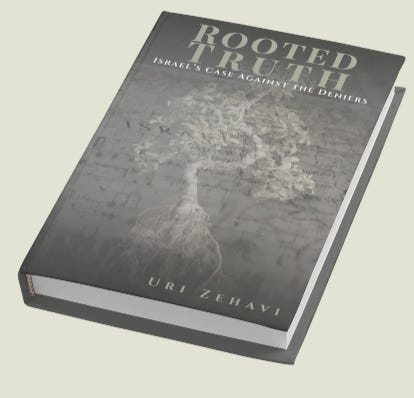
Rooted Truth: Israel’s Case Against the Deniers
by Uri Zehavi
Preface & Introduction: The Return of the Lie // Chapter 1: Setting the Record Straight // Chapter 2: From Balfour to Independence // Chapter 3: By Right, Not Permission // Chapter 4: Apartheid as Propaganda // Chapter 5: Colonialism and the Great Erasure // Chapter 6: The Genocide Libel // Chapter 7: The UN Assembly Line
Chapter 8: Campus Catechism
October 2023. Cambridge. Sirens still wail in Israel. Families are burying their dead. Within hours, thirty-four Harvard student organizations release a statement that holds “the Israeli regime entirely responsible for all unfolding violence.” The letter spreads faster than the facts. Donors revolt. A truck circles Harvard Yard with the names of student signatories. The yard itself stays quiet. The script has been written elsewhere.
Ithaca. On the Arts Quad at Cornell, a history professor steps to a microphone. He calls the Hamas onslaught “exhilarating” and “energizing.” He smiles as he says it. Students cheer. Faculty defend his “context.”
New York City. At Cooper Union, Jewish undergraduates shelter in a library as a crowd pounds on the glass. Security locks the doors. The students wait it out in silence. Upstairs, a dean issues a sterile memo about free expression.
Across campuses, a graphic promoting a “Day of Resistance” circulates. The silhouette on the poster is a paraglider—everyone knows why. Hamas gunmen used powered paragliders to descend on a music festival and hunt civilians. The image is presented as joy.
The pattern repeats. At Columbia, encampments demand “liberation from the river to the sea.” At Stanford, masked students march and chant for “intifada.” At UCLA, a kiosk hands out flyers calling October 7 a “legitimate military action.” In Philadelphia and Ann Arbor, rallies celebrate “victory.” The facts from Israel are still being counted. The catechism is not waiting.
Welcome to the new orthodoxy. It did not appear overnight. It was taught. In reading lists and teach-ins. In student government resolutions and “divestment” workshops. In departments that describe Israel as a settler colony and Jews as white Europeans. The labels are fixed before the class begins. Colonizer. Apartheid. Genocidal. These are not hypotheses to test. They are articles of faith to recite.
Dissent is treated as heresy. A Zionist student stands to speak and is booed. A visiting Israeli scholar is shouted down. A flyer for a dialogue event is ripped from a wall. Administrators invoke free speech for one side and “safety concerns” for the other. A double standard is enforced by etiquette.
Consider the machinery that delivers the creed. “Israeli Apartheid Week” began at the University of Toronto in 2004–05 and now runs on dozens of campuses across North America, Europe, and beyond. Mock walls go up. Checkpoints are staged. Panels repeat a script that ignores Israeli Arab citizenship, Knesset seats, court rulings, and coalitions that include Arab parties. The event is not a seminar. It is a sermon.
The lexicon is intentional. “Settler-colonial state” is borrowed from courses on Algeria and Kenya and pasted onto Israel. The framing erases three thousand years of Jewish rootedness and the fact that half of Israel’s Jews are Mizrahi refugees from Arab and Persian lands. The word “apartheid” is ripped from South Africa and applied to a country where Arab citizens vote and serve as judges. The word “genocide” is hurled at a people whose grandparents have numbers on their arms. Shock, rather than precision, is the goal.
The catechism travels on a closed loop, as we have been exploring. NGOs and UN bodies mint accusations and publish “findings.” Faculty assign them as authoritative readings. Students chant them at rallies. Reporters quote the chants back as proof of a trend. The same claims return to the UN as “civil society input.” The loop tightens like a noose until it feels like common sense.
And so a Harvard coalition can call Israel “the apartheid regime” even while videos show babies carried from burning homes. A Cornell professor can praise a pogrom as “exhilarating” and still be defended as a truth teller. A campus brochure can exalt a paraglider and call it resistance.
The stakes aren’t academic though. The catechism trains a generation that will staff NGOs, editorial boards, law firms, and foreign ministries. What begins on a quad ends in a courtroom brief. A chant becomes a policy memo. A mock wall becomes a real wall in a UN report. To understand that pipeline, we have to map the course materials, the funding streams, and the professional groups that certify the creed as knowledge.
Why call it a catechism? Because it supplies pre-packaged answers to complex questions and punishes deviation. It reduces a conflict of history, law, religion, language, and competing nations to a single moral binary. “Palestinians” are pure victims. Israelis, and by extension most Jews, are racial oppressors. Facts that do not serve that story are discarded. Stories that do are amplified.
The university should be a place for argument. It has, in too many corners, become a place for ritual. That ritual didn’t emerge from thin air.
Doctrines With Tenure
To trace its roots, travel back to the late 20th century, when revolutionary ideas about power, race, and empire burst into Western academia. In the vanguard was Edward Said, the literary scholar who became a celebrity intellectual. With Orientalism (1978), Said argued that Western scholars’ depictions of “the East” (including Arabs and Muslims) were inherently biased, serving imperialist domination.
Though his critique was aimed at 19th-century novels and French colonial administrators, Said’s influence on Middle Eastern studies was seismic. He essentially told a generation of academics that to side with Western narratives was to be complicit in oppression; the proper stance was to champion the “subaltern,” the colonized, the oppressed voice.
Soon after Orientalism, Said published The Question of Palestine (1979), positioning the Palestinian struggle as the archetypal anticolonial fight of the age. He explicitly framed Zionism as European colonialism in disguise. Many a grad student took note. Here was a thrilling inversion: the Jews, fresh from surviving genocide, were cast not as victims or survivors, but as powerful colonials; the Palestinians, despite alliances with surrounding Arab states, became the ultimate downtrodden natives.