

In memory of Sir Patrick Stewart (1940 - 2026). A legendary actor. A character who understand the true meaning of peace.
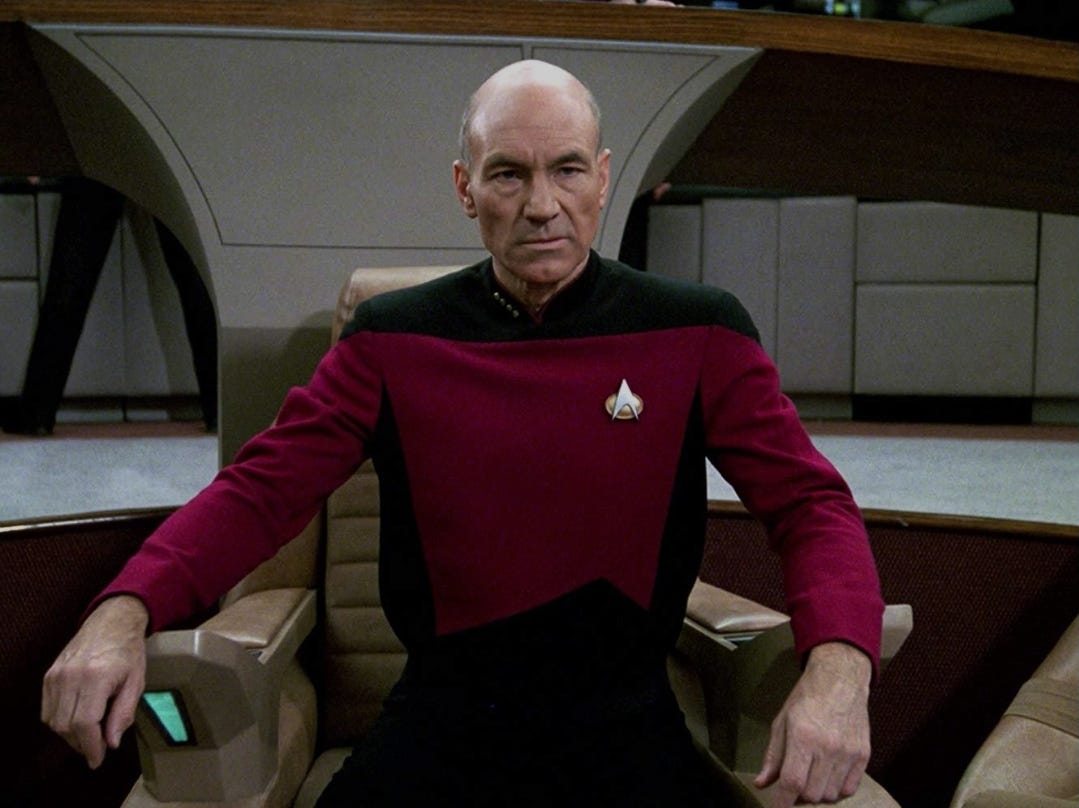
Beam me up Jean-Luc
Captain’s log 300082026. There are reports that Romulan agents have infiltrated the Neutral Zone. Starfleet Command have ordered the Enterprise to make rendezvous with the unauthorised vessel, but have advised extreme caution.
If I were to be asked for a hero, it might just have to be Jean-Luc Picard, the cerebral captain of the Federation flagship. Calm under pressure. Diplomatic but firm. Determined to avert war, but unafraid to fight. A man of principle able to navigate the most delicate of galactic geopolitical puzzles with aplomb.
On the day that legendary actor Sir Patrick Stewart passed away, it’s time to draw some lessons from the captain’s illustrous career. Specifically, what the hell happened to the United Nations?
Equal to the sum of its parts
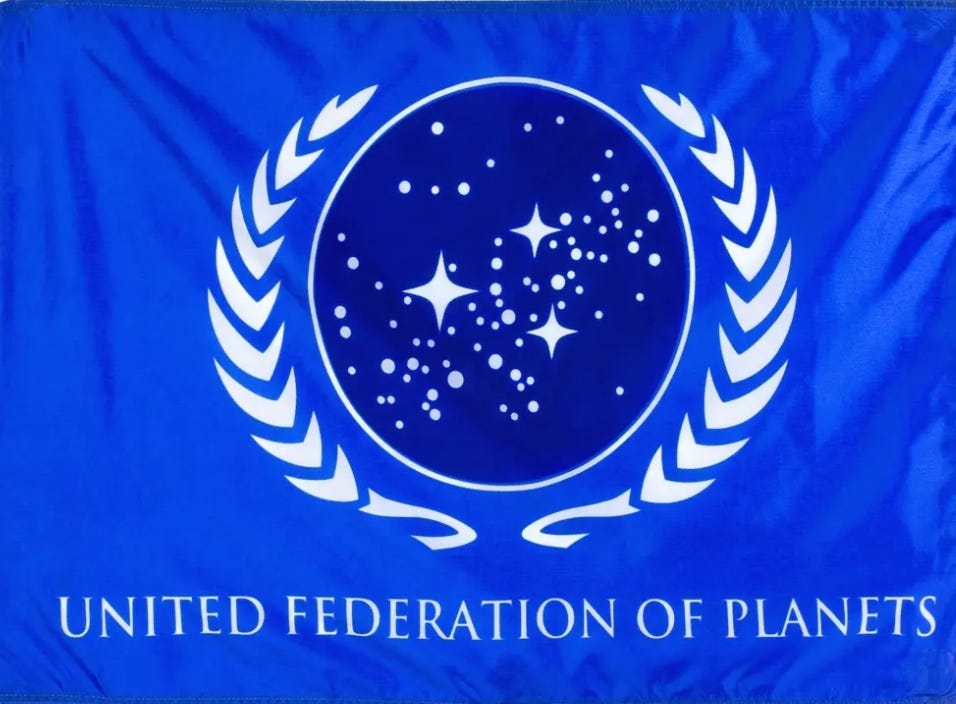
Picard and the United Federation of Planets represent everything that António Guterres and the United Nations are not:
They represent the ability of an “international” organisation to maintain the peace, stand up for principle and seek a better, more moral future.
They use ships of war to maintain peaceful frontiers, but with the principal goal of exploration and scientific enlightenment.
They fight for their own freedom.
And it isn’t that Star Trek represents a perfect future. The Federation - and its defence arm known as Star Fleet Command - are full of corrupt officials including both captains and admirals. Yet somehow the Federation is greater than the sum of its parts. Its principles are stronger than its defects. And it has senior personnel who truly believe in its mission.
Both organisations are pan-national and planetary respectively. They both have an almost identical flag. So why does the Federation succeed where the United Nations fails? How is it that Picard is a man to be admired where the United Nations Human Rights Council - with its rotating menagerie of evil regimes - is something to be detested? I have an answer. But it’s not going to be popular…
The problem with the UN
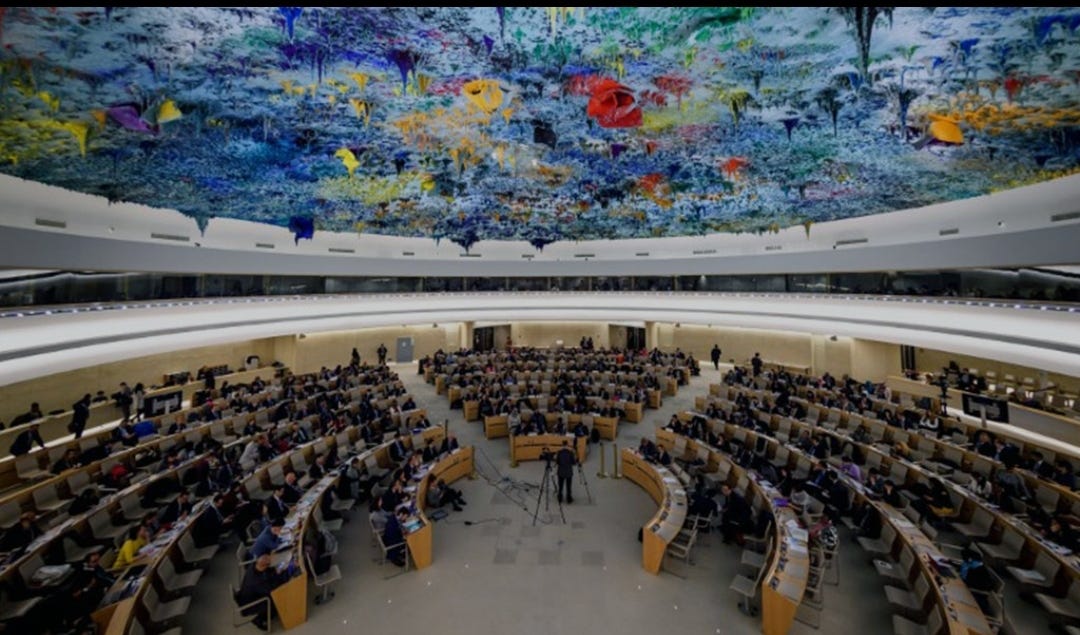
We need to examine where power resides in both organisations. The United Nations is the sum of its members. If it were comprised of Norway, Sweden and Canada, it would no doubt be the equal of the Federation. It would promote real human rights and the rule of law. Of course it would. Because all those nations do so already.
But in a world which has more Eritreas, Venezuelas and Chinas than true democracies, the United Nations promotes autocracy under the veil of liberal terminology. It represents the world we live in. It doesn’t create the world that we would like there to be. In fact, by masquerading as a bastion of morality, justice and peace, it arguably makes the world worse.
The reason that the UN fails to transcend the limitations of its membership is that it is a democracy of non-democracies. It gives every nation an equal vote, no matter how large or small, no matter how free or autocratic. And by giving the unequal equal weight - and by balancing the evil and the good as if they were one - it promotes perverse outcomes.
If x is free and 2y is unfree, then the result is clear: x + 2y. Votes are skewed to the dark side by 2 to 1. In fact it’s worse than that: because when the free trades with the unfree, the free often vote for the unfree. The Arab World with its oil and its 21 States gets the endless supply of support it never deserves.
Now if we called a spade a spade; if we recognised the UN votes for the travesty they were; this wouldn’t be so much of an issue. The UN would be impotent, yes, but harmlessly so.
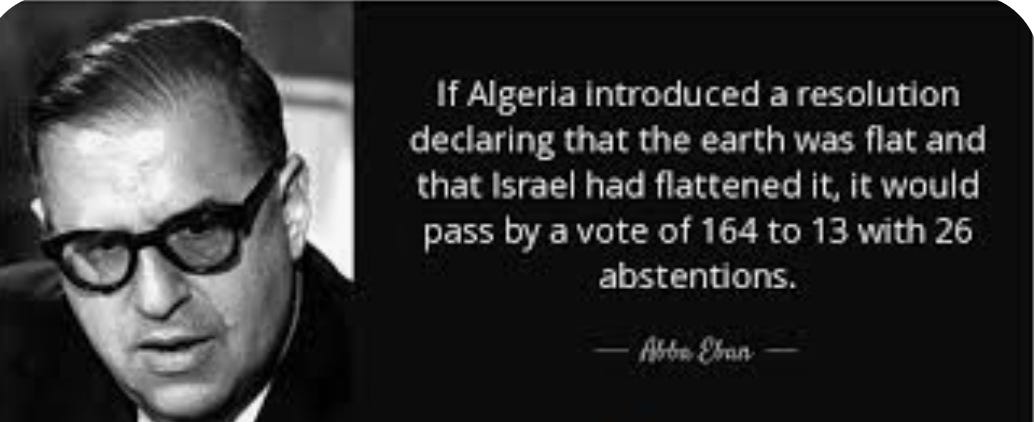
The issue is that UN votes are seen to have moral weight. If the UN General Assembly votes to condemn a nation, it’s seen as stamping that condemnation with the seal of truth. Indeed if it were to vote that the Earth were flat - to use Abba Eban’s famous dictum - then the world would be said to be flat as a matter of reality. Even though it isn’t. Through its resolutions and decisions, the United Nations dresses the devil in an angel’s clothes. And this is a dangerous deceit.
How the Federation transcends its limitations
How is the Federation different? How does it transcend its limitations? After all, this is a sector of space where the enlightened are outnumbered by the ignorant, where the peaceable are outnumbered by the intransigent and the space-faring are outnumbered by those who have never ventured into space. The Federation too has the free outnumbered. Yet - unlike the UN - it is the enlightened that decide.
In the Star Trek Universe, only the Federation have primacy within its borders. It resides in a multipolar universe - with Cardassians, Romulans and other enemies of liberty at its boundaries - and sometimes the Federation enters into peace treaties and cooperation with those external Empires. But it has full sovereignty over its own affairs.
Of whom is the Federation constituted? The enlightened. The free. The Federation isn’t a democracy of the undemocratic, nor is it a legislator of the unfree. It only admits members who sign up to its principles. You are xenophobes who want to dominate the galaxy? You don’t get in. You believe in wanton destruction? You don’t get in.
It has a Charter like the UN, but only adherence to that Charter guarantees you a place in the organisation. There are tracks to membership, where putative members can progress with a view to a Federation future, but until the requisite reforms are made, entry is barred. In the context of a modern-day Earth scenario, North Korea and Syria would have no place at the table. Merely being a de facto state would not allow you to join the UN.
More controversial is the approach of the Federation to self-determination, specifically of “developing planets”, by which I mean spheres that are yet to achieve warp speed space travel.
On one hand, the Federation is firmly anti-colonial; it doesn’t impose its will on developing planets who are left to govern themselves. Indeed such planets aren’t even aware of the of space-faring universe beyond.
Under the oft-cited Prime Directive, the Federation is expressly forbidden to interfere in the development of pre-warp societies. It is the organisation’s most important legislative provision. Only when, by their own innovation, does a planet achieve the ability to explore the galaxy, will the Federation reveal its existence to the potential candidate. And even then, they are free to accept or reject membership.
The Federation thus makes two distinctions: the free and the unfree; the developing and the developed. To be a member nation, the candidate planet must be “ready” to join the organisation in terms of its scientific, technological and, above all, moral progress. It is ashamedly elitist and Earth - with California at its heart - is unapologetically in charge.
The Federation is successful. The Federation is effective. The Federation promotes science, enlightenment, peace and freedom throughout the galaxy. Yet, to do so, it draws a clear principle in the sand. All nations/planets have self-determination and the right to govern themselves without foreign interference, but not all nations are equal. Until you meet the criteria for development and adherence to the founding Charter, you are excluded from making galaxy-wide decisions.
Syria can govern itself, but it has no place at the UN. Eritrea has the “right” to enslave its own population, but it has no right to enslave the world through its votes.
What to do with the UN?
The European Union used to be a mini-Federation, a club of six free Western European nations with open borders and similar conceptions of freedom. It was successful. It was effective. It kept the peace. And it was the envy of the world.
It had also strict rules of membership: Meet the criteria or stay out. Yet bit by bit its effectiveness has waned as it has become more United Nations than Federation of Planets. Hungary flouts the rules of democracy. It enters. It remains. Greeceonomics makes it unfit to join the Euro. It enters. It remains. Ireland promotes The Great Genocide Blood Libel. It enters. It remains. Even Serbian membership is on the cards! The more UN-ish it becomes, the more threatened is its future.
So what is the way forward with the UN? Its overly liberal approach to membership (Are you a nation state? You’re in!) has made the organisation immoral, ineffective and a threat to the world peace it has sworn to maintain. The chickens have truly come home to roost. And they’ve been living there for some considerable time.
And so it is that the organisation needs to be abolished and we need to start again from stratch. As with the Federation, so with the New Reimagined UN (NRUN). The USA - still the leader of the Free World and the NRUN’s soon-to-be biggest funder - is called upon to take charge.
It should only allow truly free nations to become members. It should ditch the “global south” and bring back the “developing world”. It should exclude hermit states explicitly (North Korea, Eritrea, Turkmenistan, Afghanistan) on the basis that they don’t know the universe beyond. It needs to ensure total adherence to the NRUN Charter.
Free is not a synonym for Western, though those nations would be the bulk of the members. Japan is free. South Korea is free. Jamaica is free. India is free. Mauritius is free. Botswana is free.
Wealth is irrelevant. What counts is freedom. As for the non-members nations, they would have full self-determination, but without membership or global power. For to join the club, they would need to subscribe to the precepts of liberty. It’s the Federation way.
The New UN would need to cooperate with China and other autocracies over global issues such as climate change; just as the Federation cooperated with the Cardassians to make Egypt-style peace treaties. But they would not be NRUN members.
Until this new reality emerges, let us say in a loud and clear voice: UN votes have no moral or legal weight. Enough is enough.
In the immortal words of Jean-Luc Picard, and the late Sir Patrick Stewart, “Make it so!”
I was rewatching Star Trek. I grew up with the Next Generation. I thought of Starfleet and the Federation as a paragon of morality (I still think of Picard's speech to Wesley, "the first duty of every Starfleet Officer is to the truth, be that scientific truth, historical truth, or personal truth".)
But I realised, in many ways, the Federation is not perfect, or even good! When Worf is accused of a war crime by shooting at a ship that decloaked directly in front of him in the middle of a shooting battle, not only did the clear tactical necessity not stand as a defense, but Starfleet offered up it's own to the Klingons. It should have said, we will investigate, you may observe, but our officers are subject to our jurisdiction, it ceeded this authority. In fact, this is a common occurrence. Being a Starfleet officer doesn't entitle you to any protections from the organisation it seems. And more so, if you look at the response to the changing "invasion" of earthin DS9, the Federation is an organisation that is ready and willing to clamp down on all personal freedoms, at a moments notice.
Some of these issues are explored in the show, but others, (particularly the ceeding of authority) are not examined at all, nor even pointed out as potentially morally suspect decisions.
But I digress. You are correct, any democracy that allows undemocratic members will eventually turn into a mockery of itself. The UN is an embarrassment and has no moral standing, which is a real shame.