



BLURB: What if we have completely misunderstood what it means to live in free and open societies? What if we have neglected the very liberal systems that gave us our freedoms and rights? What if the decline of democracies is not because of Trump, MAGA, the Right-Wing, Orban or Modi, but our own ignorance of democratic vulnerabilities? The TEN LIES THAT KILLED DEMOCRACY comes out of three decades of designing, repairing and sustaining democratic communities and organizations in the USA and elsewhere. Over 12 chapters you will receive a whole new (and genuinely radical) understanding of what liberal values really are— and how we can protect them.
PRICE: As per Guerre and Shalom policy, all new publlished book chapters are are behind a paywall. Where the author is someone other than the editor, there is a 50-50 split. So if you subscribe to Guerre and Shalom from one of Ashok’s chapters, Ashok will receive 50% and Daniel will receive 50%, giving you the right to to this Substack’s material for the entire year.
The last chapter can be found here:

Today, in Chapter 6, Ashok speaks of the sixth lie: OPEN-MINDEDNESS. Enjoy.
Chapter Summary: Who invented Open-Mindedness anyway?
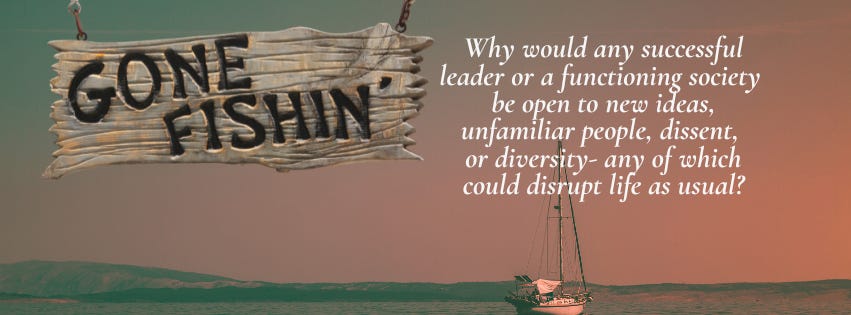
Yes, I know children are naturally open-minded, after all they don’t know enough to be closed to new ideas. But adults, those who know what they’re doing and have responsibilities, why would they keep an open mind, especially about the things they already know for a fact? For that matter, why would any successful leader of a well-functional society be open to new ideas, unfamiliar people, dissent or diversity, any of which could be disruptive to their smooth functioning?
There is nothing about being open-minded that is necessary or useful in evolutionary terms. A species adapts to changing conditions over thousands, if not hundreds of thousands of years. The great civilizations that existed for hundreds of years did so by figuring out what worked and ruthlessly sticking with it. If we are to talk about the benefits of open-mindedness, we should look at how that has worked for humans throughout much of our history, not just in our constantly changing modern era.
In this chapter, I argue that even as I have personally been aggressively open-minded, and consider the trait (and value) vital for critical thinking and creativity, I fear that its virtues have been significantly overestimated and even misunderstood.
