


EDITOR’S FOREWORD (Daniel Clarke-Serret): Today we present the Preface and Introduction to Uri Zehavi’s Rooted Truth: Israel’s Case against the Deniers. In the age of the Great Genocide Blood Libel, it is more urgent than ever to present the case for truth. That is Uri’s purpose here. In chapter after enlightening chapter, the author dismantles the despicable calumnies that have been launched against Israel —from apartheid to ethnic cleansing to genocide. Above all, Uri succeeds in dismantling the vicious canard that Zionism is a colonial project. As the title intimates, the Jewish connection to the Land is rooted in Truth.
We thank Uri for the honour of serialising his timely oeuvre here on Guerre and Shalom. In doing so he joins the Pax Arabica project of exposing language inversion, the nuclear tool of Arab Imperialism and its Western, appeasing foot soldiers. The fightback begins here, but it needs you, the reader, to make it happen. Commenting, and complaining, about current affairs is insufficient. Instead the rotten oak of the Great Genocide Blood Libel must be hacked down through sustained argument and unrelenting will. The original Middle Eastern nation state must be recognised once more and the true “common enemy of humanity” - real racism, real apartheid and real genocide - must be uncovered from their hiding place in plain sight.
Subscribe to Guerre and Shalom today to read Uri Zehavi’s Rooted Truth: Israel’s Case against the Deniers, Daniel Clarke-Serret’s Pax Arabica and other titles that are defending Western Civilization from utter destruction. Join us. Subscribe today.

ABOUT THE AUTHOR: Uri Zehavi writes with the conviction that peace must be defended, not declared. He is the founder and intelligence editor of Israel Brief, a layered, intelligence-grade publication on Israel, war, diplomacy, and the diaspora front—written without euphemism, balance theater, or institutional fog. His work synthesizes official statements, credible journalism, open-source intelligence, field reporting, and disciplined analysis into daily briefs, doctrinal deep-dives, and strategic assessments for readers who do not outsource judgment.
In addition to Rooted Truth: Israel’s Case Against the Deniers, Zehavi is the author of Holiday From History: The West’s Delusion of Peace and the Return of War with Rooted in Judea: Lives and Law in the Heart of Israel forthcoming. Shaped by a career in research, strategy, and communications, his writing turns precision into defense—of truth, of Jewish sovereignty, and of the liberal civilization that depends on both. He lives with his husband, fine-art photographer Modi Zehavi, and their dog and cat.
BLURB: What if the world’s oldest hatred didn’t disappear—only learned new grammar? What if antisemitism no longer arrives as theology or race science, but dressed up as “human rights,” “decolonization,” and the moral language of the age? Rooted Truth exposes the continuity of the lie—and why Israel became its preferred target.
With historical depth and briefing-grade clarity, Uri Zehavi traces the Jewish people’s unbroken connection to the Land of Israel—from covenant to exile, from Balfour to Ben-Gurion—and shows how history, law, and identity converge in one stubborn fact: the Jews are home. Across four parts, he dismantles the propaganda that now passes for analysis: the myth that Jewish indigeneity is metaphor, the weaponization of “apartheid/colonialism/genocide,” the bureaucracies of denial that launder bias into legitimacy, and the moral case for sovereignty and survival.
Clear. Disciplined. Unapologetic. Not a plea for sympathy, Rooted Truth is a legal brief, a moral argument, and a warning. The campaign to turn Israel into a question mark is a campaign against truth itself.
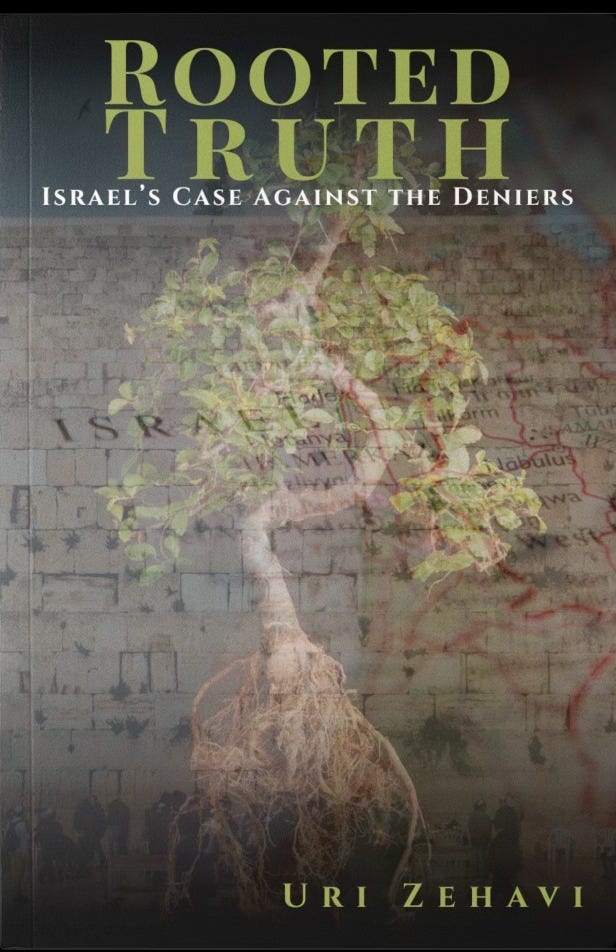
Rooted Truth: Israel’s Case Against the Deniers
by Uri Zehavi
Preface
Antisemitism never retires. It molts. It learns the moral language of each age and puts it on like a borrowed suit. In the Middle Ages it preached as theology. In the nineteenth and twentieth centuries it paraded as science and race. Today it speaks in the idiom of human rights and decolonization. The claim does not change. Jews are cast as a malignant force and Israel as the crime scene. The lie returns as virtue.
Medieval Europe had the blood libel. Jews were accused of murdering children for ritual. They were blamed for poisoning wells and for killing God.
When nationalism rose, the target shifted from faith to loyalty. Jews were smeared as a fifth column. The Dreyfus affair in France proved how far a modern state could go to brand a Jew a traitor.
The Nazis industrialized the lie. In their propaganda, Jews were both Bolsheviks and banksters. Paradox was no obstacle.
After 1945, overt Jew-hatred became unfashionable in polite company. It did not vanish. It migrated.
In 1975 the U.N. General Assembly declared that Zionism is racism. The vote said more about the Cold War bloc math than about reality, but the damage stuck. In 1991 the Assembly rescinded the line, but the stigma outlived the text. In 2001, at the U.N.’s Durban conference against racism, the NGO forum revived it with pamphlets, street theater, and the recycled Protocols. Israel was branded the world’s racial villain. The haters learned that if you wrap the oldest bigotry in the newest slogans, you can sell it as progress.
The glossary now is familiar. Apartheid. Colonizer. Genocide. The accusation is updated. The premise is identical. Jews are villains for surviving. The Jewish state is the most convenient stage on which to rerun the play.
Rabbi Jonathan Sacks described antisemitism as a virus. In one era it infects theology. In another, biology. Today, he warned, it hijacks the language of human rights to deny the Jewish People the one right it insists on for everyone else: self-determination.
When you hear human rights invoked to argue that the one Jewish state is illegitimate as such, you are hearing the old hatred in its newest clothes.
Even medieval fantasy returns. The blood libel reappears as the claim that Israel deliberately targets children or seeks extermination.
Dual loyalty resurfaces as whispers about “the lobby” and about Jews controlling policy. The far right and the far left both find ways to paint Jews as power incarnate.
On the activist left, Jews are recoded as “white” and Israel as white supremacy with Hebrew signage. The same old caricature is now graded and assigned in seminar rooms.
The intent has not changed. Strip the rhetoric and you find the same project: isolate the Jews, blame the Jews, and punish the Jews for existing.
Why now? The West helped invite the lie back in.
After the Cold War, many taught themselves that history had ended. Peace was the default. Progress was automatic. Nationhood was suspect. Strength was vulgar.
The hard lessons of the twentieth century—call evil what it is, keep your powder dry—were filed away as antique. Relativism seeped into institutions that once guarded judgment. Moral confidence eroded.
Movements skilled at moral theater filled the vacuum. Islamists learned to translate their aims into the West’s vocabulary. Postcolonial theory offered a ready-made script: divide the world into oppressors and oppressed; distrust facts as masks for power; elevate narrative over record. In that framework, Israel—the most successful anticolonial project in history—became the archetype of the colonialist. Its enemies, even when they boasted of extermination, were draped in the romance of resistance.
You saw it in the reactions after October 7, 2023. As Israelis were still burying their dead, a chorus explained that the massacre “did not happen in a vacuum.” The words, perhaps meant to signal sophistication, landed as excuse.
In the weeks that followed, a U.N. emergency session passed a ceasefire resolution that named Israel and never mentioned Hamas. On a campus green, more than thirty student groups at Harvard signed a letter holding Israel “entirely responsible for all unfolding violence.”
In each case, barbarism was rationalized by theory. The line between victim and murderer blurred into a cloud of context. A civilization that once unified to defeat fascism now struggles to name it when it wears a keffiyeh.
This lie metastasizes because institutions amplify it until it sounds like consensus.
At the U.N., Israel is a standing case. The Human Rights Council keeps a permanent agenda item just for condemning one country. The General Assembly churns out more resolutions targeting Israel than all other states combined. Durban’s template lives on: NGOs write reports, U.N. bodies cite them as if they were scripture, and headlines turn accusations into verdicts before facts are tested. “Apartheid” and “genocide” jump from a press release to chyrons in hours. Repetition does the rest.
Social media supercharges the cycle. A baseless claim can be viewed by millions before a correction is drafted. Visuals do the heavy lifting. A caption supplies the indictment. The algorithm rewards outrage, not accuracy. By the time a retraction appears, the myth has hardened into memory.
Universities, which should be immune systems for bad ideas, became incubators. Departments steeped in postcolonial theory recoded Jews from indigenous people to settlers. DEI bureaucracies built hierarchies of innocence in which Jews, now labeled “white,” default as oppressors. Student organizations took direction from national networks. Graphics, chants, and “day of resistance” toolkits spread with factory precision. Administrators hid behind neutrality while one side monopolized the megaphone. Graduates carried the catechism to NGOs, newsrooms, and international agencies. Quad slogans became policy briefs.
The method is simple. Repeat the charge everywhere. Drown dissent. Stamp it with an institutional logo. Turn volume into “consensus.” Watch decent people, numbed by the noise, start to nod along. Common, to be clear, does not mean true.
This book is not a plea for indulgence. In it, we will dismantle the lies. We will show an unbroken tie between a people and its land. We will show how international instruments recognized that prior right and tasked Britain to help reconstitute it. We will show how Israel met the tests of statehood on day one—and did not require a permission slip. We will show how “apartheid,” “colonialism,” and “genocide” are not analyses in this debate but weapons, selected for effect and severed from their meanings. We will follow the machinery that launders slogans into “international findings.” We will expose the cowardice and complicity of elites who know better and stay silent.
Israel does not ask permission to exist. It does not owe apologies for defending Jewish lives. Those who deny Jewish sovereignty condemn themselves, not Israel. The ledger of history is clear on that point.
The chapters ahead map how the lie was reborn, how it spread through systems meant to prevent it, and how truth can fight for oxygen again.
The lie returned because the West forgot how to recognize one.

