


In Part 4 of The Genocide of Truth (The Remnant), we begin the fightback against The Great Genocide Blood Libel. In 3 chapters (Courage, Reason and History) and the afterword (Thought), we explore what resistance against credentialed authority looks like.
I have read so many comments bemoaning the globalised intifada and asking what we strategy we have to fight these post-October 7th post-linguists who wish to destroy the Jewish People and Western Civilisation. THIS BOOK IS THE STRATEGY. It’s not geopolitical because the war isn’t geopolitical. It’s about philosophy, culture and the misuse of words. So stop complaining, ranting and talking to yourselves and act like Václav Havel! Sign up as paid to support this important work: We need finances, not just warm words, to end this linguistic, antisemitic evil.
A paid sub gives you the right to submit articles and book manuscripts of your own.
A paid sub lets you see serialised books by myself, Khaled Salih, Ann-Catrin Emanuelsson, Ashok Panikkar, Uri Zehavi, Richard Neat, Eli Kavon AND (the inimitable, bestselling) NACHUM KAPLAN (his new book will be coming out next week exclusively through the Guerre and Shalom Publishing House!!!)
A paid sub gives you membership to the Anti-Palestinianist Coalition. Together we will return truth, words and reason to the West.
SUBSCRIBE AS PAID TODAY! - Daniel Clarke-Serret (editor, Guerre and Shalom; author, the Genocide of Truth)
THE GENOCIDE OF TRUTH: The Deep Roots of a Modern Blood Libel
by Daniel Clarke-Serret
Introduction: The Genocide of Truth
PART 1: The Tree of Knowledge
Chapter 1: Truth // Chapter 2: Ideology // Chapter 3: Religion // Chapter 4: Science // Chapter 5: Attention // Chapter 6: Distraction // Chapter 7: (True) Expertise // Chapter 8: Authority
PART 2: The Descent to Babylon
Chapter 9: Declaration // Chapter 10: Confusion // Chapter 11: Conversation // Chapters 12: Democratisation // Chapter 13: Sophistry // Chapter 14: Image
PART 3: The Rise of Byzantium
Chapter 15: Guilt // Chapter 16: Belief // Chapter 17: Christ // Chapter 18: Mission // Chapter 19: Doctrine // Chapter 20: Heresy // Chapter 21: Sin
PART 4: The Remnant
Chapter 22: Courage // Chapter 23: Reason // Chapter 24: History (chapters 23 and 24 to be released)
AFTERWORD: Thought
Chapter 22: Courage
The Power of the Silent
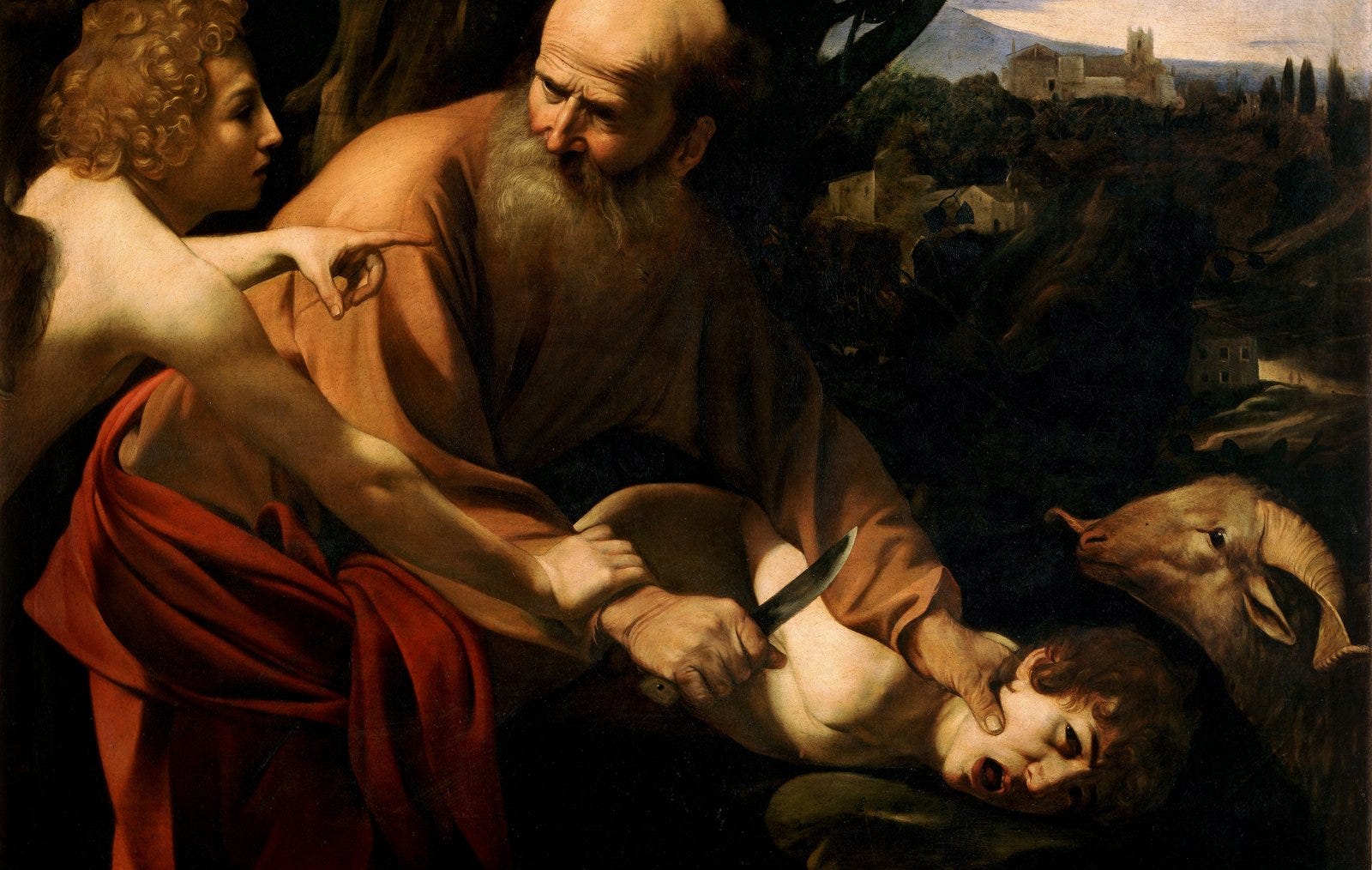
It was a day that would live in history. Abraham woke up early, saddled his horse and took the long faithful journey to Moriah. He had been told to do the unthinkable: to kill his son, his only son, the son he loved, and take him to the mountain that God would show him. Having waited for Isaac an eternity, into the depths of his old age, he was to sacrifice him as a burnt offering.
His rationality told him to ask questions, those same hard questions he had posed at Sodom, where he had asked if the Judge of all the world would do Justice :
Would this killing not be a breach of the Covenant, that whereby Abraham’s descendants would be a mighty nation and more numerous than the sand on the beach and the stars in the sky? And if it were a breach, was this God not a liar, a breacher of the most sacred bonds of morality?
Would not this death of an innocent child go against the very foundations of justice? What had Isaac done to merit this death penalty? And if it were not so merited, as surely was the case, how, once more, could this Judge of all the world defy Justice? And so often (nearly) in the breach of this foundational ethic, how had God not lost his place on the Bench?
Yet beyond even the above, was this God not some kind of sadist? He had made Abraham and his wife wait for decades for a child. Through Sara’s childlessness, they had borne misery. Through her tears, they had birthed commitment.
They had suffered and suffered and endured more suffering still, only on the hope that some mystical promise be fulfilled that defied nature and all reason. They had left their home and their father’s house only to hope in the hard pasture land of Canaan. And then, in their old age, when they were finally to give birth to the promise of a national future, they were to commit the greatest crime of all time: to murder the son that had been the subject of their lives’ longings.
Yet though reason, at its most compelling, spoke against such an outrageous act, Abraham chose to act like a man possessed. Armed only with faith, he rose early in the morning - without hesitation - and proceeded towards the mountain of destiny.
We all know how the story was to end. God was to intervene at the 11th Hour and tell his loyal servant to sacrifice a ram instead of his beloved son. Yet for three millennia, this famed tale has posed more questions than answers— and one above all: Had Abraham passed the test?
The answer of the religious, from the Rabbis through Luther to Kierkegaard has been simple and affirmative: The patriarch was a hero of faith. In his intentional failure to ask questions, he showed reliance on his Divine Creator, an act which, ultimately, was to be vindicated. That is not my answer; for in my own humble reckoning, he failed and failed spectacularly, and was saved from eternal humiliation by a Teacher who had known he had gone too far.
I know that, in the saying, I depart from tradition; a tradition I love; one nurtured through the millennia and crystallised in Kierkegaardian modernity. But here I stand. I can do no other. If Abraham could challenge God in the face of divine resolution, then I can stand against an interpretation, ever so human, that I can no longer defend. That is the defiance of writing in an age of “genocide”.
In our interpretation, we must separate the literary from the moral aspects of the tale, one which must be of particular resonance to couples unable to conceive. The Akeidah is the climax of a life of wandering in search of a scarcely believable goal: childbirth from barrenness. To be about to lose what you had waited for for so long is an act of tension rarely bettered in the entire history of literature: This, even beyond any moral-analytical aspects, are a key reason why we still talk of this tale today.
Yet ethically, Abraham acted unconscionably in failing to engage his reason; and failing to ask questions of himself. He had asked those questions so brilliantly at Sodom, showing no fear in the face of divine advocacy, and not relenting until the fate of destruction had been made out with moral persuasion.
God had shown that he was indeed in the business of doing justice.
Abraham had shown that he was indeed a warrior of reasoned human rights —and not the “human rights” of the postlinguist religion.
So at Moriah, God was to pose the same test in even starker form. Yet, instead of showing courage; instead of challenging the divine will on charges of lies, justice and sadism; Abraham repressed his anguish and marched onwards to murder.
Abraham’s test was to show faith in reason and divine justice; on the power of the miniscule human to challenge the power of the omnipotent. Yet he closed off his mind in an act of wimpish obedience. He was asked to be courageous, but he showed precisely the wrong kind of courage.
For the correct answer to God’s challenge was this: getting up early in the morning and engaging him in debate.
This is a challenge that has been failed over and over again, and most horrifically in the 21st century. Unlike in the beautifully controlled literature of Genesis, God has rarely intervened at 23:59 for a happy ending. Planes have crashed into Twin Towers, babies have been beheaded at kibbutzim and Christmas markets have been made unholy, all with the goal of mass murder.
In a fateful challenge to neo-neoplatonism (sic), intelligent, educated and often wealthy individuals have chosen to turn off their reason. Their anguish has been suspended. Their innate sense of justice ignored. And why? In order to put faith in the murder that “God commanded”.
But whereas Abraham’s God sought justice through a failed test; intervening before the Prison Experiment ethics committee came to call; the “god” of the terrorists really is a brute. He demands total, unquestioning submission.
Courage comes only from questioning and questioning comes only from reason. It has been innate in human nature since Sodom, and only those who seek evil would deny it.
This too is what is sought by the postlinguist: the absence of questioning, the denial of the obvious, the suspension of disbelief and the parroting of self-evident unrealities. And through this anti-Enlightenment philosophy, that which Abraham’s failure sought to ward us away from millennia ago, they turn devotees into martyrs for an unspeakable cause.
