


Today the Torah weighs in on democracy, “Jewish values” and the judicial reform debate…
EXODUS: THE QUEST FOR FREEDOM
by Daniel A Clarke-Serret
CONTENTS
PROLOGUE: The Creation of Unity. Putting Humpty Dumpty together again
EXODUS: THE QUEST FOR FREEDOM. A Short Introduction
CHAPTER 1 (Shemot, Exodus 1:1-6:1): Moses, his African Wife & Conversion to Judaism
CHAPTER 2 (Va’eira, 6:2-9:35): Gandhi, the Lancastrians & the Exodus of the Egyptians
CHAPTER 3 (Bo, 10:1-13:16): And so the National Story Begins…
CHAPTER 4 (Beshallach, 13:17-17:16): Exterminating Doubt
CHAPTER 5 (Yitro, 18:1-20:23): A Kingdom of Followers
CHAPTER 6 (Mishpatim, 21:1-24:18): The Original “Judicial Coup”
CHAPTER 7 (Terumah, 25:1-27:19): Land of the Free, Home of the Brave
CHAPTER 8 (Tetzaveh, 27:20-30:10): Love Peace and Pursue it
CHAPTER 9 (Ki Tisa, 30:11-34:35): Holding out for a Leader
CHAPTER 10 (Vayakhel-Pekudei, 35:1 - 40:38): Exodus Denied: The Rejection of Freedom
CONCLUSION: Why have I written commentaries on Exodus?
EPILOGUE: A Tribute to Rabbi Jonathan Sacks
CHAPTER 6: Mishpatim
The Original “Judicial Coup”

“If there is serious injury, you are to take life for life, eye for eye, tooth for tooth, hand for hand, foot for foot, burn for burn, wound for wound, bruise for bruise.” (Exodus 21:23-25)
Who rules?
The legislature or the judiciary?
The written rules of the Torah or the judicial interpretation of the rabbinical “halachic” system of Jewish law?
Topical then, topical now.
In this week’s parashah (section) of the Torah, the civil and criminal laws of the Torah are set out clause after clause, rules that religious Jews follow to the letter. Or do they? Even a cursory reading of the text will make plain that the laws of Torah set down here - although formally relied upon in the oral tradition - bear little resemblance to the laws as in fact followed in even the strictest religious communities.
Sometimes that is because the end to be achieved by the Torah - abolition of slavery for example - has already been achieved; thus the incremental progressive changes to the slave-owning tradition, radically instituted by the Torah, are no longer relevant. Sometimes it is because the Torah’s laws (non-oppression and good working conditions of the stranger for example, explicitly referred to numerous times in the parashah) are so idealistic that humans in any era seem incapable of heeding them.
But sometimes it is because the harshness of the law has been softened time after time by rabbinical equity. Every time one reads that this or that person should be “put to death” ask yourself how many times in history that has actually happened. And from Sinai to today the answer is not even once.
Right from the giving of the Torah to the current era, the Rabbis have implemented the judicial coup of all history by not only interpreting the law in a “creative” way, but by explicitly saying, in the words of the Vilna Gaon, that “the halakha (Jewish law) uproots the Torah text”. Professor Yeshayahu Leibowitz, in his fantastic writings on Mishpatim, paraphrases the commentary of Ketzot Hachoshen thus:
“The rabbinical authorities in the field of Halakha have the right to rule in accordance with their understanding of the Torah….practical (everyday laws) could not have been given directly from God whereby we would be tied to it in exactly the way it is written”.
The most famous example of the Rabbis (or Jewish judicial authorities) explicitly changing the clear literal meaning of the text is “Eye for an eye, tooth for a tooth (etc)”. Although this verse is often used as a source of antisemitism against the “bloodthirsty Jews”, it has - as every educated Torah scholar knows - been interpreted from the very earliest days as the foundation of the law of Tort; which is to say that in return for any harm against another, the wrongdoer is to pay a financial payment or damages. Never has a bodily punishment been sanctioned by a Jewish court.
Maimonides, perhaps the most famous Jewish sage, acknowledges the explicit and intentional divergence of the actual law applied by Jews from the written law; according to the Jewish tradition, God has authorized this divergence from Sinai by giving the deciders of the oral law the right to rule differently from the plain text. Indeed, as I commented in the previous chapter, God was forced to give written rules against his will.
As Leibowitz wryly notes, the idea that Jewish legal rulings are simply an authorised interpretation of the written Torah text is “commonly accepted among the naive”. Or to use the language of political discourse today, it was a judicial coup like none implemented before or since.
But let us also be clear; we have not subverted the Divine will here. For written legal texts become stale and irrelevant very quickly. We cannot apply laws on slavery when slavery no longer exists. The same applies to the laws on sacrifices and in this I rely upon the Rambam’s Guide to the Perplexed Book 3, Chapter 32. To use modern legal parlance, as the centuries pass we get burdened with “the dead letter of the law”. The aim of the judicial authorities in any legal system is to give life to the spirit or principles of the law in every new era as applied to modern cases —particularly when it comes to religious rules based on millenia old texts.
Yet there is a ‘but’, a ferocious criticism to be leveled at the rabbinical authorities. While they started as legal radicals, come the enlightenment they turned into legal conservatives. And in the modern era, worse was to come; they turned the Halakhah into the dead letter of the law - a stale written legal text - that it was designed to supplant. To quote again the Ketzot Hachoshen “The oral Torah is ours” (ie not God’s); it is ours to study and develop with the passing years.
The lack of a living, breathing, changing, developing Oral Torah means that modern Jewish Law has turned into the Written Torah 2.0. And that is why Jew after Jew - myself included - finds it stifling and increasingly irrelevant to modern life and the religious and spiritual challenges we all face. It must adapt - and quickly - or become extinct.
Remember God gave us the authority at Sinai to be adaptive in interpreting his laws. Who are the modern rabbinical authorities to be more exacting than the King of Kings Himself?


CHAPTER 7: Terumah
Land of the Free, Home of the Brave
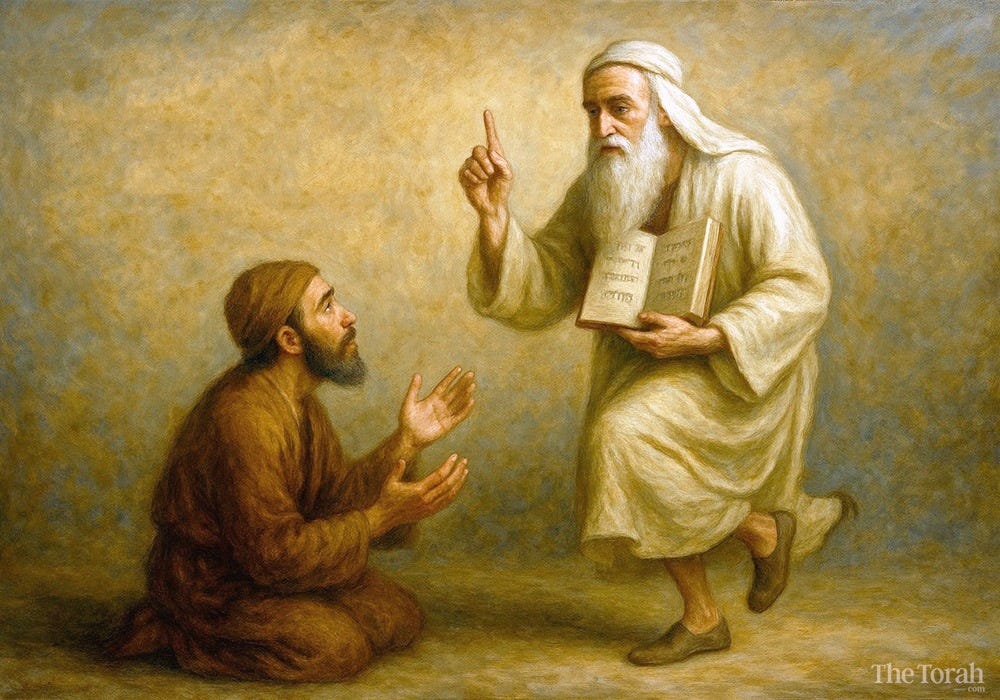
We all know the story. It’s an oldie but a goody. Back in the 1st Century, a stranger came to Hillel. “Teach me the Torah while I’m standing on one foot. Unperturbed by his questioner’s impertinence, the Rabbi responded, “That which is hateful to you, do not do to your fellow. That is the whole Torah, all the rest is commentary. Now, go and learn it.”
A lovely answer. A famous answer. And a reformulation of the Golden Rule of both Leviticus and countless other cultures. But with respect to the great man, I must humbly disagree.