


Daniel Clarke-Serret’s Pure Jewish Anger: Available now on Amazon.com at this link and Amazon.co.uk at this link. #7 in Political Protest & Poetry.
The Lost Dream of Peace
The author responds to reviews of Pure Jewish Anger
If everything we have,
they take;

If everything we bestow,
they inherit;

If everything we are,
they become,

Would it be possible
- just for once -
that when we offered peace,
they could say yes?
(Indictment 4: Cultural Appropriation)
Reviews of my new book Pure Jewish Anger are starting to come in and they’re beginning to follow a familiar pattern. They comment on the innovative structure, turning gradually from anger at the outside world to despair at Israeli politics and Jewish religious law. They note the change of tone from pure Jewish anger at the start to pure Jewish loneliness at the conclusion. They even pick out the key themes from Palestinians’ agency to the betrayal of truth to the destruction of language to the eternal problem of Jewish belonging.
Yet not a single review, comment or critique has identified the book’s most pressing concern: peace — and the depressing lack of it. Rereading the first three indictments again, I’m struck not so much by anger, but by depression about what could have been. The author isn’t angry at the Palestinians for being Palestinians but for their rejection of peaceful coexistence again and again and again. This hasn’t only destroyed their own people, as evidenced in the ruins of Gaza, but the Jewish people too. We have been reduced to surviving behind walls and defending ourselves behind fences. We have been reduced to electing the morally suspect government of Benjamin Netanyahu, precisely because the dream of peace seems dead and all we want is life and safety behind an insurmountable barrier.
Despite all that is said, the Jewish people are not the strong people in this conflict. We are the weak, desperate refugees who survived because we had to. We didn’t come from privilege, but from poverty and genocide; from mass murder at the hands of European Nazis to mass expulsion at the hands of Middle Eastern Arabs. We built the nation of Israel not from supremacy or power, but from the basic human instinct to survive. In a world that prizes victimhood, we took our victimhood and made something of it — one of the most wealthy and innovative countries in the world.
Yet despite our apparent successes, we remain weak and vulnerable. Our existence as a nation and a state is still seen as conditional on an impossible Christ-like standard of behaviour, while the rest of the world can get away with blue murder without even the remotest of consequences. We live on a tiny strip of land, welcoming more and more refugees from France and Europe as they are hounded out by indigenous extremists and an increasing and hostile Islamist-adjacent population. Yet they are fleeing to a land that is itself under threat, 10 miles wide and overlooked by those ominous highlands of Samaria. We are living in fear. We know that to withdraw from the West Bank sans true peace means the end of the Jewish People.
The world has it all wrong; the Palestinians are seen as agency-less victims of “structure”, while the Jews are the all-powerful choosers and implementers of their will. Yet the Palestinians have agency and the Jews face structures too. As for the Palestinian, they have the ability to choose peace, to stop educating for hate, to cease hoping for the end of their neighbours and to coexist in genuine harmony. They have had this choice from the very beginning, yet time and time again they have refused to do what’s best for themselves and for us. Their leadership - which is to say those they choose under a system of “Palestinian self-determination” - have unceasingly preferred to destroy al-Yahud rather than to improve the lives of us all.
Meanwhile the Jews are also victims of “structure”. The structure of the United Nations-international system where autocratic and anti-Jewish governments are in the ascendancy. The structure of the political planet which is dominated by Christian and Muslim polities. The structure of a depressing reality where self-determination is consistently denied to global minorities.
Both the Jewish and the Palestinian peoples have some agency and some structural reality, but only the former has emphasized its agency while the latter has wallowed in self-destructive and mutually-destructive hatred excused by “victimhood”. Some individual Jews still emphasise their structural disadvantages; some individual Palestinians their agency. However, to quote a cliché, the proof of the pudding is in the eating and not a single Palestinian leader has prepared a desert menu of peace.
Nonetheless, we both live by the sword and die by the sword. A future of the Jews choosing agency and the Palestinians choosing victimhood can only end horrendously for all of us. The Israeli government cannot continue smashing up Palestinian buildings because of weapon tunnels underneath, and then satisfy itself with economic growth caused by high-tech innovation. The world has turned against us; they accept Palestinian terrorism as perfectly normal; they really believe that a Palestinian State operating on genocidal ideology will end well. It won’t. We are all going to end up in hell.
This has been the tragedy of the death of peace. By now both peoples could have been thriving in two states living side by side or as part of a EU-style federation. Yet because of the Second Intifada, the rocket-filled response to Gaza disengagement and other such moral travesties, both peoples are living in a death spiral.
Israel is consistently electing more and more right-wing governments because its people rightly realize that the other side has absolutely no interest in peace — yet in the doing we are compromising our own morality, welcoming Kahanist ministers into the fold, and a emboldening a Likud that now engages in the delegitimisation of Israeli Arab voters. While the behavior of this government is increasingly erratic, the behavior of the Israeli electorate is quite rational: they are in utter despair at a neighborhood that despises peace and has proven it in tragic abundance.
Yet the book is quite clear at where it places the greatest blame. Yes it condemns Palestinians for rejecting my life’s work: the pursuit of peace. Yes it excoriates that dictatorial, antisemitic convention known as the United Nations; that which spreads hate with the assured success of Bubonic Plague. And yes it condemns an Israeli government that was rationally, but unfortunately, elected in response to wave after wave of terrorism, violence and murder. But the most important defendant, the repository of the author’s complete contempt, is Defendant B: the Far (W)est – the moral and linguistic collapse of The West and The Far-Left.
It has always been open to the West to call out Palestinian terrorism and the immoral gaslighting of the wider “International Community”. They have always had the agency and the structural advantage to condition Palestinian statehood on a genuine commitment to peace and coexistence.
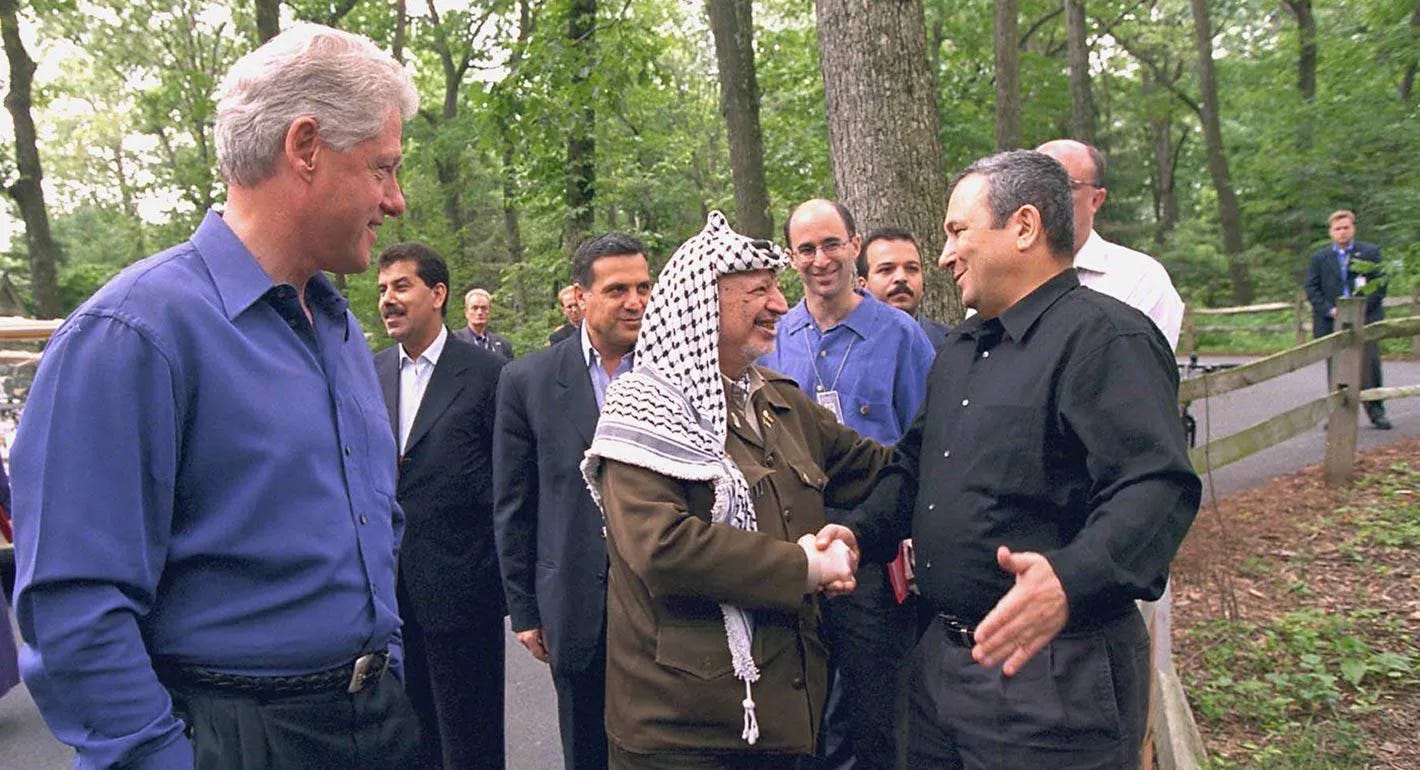
They could have condemned Yasser Arafat and the Palestinian Authority for their disgusting reaction to the Clinton-Barak peace process and refused to blame Israel for its necessary defence. They could have banished antisemitism from their universities and regulated the weekly hate marches. They could have refused to indulge in the genocide blood label, called out international law for its evident partiality, boycotted United Nations proceedings and acted upon reports of an antizionist obsession in their national broadcasters. Most of all, they could have refused to give money to the Palestinians for their corrupt, often violent, leaders and their subsidy of terror. In other words they didn’t have to play Arafat’s game.
Yet we live in an age where every one of our institutions is overrun by a small,but influential, number of far-leftists who genuinely believe that appeasing terrorism is virtuous progressivism. In doing so, the Far (W)est has not only caused hell for Israeli Jews, but destroyed peace for both Israelis and Palestinians. Even those Palestinians who would choose peace, and can see past the educational conditioning of the UNRWA travesty, see no point in risking their lives for a cause that even the so-called liberal West doesn’t believe in. As a father, I sympathise. Survival is hard enough in Spain, let alone Jenin.
In the Concluding Statement, rarely mentioned in any of the reviews so far, I make one final desperate call for peace. I speak past the duplicitous (secular/Islamist) Palestinian leadership(s), the United Nations and Western institutions. I speak directly to the ordinary Arab, the ordinary Palestinian and the ordinary Lebanese caught in Hezbollah's hell. I call upon them to be genuine martyrs — martyrs for democracy, martyrs for freedom and, most of all, martyrs for peace. And they will have to be martyrs because they live in political hell, terrorised by evil leaders supported by the West, the international community and their own suicidal choices. Only through sacrificing everything, will they change their societies for the good and achieve a fabled, long hoped-for peace. That sounds impossible, and, unfortunately, perhaps it is. That is the tragedy that provokes Pure Jewish Anger.
The final words of the book are not, as is often claimed, “To those who sit alone, I sit with you and together we are home”. Those are the last words of the 18th indictment. Instead, the final words can be found in the Closing Statement: “Free Palestine. Really Free Palestine.”
This gives us an important insight; a tool for interpretation; a sure and steady sign for all who dare listen. It's this. Pure Jewish Anger isn’t a remotely partisan book. It is a book that seeks that which we should all seek: Peace. Two states for two peoples, and freedom of movement. Yet it is angry - furious - not because we failed, but because so many people and groups determined that it would. Above all the Palestinians, but most painfully the Far (W)est: those maximalist Palestine “partisans” who claim to seek peace through destroying any chance of it.
Through such betrayal, such mendacity, such immorality and such commitment to forever war, we are left with perhaps the most painful question of all: Does the West itself deserve to survive? And I’ll be honest. I don’t know.
I completely agree. The irony is that, as we all know, this conflict receives disproportionate, constant attention from the UN, the UN Human Rights Council, and human rights NGO’s. With all that, one would assume that Israel/ Palestine should be making substantial progress towards peace. But of course the truth is the opposite- not only do these institutions not help, but they actively make things worse. And for all the harm they cause, these organizations face no accountability whatsoever. That is a great betrayal of trust.
Daniel, this is an excellent response. I’m struck by how many reviewers heard the anger and how few heard the grief. The line about what could have been stayed with me. Israelis and Palestinians could have spent these years building lives alongside one another. Think how much of that ordinary life has been lost, and how easily we’ve come to talk as if this were the only future either people ever had.
You’re also right to insist that Palestinian agency and Jewish vulnerability belong in the same conversation. There’s a peculiar kind of condescension in talking about Palestinians as if their choices don’t matter, and a real blindness in assuming that everything Israelis have built makes them feel any less exposed. Both habits of thought make it easier to explain why peace failed and easier to give up on it. I fear it will take a few generations before conditions enable another go at a two state solution.
I’ve just ordered Pure Jewish Anger. I’ll read it with your closing words in mind. I’m glad you wrote this.