



Editor’s Note (from Daniel Clarke-Serret):
Today we are releasing Part I — The Dream Before the States from Kurdistanî Azad, a long awaited book on the Kurdish dream of self-rule. It’s a seminal work from two distinguished and expert authors on a oft-ignored topic.
The authors have requested an accelerated serialization process which means that the book will be released one part at a time. So for example, this opening part includes the Part I Introduction and three chapters: • Chapter One: The Dream Called Kurdistan • Chapter Two: Beside the Empires • Chapter Three: The Irreversible Passage. (Note: The Author’s Prologue, Acknowledgments, and Abbreviations were already shared freely with everyone.) The consequence of this is that the posting is very long and most readers will not be able to consume it in one sitting.
This isn’t a problem because the Guerre and Shalom website is now divided into sections with each of the published books having its own dedicated tab. This means that you can dip into each and every book, including Kurdistanî Azad, at your leisure.
This does mean, however, that we are working against the algorithm. Readers will not have the drive to “like” the article because they (likely) won’t have read it in one go. The authors and editor therefore request that you “like” and share IN ADVANCE, then read at your own pace via the Guerre and Shalom website or this email. This is vital if the Kurdish cause is to be brought to the fore. Thank you for supporting this deeper, long-form project.
Part I begins from a guiding proposition: that the Kurdish dream did not begin as a modern border dispute. It began from older, imperfect forms of lived self-rule that the modern state system later narrowed, hardened, and politicized. Before Kurdistan became a question for diplomats, border commissions, armies, and ministries, it was already a lived world — in mountains, villages, routes, dialects, religious networks, principalities, tribal confederations, cities, memories, and frontier bargains. Kurdistanî Azad begins with a name that carries both intimacy and politics: a child named Kurdistan by a father named Azad.
*****
A note on the authors:
Ann-Catrin Emanuelsson earned her PhD in Peace and Development Research at the University of Gothenburg in 2005 with a dissertation on Kurdish political institutions in the diaspora. She was a visiting researcher at the Defence Academy of the United Kingdom in 2007 and 2008. Her ongoing research concerns the opportunities available to Kurdish entrepreneurs in the diaspora to contribute to development in the Kurdistan Region. On this theme, she has previously published “Should We Return, Stay, or Commute?” in Global Families: Transnational Migration and Kinship (eds. Eastmond & Åkesson, Gidlunds Publishing, 2007).
Khaled Salih earned his PhD in Political Science at the University of Gothenburg in 1996 with a dissertation on state- and nation-building in Iraq. He worked as a lecturer at the Center for Middle Eastern Studies at the University of Southern Denmark between 1997 and 2003. Between 2003 and 2010, he served as an adviser to the Kurdistan Regional Government. In the spring of 2011, he was a visiting researcher in the Department of Political Science at the University of Pennsylvania. He was Vice-Chancellor for the University of Kurdistan-Hewlêr, 2012-2016. Among his publications is The Future of Kurdistan in Iraq (University of Pennsylvania Press, 2005), co-authored with B. O’Leary and J. McGarry.
Together, they co-authored, Drömmen om Kurdistan (Dreaming of Kurdistan) in 2012 (in Swedish)
******
Why you should subscribe to Guerre & Shalom to read Kurdistanî Azad?
Because Kurdistan is too often treated as a footnote to other people’s histories: a border problem, a security problem, a tribal problem, a regional complication. Kurdistanî Azad begins from a different premise: that the Kurdish question is one of the great unfinished moral and political questions of the modern Middle East.
This is not only a story about betrayal, borders, uprisings, exile, self-rule, war, and hope. It is a story about what happens when a people are denied the ordinary right to shape their own future — and yet continue to imagine freedom.
Subscribe and read because this project does not offer slogans. It asks harder questions. Why have Kurdish victories so often remained fragile? Why does hope keep returning after punishment? What kind of freedom can survive between four states, rival parties, foreign powers, and the memory of repeated abandonment? And what would it mean to build a Kurdistan capable not only of resisting oppression, but of correcting its own errors?
Kurdistanî Azad is written for Kurds, for friends of Kurdistan, and for anyone who wants to understand how dignity survives without a state, how memory becomes politics, and how the dream of self-rule can remain alive without becoming blind to its own difficulties.
Subscribe if you believe the Kurdish story deserves to be read not as a tragedy alone, but as a warning, a possibility, and a living argument about freedom, about human dignity, about the Kurds as Universal Explainers (human beings capable of building institutions, correcting errors, creating knowledge, governing themselves, criticizing their leaders, and shaping a future).
TABLE OF CONTENTS
Authors’ Prologue
Acknowledgments
Abbreviation List for Quick Reference
Part I — The Dream Before the States
Part I Introduction
Chapter 1: The Dream Called Kurdistan
Chapter 2: Beside the Empires
Chapter 3: The Irreversible Passage
Part II — The States Against the Dream
Part II Introduction
In the Name of Civilization
Kings, Mandates, and Broken Promises
Republics, Revolutions, and Traps
Syria: Silence, Denial, and Survival
Part III — The Age of Armed Movements
Part III Introduction
Revolution as a Language of Hope
My Allāh, Your Punishment
The Nightmare
Part IV — The Dream Becomes Government
Part IV Introduction
The Safe Haven
The Kurdish Civil War
A Federal Opening
The Difficult Art of Governing
Part V — The Dream After 2011
Part V Introduction
Rojava and the Syrian Earthquake
ISIS and the Kurdish Moment
A Moment of Dignity and the Punishment of Hope
The Cage Has Adapted
The Dream in the Twenty-First Century
Kurdistan as Warning and Possibility
Recommended Reading
Kurdistanî Azad: The Long Dream of Kurdish Self-Rule
by Ann-Catrin Emanuelsson & Khaled Salih
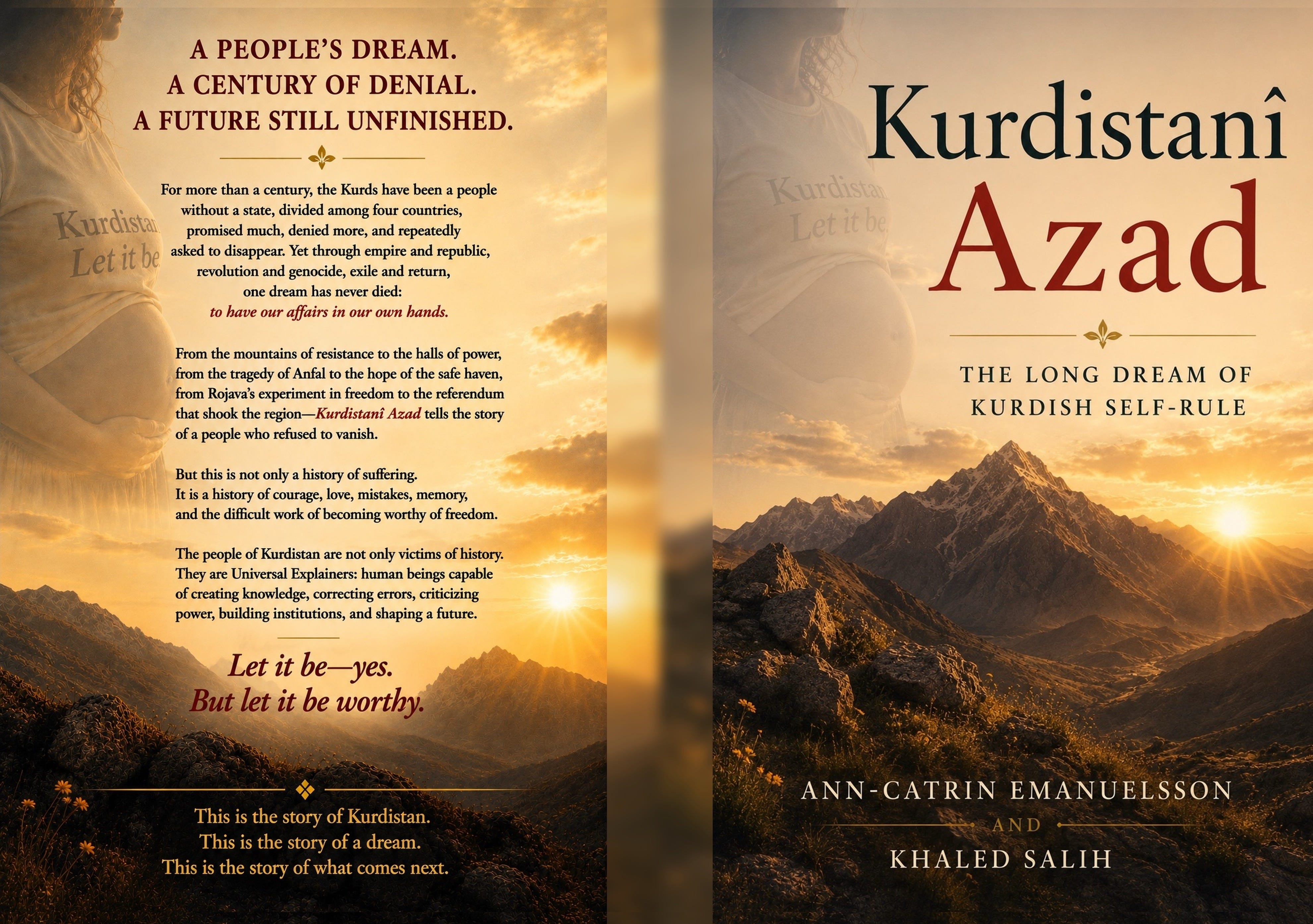
Part I — The Dream Before the States
Part I Introduction
The Dream Before the States
Guiding proposition: The Kurdish dream did not begin as a modern border dispute. It began from older, imperfect forms of lived self-rule that the modern state system narrowed, hardened, and politicized.
Before Kurdistan became a question for diplomats, border commissions, armies, and ministries, it was already a lived world.
This introduction has one task: to show that the Kurdish dream preceded the states that later enclosed it, without turning the older Kurdish world into a myth of innocence.
It existed in mountains, villages, routes, dialects, religious networks, principalities, tribal confederations, cities, memories, and frontier bargains. It did not yet exist as a modern state. It did not have one parliament, one capital, one recognized border, or one seat among the nations. But it was not nothing. That is the given from which Part I begins. It was not an empty space waiting to be named by others. Kurdish life had forms of authority, belonging, protection, rivalry, and self-rule long before modern nationalism arrived.
This first part begins with a name: Kurdistanî Azad.
A child is named Kurdistan by a father named Azad. The phrase means both “Kurdistan of Azad” and “Free Kurdistan.” Because the Kurdistan in question is also Azad’s daughter, the title carries the book’s emotional and political key. Kurdistan is not introduced first as a map, a grievance, or a geopolitical problem. It is introduced as a daughter, a memory, a promise, and a question: under what conditions can a people have their affairs in their own hands?
To answer that question, we must begin before the modern states that now divide Kurdistan. We must look at the older Kurdish world beside the Ottoman and Persian empires, where self-rule was not yet a nationalist program, but often meant practical room for Kurdish rulers, sheikhs, tribes, and communities to survive through negotiation, distance, loyalty, rebellion, and local authority. That world was not democratic or innocent. It was often unequal, patriarchal, periodically violent, and fragmented. It should not be romanticized, but neither should it be judged as if it had been allowed the long, protected development of a modern constitutional order. Yet it contained something the modern states would later weaken, absorb, suppress, or destroy: Kurdish society’s capacity to govern parts of its own life through its own institutions, languages, memories, and authorities.
This is not a search for a Kurdish essence. It is not a claim that all Kurds shared one consciousness, one institution, one dialect, one class position, or one political program before modernity. It is a search for the historical conditions under which Kurdish life could govern parts of itself, lose that room, recover it, misuse it, and perhaps turn it into institutions worthy of a home.
Part I follows the passage from that older world into the modern one.
This post is for paid subscribers. Upgrade now to continue reading Part I and future book installments. Thank you for supporting this long-form project.
