


Help us end The Great Genocide Blood Libel today. Sign up as paid to Guerre and Shalom and read/spread this important work.
THE GENOCIDE OF TRUTH: The Deep Roots of a Modern Blood Libel
by Daniel Clarke-Serret
Introduction: The Genocide of Truth
Chapter 1: Truth // Chapter 2: Ideology // Chapter 3: Religion // Chapter 4: Science // Chapter 5: Attention // Chapter 6: Distraction // Chapter 7: (True) Expertise // Chapter 8: Authority // Chapter 9: Declaration // Chapter 10: Confusion // Chapter 11: Conversation // Chapters 12: Democratisation // 13: Sophistry
Chapter 14: Image
The Art of Suffering
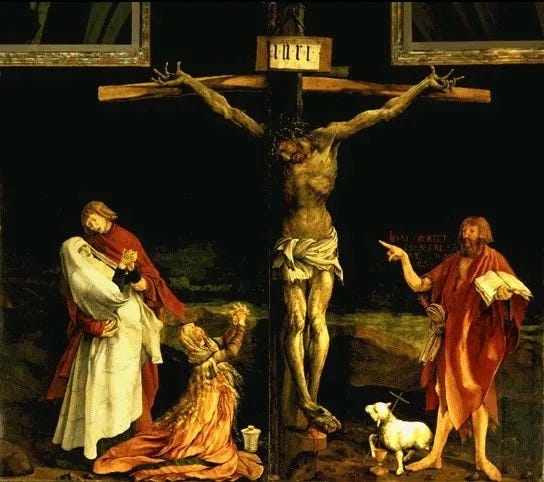
Where the word is no more, only the image remains —and it has its consequences…
The Purpose of Art
Art has two primary purposes. The first is innocent and even uplifting: it is the aesthetic necessity to create beauty in our lives. Paintings decorate our living rooms and sculptures adorn our yards. They turn solemnity into celebration, greyness into joy. Decontextualized and serving this basic function, the second commandment seems to hold little sway. Surely only a puritanical society could hold such a dim view of graven images. Surely the second “thou shalt not” should be restricted to idols cast in stone.
Yet art has a second purpose more closely aligned with the vision of the artist. Today, we may view ancient art as objects of beauty, but in their day the maestros were making truth claims. They were making a statement about what “is” in the world and in this endeavor they were encroaching on dangerous ground.
An artist, and the artist’s patron, are not merely in the business of making beautiful things. When working with integrity, they care little about the Beverly Hills living room that centuries hence will showcase their work. Instead they use paint as we use words. They manipulate stone to describe “reality”.
The problem, however, is that artists, ancient and contemporary, fail in this endeavor. Rather they distort reality - intentionally or otherwise - to turn the world of things in themselves (Kant's Ding-an-sich) into the world of limited appearances. In an act of uncritical alchemy, they make their inner world outward “fact” and cajole the viewer to see the world through the master’s limited eyes. Thus, visual art is untrue, a beautiful lie told by magicians who seek to heal their wounded souls.
The Crucifixion: The Christian Message Usurped
Let us take the most celebrated subject of the visual arts: the crucifixion of Jesus. Stop and ask yourselves: why did medieval artists (or their patrons) endlessly choose this gruesome subject? Why did they decorate Catholic Church after Catholic Church with paintings of unimaginable suffering and altar pieces of bloody hell on Earth?
The answer isn’t that they lived in a Christian age, for the Crucifixion is not and was not the true message of Christianity. Easter, far from being a glorified retelling of the death of Jesus, instead concerns itself with his overcoming of death. According to tradition, he rose from his tomb come Sunday morn and in that event Christians learned the Good News: that life was more powerful than death. Hope sprung eternal. Had Jesus died that day on the cross, in agony and humiliation, what would be the story of the faith? That God abandons those who spread His message?
So I ask again: Why do Christians past and present focus so heavily on the Crucifixion? Why are churches adorned with crosses splattered with sculpted human blood? Surely a true Church would celebrate the resurrection, both of Jesus and of Lazarus before him. So why the morbid fascination with the inverse of the Christian message? Why the fixation with death over life?
It was not Christianity that motivated painting after bloody painting of Roman-induced agony. Instead it was the ever present human desire to represent suffering. With every splash of paint, the Masters bore their own soul in an era of plague, want and eternal war. They defied the religious message to present their own doubts and fears. They railed against injustice, cloaked in a devout tunic of faith. They fought against the Machine using the Machine itself.
But in doing so they erred. They cast aside the Good News with frivolous abandon. For half a millennium the Crucifixion had been best forgotten, unvisualised amongst the Greek, un-understood words of an ancient text. To see the Crucifixion in blood would have been an abomination, a traumatic reminder of the Roman devil. “Thou shalt not make unto thee a graven image”. Yet as the “dark” centuries passed, art reasserted itself. The Masters emerged to present suffering in all its unwelcome detail.
