


This is final part of my series on inflation. Enjoy.
Coming next: Travel Week! In the coming 3 articles we'll be off to Egypt, Morocco and Spain where of course there'll be a Guerre and Shalom twist.
ARTICLE 1: Word Inflation (Daniel Clarke-Serret):

ARTICLE 2: Moral Outrage Inflation (Nachum Kaplan):

ARTICLE 3: Mamdani Inflation (Daniel Clarke-Serret):

“The Government that beat Inflation” by Daniel Clarke-Serret
“Cheer Churchill, Vote Labour”
(The Labour Party's 1945 election slogan)
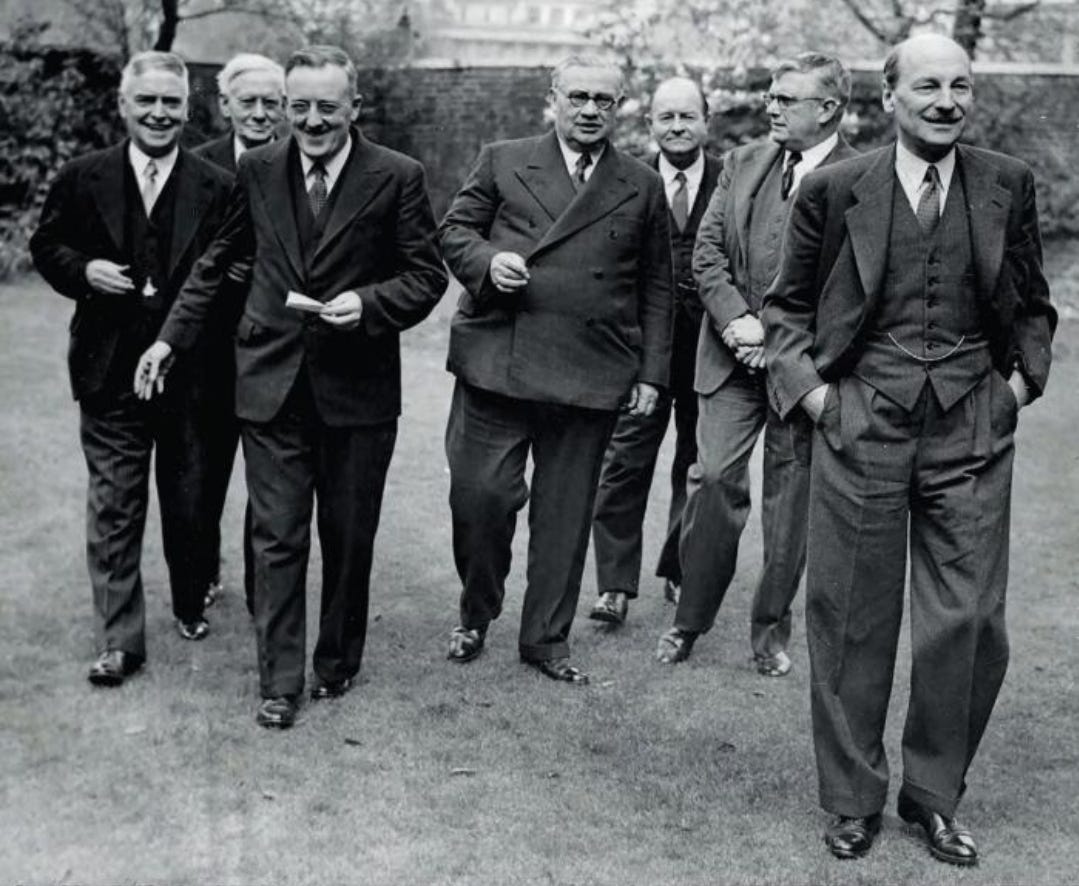
[Image: Clement Attlee and leading members of his patriotic, but socialist, government.]
Search for a New Jerusalem
Socialism has become somewhat of a dirty word and in many ways this is understandable. Seeing the horrors of Stalin and the demise of Maduro’s Venezuela, the attractions of living in a more collective society seem less than tempting.
Eastern Europe of the Soviet era was unfree, economically stagnant and an affront to human dignity. Within the democratic world, the reality of socialism was scarcely better. The British remember the Winter of Discontent (1979) only too well: rubbish piled high on the streets, corpses unburied and picket lines outside NHS hospitals, all fueled by overpowerful Unions imposing their will on the elected government. The fear of a return to Trade Union rule propelled Margaret Thatcher to the Premiership, a fear that kept the Conservatives in power for 18 long years and compelled Tony Blair’s Labour party to reform their socialist constitution. To return to power, the 1990’s Labour party had to demonstrate its commitment to market economics and a society that was "intensely relaxed about people getting filthy rich"1.
The British electoral cycle represents a clash of fears. Thatcher’s rise was predicated on a fear of Union power, while post-1945 Labourism was birthed on a fear of squalor.
The interwar period, marked by economic depression, mass unemployment and appalling social conditions, had left an indelible mark on the minds of the British electorate. WWI Prime Minister David Lloyd-George had promised a new Jerusalem: “a land fit for heroes to live in”. But upon returning from the trenches, the British worker was faced with an entirely different reality: A shortage of housing stock, damp, cold habitations, malnutrition, declining wages and poor working conditions. Unemployment approached 40% in parts of the country and theft was the last resort of the desperately hungry. Despite putting their lives on the line in the fields of France, our soldiers returned for a reward of abject poverty.2
Worries in Woodford
We weren’t prepared to make the same mistake twice. After the second war and its Churchillian demands for blood, toil and sweat, the British people were determined to see promises of a better world realised. A New Jerusalem had been envisioned once before, yet our hopes had been dashed. This time it would be different.
Upon Victory in Europe, fulfilled his constitutional duty: he called a General Election. All assumed the “inevitable”; riding on coattails of wartime triumph, the PM's Conservatives would be returned to Downing Street. The cheering crowds seemed to confirm this. Travelling around the country, the election tour in full swing, Churchill was struck by the love felt towards him. From Glasgow to Manchester, he was greeted as a hero.
Yet his politically astute wife had a different sensation. For behind the cheering crowds, whooping and wailing at his every movement, lay a mass of stillness: A background crowd who admired the man, but not his party. Patriots who were respectful, yet sought immediate change.
Polls were a rare breed in those days, but if Gallup had been consulted, there would have been no doubt about the impending socialist triumph. It showed regular double digit leads in Labour support and though even its leadership felt unsure, they ultimately prevailed.
The election dragged on over several days, fighters in the Far East being afforded their moment in the democratic Sun. Churchill, exhausted and in desperate need of a paint-filled holiday, took a break in the calm of southern France. As the votes were being counted, he joined Labour’s Attlee in bomb-wrecked Potsdam.
Discussing the post-war settlement, Stalin commented to Churchill that victory was in his grasp. He’d been closely following the election, though struggled to understand how a war victor could submit himself so soon to democratic judgment (the political reality in Russia being rather different).
Upon his return home, the political signs were grim. His wife Clemmie, standing in for Churchill at the election count, sensed that all was not quite right. The Labour Party, committed to its wartime patriotic duty, declined to stand a candidate in the great man’s Woodford seat. Yet an eccentric independent, in a show of far less deferential feeling, took roughly 10,000 votes to Churchill’s 27,000. A personal victory it may have been, but for an unknown to achieve such support against the saviour of the free world showed that something unexpected was brewing. And indeed it was. Labour cruised home in a landslide victory that shocked the world.
The Unlikely Mr Attlee
Surprise at Churchill’s loss was compounded by the nature of his opponent. Churchill quip - that Clement Attlee was “a humble man with much to be humble about” - was cruel, though spoke to a greater truth: The leader of the Labour Party lacked charisma. His words failed to inspire.
Indeed he had come to lead his party quite by accident. In the face of the 1931 near Labour wipeout, the rump party was short of MPs. The erstwhile leader Arthur Anderson had lost his Parliamentary berth along with nearly his entire top team. Led by a now elderly George Lansbury (father of Murder She Wrote’s Angela and personal friend of my family in turn-of-the-century Brighton), the baton was soon passed to Attlee for little other reason than lack of alternative.
He was seen at the time as a mere stop gap appointment until a more suitable replacement could eventually be found. In the event, Attlee remained party leader for 20 years, the longest period of policy stewardship in the 20th Century, and unlike second placed Thatcher, who was removed from post by her own colleagues, the member for Limehouse left at a time of his own choosing.
In a modern television age, Mr Attlee may have struggled, but in the midst of the post-war destruction, he was set fair for his place in history. Charisma was viewed with suspicion in an age which needed jam today. Ramsay McDonald's ghost loomed large.
In time, the doer mentality bore its fruits, for the impact of Attlee's government left a lasting impression on British (and world) politics. In recent times, Attlee was chosen by a group of academics as a best British Prime Minister of the 20th Century.3
The Attlee administration came to entirely transform British society and these transformations were maintained by subsequent Conversative governments in a period of post-war national consensus. Its signature domestic achievement was the creation of a National Health Service which continues to be a pillar of British national life to this day. Suddenly, people suffering from horrific health conditions after years of conflict and pre-war squalor were finally able to treat their conditions for free and at the point of need. To deal with poverty, the National Insurance Act of 1946 provided for old-age pensions and financial support in times of sickness and unemployment.
With minimal living conditions ensured for all, absolute poverty became a thing of the past. The education leaving age was raised to 15 and children were expected to continue beyond that age if academically appropriate to do so. Under the New Towns Act of 1946, 12 new towns were planned to reduce overcrowding and clear out the big city slums.
This is a mere cursory list of the many social reforms introduced by the 1945 Labour government, but their effect was undeniable: Over the course of one short Parliamentary term, the 5 evils laid out in the 1942 Beveridge Report were effectively dealt with: Squalour, Idleness, Want, Ignorance and Disease were increasingly confined to a different age.4
Beating the Phillips Curve
The best was yet to come, for this storied government was able to beat the Phillips Curve, the economic model that postulates an inverse relationship between unemployment and inflation.