


Once upon a time, the world was filled with “Hamas” (wanton violence in Hebrew). There was no justice, morality or accountability. An inverted world, filled with corruption and absent of civilisation, made the Almighty “regret” his creation. Good job then that God promised not to destroy the world again….
Today Torah Correspondent Maish Yarmush speaks about the famous Biblical tale and though he has written of many fascinating aspects elsewhere - questions of animal suffering and the philosophical problem of natural disasters among them - here we narrow the discussion to the fundamental difference between the Torah and Mesopotamian accounts. Enjoy. I know I did. - Daniel Clarke-Serret (editor)
Introduction
There are few narratives in the Torah more disturbing, more intellectually challenging, or more theologically consequential than the story of the Flood. We encounter a God who has created a world, declared it good, populated it with living creatures, and entrusted its development to humanity only to announce, ten generations later, that nearly the entire enterprise must be destroyed.
The language is devastatingוַיִּנָּחֶם ה׳ כִּי־עָשָׂה אֶת־הָאָדָם בָּאָרֶץ וַיִּתְעַצֵּב אֶל־לִבּו ׃, “And the Lord regretted that He had made humanity upon the earth, and He was grieved to His heart.” (Bereishit 6:6)
What are we to make of this astonishing declaration? Does God regret His own creative act? Has an omniscient Creator discovered something about human nature that He did not previously anticipate? And is the Flood an expression of divine anger, a carefully measured act of justice, or a cosmic reset intended to restore the possibility of moral civilization?
These questions become even more fascinating when we recognize that the Torah’s Flood narrative did not emerge in a cultural vacuum. Long before the biblical text reached its final literary form, the civilizations of Mesopotamia were telling similar stories about a catastrophic inundation, a divinely warned survivor, an enormous vessel, the preservation of living creatures, and the restoration of human civilization. These similarities are too extensive to dismiss as coincidence. But the differences are even more consequential.
The Torah did not simply reproduce an ancient Mesopotamian legend with the names of the gods changed. It presented a radically different understanding of why the world was destroyed, what justified its preservation, what obligations human beings bear toward one another, and what moral limitations govern even the exercise of divine power.
The Mesopotamian flood traditions generally depict a catastrophe arising from decisions made within a contentious divine society. The Torah transforms the catastrophe into an inquiry into the moral foundations of the earthly civilization itself. That transformation is the subject of this essay.
My argument is that the originality of the Torah’s Flood narrative lies not primarily in its plot, which shares numerous elements with earlier Near Eastern traditions, but in its theological architecture. The biblical account places moral accountability at the center of cosmic history. It connects human violence to the integrity of creation, presents divine judgment as constrained by mercy, and concludes with a covenant that imposes obligations upon humanity while also declaring limits upon future divine destruction.
The Flood is therefore simultaneously an act of judgment, a partial reversal of creation, and the beginning of a new moral order. To appreciate just how remarkable this is, we must first examine the stories that preceded and surrounded it.
Before Noach: The Flood Stories of the Ancient World
The discovery of Mesopotamian flood literature in the nineteenth century transformed biblical scholarship. For centuries, readers familiar primarily with the Torah could regard the story of Noach as a singular account of primordial catastrophe. The recovery and decipherment of cuneiform tablets revealed that the ancient Near East possessed a much larger literary tradition involving destructive floods and extraordinary survivors.
One of the most dramatic moments occurred in December 1872, when George Smith, a young scholar working at the British Museum, publicly announced his decipherment of a Babylonian flood account preserved on a tablet from the library of the Assyrian king Ashurbanipal at Nineveh.
The discovery was sensational. Here was an ancient account of a man warned of an impending deluge, instructed to construct a vessel, commanded to preserve living creatures, and eventually brought safely through a catastrophe that destroyed the surrounding world. Birds were released to determine whether the waters had receded. The survivor offered sacrifices after emerging from his vessel. These were not vague similarities. They were recognizable narrative correspondences.
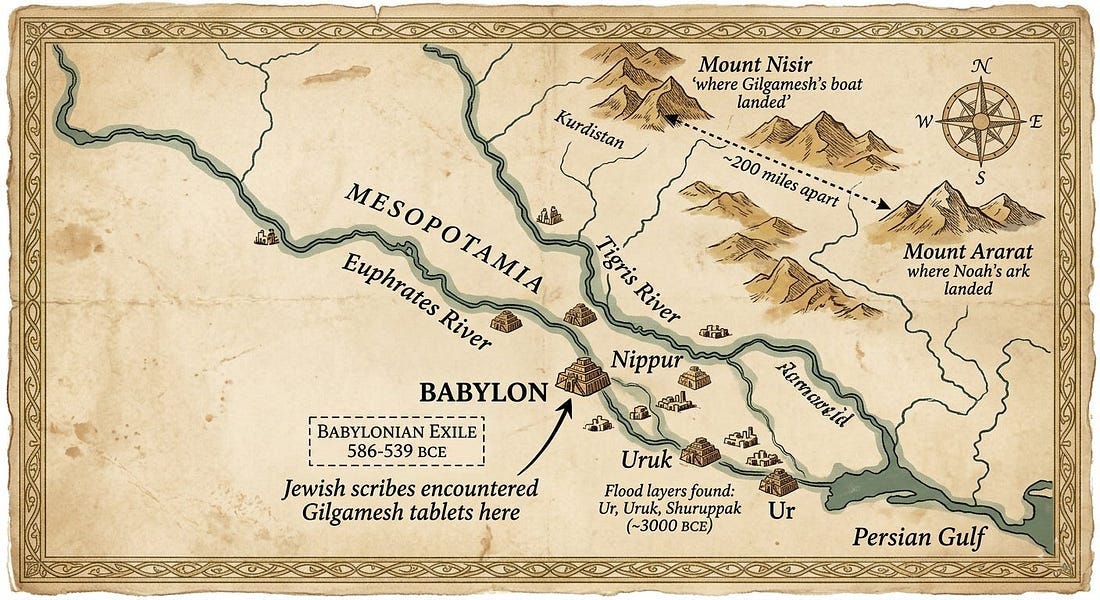
Subsequent discoveries established that the flood episode in the Epic of Gilgamesh belonged to a broader Mesopotamian tradition extending back many centuries. The principal surviving accounts include the Sumerian story of Ziusudra, the Akkadian Atrahasis Epic, and the flood narrative told by Utnapishtim in Tablet XI of Gilgamesh.
We must distinguish the dates of surviving manuscripts from the dates of the traditions they preserve. A seventh-century BCE tablet can transmit a much older composition, and the antiquity of a literary motif does not establish the precise date of its original invention.
Ziusudra: The Sumerian survivor of the Flood
The Sumerian flood tradition, commonly discussed under the modern title Eridu Genesis, survives in fragmentary form on an early second-millennium BCE tablet. Its principal human figure is Ziusudra, whose name is commonly interpreted as referring to prolonged life.
The text places the Flood within a larger history of humanity, kingship, cities, and divine administration. Civilization exists under the authority of the gods. A divine decision brings about a catastrophic inundation, but Ziusudra receives a warning and survives.
The preserved text describes a devastating storm lasting seven days and seven nights. Afterward, Ziusudra offers sacrifice, and the gods grant him an extraordinary destiny associated with immortality and residence in Dilmun. The parallels with Noach are unmistakable: divine warning, a catastrophic flood, the survival of a chosen individual, post-Flood sacrifice, and the continuation of human existence.
Yet the surviving Sumerian narrative does not provide the sustained indictment of human violence that dominates Bereishit 6. Because the text is fragmentary, however, we cannot confidently assert that its complete original form contained no moral explanation whatsoever.
That distinction is important. Absence from a damaged manuscript is not proof of absence from the original composition. The significance of the Sumerian story is that it establishes the antiquity of a recognizable flood tradition within Mesopotamian religious literature.
Atrahasis: Humanity was destroyed because the gods could not tolerate its noise
The Atrahasis Epic, preserved in Old Babylonian manuscripts from the second millennium BCE, offers a much fuller explanation of why the gods decided to destroy humanity. According to the narrative, the lesser gods were originally compelled to perform exhausting labor, maintaining the physical infrastructure of the divine world. Eventually, they rebelled against their burdens.
The gods therefore created human beings to assume the work. Humanity’s original purpose was not to exercise moral freedom, perfect creation, or cultivate justice. Human beings were created to relieve the gods of labor. But the solution generated an unexpected problem.
Human beings multiplied. Their settlements expanded. Their collective noise became intolerable to Enlil, one of the principal Mesopotamian deities. Unable to endure the disturbance, Enlil attempted to reduce the human population. First came plague. Then drought and famine. Enki, the deity associated with wisdom and subterranean waters, repeatedly intervened to help humanity survive. Finally, Enlil resolved upon a catastrophic flood.
The underlying theological structure is remarkable. Humanity’s multiplication, which Bereishit repeatedly presents as a divine blessing, becomes a problem for the Mesopotamian gods. In Atrahasis, population growth threatens divine comfort. In the Torah, population growth is part of humanity’s original mandate: פְּרוּ וּרְבוּ וּמִלְאוּ אֶת־הָאָרֶץ וְכִבְשֻׁהָ, “Be fruitful and multiply, fill the earth and subdue it.” (Bereishit 1:28). Following the Flood, God repeats the command: וְאַתֶּם פְּרוּ וּרְבוּ שִׁרְצוּ בָאָרֶץ וּרְבוּ־בָהּ, “And you, be fruitful and multiply; abound upon the earth and multiply upon it.” (Bereishit 9:7) What Enlil finds intolerable, the God of Israel commands. The Mesopotamian deity seeks to restrain human proliferation. The biblical God desires human flourishing, provided that humanity observes the moral conditions necessary to sustain it.
The ending of Atrahasis makes the distinction even sharper. The gods establish mechanisms that limit human reproduction and population, including infertility and forms of infant mortality, as part of the post-Flood settlement. The Torah’s response is different. God does not solve the problem of human existence by restricting humanity’s right to reproduce. He establishes a covenant, forbids murder, and demands accountability for the taking of human life. The problem, in other words, is not that too many human beings exist. The problem is what human beings do to one another. This is one of the most profound differences between the two traditions.
Gilgamesh: A divine catastrophe that terrifies the gods themselves
The Epic of Gilgamesh provides the most famous ancient parallel to the biblical Flood. In Tablet XI, Gilgamesh encounters Utnapishtim, a survivor of the ancient deluge who has been granted immortality. Utnapishtim recounts how the gods decided to destroy humanity and how Ea secretly warned him of the impending catastrophe.
Utnapishtim is instructed to build a vessel, seal it with bitumen, and bring aboard his family, skilled workers, and representatives of living creatures. A catastrophic storm follows. The vessel eventually comes to rest upon a mountain. Birds are released to test whether dry land has reappeared. Finally, Utnapishtim offers sacrifice.
When the Flood begins, the gods themselves are terrified. The ancient text describes them fleeing upward, crouching in fear, and lamenting the destruction of humanity. Ishtar grieves over the annihilation of the people she helped bring into existence. This is a universe in which the gods can unleash forces that frighten even themselves. The divine council has made a catastrophic decision, but its members are neither morally united nor entirely secure in their control of events.
When the Flood ends, the gods gather around Utnapishtim’s sacrifice. The text memorably compares their gathering to flies attracted to an offering. The gods need human beings, not merely as objects of affection, but as providers of sacrifices and ritual sustenance. The destruction of humanity threatens the economic and religious relationship upon which the divine order depends.
In the Torah, by contrast, God does not require food, does not depend upon sacrificial nourishment, and does not become frightened by the forces He has unleashed. He initiates the Flood, governs its progression, remembers Noach, causes the waters to recede, and establishes the terms under which the world will continue.
When Noach offers sacrifice, the Torah says: וַיָּרַח ה׳ אֶת־רֵיחַ הַנִּיחֹחַ, “And the Lord smelled the pleasing aroma.” (Bereishit 8:21). The resemblance to Mesopotamian sacrificial language is unmistakable. But the theological function is different. The biblical God does not swarm toward the sacrifice because He is starving. Rather, the offering introduces a divine declaration concerning the future of the world.
God promises not to repeat the destruction of all living things in this manner, despite recognizing that the human inclination toward evil remains. In Gilgamesh, the gods disagree about the catastrophe, and the survivor ultimately receives immortality. In Bereishit, God establishes a continuing covenant with mortal humanity. The biblical resolution is not the elevation of one exceptional survivor beyond ordinary human existence. It is the preservation of ordinary human existence itself.
A Comparative Anatomy of the Flood Traditions
The following comparison captures the major theological differences without erasing the substantial literary relationships among the texts.
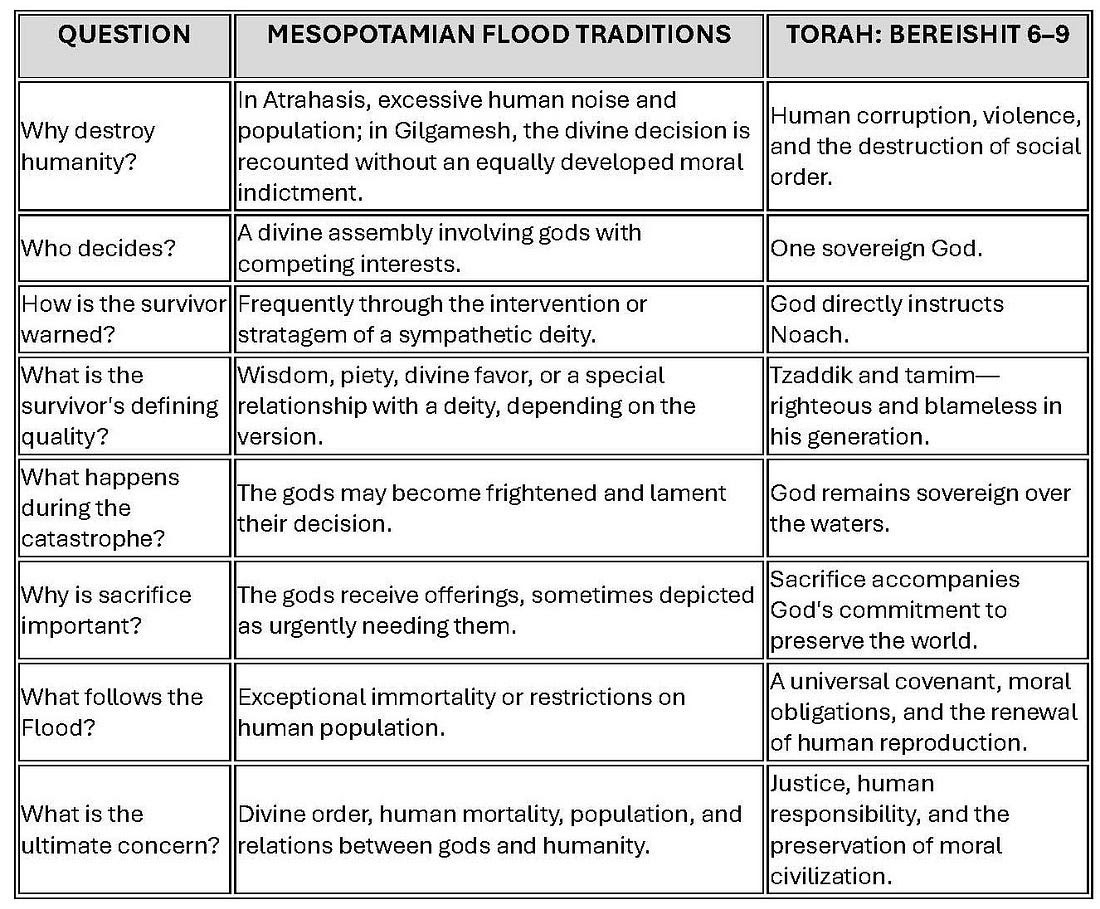
The comparison does not establish that Mesopotamian religion was devoid of ethics. Ancient Mesopotamia possessed sophisticated legal traditions, concepts of justice, and moral expectations. Nor should the flood traditions be treated as a single uniform narrative. Their emphases vary considerably. The specific point is that Bereishit makes human moral corruption the explicit and organizing justification for the Flood in a way that the principal surviving Mesopotamian accounts do not.
The Torah’s Revolutionary Accusation: The World Was Destroyed Because It Became Immoral
The biblical narrative begins not with divine inconvenience but with a moral indictment. וַתִּשָּׁחֵת הָאָרֶץ לִפְנֵי הָאֱלֹהִים וַתִּמָּלֵא הָאָרֶץ חָמָס׃, “The earth became corrupt before God, and the earth was filled with violence.” (Bereishit 6:11)
The verb vatishachet, from the Hebrew root שחת, denotes corruption, ruin, or destruction. The noun chamas denotes violence, wrongdoing, and oppressive conduct. The Torah repeats the root שחת in a striking sequence: וַיַּרְא אֱלֹהִים אֶת־הָאָרֶץ וְהִנֵּה נִשְׁחָתָה, “God saw the earth, and behold, it was corrupted.” (6:12). And then: וְהִנְנִי מַשְׁחִיתָם אֶת־הָאָרֶץ, “And behold, I am about to destroy them with the earth.” (6:13). Human beings have corrupted creation. God responds with an act described by the same verbal root.
The Flood is not presented as an arbitrary catastrophe imposed upon an otherwise innocent civilization. It is the culmination of a process in which humanity has already begun destroying the moral conditions necessary for its own existence. The world is not merely wicked. It has become structurally corrupted. Violence is no longer an occasional deviation from an otherwise functioning social order. It has become the organizing principle of that order.
The Ramban: The Sin That Requires No Revelation
The Ramban (1194–1270), provides an especially important interpretation of Bereishit 6:13. He explains that chamas includes robbery and oppression: החמס הוא הגזל והעושק, “Chamas means robbery and oppression.” The Ramban then explains why this transgression receives special emphasis even though the generation was guilty of other forms of corruption. He writes: מפני שהוא מצוה מושכלת אין להם בה צורך לנביא מזהיר, “Because it is a rational commandment, they have no need for a prophet to warn them about it.” He then adds: ועוד שהוא רע לשמים ולבריות, “Moreover, it is evil toward Heaven and toward other creatures.”
The Ramban is effectively distinguishing between two categories of moral obligation. Some obligations depend upon specific revelation. A person cannot necessarily know the details of Shabbat observance, the laws of sacrifices, or the intricacies of ritual purity without receiving instruction. But the prohibition against robbery and oppression belongs to another category entirely. They are accessible to human reason. One does not need a prophet to explain that stealing another person’s possessions is wrong. One does not require a revelation at Sinai to understand that violence destroys human relationships or that powerful individuals should not be permitted to exploit the vulnerable. These are moral truths that precede the distinctive religious obligations of Israel.
The generation of the Flood was therefore condemned not for failing to observe commandments it had never received, but for violating obligations that any functioning moral intelligence should have recognized. This interpretation becomes particularly important when compared with Atrahasis. In that narrative, human beings are destroyed because their existence has become intolerable to a god.
In Ramban’s interpretation of Bereishit, human beings are destroyed because their behavior has become intolerable to justice. One is a conflict between divine convenience and human existence. The other is a conflict between moral law and human conduct.
The Failure of Institutions
There is another dimension to the Ramban’s interpretation that deserves attention. Earlier in Bereishit 6, the Torah describes the bnei ha-elokim taking women whom they desired. The Ramban discusses the interpretation that these were the sons of rulers and judges, individuals associated with positions of authority. On this reading, the corruption of the generation was not confined to private misconduct. It had penetrated the institutions responsible for maintaining justice. The people who should have protected the vulnerable instead exploited them. Those who possessed the authority to administer justice had become participants in injustice.
This is the point at which a society begins to lose its moral legitimacy. Ordinary criminality is destructive enough. But when judges, rulers, and other guardians of the social order become perpetrators, the mechanisms through which society might correct its wrongdoing begin to disappear. The Torah’s accusation is therefore more serious than the claim that the generation contained many wicked individuals. It describes a civilization in which wrongdoing had become institutionalized, power had escaped moral restraint, and the distinction between authority and predation was collapsing. The significance of chamas is not simply that some people were violent. It is that violence had become pervasive enough to define the world. The Flood, in this interpretation, represents divine judgment upon the destruction of justice itself.
The Flood as the Reversal of Creation: God Returns the World to Chaos
The Flood narrative contains another extraordinary dimension. Its language and structure deliberately recall the opening chapter of Bereishit. In the Creation narrative, God brings order out of the primordial waters. וְהָאָרֶץ הָיְתָה תֹהוּ וָבֹהוּ וְחֹשֶׁךְ עַל־פְּנֵי תְהוֹם, “And the earth was unformed and void, and darkness was upon the face of the deep.” (Bereishit 1:2). The primordial waters are subsequently separated. Dry land emerges. Vegetation appears. Animals populate the earth. Finally, humanity is created in the divine image. Creation proceeds through differentiation. God separates light from darkness, waters above from waters below, and sea from dry land. Boundaries make life possible.
The Flood reverses that process. בַּיּוֹם הַזֶּה נִבְקְעוּ כָּל־מַעְיְנֹת תְּהוֹם רַבָּה וַאֲרֻבֹּת הַשָּׁמַיִם נִפְתָּחוּ, “On that day all the fountains of the great deep burst open, and the windows of heaven were opened.” (Bereishit 7:11). The boundaries separating the cosmic waters are breached. The waters from below rise. The waters from above descend. Dry land disappears. The terrestrial creatures perish. Creation is being dismantled.
The Hebrew word tehom, the deep, connects the two narratives. The primordial waters that God had restrained in Bereishit 1 return to overwhelm the ordered world in Bereishit 7. This is not simply an unusually severe rainstorm. It is a literary portrayal of de-creation. The world is being returned toward the condition from which divine ordering originally rescued it.
The extraordinary symmetry of destruction and renewal
The reversal becomes even more striking when we examine the recovery. After the waters have prevailed, the Torah announces: וַיִּזְכֹּר אֱלֹהִים אֶת־נֹחַ וְאֵת כָּל־הַחַיָּה וְאֶת־כָּל־הַבְּהֵמָה אֲשֶׁר אִתּוֹ בַּתֵּבָה וַיַּעֲבֵר אֱלֹהִים רוּחַ עַל־הָאָרֶץ וַיָּשֹׁכּוּ הַמָּיִם, “God remembered Noach and every living creature and all the cattle that were with him in the ark; and God caused a wind to pass over the earth, and the waters subsided.” (Bereishit 8:1). The word ruach is particularly important. In Bereishit 1:2, the ruach Elokim moves over the primordial waters. In Bereishit 8:1, a ruach passes over the flooded earth and initiates the recession of the waters.
Dry land eventually reappears. Living creatures emerge. Humanity receives a renewed command to reproduce. The narrative is constructed around a theological symmetry: Creation establishes order. Human wickedness corrupts that order. The Flood reverses creation. Divine remembrance initiates its restoration. Yet the restored world is not identical to the original world.
Before the Flood, the human diet is described in predominantly plant-based terms. Afterward, the consumption of animals is explicitly permitted, subject to restrictions involving blood and life. Before the Flood, humanity is commanded to exercise dominion. Afterward, the relationship between human beings and animals is described in terms of fear and dread. Before the Flood, humanity receives the divine image as the basis of its extraordinary status. Afterward, that image becomes the explicit justification for the prohibition against murder. The post-Flood world is therefore not merely a reproduction of Eden. It is a world in which the moral dangers revealed by human history have been incorporated into the structure of divine law.
The Flood represents not simply a return to the beginning, but a transition to a different stage of human existence. Creation establishes the possibility of human freedom. The Flood exposes the catastrophic consequences of its misuse. The covenant establishes the moral limits within which that freedom must operate.
The Extraordinary Reversal: Before the Flood, Human Evil Justifies Destruction; After the Flood, It Justifies Mercy
Perhaps the most intellectually astonishing feature of the entire narrative appears after Noach leaves the ark. God declares: לֹא־אֹסִף לְקַלֵּל עוֹד אֶת־הָאֲדָמָה בַּעֲבוּר הָאָדָם כִּי יֵצֶר לֵב הָאָדָם רַע מִנְּעֻרָיו “I will not again curse the ground because of humanity, for the inclination of the human heart is evil from youth.” (Bereishit 8:21). This verse deserves to be read alongside Bereishit 6:5: וְכָל־יֵצֶר מַחְשְׁבֹת לִבּוֹ רַק רַע כָּל־הַיּוֹם, “And every inclination of the thoughts of his heart was only evil continually.”
Before the Flood, human evil provides the justification for destruction. After the Flood, the persistence of human evil accompanies God’s decision not to destroy the world again. The same fundamental problem remains. Human nature has not been transformed. Noach’s descendants will not be morally perfect. Indeed, the very next chapters describe drunkenness, familial disgrace, political ambition, and the construction of Babel.
If the purpose of the Flood was to eliminate the human capacity for evil, the project failed. But perhaps that was never its ultimate purpose. The Flood demonstrates what unrestricted corruption can produce. The covenant establishes that the continued existence of creation cannot depend upon the permanent elimination of human wrongdoing. Otherwise, the world could never survive.
God therefore commits Himself to preserving the regularities upon which life depends. עֹד כָּל־יְמֵי הָאָרֶץ זֶרַע וְקָצִיר וְקֹר וָחֹם וְקַיִץ וָחֹרֶף וְיוֹם וָלַיְלָה לֹא יִשְׁבֹּתוּ, “As long as the earth endures, seedtime and harvest, cold and heat, summer and winter, day and night shall not cease.” (Bereishit 8:22).
The continuity of the natural world is no longer presented as dependent upon the moral perfection of its inhabitants. Human beings may remain deeply flawed, but the basic cycles of nature will continue. The seasons will not cease because humanity sins. Agriculture will remain possible. The earth will not again be subjected to a comparable universal destruction by flood.
The promise is not that there will be no more natural disasters. Nor does it mean that human beings can no longer destroy themselves. It is a covenantal commitment that God will not again use a flood to annihilate all terrestrial life in the manner described. Before the Flood, divine justice responds to human wickedness by destroying the world. After the Flood, divine mercy establishes the continued existence of the world despite human wickedness. This is not the abandonment of justice. It is the recognition that justice alone cannot provide the entire foundation of an enduring creation.
A world containing free human beings requires the possibility of wrongdoing. A world that is destroyed whenever wrongdoing becomes serious cannot sustain the historical development of moral civilization. The covenant therefore creates the conditions within which humanity can continue to struggle, fail, repent, establish institutions, and attempt to improve. The Flood is not the final solution to evil. It is the event after which God declares that universal destruction will not be the recurring solution.
The Rainbow: God Places a Limit Upon Divine Destruction
The covenant reaches its symbolic culmination in the rainbow. אֶת־קַשְׁתִּי נָתַתִּי בֶּעָנָן וְהָיְתָה לְאוֹת בְּרִית בֵּינִי וּבֵין הָאָרֶץ, “I have set My bow in the cloud, and it shall be a sign of the covenant between Me and the earth.” (Bereishit 9:13)
The Hebrew word keshet means bow. It can designate the familiar atmospheric phenomenon, but it is also the word used for a weapon of war. That linguistic overlap has inspired an enduring interpretation: the rainbow symbolizes the setting aside of a weapon. A bow suspended in the clouds becomes a sign not of impending attack but of restraint. Whether one understands this as the original literary intention or as a later theological reading, its symbolic force is unmistakable. The instrument associated with violence becomes a reminder of peace.
But there is something even more remarkable in the covenantal language. וְזָכַרְתִּי אֶת־בְּרִיתִי, “And I will remember My covenant.” (Bereishit 9:15). And again:וְהָיְתָה הַקֶּשֶׁת בֶּעָנָן וּרְאִיתִיהָ לִזְכֹּר בְּרִית עוֹלָם, “And the bow shall be in the cloud, and I will see it, to remember the everlasting covenant.” (Bereishit 9:16)
Notice who is doing the remembering. It is God. The rainbow is not merely a reminder to humanity that God once destroyed the world. The text presents it as a sign that God Himself will see and remember His promise. This does not require us to imagine divine forgetfulness. Covenant remembrance in biblical language often signifies the active fulfillment of a commitment rather than the recovery of forgotten information. The sovereign Creator voluntarily binds His future conduct to a promise.
The God who possesses the power to destroy the world declares that He will not exercise that power again in this particular manner. This is a profound statement about the relationship between power and morality. Power is not presented as legitimate merely because it can be exercised. Even divine sovereignty is expressed through fidelity to a covenant. That is an idea with enormous implications for political philosophy, law, and the moral exercise of authority. The most powerful actor in the biblical universe does not celebrate unlimited discretion. He announces restraint.
And the covenant is not restricted to Noach personally, his family, or the eventual people of Israel. It explicitly includes future generations and living creatures. בֵּינִי וּבֵינֵיכֶם וּבֵין כָּל־נֶפֶשׁ חַיָּה, “Between Me and you and every living creature.” (Bereishit 9:12) The covenant is universal in its scope. It precedes Abraham. It precedes Sinai. It precedes the emergence of Israel as a nation. The Torah’s first great post-catastrophe covenant concerns the preservation of life itself.
Noach and Utnapishtim: The Difference Between Immortality and Responsibility
We can now return to one of the most revealing contrasts between the biblical narrative and the Epic of Gilgamesh. At the end of the Mesopotamian Flood story, Utnapishtim and his wife receive extraordinary immortality. Their survival becomes an exceptional departure from the ordinary human condition. This is entirely appropriate to the larger literary purpose of Gilgamesh, which is concerned with mortality, the limits of human achievement, and the hero’s unsuccessful search for everlasting life.
The biblical narrative takes a different direction. Noach is not made immortal. He lives, plants a vineyard, becomes intoxicated, experiences familial humiliation, and eventually dies. וַיִּהְיוּ כָּל־יְמֵי־נֹחַ תְּשַׁע מֵאוֹת שָׁנָה וַחֲמִשִּׁים שָׁנָה וַיָּמֹת, “And all the days of Noach were nine hundred and fifty years, and he died.” (Bereishit 9:29), The final words are decisive. Vayamot. And he died. The righteous survivor of the greatest catastrophe in primordial history remains mortal. His distinction is not that he escapes the human condition. It is that he becomes responsible for preserving its future. Noach’s achievement is not immortality but continuity. He saves his family, preserves animal life, and becomes the ancestor of a renewed human civilization.
The Torah thus shifts the focus from the exceptional destiny of one man to the collective destiny of humanity. In Gilgamesh, the Flood helps explain why one extraordinary human being attained immortality. In Bereishit, the Flood helps explain why ordinary human beings must live under moral law. This is not merely a different ending. It is a different understanding of what matters. The central question is no longer whether an exceptional individual can overcome death. It is whether mortal human beings can construct a civilization worthy of continued existence.
A Final Paradox: God Does Not Eliminate Evil. He Creates the Conditions for Humanity to Confront It
There is one final implication that deserves particular emphasis. If we evaluate the Flood solely as an attempt to eliminate evil, it appears remarkably unsuccessful. Humanity survives. And so does human wickedness. Noach becomes intoxicated. His family experiences conflict. Nimrod appears in the genealogy of nations. The builders of Babel organize a project that provokes another divine intervention.
The moral history of humanity continues almost immediately. What, then, did the Flood accomplish? It established that human violence matters. It demonstrated that civilization cannot be understood merely as the accumulation of cities, technologies, populations, and political institutions. A society may be materially sophisticated and morally bankrupt. It may possess extraordinary organizational capacity while lacking elementary justice. Indeed, the subsequent Tower of Babel narrative develops precisely this problem.
The builders possess technological ingenuity. They manufacture bricks, employ bitumen, organize labor, and pursue an ambitious construction project. Yet their collective enterprise becomes associated with a form of unity that the Torah regards as dangerous.
The sequence is revealing. Before the Flood, humanity fails through pervasive violence and corruption. After the Flood, humanity again risks subordinating moral purpose to collective ambition. Neither technological progress nor political unity guarantees righteousness. Civilization requires something more fundamental. It requires restraints upon power, recognition of human dignity, respect for life, and institutions capable of administering justice.
The Torah’s account is therefore not simply a warning that God may destroy a wicked society. It is a warning that a society can become destructive through its own moral failures. The Flood gives cosmic expression to that danger. The covenant gives humanity the opportunity to respond differently.
And this brings us to the most important theological conclusion of all. God does not promise that human beings will become good. He promises that the world will continue despite their capacity for evil. It is for Humanity to make that continued existence morally meaningful.
