


We have grown up with the optimistic idea of progress, that today is better than yesterday, and yesterday was a quantum leap from the Middle Ages. The arrow of history, we’re taught, tends towards progress. Or does it? Whilst this maxim generally holds true across the grand sweep of history , it meets its defiant contradiction in the tragic case of Hong Kong. Chinese rule has (inevitably) led to the crushing of freedom and the dismemberment of human flourishing. Not only is her fate a great leap backwards to darker times, but the promise of British rule will never again be realised; China’s superpower status meaning sustained hopelessness is guaranteed.
It is hoped that the Hong Kong nightmare will be a lesson to us all. Progress is an illusion if we don’t choose to sustain it. American power, for all its failings, is by a distance morally superior to the Chinese nightmare. “British imperialism”, oft-mocked, oft-fought, actually left a legacy to be proud of, which Chinese totalitarianism is doing its best (and succeeding) in reversing. Human beings of all backgrounds - Chinese included - are capable of greatness when liberated from the evil of dictatorial oppression.
But Western youth, their 5th column social science professors and their Iranian-Qatari paymasters are doing their utmost to destroy all we have worked for: Supporting violence as long as it is against so called Western imperialism. Undermining our freedom. Protesting against Israel, the US and Western Civilisation. Showing utter hostility to democracy, civil society and rule of law values bequeathed in the era of British, then American power.
Our enemies, above all internal ones, would prefer a multipolar world of Xi-ism, Ayatollah-ism and Putinism. They would see the fall of Hong Kong replicated throughout the world. Taiwan must be trembling right now with Hong Kong abandoned in a wave of Chinese appeasement.
As we look on at events in Iran, however they end, whatever the price of petroleum, let us remember the alternative: surrender to the axis of hell; the fall of everything we have worked for. Hong Kong must never be forgotten. It is the Carthage that fell to Rome, the Atlantis abandoned to the sea. It is what happens when British Anglo-civilisation is abandoned in a whirlwind of language inversion to the forces of unfreedom.
The third exile from Jerusalem has begun. - Daniel Clarke-Serret (editor)
Please sign up as paid so I can work on this project full time:
“What now for Hong Kong?” by Cymposium
The Sentencing of Jimmy Lai and the Fall of Hong Kong
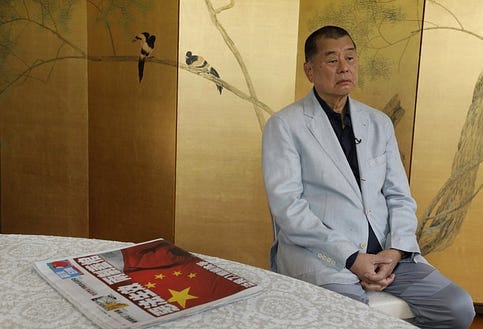
Readers in the UK and the West would be forgiven for missing the story of the jailing of Jimmy Lai, a British citizen and newspaper mogul in Hong Kong, under the national security law. However, this highlights how far Hong Kong has fallen, reveals the sentiments in Beijing, and provides a dangerous template for authoritarian creep around the world.
Hong Kong occupies an unusual position in the geopolitical imagination. It is often framed as a hybrid, sort of Western, sort of not, sort of democratic, sort of not, but this framing can obscure as much as it reveals. Hong Kong is an ethnically diverse city, the original population would now be referred to as Cantonese, but a series of complex historical factors have resulted in a unique blend of different Chinese cultures, large waves of European immigration, significant Vietnamese communities and many other smaller ethnic groups. This mixture has always made Hong Kong different, and hard to generalise.
For between 99 and 155 years (depending on exactly which part) Hong Kong was ruled by the British. In this period, modern Hong Kong culture developed and was shaped by the many waves of immigration, both from China and elsewhere. Hong Kong evolved into a deeply commercial city, with Chinese entrepreneurial spirit allied with Western capitalist practices and experience.
This fed into the governance of Hong Kong, as massive institutions sought to protect their interests, with little moves from the establishment towards the kind of democratic institutions we see around the Western world today. The government of Hong Kong before the handover to China in 1997 was top-down, highly technocratic, and only began to become democratic in the 1980s. This may sound an anathema to its Western equivalents at the time, but it was also distinctly different from mainland China. Hong Kong was firmly capitalist, more meritocratic than China and very outward-looking. In short, Hong Kong was then, and remains, neither like China, nor like the West.
A Brief History of Hong Kong’s Democratic Experiment
The relevant history here is not the full saga of Hong Kong, but the narrow corridor of democratic development that made Jimmy Lai’s journalism possible and his prosecution inevitable.
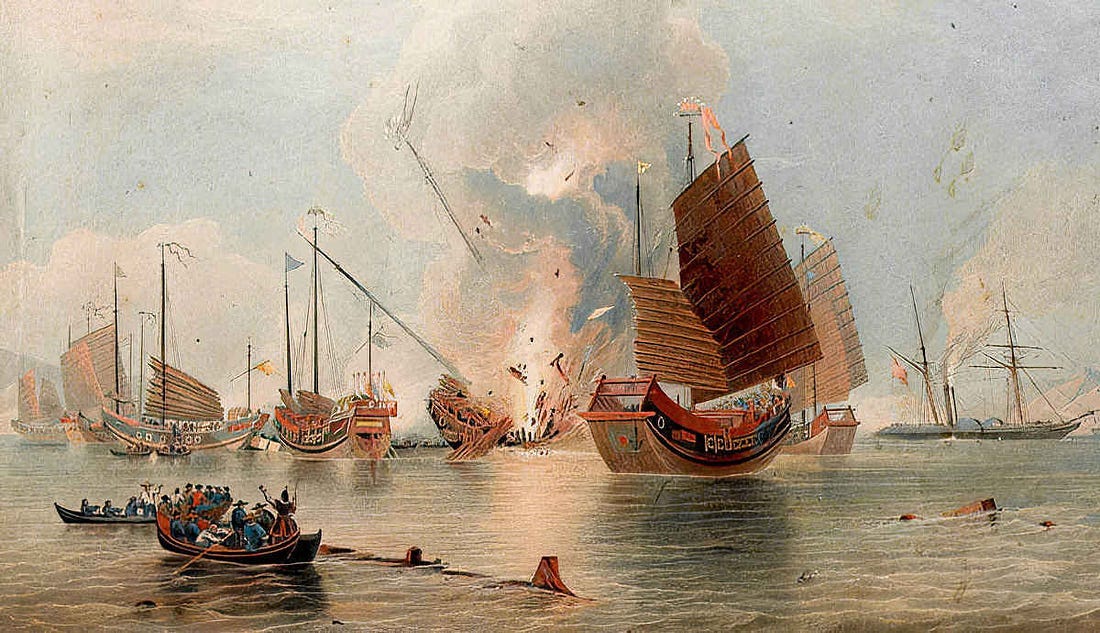
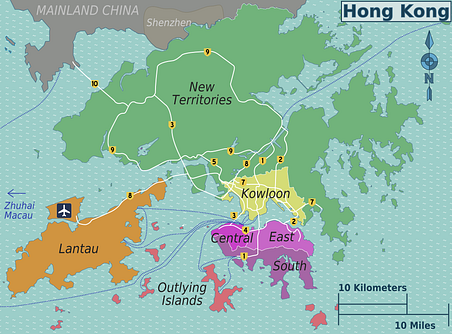
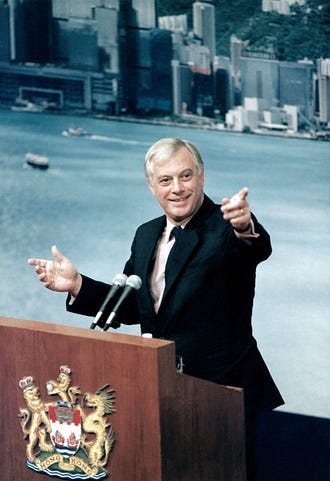
Hong Kong was a British colony for over 150 years. Hong Kong Island was ceded to Britain after the First Opium War under the Treaty of Nanking in 1842. The Kowloon Peninsula followed in 1860 after the Second Opium War, and in 1898 Britain secured a 99-year lease on the much larger New Territories. It was the expiry of this lease that made the handover to China in 1997 a legal inevitability; although Hong Kong Island and Kowloon had been ceded in perpetuity, the territory was not viable without the New Territories, and so the whole of Hong Kong was returned. Of those 155 years of British rule, Hong Kong was democratic for at most fifteen. The first indirect district-level elections were held in 1982, the first direct elections to LegCo not until 1991, just six years before the handover. For the vast majority of its colonial history, Hong Kong was governed by an appointed governor with no elected legislature whatsoever. To paraphrase Chris Patten, the last of those governors, British colonial policy elsewhere had been to build institutions and democratic precedents, then pack up and go home. That was never the plan for Hong Kong, and the colonial administration was conducted accordingly. This late and truncated democratic experiment is both the foundation of the freedoms Jimmy Lai exercised and, Beijing would argue, evidence of their shallow roots.
Democratisation began in earnest in the 1980s, although the Joint Declaration with China had already been signed by this point, making it clear the colony would be handed back. China was opposed to universal suffrage. This created a fundamental tension that shaped everything that followed. The result was a hybrid legislature, the Legislative Council, or LegCo, built around three types of constituency: directly elected seats, appointed seats chosen by the governor, and functional constituencies, indirectly elected seats designed to represent business and professional interests. Functional constituencies were a concession to Beijing’s fear of mass democracy, particularly acute after the Tiananmen Square massacre of 1989, when many Chinese dissenters fled to Hong Kong.
The democratic trajectory was real but constrained. By the last British elections in 1995, LegCo had 20 directly elected seats, 30 indirectly elected, and 10 chosen by an Election Committee. The largest party was the Democrats, led by Martin Lee, a fierce critic of Beijing. At the moment of handover in 1997, this legislature was dissolved and replaced by a provisional body entirely chosen by a 400-person selection committee in Beijing. The 1984 Joint Declaration had guaranteed, for at least 50 years, that Hong Kong would enjoy a high degree of autonomy, that its capitalist system would remain unchanged, and that freedoms of speech, press, and assembly would be protected. This was the promise of “one country, two systems.”
There was some fitful progress. In 1998, fresh elections broadly restored the pre-handover balance. By 2010, LegCo was split evenly between directly and indirectly elected seats. But all candidates for the Chief Executive had to be approved by Beijing, a restriction that triggered the Umbrella Movement protests in 2014. Then, in 2019, Chief Executive Carrie Lam introduced the extradition bill, which would have allowed suspects to be tried in mainland China under Chinese law. Mass protests erupted, and Beijing responded by imposing the National Security Law in 2020, criminalising secession, subversion, collusion, and terrorism under definitions broad enough to catch almost any form of dissent.
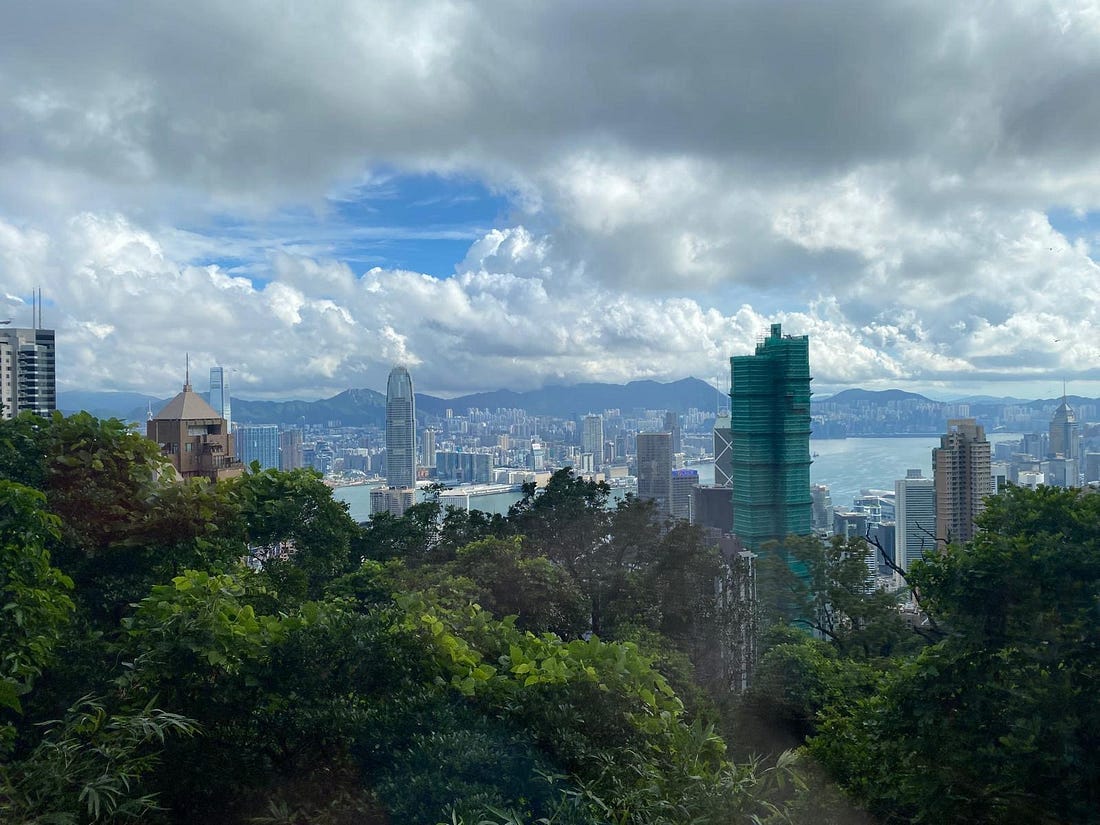
In 2021, elections were restructured. Only 20 of 90 LegCo seats were directly elected, and all candidates had to pass “patriots governing Hong Kong” vetting, designed to remove dissenting voices before they reached the ballot. The Chief Executive and legislature are now effectively hand-picked by Beijing, with an illusory veneer of democracy providing plausible deniability.
The Complicated Relationship Between Hong Kong and the Mainland
To understand why Jimmy Lai’s case resonates so deeply, it is necessary to understand the fraught relationship between Hong Kong and mainland China after 1997, a relationship that operates on two distinct levels.
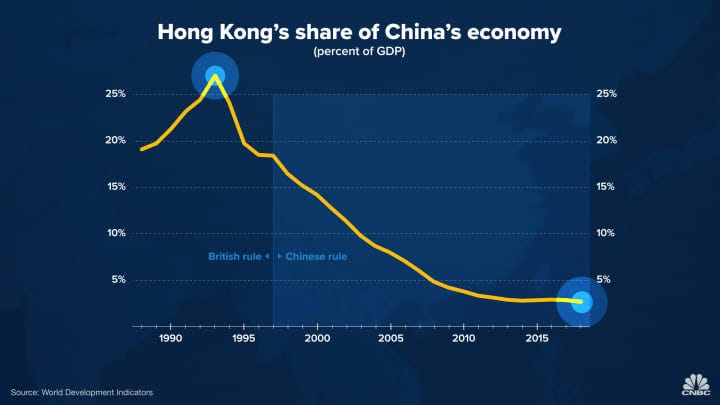
At the governmental level, the dynamic has always been one of asymmetric power, but the legal architecture of “one country, two systems” was more than a fiction. The Basic Law gave Hong Kong courts genuine power, including the theoretical ability to strike down laws imposed from Beijing that breached its provisions. Institutions like the court system and civil service predated the Joint Declaration, and the frameworks established in 1984 and 1997 were designed to entrench and expand them, and their democratic basis. But Beijing has always regarded this arrangement as a temporary concession rather than a permanent settlement. Every expansion of democratic space in Hong Kong was treated in Beijing as a provocation, and every protest as evidence that the experiment in liberalism had gone too far. The National Security Law was not an aberration but a correction, from Beijing’s perspective, a reassertion of sovereignty over a territory that had been allowed too long a leash. It is notable that Beijing’s decisive move came only after years of patient institutional capture, gradually ensuring that colonial-era judges were replaced and that the judiciary, once a genuine check on Beijing’s power, was staffed with figures whose independence could not be relied upon.
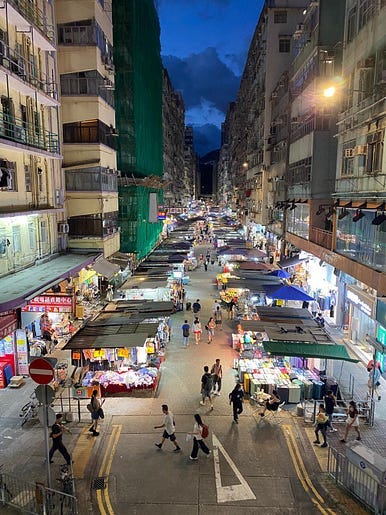
At the level of ordinary people, the relationship is more complicated and more bitter. Many Hong Kongers have long viewed mainlanders with a mixture of disdain and anxiety, considering them uncouth and representative of a system antithetical to Hong Kong’s self-image as a globalised, rules-based society. Mainlanders, in turn, have often viewed Hong Kongers as arrogant and ungrateful, beneficiaries of Chinese sovereignty who refuse to acknowledge it. But the neat division between Hong Konger and mainlander is itself somewhat misleading. The vast majority of Hong Kong’s population moved there from China at some point; most had/have family across the border and were, in origin, mainlanders themselves. There is significant diversity of origin in the territory, and many Hong Kongers are native Mandarin speakers as much as Cantonese. What unified this diverse population was not a shared ethnic or linguistic identity so much as a shared reason for being there: overwhelmingly, the people who came to Hong Kong, particularly from the late 1940s onwards, came because they feared communism and the CCP. The freedoms guaranteed by British rule, freedom of speech, of the press, of assembly, the rule of law, were not incidental attractions but the reason many had fled China in the first place. This is what made Jimmy Lai’s story both typical and extraordinary. Born on the mainland, he came to Hong Kong as a child, as so many did, and became the loudest champion of the freedoms that had drawn his family there. Beijing has weaponised the cultural friction between Hong Kong and the mainland to paint the democracy movement as anti-Chinese separatism, but the movement was never about rejecting Chinese identity. It was about defending the specific liberties that had made Hong Kong a refuge.
Jimmy Lai and Apple Daily
Jimmy Lai was born in 1947 in mainland China as Lai Chee-ying. He moved to Hong Kong as a child and became a successful businessman, founding Giordano, a retail clothing chain. Taking the name Jimmy Lai and becoming a British citizen, he consistently supported and called for democracy in Hong Kong, criticising the British administration for not moving fast or far enough. In 1995, he founded the newspaper Apple Daily, which was always strongly pro-democratic, supportive of protest movements, and fiercely critical of the Chinese Communist Party.
In both 2014 and 2019, Apple Daily supported the protest movements and was sharply critical of the Hong Kong government. Lai and his paper also called for US and UK/EU sanctions on Hong Kong and China, specifically over violations of the Joint Declaration and the Basic Law, the suppression of free speech and the free press, and democratic backsliding.
In 2020, Lai was arrested under the National Security Law. In 2021, authorities froze Apple Daily’s assets and forced its closure. Lai, along with several colleagues, was charged with “collusion with a foreign country or with external elements to endanger national security.” The specific allegations included calling for foreign sanctions, meeting with foreign officials, and participating in a plan to “provoke hatred” against the governments of Hong Kong and Beijing.
On Monday 9th February 2026, Jimmy Lai was sentenced to 20 years’ imprisonment. He is 78 years old. His son Sebastian Lai described this as “effectively a death sentence.” It seems extremely likely that Lai will die in a Chinese prison, for speech he made in Hong Kong, a jurisdiction that should protect freedom of speech and the press under both the Joint Declaration of 1984 and the Basic Law of 1997.
The Silence of the West
So what has been the reaction? To all intents and purposes, nothing. A few carefully worded statements from junior diplomats, no official response from the UK government, the country where Lai holds citizenship. The British Prime Minister was in China just hours before the sentence was handed down, reportedly discussing closer trade relations, geopolitical alliances, and security cooperation. As far as we know, he did not mention Hong Kong or Jimmy Lai.
This silence is striking precisely because it represents a departure. Previous British governments were not so quiet. In 2014, the coalition government formally raised concerns with Beijing and launched a parliamentary inquiry into the erosion of Hong Kong’s autonomy. In 2016, when the bookseller Lee Bo was abducted from Hong Kong by Chinese agents, the Foreign Secretary summoned the Chinese ambassador and demanded a public explanation. In 2019, the UK suspended export licences for crowd control equipment to Hong Kong. And in 2020, Britain formally declared that China was in material breach of the Joint Declaration, extended its arms embargo on China to cover Hong Kong, and offered BNO passport holders, those Hong Kong citizens who held pre-1997 British National Overseas status, the unlimited right to live, work, and study in the UK for five years, a scheme under which more than 150,000 Hong Kongers have since relocated to Britain.
Each of these responses was meaningful but insufficient, and the trend line is unmistakable. In 2014, formal complaints and inquiries. In 2016, a summoned ambassador. In 2019, suspended licences. In 2020, a formal legal declaration and a generous visa scheme. And in 2026, when a British citizen is sentenced to die in a Chinese prison for exercising the very freedoms Britain promised to protect? Silence. The trajectory is one of steadily diminishing response in the face of steadily escalating provocation.
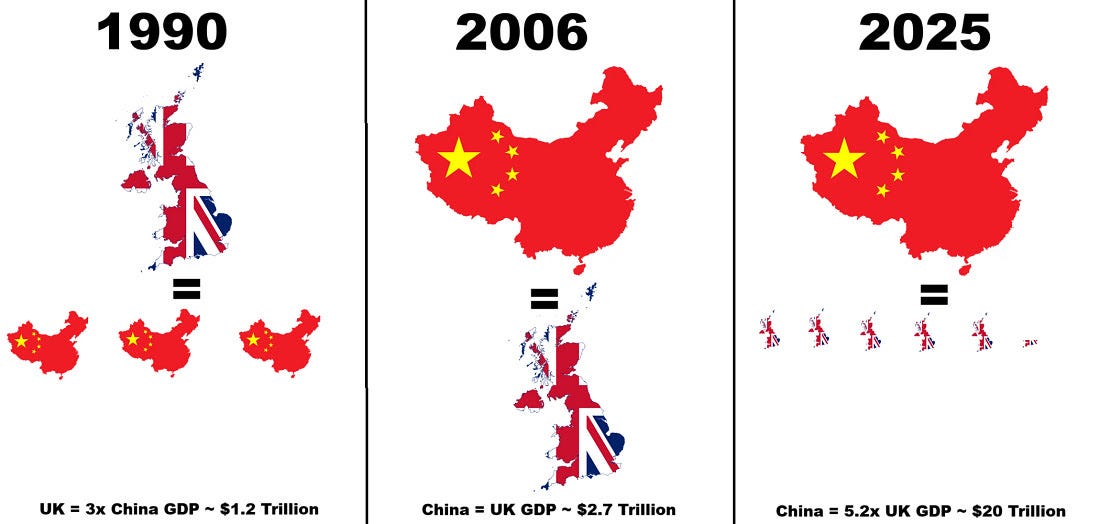
The reasons are partly economic. In 1997, the UK economy was 20% larger than China’s, and the US economy was roughly four times the size. Today, China’s economy is at least 5.2 times larger than Britain’s and only about a third smaller than America’s. The West could dictate terms to China in 1984 and 1997; it cannot today. But the shift is not merely one of relative power. The political will has evaporated. In 2020, Britain was still willing to absorb a diplomatic cost for Hong Kong. In 2026, it is not, and the calculation appears to be that the cost of speaking up now outweighs the cost of staying silent, even when the life of a British citizen is at stake.
This is further complicated by the wider global free-speech debate. China would likely react to criticism by parroting right-wing talking points from the UK and US, pointing out that certain forms of censorship (for example of hateful or inflammatory language) are commonplace and accepted in the West. This equivalency is nothing more than superficial; in the UK and Europe, citizens are free to criticise their government, and many people make it their full-time job. However, the argument is already raging globally about free speech and censorship, and it is perhaps understandable that some actors would prefer not to involve China in internal debates about domestic policy.
Hong Kong as a Blueprint
The case of Jimmy Lai is not merely a story about one man, one city, or even one bilateral relationship. It is a template, and the world should pay attention to what it reveals.
China shares land borders with fourteen countries and has active territorial disputes or fraught relationships with the majority of them. It claims almost the entirety of the South China Sea, putting it at odds with Vietnam, the Philippines, Malaysia, Brunei, and Taiwan. It has unresolved border tensions with India, with whom it fought a deadly skirmish in the Galwan Valley as recently as 2020. It maintains an uneasy relationship with Japan over the Senkaku Islands and with South Korea over its support of North Korea. Even relations with Russia, ostensibly China’s closest partner, are underlaid by a history of territorial competition in Central Asia and the Russian Far East.
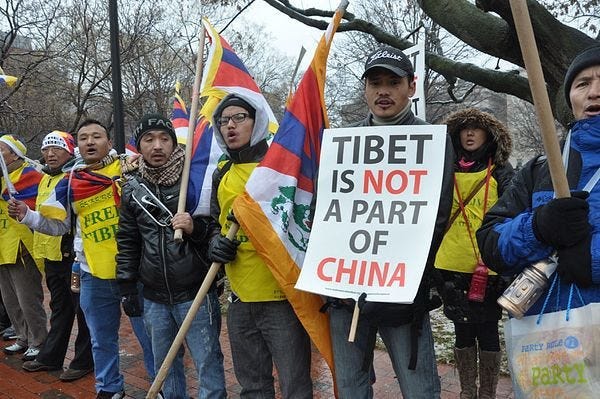
Tibet offers the earlier draft of the same playbook. Its culture is ancient, distinctly Central Asian in character, and far removed geographically and culturally from the Western powers best placed to object; it had few natural allies, and China could move against it with relatively little diplomatic consequence. Absorbed into the People’s Republic in 1950, its autonomous institutions were gradually dismantled, its religious and cultural leadership driven into exile, and its distinct identity subordinated to the demands of the central government. The world looked on and, in time, looked away. That experience appears to have taught Beijing something important: that the international community’s outrage is loud but short-lived, and that the isolation of a target matters. Hong Kong was a harder case, an ex-colony with deep Western ties, a free press, and a treaty guarantee from a permanent member of the UN Security Council. And yet the response was, if anything, less sustained. The implication for Taiwan, a fully functioning democratic state with its own government, currency, and military, should not be lost on anyone.
Hong Kong is the most visible and most complete example of what happens when Beijing decides that a territory’s autonomous tendencies have become intolerable. The playbook is now well established: legal mechanisms are imposed under the guise of national security, dissent is criminalised, institutions are hollowed out and restaffed with loyalists, and the international community is dared to respond. What should concern us is not just that the international community failed to respond on Hong Kong, but that a pattern of escalation has been established in which each provocation from Beijing is bolder than the last and each reaction from the West is weaker. The dissolution of LegCo drew protests; the National Security Law drew formal declarations and visa schemes; the imprisonment of a British citizen for life drew near-total silence. Beijing has watched this pattern closely and drawn the rational conclusion: the cost of asserting control diminishes with each iteration. Taiwan watches most closely, but so do the governments and peoples of every state along China’s periphery.
The First Domino
Whilst we worry about what might become of the world, and where the authoritarian great-power politics of the 18th and 19th centuries may lead us in the 21st, we should take a moment to acknowledge what has already been lost. Recent events have made the global economy more unstable, and many countries are turning towards China, as the recent deal with Canada illustrates. China is clearly the ascendant economic power of the world, and its authoritarian model, its repressive approach to speech and press freedoms, look increasingly in step with, rather than opposed to, the direction of other world powers, including, troublingly, the United States.
Jimmy Lai was not prosecuted for his speech before 2020, and critically, his views and his speech did not change in 2020. He said the same things after the National Security Law that he had said before it. What changed was not Jimmy Lai but the world around him. An increasingly illiberal and reactionary global order has allowed China to punish him for that speech now, and such is China’s power, and the power of authoritarian and repressive voices globally, that nobody feels able or compelled to object to China’s treatment of its obligations under international agreements.
It may be appropriate to view Hong Kong not as an outlier but as the first domino to fall in a Western-led world order. For decades, that order rested on the assumption that liberal democratic norms, freedom of speech, rule of law, human rights, were not merely Western preferences but universal principles that the international community would defend, and that other countries would, in the fullness of time, come to embrace. Hong Kong has proven both assumptions false. The guarantees were made, the treaties were signed, the promises were given, and when the time came, not a single Western government was willing to enforce them against a sufficiently powerful adversary. And the belief that the arc of history bends towards liberalism, that economic development would inevitably bring political liberalisation, has been comprehensively disproved by a China that has become the world’s second-largest economy while tightening, not loosening, its grip on political freedom.
If and when Taiwan falls under similar pressure, historians may well mark the sentencing of Jimmy Lai, and the silence that followed it, as the moment the post-war liberal order ceased to function as anything more than a convenient fiction. We have already reached the point where world leaders will stay silent on human rights, free speech, and international law in exchange for better trade terms, or at least to avoid offending a great power. That is a decisive first step onto a slippery slope, and we have a very long way to go to get back to a principled, rules-based order from here.
Please sign up as paid so I can work on this project full time:


Many thanks to Guerre and Shalom and @Daniel Clarke-Serret for reposting this, much appreciated!
Excellent article from Cymposium. We lived in Hong Kong for 23 years and were present during the disappearance of the booksellers that were selling works gossiping about Xi and his girlfriends. Today, it seems that a book about a local Hong Kong hero who did nothing more than amplify the views of the vast majority of Hong Kongers (I remember the massive swing against pro-Beijing parties in the local constituency elections of 2019 which "curiously" were not reported on the Mainland as well as the beautiful spontaneous singing of ordinary Hong Kongers in the luxury shopping malls supporting the pro-democracy protests and the home they loved in 2019/2020 before the sedition law was passed). Thanks for this article. I shall follow your articles closely in future.