


Zionism is not a modern phenomenon. It’s a deep continuation, not only of the two temple periods, but also of the long and wrongly-forgotten exile.
Here is the thesis of serialising author Eli Kavon: We should stop considering exile as the Dark Ages for it it was practise for Statehood. Diaspora life, along with the entire Jewish historical experience, forms one exciting, continuous story of Jewish memory. And throughout this narrative, we had a difficult balancing act, one that continues to this day: the righteousness of Jacob v the street smarts of Esau. Part I continues below. - Daniel Clarke-Serret (Editor of Guerre and Shalom)
Also from The Guerre and Shalom Publishing House:
Kurdistani Azad continues tomorrow, where we find out the truth about what’s happening in modern Syria. Please subscribe as paid to access the chapters:
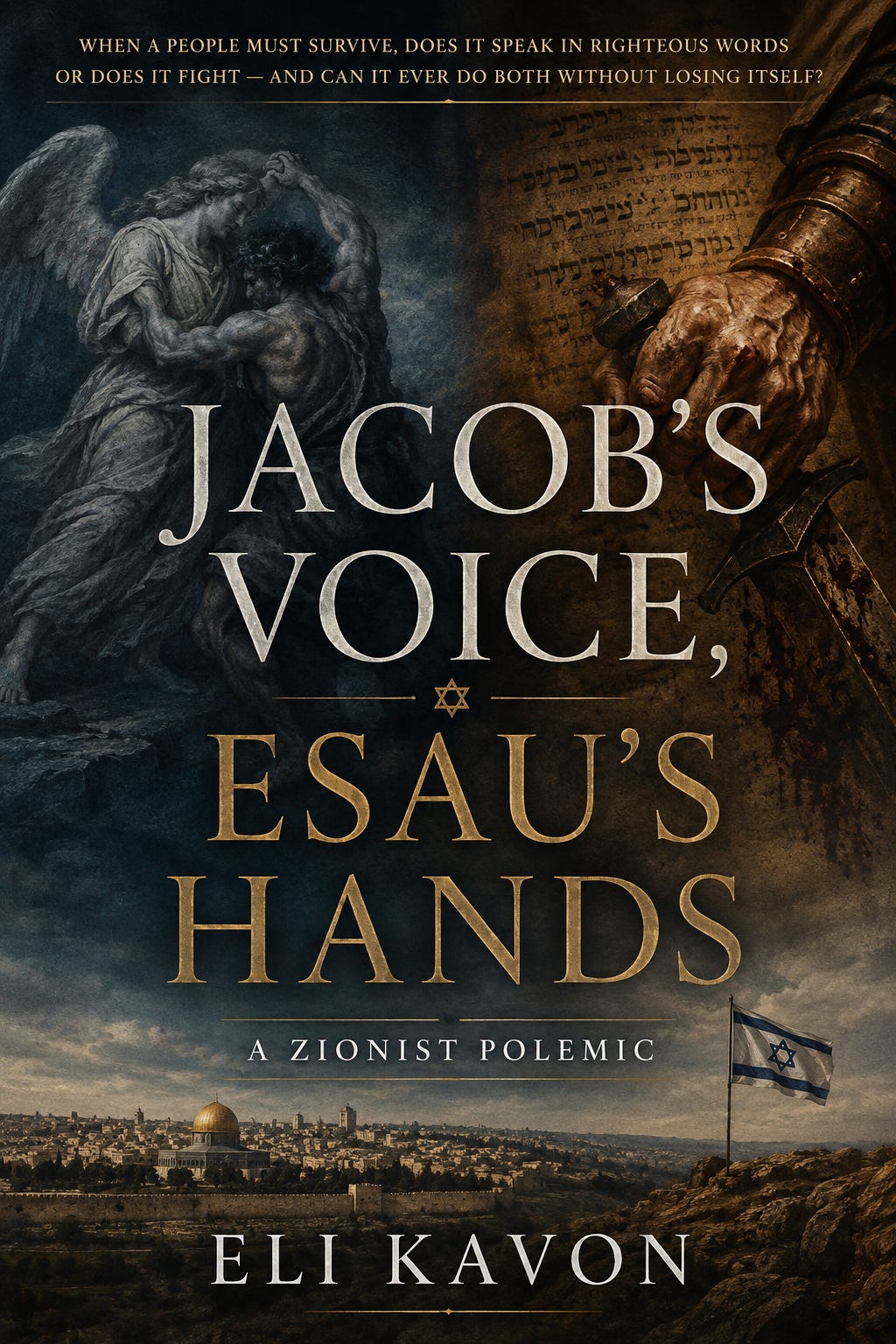
Jacob’s Voice, Esau’s Hands: A Zionist Polemic
by Eli Kavon
Introduction: The Birth of a Nation
PART 1] Foundations: The Claim of Continuity
Chapter 1: Jacob’s Journey: Evolution of a Patriarch. // Chapter 2: Triumph of the Jewish Polemic
Chapter 3: Reflections on Yerushalmi’s Zakhor
The Jewish exceptionalism traced in the previous chapter rests on an assumption: that her ancient and medieval past spoke with continuous authority to the present. Before I could accept or reject Zionism’s claim on the Jewish past, I had to reckon with the scholar who most rigorously challenged it.
****
I was a student of Professor Yosef Hayim Yerushalmi but never a disciple. After ten months of study at the hesder yeshiva in Gush Etzion, I returned from Israel to the United States. There, in 1983, I matriculated at Columbia University on Manhattan’s Upper West Side.
At the time, Yerushalmi’s study of Jewish history and memory—Zakhor—was gaining attention as a central text addressing the craft and challenges of writing Jewish history. I enrolled in two of his classes on the history of the Jews of Spain.
The lectures were outstanding and Yerushalmi’s assigned papers and exams were creative and memorable. Although I did not continue at Columbia for graduate studies in 1987, I left Morningside Heights with a knowledge that the professor appreciated and praised in my essays and exams. Yet, the shadow of Yerushalmi’s influence on my worldview continues to trouble me, especially as articulated in his study of Jewish history and Jewish memory.

