



What would Jesus do? Get the disinterested Samaritan to call the appropriate government agency! Inspiring? If not, why not?
Continuing our series on social cohesion, thinker Richard Neat takes off his Michelin-starred chef’s hat and writes one of the most persuasive cases for conservatism I’ve ever read. It isn’t a simplistic, sloganistic article full of clichés such as “We need a smaller state!” or “Get the government out of our lives!” Nor is it a Thatcher-Reagan tribute act worshiping the “power of the free market”. It’s something far more subtle and far more special. It’s about liberty, and the institutions we need to practise the lost arts of responsibility, judgment and decision. In a work of great nuance, Richard examines the conditions for continued community in a world assailed by two completing ills, uber-consumerism and all-encompassing bureaucratisation, that, each in their own way, remove the individual from the realm of self-thought.
It’s a wide ranging, intellectual exercise which takes in education, philosophy, and the effect of post-war politics first on the the community and then on the individual who is left to navigate a soulless, atomised world where the only institutions left are federalised civil servants. I have a feeling that this piece will be some importance for years to come. - Daniel Clarke-Serret (Editor, Guerre and Shalom)
An interview with Richard Neat:

Final chapter of Richard Neat’s “Observations from the Kitchen” serialised on Guerre and Shalom:

“What sort of human being does a free society require - and are our institutions still capable of producing him?” by Richard Neat
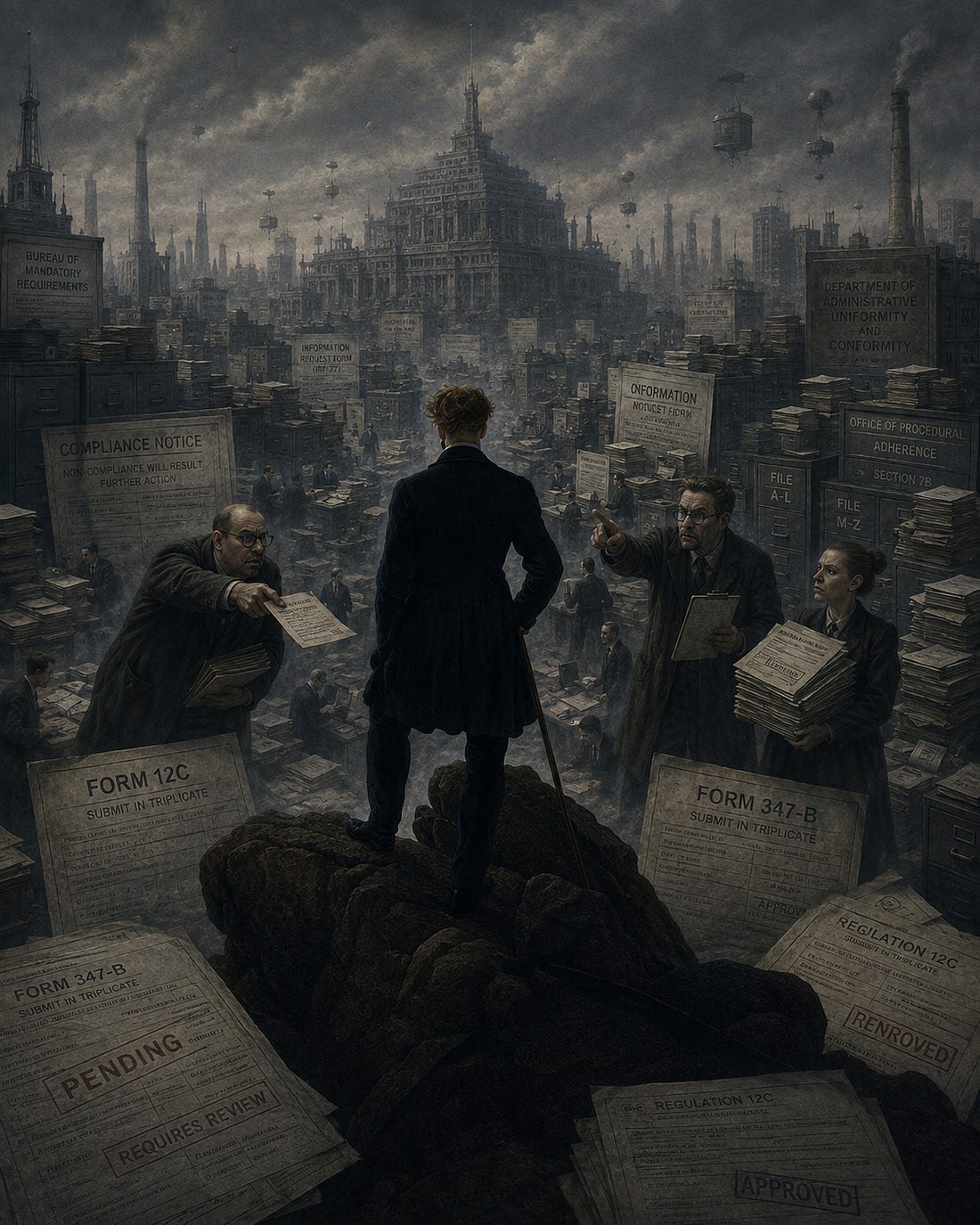
Let us begin with one of modern conservatism’s favourite targets, one as easy as hunting dairy cattle with rifles equipped with telescopic sights: the teachers’ unions. The quarry is so deliciously deserving. We spend fortunes upon education, create ministries and departments, multiply qualifications, professional standards and administrative posts, and then discover that an alarming number of adults appear less capable of governing themselves than previous generations who enjoyed far less formal instruction. The customary political argument then begins: one side demands more money, the other demands more accountability, while both quietly accept that education is chiefly a system for producing employable workers and measurable outcomes.
But that is already to surrender the central question. The older purpose of education was not merely to prepare a person for employment. It was to form the kind of human being capable of living freely and well. The Greek ideal of paideia meant the cultivation of the whole person: reason, judgment, courage, moderation, civic virtue and the capacity to participate in the life of the polis. Education prepared a citizen not simply to earn a living, but to govern himself and, with others, to share in governing the community.
Humboldtian Bildung carried this idea into the modern liberal world. Bildung is self-formation: the development of individuality and character through the active encounter between a human being and a varied world. Wilhelm von Humboldt understood that this development required freedom. A person whose choices are continually directed toward officially approved ends may become orderly and useful, but the faculties of judgment, initiative and responsibility remain stunted. Human capacities develop through exercise. We learn judgment by judging, responsibility by bearing responsibility, self-restraint by restraining ourselves, and freedom by exercising freedom.
John Stuart Mill inherited precisely this concern. Individuality, for Mill, was not a decorative luxury added to a liberal society after the serious work had been completed. It was one of the principal conditions of human development. A person does not acquire character by having every important decision made for him. Even error has educational value. The possibility of choosing wrongly is part of being free; remove that possibility and we have not perfected liberty but abolished it.
The intellectual genealogy is therefore clear: Greek paideia, Humboldtian Bildung and Millian individuality all assume that a free society depends upon persons whose faculties have been formed through use. This gives us the governing question: What sort of human being does a free society require - and are our institutions still capable of producing him?
We tend to speak of liberty as though it were principally a constitutional arrangement: limits upon state power, protected rights, elections, independent courts and freedom of expression. All are indispensable. Yet they are not sufficient. Liberty is also an achievement of character. A constitutional order can guarantee a sphere of freedom; it cannot guarantee that citizens possess the judgment, courage and self-command required to inhabit it.
A free society therefore depends upon internalised social regulation. Most decent conduct does not begin with the fear of prosecution. I do not refrain from cheating my neighbour because I have calculated the probability of conviction. I refrain because one simply does not behave that way. The rule resides within the person rather than above him. Where conscience fails, a second layer appears: reputation, embarrassment, loss of respect, exclusion, disappointing one’s family, being thought dishonourable. Only after conscience and social opprobrium fail need coercive law become the backstop.
