

Rooted Truth · Part Three · The Machinery of Denial · Chapter 8
“It’s an obscene inversion: a UN official accuses the Jewish state — fresh from having had its civilians butchered en masse — of genocide, while being unable to unequivocally denounce the genocidal terror group that provoked the war.”
About the book. The libels arrive in waves — apartheid, colonialism, genocide — each one presented as new, each one a fresh costume on a wish older than any of them. Rooted Truth dismantles them and traces their lineage to the Soviet propaganda machinery that drafted the modern vocabulary now used against Israel at the UN, on campus, and through the NGOs that traffic in it.
Read the serial from the start: Rooted Truth on Guerre & Shalom
Get the book: Paperback · Hardcover · Kindle
About the author. Uriel Zehavi is Managing Director of the Mitzpe Institute and publisher of Israel Brief. He is the author of Holiday From History, also serialised here on Guerre & Shalom, Rooted in Judea, and Letters Across the Table.
Chapter 8: The UN Assembly Line
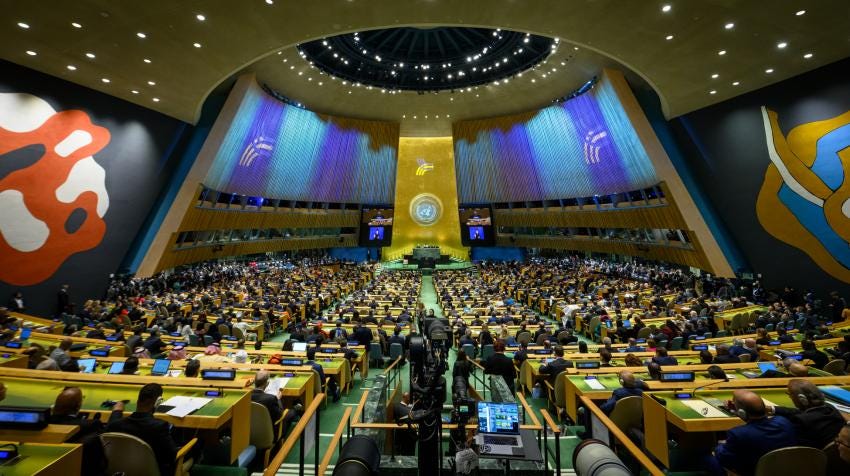
Late fall in New York. The gavel drops, the lights rise, and the choreography begins. Delegates sit beneath the giant gold seal. A representative of a police state condemns Israel with practiced indignation. The votes flash green. Another resolution passes. In the same session, mass graves in Syria and prison camps in North Korea slip by with a sigh. Israel, alone, gets the spotlight. The theater is absurd, but the script is deadly serious: repeat the charge often enough and the audience will forget who wrote it.
The UN runs an institutionalized assembly line against Israel, with bias built into the routine. A permanent agenda item exists to single out the Jewish state at every Human Rights Council meeting. Committees stacked with dictatorships write “findings” about the Middle East’s only liberal democracy. Agencies meant for refugees morph into political instruments. Year after year, the belt moves: accusations go in, condemnations come out, press releases fly, and headlines harden into “common sense.”
Pull back the curtain. Watch how law becomes lawfare, how commissions of inquiry echo NGO talking points, and how the worst regimes on earth launder their own crimes by denouncing the Jewish state. Slogans — “apartheid,” “colonialism,” “genocide” — get stamped with a UN seal and shipped worldwide as if they were facts. The UN is a battlefield where procedure is the weapon and repetition the artillery. The goal: drag the Jewish state through mud until the mud looks like truth.

Built-In Bias
Walk into a session of the UN Human Rights Council in Geneva and the bias is visible before a word is spoken. Among global themes like women’s rights or disability inclusion sits one permanent agenda item devoted to a single country: Israel. No other nation — not Iran, not North Korea, not China — has its own standing slot. Every regular session features “Agenda Item 7,” a guaranteed time to condemn the world’s only Jewish state. Facts are optional. The machinery will run either way.
Item 7 was the concession Arab states and their allies extracted when the Council was created in 2006.1
Even UN Secretary-General Ban Ki-moon called it “an historic anomaly.”2 Western democracies have tried to scrap it. Britain, Germany, Australia, and others have all denounced it as a stain on the Council’s credibility. Yet it survives, carved into the agenda like scripture.
The effect is automatic vilification. Each session contains the familiar ritual: a parade of autocrats and activists reciting a litany of Israel’s supposed crimes. Hamas may be firing rockets at civilians. Syria may be gassing its own people. It doesn’t matter.
The Council will dutifully adopt its pre-written condemnations. The very existence of a permanent agenda item gives the farce a veneer of legitimacy. To the casual observer, it appears that Israel must be uniquely monstrous — after all, no one else earns their own line on the docket. That illusion is the point.
Item 7 is only the most blatant symptom. Since its founding, the Council has convened dozens of special emergency sessions on world crises. Nearly a third of them have focused on Israel. Not Syria. Not Myanmar. Israel. A Martian watching Earth through UN broadcasts could be forgiven for thinking that a small democracy of nine million people is the planet’s chief violator of human rights. The inversion is that complete.
Meanwhile, the same body welcomes serial abusers into leadership roles. In 2003, Qaddafi’s Libya chaired the old Human Rights Commission. In 2015, Saudi Arabia — a monarchy that flogs dissidents, beheads minors, and chops up journalists in Western countries — was appointed to head a panel selecting human rights experts. In 2018, Syria, fresh from gassing its citizens, won a seat on a UN disarmament forum. In 2023, Iran, even as it executed protesters, joined UN women’s rights committees.
These absurdities would be comic if they weren’t so corrosive. The foxes don’t just guard the henhouse — they run the ethics committee and chair the panel investigating the missing chickens.
For Israel, this is the daily weather. Every session, every debate, begins preloaded with condemnation. Even when Israel delivers disaster relief abroad or rescues refugees from its enemies’ wars, the script does not change. As one Israeli diplomat joked, if the General Assembly could find the votes, it would accuse the Jews of causing climate change. I’d laugh if I didn’t think it plausible to read that headline in the New York Times. Diabolical.
This is the real climate: a system designed to isolate the lone Jewish democracy, to turn repetition into reality. The libels — apartheid, colonialism, genocide — don’t gain global traction by accident. The UN gives them a platform, a vote tally, and a press release. Bias becomes procedure. Procedure becomes “international consensus.” That consensus drives the war of words that seeks to dismantle Israel itself.

A Flood of Resolutions
The conveyor belt runs from Geneva to New York. The Human Rights Council warms up the chorus. The General Assembly belts the finale. With 193 votes to marshal, Israel-bashing becomes an annual sport. A blizzard of texts falls from the rafters. Each one lands with the same thud: condemn, deplore, demand. Truth is the first casualty. Repetition is the weapon.
The arithmetic gives the game away. Between 2015 and 2023 the General Assembly adopted well over a hundred resolutions against Israel and only a few dozen on every other country combined. One small democracy was singled out more than all tyrannies together. North Korea, Iran, Syria, Myanmar, Venezuela — serial abusers with mass graves and torture cells — barely register next to apartments in Judea or a checkpoint that stopped a bomber.
Take a single session. Fifteen separate resolutions on Israel. Five or six for the rest of the world. Not because the world enjoyed peace elsewhere. Because blocs hostile to Israel flood the docket by design. The language is ritual. “Israeli practices affecting the human rights of the Palestinian people.” “The occupied Syrian Golan.” “Israeli settlements in the Occupied Palestinian Territory.” Context is stripped out. Terrorism vanishes. History disappears. The text reads like a press release from Ramallah wearing a UN masthead.