


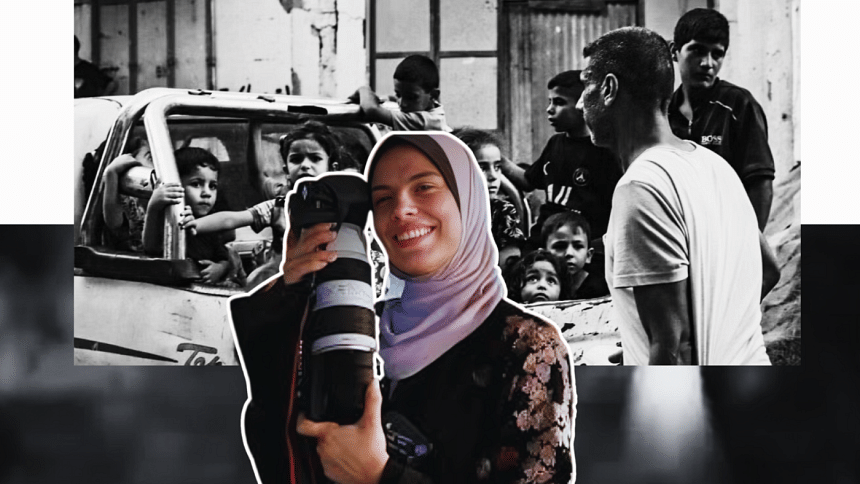
[Image: Palestinian journalist Fatma Hassona who was killed in Israeli missile strike]
EDITOR’S NOTE:
Francisco J Bernal is an expert media analyst and in today’s landmark contribution to Guerre & Shalom, he demonstrates how Gaza War grief has been weaponised to ill effect. He takes just one article from the international press to make his case - an exhibit to indict France 24 - but in truth he could have taken the vast majority of emotion-laden reports that we see in the media everyday. His case is powerful and it must be SHARED. Journalism is in crisis. Not longer content to share the facts, it manipulates its audience through emotion and places itself as judge and jury over the official narrative.
On his own Substack, The Lantern & the Void, Francisco regularly analyses news items from BBC, El País and other international icons; to take them to task for their failure to report facts in the way that every ethical journalist should do. Do subscribe.
“Anti-Israel Media Bias Fortnight” is reaching its climax. Next up will be the much anticipated Israel Media Bias Interview with Daniel and Nachum, to be released on Friday. It’s not to be missed.
“Target Acquired: France 24 and the Weaponisation of Grief” by Francisco J Bernal
“The journalist is not here to redeem the world, but to tell it.”
Manuel Chaves Nogales
Grief and Framing
I do not deny the suffering of Palestinians in Gaza War. Especially as one fought in dense civilian areas and fuelled by armed groups that operate from within them, it produces terrible human consequences. Tens of thousands have been killed1. Many more have lost their homes. Water, electricity, food, medicine: all are in short supply. And yes, women, children and elderly civilians have died2. These are not statistics. They are lives, and they matter.
It is precisely because their lives matter that they deserve to be reported with honesty, responsibility and context. This is why headlines like the one published by France 24, “Fatma Hassona’s death in Gaza was ‘targeted’ killing, film director tells Cannes,” are not only misleading. They are dangerous.
Not because they report on grief. But because they present grief as proof.
The article opens not with a news report, but with a eulogy:
“Fatma Hassona, the Palestinian photojournalist whose death in an Israeli missile strike has sparked global outrage, was the victim of a targeted assassination, Iranian director Sepideh Farsi told Cannes audiences.”
No hesitation. No attribution of the claim to an investigation. No use of “allegedly.” No counterpoint. Just the narrative, delivered through tears and applause.
There is no indication of further investigation. No serious review of evidence is offered in the published piece. A single claim, shaped by grief and coloured by ideology, is treated as fact. The reader is invited not to examine, but to mourn. And once in mourning, to assign blame.
France 24 quotes Farsi at the film’s premiere:
“Two missiles fired from a drone sliced through her building and exploded on the floor where Fatma lived, as they had been programmed to do,” she said. “It was a targeted attack.”
This is not journalism at its best. It is narrative construction masquerading as reporting, a disservice to the public and to the values of responsible media.
Farsi’s grief is her own. One can understand her anger. But for a news outlet to relay that anger unfiltered, as if it were fact, is a dereliction of journalistic duty.
Even if this were an isolated lapse, it would demand scrutiny. But it isn’t. And no credible outlet should present such a claim unexamined, however emotionally compelling it may be. Israeli military action is repeatedly framed as malicious. Hamas is systematically omitted from the equation. Voices that confirm the “right” kind of grief are elevated without question.
To understand Gaza, one must begin with how the battlefield was built.
On 7 October 2023, Hamas launched the worst massacre of Jews since the Holocaust. Over 1,200 people were murdered, most of them civilians. Women were raped. Families were burned alive. Hundreds were abducted into tunnels beneath Gaza. That attack was not an act of desperation. It was a calculated provocation. It succeeded. The invaders forced the invaded to respond, knowing that every Israeli action in self-defence would be used as evidence against it in the court of public opinion. This is how Hamas fights: not just with rockets or rifles, but with spectacle. On that fateful day, it filmed the slaughter, uploaded the fire, dragged the world into its theatre of blood. It forced Israel into war, then began counting the dead.3
But in truth, it began long before that. Hamas has launched thousands of rockets into Israeli towns and cities over the past two decades, often unprovoked. There were major escalations in 2008, 2012, 2014, and 2021. Each time initiated by Hamas, each time resulting in an Israeli response. In the months before October 7, Hamas-backed militias tested Israeli defences with rocket fire and incursions. Even during so-called ceasefires, the group continued to stockpile weapons and deepen its tunnel network beneath civilian infrastructure.4
And it worked. Because Hamas does not fight from open ground. It builds tunnels beneath hospitals, stores rockets in schools, and launches attacks from mosques and civilian rooftops. It has used ambulances to transport weapons and forced families to remain in buildings used as operational command centres. These are not unverified claims. They have been documented by both Israeli and international sources, including UN bodies in previous conflicts.5
That is why Palestinians in Gaza are suffering. Not because Israel seeks civilian harm, but because their rulers, in power since violently seizing Gaza in 2007, have built a war machine inside the places people live. Hamas has had nearly two decades to govern. It has chosen tunnel-digging over hospitals, rockets over jobs, martyrdom over life.
Hamas has received billions in aid over the years. But what has it done with that money? Has it built functioning hospitals, or has it constructed vast underground tunnel networks? Has it invested in clean water, energy infrastructure and education? Or has it funnelled funds into weapons manufacturing and recruitment propaganda? Gaza has not been developed. It has been militarised.6
And these tunnels are not shelters for civilians. Israel has built shelters for its people. Hamas has not. It could have allowed its citizens to take refuge underground, but it chose not to. It built bunkers for weapons and commanders, not for children.
This is the context France 24 leaves out.
The IDF, for its part, is quoted in the article saying:
“The Israeli military said in a statement on Thursday that it had struck a Hamas militant in Gaza City on April 16 and that ‘steps were taken to mitigate the risk of harming civilians’.”
The quote is included, but only as a formality. No visible effort is made in the piece to explore the claim or weigh it against available evidence. The reader is not informed. They are nudged toward a predetermined conclusion: the only valid one, in the eyes of France 24.
What Was Left Out
The claim that Israel is systematically targeting journalists is grave. It demands hard evidence. France 24 provides none.
Instead, it cites a statistic:
“More than 200 journalists have been killed in Gaza since the start of the war, the deadliest toll on record for a military conflict, according to media watchdog Reporters Without Borders.”
The number is left to do the work of implication. France 24 does not ask how many were embedded with Hamas media arms. It does not ask how many were operating near known combatants or infrastructure. It does not engage with the fact that Hamas, like Hezbollah, routinely uses journalists and press vests as shields and tools of its information war.
Journalism in Gaza is not free. Reporters Without Borders7, Freedom House8, and the Committee to Protect Journalists9 have all noted the environment of intimidation, censorship, and control imposed by Hamas. Local journalists face threats, surveillance, and arrest. Foreign journalists are heavily managed. In some cases, reporters are effectively forced to operate as extensions of the Hamas narrative machine or not at all.
And some are not merely passive participants. After the October 7 attacks, evidence emerged, first published by HonestReporting, showing that several freelance journalists had crossed into Israel alongside Hamas terrorists, photographing the massacre in real time. Cameras had been set up in advance. These photographers, some of whom had bylines with international outlets, appeared to have had advance knowledge of the incursion. At minimum, they were present from the beginning. Not as distant observers, but as participants in the spectacle.110
To be absolutely clear: Fatma Hassona may have been a devoted photojournalist, a witness to human suffering, documenting with courage and care. Her death is a human tragedy. But grief must not eclipse the journalistic obligation to ask hard questions. Honouring her life requires truth, not myth.
France 24 does not ask how close Hassona was to a legitimate target. Whether Hamas was operating nearby. Or whether another operative may have been the intended subject. It does not ask because it does not investigate. It takes an opinion as evidence, and forgets the principle that journalism that does not inquire cannot claim to inform.
Manufactured Authority
France 24 reinforces Farsi’s claim with this line:
“FRANCE 24 was able to consult the report by Forensic Architecture, which states that, ‘The missiles dropped by the Israeli military specifically targeted the Hassona family’s apartment on Floor 2’ of the five-floor building.”
No dissenting view is offered. No scrutiny of methodology. Just a single line, presented as final.
Forensic Architecture’s work has drawn scrutiny from legal scholars and analysts for its advocacy affiliations and methodology. Its 2021 reconstruction of the bombing of the Al Jalaa tower, which housed Al Jazeera and the Associated Press, was commissioned by B’Tselem, an Israeli activist group11. Critics argued that the group’s conclusions lacked balance, selectively omitted Israeli military justifications (of Hamas using the tower's electronic equipment to block GPS signals and disrupt the Iron Dome missile defence system12), and relied on open-source material without any adversarial review. This omission is notable given that independent legal scholars have questioned claims that the tower lacked military utility, citing IDF statements that it housed Hamas R&D infrastructure tied to electronic warfare capabilities, including GPS jamming systems13. In the case of the death of Shireen Abu Akleh, similar concerns were raised about the absence of verifiable chain-of-custody evidence, failure to incorporate declassified operational data, and ignoring third-party investigations, which determined that Abu Akleh was likely killed by unintentional Israeli fire.14
The Performance of Mourning
France 24 describes the reception of Farsi’s film at Cannes:
“The film’s Cannes premiere drew tears and a lengthy standing ovation.”
“On the eve of the festival, ‘Schindler’s List’ actor Ralph Fiennes and Hollywood star Richard Gere were among more than 380 figures to sign an op-ed slamming the film industry’s silence over ‘genocide’ in Gaza.”
“Cannes jury president Juliette Binoche... read excerpts from a poem by the Palestinian photojournalist.”
These moments are described with reverence, as though artistic grief confers investigative weight. But are actors military analysts? Are standing ovations evidence?
There is no mention of the hostages still underground. No poems for the babies burned alive in Kfar Aza. No cultural tributes for the Thai farm workers executed in fields. These deaths, too, are real. But they are not the subject of a film. They do not fit the arc.
One side is mourned in verse. The other vanishes into footnotes.
To grieve is human. To report is a responsibility.
France 24 has every right to cover the war. But it has no right to abandon balance, collapse complexity into accusation, or blur the line between feeling and fact. When journalism stops asking questions and starts staging catharsis, what it produces is not truth.
It is propaganda.
To subscribe to Guerre & Shalom, click below:
To subscribe to Francisco’s The Latern & The Void, click here.
FOOTNOTES
The original article, titled Fatma Hassona's death in Gaza was ‘targeted’ killing, film director tells Cannes, can be found here.
While casualty figures cited by international media typically originate from the Hamas-run Ministry of Health, these numbers are not independently verified and systematically exclude distinctions between combatants and civilians. Independent analyses, including those detailed in Chapter 2 of the Henry Jackson Society report (Hamas’s Human Shield Strategy in Gaza, 2025), argue that the death toll includes a much higher proportion of military-age males than reported. The report demonstrates that Hamas’s strategy of embedding fighters and infrastructure within civilian areas, such as hospitals, schools, and apartment blocks, has not only increased civilian casualties but also blurred the line between combatants and non-combatants. This tactic is designed to provoke international outrage by inflating perceived civilian harm while concealing the role of Hamas as an active belligerent.
Foreign Policy. “The Civilian Deaths in Gaza by Israel Were Inevitable”. 14 February 2024
Human Rights Watch, “I Can’t Erase All This Blood from My Mind”: Palestinian Armed Groups’ October 7 Assault on Israel'”, 17 July 2024
Lieber, Dov. “Israeli Military Reveals Tunnel It Says Hamas Built for Large-Scale Attack”. The Wall Street Journal, 17 December 2023
NATO Strategic Communications Centre of Excellence. Hamas' Use of Human Shields in Gaza. 2019.
Mohammed, Arshad; Saul, Jonathan; Irish, John; and Hafezi, Parisa. “Insight: Israel’s Gaza Challenge: Stopping Metal Tubes Turning into Rockets”. Reuters, 23 May 2021
Reporters Without Borders, “Gaza: RSF condemns Hamas' threats against journalists bombarded by Israel,” April 2025
Freedom House, “Gaza Strip: Freedom in the World 2022 Country Report”.
Committee to Protect Journalists, “Gaza journalists speak out about Hamas intimidation, threats, assaults,” May 2025
HonestReporting, “Media Give Platform to Gaza Journalists Who Infiltrated Israel or Praised Hamas Massacre,” November 2023
Ahmed, Kaamil; Dyke, Joe; and Baba, Anas. “Countdown to the Airstrike: The Moment Israeli Forces Hit al-Jalaa Tower, Gaza.” The Guardian, 28 July 2021.
Gross, Judah. “Former IDF General: Bombing AP Tower in Gaza in May Conflict Was an ‘Own Goal’.” The Times of Israel, 24 October 2021
Brian L. Cox, “The IDF Attack on Al Jalaa Tower: Criticisms Are Correct on the Law, But Mistaken in Applying It,” Just Security, 28 May 2021
Axios, “U.S. says Shireen Abu Akleh likely killed by Israeli gunfire, but not intentionally,” 4 July 2022.

Masterfully explained
Is there a Spanish language version of this article?