


Uri Zehavi takes on the most controversial geopolitical issue of our day in an (extremely) passionate chapter filled with facts, legal sources and historical references. I don’t wish to say more. And why? Because as an editor, it isn’t my place to give opinions. I am not charged with choosing: between reference to communities v settlements, Judea and Samaria v West Bank, return v occupation. Hence “the land of the patriarchs” in the subtitle. In my capacity as head of The Guerre and Shalom Publishing House, my job is to let the writer speak FREE; to express their views openly and without censorship. So long as the author is articulate, engaging and committed to the facts, they must be allowed to speak and in their full voice. Uri Zehavi achieves these criteria with flying colours. So listen, reflect and make up your own mind —for that is the only way to truth. - Daniel Clarke-Serret (Editor)
Also on the topic of sovereignty and theft:

Also from the Guerre and Shalom Publishing House:


Rooted Truth: Israel’s Case Against the Deniers
by Uri Zehavi
Preface & Introduction: The Return of the Lie // Chapter 1: Setting the Record Straight // Chapter 2: From Balfour to Independence // Chapter 3: By Right, Not Permission // Chapter 4: Apartheid as Propaganda // Chapter 5: Colonialism and the Great Erasure // Chapter 6: The Genocide Libel // Chapter 7: The UN Assembly Line // Chapter 8: Campus Catechism // Chapter 9: NGO Lawfare // Chapter 10: The Jewish Right to Return
Part Four (continued): Answering the Deniers
Chapter 11: Sovereignty is Not Theft
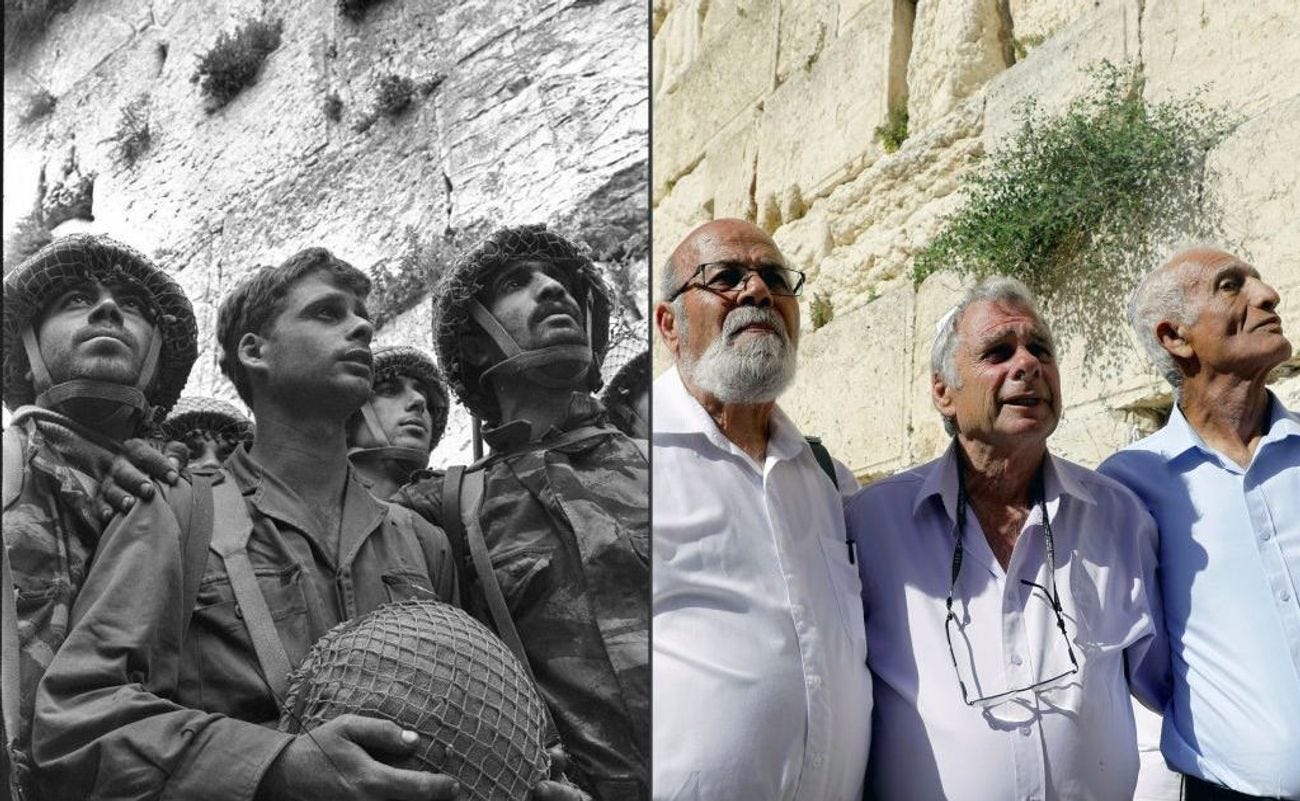
June 1967. Jerusalem still smelled of gunpowder when Israeli paratroopers pressed their palms to the stones of the Western Wall—exhausted and weeping. They had fought their way through fire to touch the last remnant of the Temple their ancestors built. For the first time in two thousand years, Jews walked freely through the Old City—not as pilgrims or supplicants, but as its guardians. One recited the Shehecheyanu prayer of gratitude; another murmured a psalm. The moment was history folding back on itself.
Yet while those young men were kissing the Wall, another campaign had already begun far from Jerusalem. In Cairo, Damascus, and Moscow, the war’s defeated architects were drafting a new narrative. Their armies had failed to destroy Israel, so they would try to delegitimize it. Their newest weapon was a single word: occupation.
That word was never neutral. It was designed to turn victory into sin—to recast the Jews not as a people restored to their capital but as intruders in it. Overnight, the liberators of Jerusalem became “occupiers.” David was rebranded as Goliath. The term entered Western discourse like a Trojan horse, carrying inside it a false premise: that Jews could be foreigners in Judea.
But you cannot occupy your own house. You cannot be an invader in the city that bears your name.
The Six-Day War was not planned as expansion but as survival. Israel faced encirclement. Egypt closed the Straits of Tiran, Syria shelled northern villages, and Arab leaders promised annihilation. “Our basic aim is the destruction of Israel,” declared Egypt’s Nasser. When Israel struck preemptively on June 5, it fought for existence—and won. In less than a week it captured the Sinai Peninsula, the Golan Heights, Gaza, and, most fatefully, the biblical heartlands of Judea and Samaria, which Jordan had seized in 1948.
For Israel, the outcome was defensive victory; for the Arab world, it was well-earned humiliation. Within months, Arab leaders gathered in Khartoum and issued their now-famous “three noes”: no peace, no recognition, no negotiations. Having failed to destroy Israel by arms (though they would try again and again), they sought to undermine it by language. The battlefield moved from the Sinai sands to the halls of the United Nations.
The Palestine Liberation Organization had existed since 1964—three years before Israel controlled a single inch of Judea, Samaria, or Gaza. Its original charter made no claim to those territories because they were under Arab control: Jordan in the west, Egypt in the south. The PLO’s goal was not liberation of those lands but the eradication of Israel and her Jews within its pre-1967 borders. “Palestine,” in the Arab lexicon of that era, meant Haifa, Tel Aviv, and Jerusalem—not Nablus or Gaza City.
Only after Israel’s 1967 victory did the word occupation appear. Suddenly, areas that had never been considered a “Palestinian state” became sacred territory whose “liberation” justified perpetual war. The irony is glaring.
Under Jordanian rule, no-one demanded an independent Palestine. Under Israeli rule, the same towns became the alleged cradle of Palestinian nationhood. The timing exposes the truth: occupation was about sovereignty—specifically about denying Jewish sovereignty.
The UN Security Council’s Resolution 242, adopted in November 1967, was drafted to outline the terms of peace. Its English version calls for “withdrawal of Israeli armed forces from territories occupied in the recent conflict”—not all the territories, and not the territories. The omission was deliberate. Lord Caradon, Britain’s UN ambassador who wrote the text, later confirmed that the language allowed for secure, negotiated borders, not a wholesale retreat to the vulnerable armistice lines of 1949.
President Lyndon Johnson agreed. “An immediate return to the situation of June 4,” he said, “is not a prescription for peace.” Yet Arab diplomats and Soviet propagandists quickly mistranslated the resolution into French—adding the word des to territoires occupés (“the territories”)—and then cited that mistranslation as proof that Israel was legally bound to withdraw from everywhere. A linguistic trick became a diplomatic cudgel.
The formula “land for peace” morphed into “land first, maybe peace later.” In every retelling, Israel was cast as the violator of law, while the aggressors of 1967 rebranded themselves as victims of “occupation.” The world forgot that the territories in question had been taken from Jordan and Egypt—countries that had attacked Israel. There had been no sovereign Palestinian state, no Palestinian borders to occupy.
In English, the word occupation evokes foreign boots on native soil—Nazi troops in France, Soviet tanks in Hungary. It implies trespass. That is why it was chosen. Arab propagandists and their Soviet patrons understood the psychological power of language. Call Israel an occupier often enough, and people will forget who the natives are.
Of course, the Jews take their very name from Judea—the land now labeled “occupied.” Every town and ridge in those hills carries a Hebrew name from Scripture. Bethlehem, Shiloh, Hebron, Bethel—these are not colonial outposts but the setting of the Jewish Bible. To call Jews occupiers there is like calling Greeks occupiers in Sparta or Navajo occupiers in Arizona. It is linguistic vandalism used to justify political aggression.
If Jews are “occupiers,” what exactly are they occupying? The territories captured in 1967 were not taken from a Palestinian sovereign. Jordan’s annexation of Judea and Samaria in 1950 had been recognized by only two countries: Britain and Pakistan. Egypt never claimed Gaza as its own. When Israel gained control of these lands in a defensive war, it assumed legal responsibility for disputed, not foreign, territory.
And beyond law, there is history. These are the hills of King David, the burial caves of the patriarchs and matriarchs, the vineyards of Samaria. The charge of “occupation” erases both the archaeology underfoot and the ancestry that named it. It asks the world to believe that the descendants of the builders of Jerusalem are trespassers in Jerusalem.
The Six-Day War did not create a new moral problem; it exposed an old one. The Arab world still could not accept Jewish sovereignty anywhere, in any borders. “Occupation” became a fig leaf for that rejection. It allowed those who lost a war of aggression to pretend they were fighting for liberation. It let the Soviet Union clothe its anti-Western politics in anti-colonial rhetoric. It gave Western liberals an easy moral cause that cost them nothing.
But facts are stubborn. The Jews who cried at the Wall in 1967 were not conquerors. They were sons returning to their father’s house. The same paratrooper who whispered a prayer there could walk a few blocks and read his own ancestor’s name on an ancient tomb. That is not occupation. That is homecoming.
Judea and Samaria: History in Brief
Call it what it is. The ridge today branded “West Bank” is Judea and Samaria. It is the spine of the country and the cradle of the Jewish People. Hebron, where Abraham bought a burial cave with minted silver. Bethel, where Jacob dreamed of a ladder. Shiloh, where the Ark rested before Jerusalem. These are not sermon topics. We dig them from the soil. Walk the stones of ancient synagogues in the Etzion hills or the stepped winepresses in Samaria and you are walking the Hebrew Bible in the present tense.
Rome might have broken the kingdom but it could never sever the link. After 70 CE and again after 135 CE, the empire scattered crowds and renamed the province to humiliate the natives. Some managed to stay. Others returned in pulses. Through Byzantine, Arab, Crusader, Mamluk, and Ottoman rule, Jewish communities kept a foothold—Jerusalem first, then Safed and Tiberias, then Hebron again. By the mid-nineteenth century Jews were the largest community in Jerusalem, as travelers and consuls recorded in their own matter-of-fact reports. In the highlands, devout families held small courts near the graves of the patriarchs and matriarchs. Hebron’s Jews, Sephardi by tradition and later joined by Ashkenazim, traced their line back centuries.
That line was cut in 1929. A mob, inflamed by lies about the Temple Mount, rampaged through Hebron. Sixty-seven Jews were butchered. Homes were sacked. Scrolls were slashed. A few Arabs hid their Jewish neighbors and saved lives—credit where it is due. The British, unwilling to secure the city, removed the survivors “for their own safety.” Hebron, the City of the Patriarchs, was cleared of Jews. In 1929.
The pattern widened in the 1936–39 Arab revolt. Jews were driven from mixed towns, including Gaza, where a small Jewish community had lived and prayed.
Then came 1947–48. Arab leaders rejected partition, opened fire, and wherever their forces prevailed, Jewish life was erased. When the armistice lines were drawn in 1949, Jordan held Judea, Samaria, and eastern Jerusalem. Egypt held Gaza. Every Jew in those areas—roughly ten thousand people—was dead, expelled, or a hostage exchanged. The Jewish Quarter of the Old City lay in rubble. Synagogues were blown up or turned into stables. Jews were barred from the Western Wall and from the Mount of Olives. Jordan annexed the territory in 1950. Almost no-one recognized the move. Even the Arab League kept its distance.
Take the term the world prefers: occupation. If it means holding land by force without sovereign title, that was Jordan in Judea and Samaria from 1949 to 1967. Britain and Pakistan offered recognition—no one else did. During those nineteen years there was no Palestinian state in Judea and Samaria, no international drumbeat for one, and the PLO’s 1964 charter pointedly disclaimed sovereignty there while those hills were under Arab rule. The project in those years, as it is now, was not self-determination. It was the removal of the Jews.
June 1967 changed the facts on the ground, not the facts of history. Israel, facing annihilation, fought and won. Gaza came out of Egyptian control. The Golan came out of Syrian control. And Judea and Samaria came out of Jordanian control. The gates of places Jews had been barred from for (just) nineteen years swung open (once again). Rachel’s Tomb. Hebron’s Cave of the Patriarchs. Joseph’s Tomb. The Western Wall. No-one said, “We have occupied foreign land.” They said, “We have returned home.”