



Today Navi Pillay, one of the devils that spread The Great Genocide Blood Libel, was awarded The Nobel “Eternal Islamist War” Prize. This tells you everything you need to know about our Palestinianised institutions, our contempt for Truth and the fall of our corrupted world.
This is why I was called to write The Genocide of Truth. This is why you need to sign up as paid today to read and spread the work that will bring the world back to sanity.
THE GENOCIDE OF TRUTH: The Deep Roots of a Modern Blood Libel
by Daniel Clarke-Serret
Introduction: The Genocide of Truth
PART 1: The Tree of Knowledge
Chapter 1: Truth // Chapter 2: Ideology // Chapter 3: Religion // Chapter 4: Science // Chapter 5: Attention // Chapter 6: Distraction // Chapter 7: (True) Expertise // Chapter 8: Authority
PART 2: The Descent to Babylon
Chapter 9: Declaration // Chapter 10: Confusion // Chapter 11: Conversation // Chapters 12: Democratisation // Chapter 13: Sophistry // Chapter 14: Image
PART 3: The Rise of Byzantium
Chapter 15: Guilt // Chapter 16: Belief // Chapter 17: Christ // Chapter 18: Mission // Chapter 19: Doctrine // Chapter 20: Heresy // Chapter 21: Sin (below)
Chapter 21: Sin
The Pear Tree or The Tree of Knowledge?
“Genocide” came from an emotional desire among the comfortable Western elite: to change the world; to make it better “for you and for me and entire human race”. Yet Truth wasn’t enough for them. They needed rage and empathy and burning desire. That was their need and their failing, and in its wake they produced a postlinguism that destroyed language, expelled Truth and left us with harmful slogan. They stole the pear the long way around.
The Historical Project to end Evil
What is it that causes human beings to engage in wrongdoing? This is a question that has perplexed philosophers, theologians and educationalists for centuries, being very much interrelated with the evergreen problem of evil. Its implications for modern-day malaises from schooling to anxiety relief to “genocide” activism are powerful and in need of immediate explication. Far from a matter of pure academic import, it is a topic that reaches to the very roots of the postlinguist religion and should be revived from the ancient vaults in which it is currently buried.
There are many explanations for the roots of human action. The perversity of our individual and collective behaviour has led many over the centuries to question the existence of a benevolent God. How is it that an all-powerful loving deity could permit the existence of evil on the planet which He is said to have created? It is not my intention to needlessly repeat the theodicies which have been well explained in my other work. Theologians, ancient and modern, have turned to the explanations of contrast, soul-making and, above all, free will to explain the coexistence of a monotheistic Creator with His fallen world.
Yet beyond the theodicies here and elsewhere mentioned, there is one classical response which requires further deliberation, that provided by the extinct world religion of Manichaeism. Unlike Christianity and Islam, which flourish numerically to this day, and Judaism, which survives lion-heartedly in diminished form, Manichaeism was the 7th world faith that is no more. In the classical world, it was a belief system of region-spanning popularity and amongst its celebrity adherents was a young Saint Augustine.
Fully available for Paid Subscribers:

The Ancient Woke of Manichaeism
Manichaeism was a faith which spoke of the existence of two deities, one good and one evil. In the Roman world of the early Church, its followers identified the Creator “God of the Old Testament” as being the God of darkness in contrast with the “loving God” of the New. His supposed evilness was demonstrated not only by his anthropomorphic jealousy and regular interventions to smite the disobedient, but more fundamentally by His association with matter. As the creator of material things, He was intimately associated with the sinfulness of the flesh. With the spiritual being inherently superior to the material - and the former perpetually being in conflict with the latter - YHWH was the Satanic force keeping us in touch with wrongdoing.
As a Jew, the author is naturally uncomfortable with the literal demonization of the Hebrew Bible, but as a purported resolution to the problem of evil, one can see its attractions. It is easy to understand the cruelty and suffering of this life if it is implicit in the material substance of things, a substance which was created and maintained by an all-powerful divine force. The spiritual good God may try to aid us in our fight against the flesh, but we are confounded by the material reality in which we live.
Nonetheless, this creed faces some severe problems, and not merely the anger of long-defamed Jewish theology. From a classical Christian perspective, it reopens the Pandora's box of Byzantine era heresies. If the flesh is inherently evil, then the “good God Jesus” could not have been made of such a substance. He may have appeared to have been a human; he may have seemed to have died on the Cross; but in reality he was a non-human person of full divinity.
More practically for the modern era, Manichaeism, intentionally or otherwise, presupposes a world of limited accountability. If the physical human is so wracked by unavoidable sin, then he is helpless in its wake. There is nothing he can do; therefore no wrongdoing can be attributed to its author. Such a rationalist philosophy would either lead followers to chronic inaction underwritten by guilt or, more likely, a life pursuing power, pleasure and meaninglessness with gay abandon. Lack of enforced responsibility births necessary impunity. Who is fallen man to overcome the evil god of flesh?
Manichaeism is the classical equivalent of scientific or historical determinism. “I can’t help it” philosophised. I act as I do because of my genes, historical injustice and how I was beaten up as a child. I come from a victim group and was blighted with a disability. In brief, it’s not my fault Officer Krupke.
In truth, Manichaeism never died; it just morphed into modern mutations. Wokeness and the like are its contemporary bastard children. As a philosophy, it was an intellectually satisfying explanation of evil, but a morally warped basis for a just society. It was time for St Augustine to look elsewhere.
Neoplatonism: “Education is the solution”
The second stop on Augustine’s train of intellectual discovery was Neoplatonism. Would the celebrated Athenian’s teachings be able to explain the perpetual wrongdoing of humankind?
We're all familiar with the Allegory of the Cave, with the unfortunate inhabitants chained against the subterranean wall, all the while seeing reflected shadows of the reality beyond. To those who need a refresher, this description from Neel Burton is appropriately evocative:
“Human beings have spent all their lives in an underground cave or den which has a mouth open towards the light. They have their legs and their necks chained so that they cannot move, and can see only in front of them, towards the back of the cave. Above and behind them a fire is blazing, and between them and the fire there is a raised way along which there is a low wall. Men pass along the wall carrying all sorts of statues, and the fire throws the shadows of these statues onto the back of the cave. All the prisoners ever see are the shadows, and so they suppose that the shadows are the objects themselves.”
The famed metaphor presents the cave-dwelling residents as being in a state of ignorance. Uneducated and unenlightened, they mistake the unreality of the reflected images as being the genuine, unmediated truth. Having (literally) turned their backs on veracity, which is to say the undefiled light of The Sun beyond, they stumble around in their ignorance.
According to Neoplatonist thought, it is this absence of education that directly leads to wrongdoing. The Transcendent One, the Sun of the Allegory, is pure goodness and unadulterated light. Once we have ascended from the cave and fully turned our faces to the purity of the Good, wrongdoing will be banished from our lives. In contrast, turning our backs to the Sun will lead us, by our own hand, to our own demise.
The Transcendent One can create no evil nor be held responsible for the existence of sin in the world, but Her absence can lead to meaning-deprived groping and a nihilism which seeks only for power and riches. Thus there is no divine-created evil in this world; only that which we create for ourselves by turning our back on the One.
On one level, Neoplatonism is intellectually satisfying as it conceives of a finely-graded ladder between complete materialism and complete spirituality. As we gradually ascend from the cave and become closer to the One, we desist in our ignorance and thereby our resultant wrongdoing. It makes it clear that there is a ladder between materialism and spirituality, whereby we must ascend to learn the highest truth (education) before descending to apply our learnings in the world (service). It also absolves the Higher Being of blame for human misery and places full accountability upon the citizen.
Put simply, where there is evil, we are to blame. If we do wrong, it is because we decided to remain in ignorance. If we - the uneducated - chose to do evil, it is us that must be held accountable. If our world is absent of inspiration and meaning, it is because, having ascended to the truth, we refused to return to serve our fellow countrymen. Neoplatonism is a vision of an educated citizenry, the enlightened teaching the ignorant and spiritual advancement leading to service in the material realm.
Neoplatonism continues to be one of the greatest forces in the modern world. Although not named as such, its presence is all around us; those who say that the answer to every problem is education. No matter the issue, they claim that there is nothing that the right schooling cannot correct. Yet, as with many such easy political formulas, it denies the complexity of reality.
We need not look far to see evidence to the contrary: educated men turned evil. Did not Robert Mugabe work as a school teacher? Did not Hitler and Stalin read widely and enjoy classical music? Isn't postlinguistic antisemitism rampant on American university campuses, more contagious among the educated than in the impoverished streets of Mississippi? In each and every here listed case, there are multiple factors at play, Yet it seems that education is no simplistic cure to evil —and in some campus-confined cases, it actually exacerbates it behind the sainted cloak of rational detachment.
So if pure education fails, where else can we turn?
The Case of the Pear Orchard
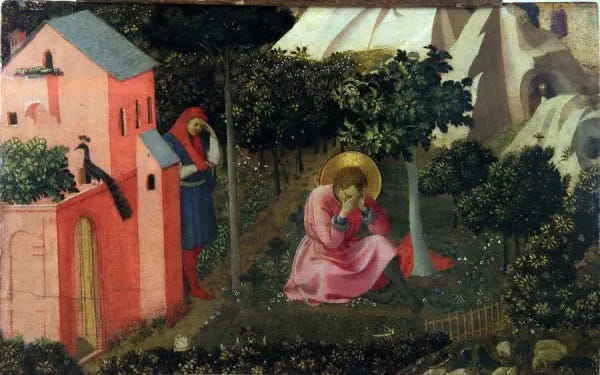
Ultimately Augustine was to reject both Manichaeism and Neoplatonism and it is this intellectual journey that is clearly laid out in his famed Confessions. For the purposes of this chapter, we are going to focus on Augustine's story of the Pear Orchard, a tale which holds significant insight on the question of wrongdoing. Far from being an ancient story of little interest, it is an anecdote of far-reaching contemporary implication.
