

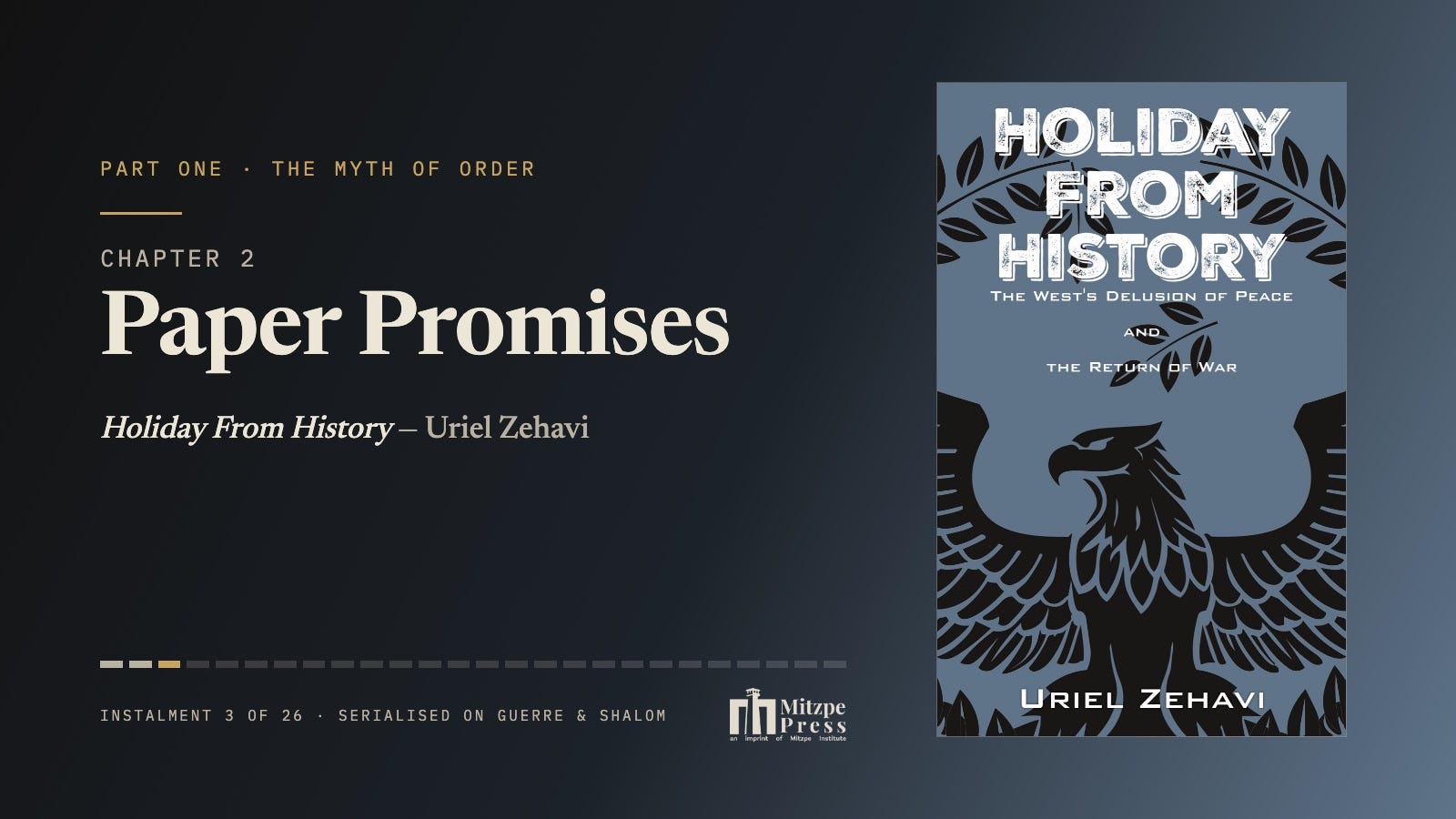
Holiday From History · Part One · The Myth of Order · Chapter 2
“Enough liturgy. If you want peace, bring strength to the table and a clock the enemy does not control. Without those, the talks are tribute, paid in installments.”
From Oslo and Iran to Ukraine, Uri Zehavi’s new chapter exposes the worthlessness - and danger - of modern diplomacy when strength isn’t brought to the table. He’s seen the evidence. “Peace” has brought war.- Daniel Clarke-Serret (Editor, Guerre and Shalom)
About the book. On October 7, 2023, Israel paid the bill for thirty years of Western complacency in a single morning. Holiday From History is the forensic account: how the post-Cold War West convinced itself history had ended, why the warnings did not break the spell, and what the collapse now reveals about the institutions meant to defend free nations.
Read the book from the start: Holiday From History on Guerre & Shalom
Get the book: Paperback · Hardcover · Kindle
About the author. Uriel Zehavi is Managing Director of the Mitzpe Institute and publisher of Israel Brief. He is the author of Rooted Truth, serialised here on Guerre & Shalom, Rooted in Judea, and Letters Across the Table.
Chapter 2: Paper Promises
In the 1990s the West took a holiday from history. The Cold War’s end convinced leaders that liberal democracy had won forever, and that peace was now the default setting of mankind. Confident in this illusion, they turned diplomacy into ritual.
Wars were treated as paperwork problems. Hold a summit, draft an accord, stage a photo-op — then declare peace achieved. Treaties became talismans. Ink on paper was supposed to erase centuries of strife.
It never worked that way. From Oslo to the Iran nuclear deal, Western leaders celebrated the signing ceremony while violence raged on the ground. Paper without power invites war.
On September 13, 1993, Yitzhak Rabin and Yasser Arafat shook hands on the White House lawn. Cameras framed it as history. Israel recognized the PLO. The PLO said it recognized Israel and renounced terror. A Nobel followed. On paper, peace had begun.
Oslo built a process and a bureaucracy. Israel handed governance in Gaza and in major towns of Judea and Samaria to Arafat’s new Palestinian Authority, allowed exiled leaders to return, and armed PA police. Donors poured in billions to build institutions. The “peace industry” bloomed. Violence did too.
Arafat spoke in two languages. In English, “peace of the brave.” In Arabic, a different message. In May 1994, at a Johannesburg mosque, he likened Oslo to Hudaybiyyah — a tactical truce to be broken when strong enough.1 The point was plain. Use the accord to gain time, funds, and leverage. Keep the war alive.
Incitement never stopped. PA media glorified “martyrs.” Textbooks erased Israel. Maps lied. Sermons dehumanized Jews. Streets and camps were named for bombers. The PLO charter’s promise to end the armed struggle never truly materialized. Senior figures signaled the conflict was not over. “We reserve the right to return to resistance,” Mahmoud Abbas said years later.
The “revolving door” policy did the rest. Under pressure, PA police detained Hamas and Islamic Jihad operatives, then released them or gave them soft custody. Bomb workshops operated under PA noses. Off-duty Fatah men moonlighted as gunmen. Terror climbed. In the six years after Oslo’s signing, roughly 300 Israelis were murdered in attacks. Buses and cafes in Tel Aviv and Jerusalem exploded.
Then came 2000. Camp David collapsed after Ehud Barak offered a state in Gaza and most of Judea and Samaria, a capital in parts of East Jerusalem, and creative arrangements for holy sites. Arafat said no and offered nothing.2 The Second Intifada followed — organized shootings and suicide bombings, many run by Fatah-linked cells. In 2001 more than 200 Israelis were killed. In 2002 about 450. Most were civilians: buses, restaurants, a children’s pizzeria.3
