


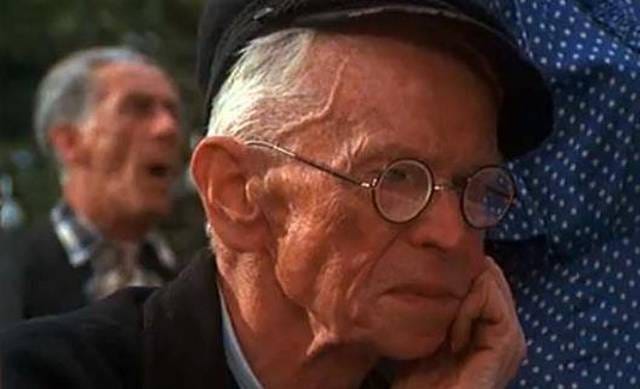
[Image: from Cabaret. He’s seen it all before….]
Human beings have an inbuilt weakness and it’s been exploited by magicians the world over: we see only that to which we are directed. The news could talk about Sudan or Yemen or Burma or any number of world conflicts, but they don’t, so we act as if they don’t exist. The same is true of the weekly hate marches which call for “ceasefire now!” unless, of course, a ceasefire is actually on the table (in which case the proposed truce is “genocide by other means”.) When we see these aggressive lunatics with anger in their eyes, intimidation in their bellies and the protection of safety in numbers, we assume that they represent a large percentage of the population. They don’t. They’re a tiny minority who grab our attention because they’re colonizing the streets.
Only last week I was walking through my hometown of Reading (England, not Pennsylvania). There they were, all 10 of them, the Palestine flag-waving, useful idiots, peddling their language inversion in the middle of the High Street. Meanwhile thousands of people were passing them, each uninvolved, disinterested or in opposition. None of them waving Israeli Flags or British flags or the Cross of Saint George. None of them displaying any sign of political partisanship whatsoever. In many cases, they probably had far more pressing issues on their mind, such as how to pay the next gas bill. In the words of Alan Mairson:
“The plumber is fixing pipes, the baker is kneading a loaf of bread and the electrician is replacing faulty wiring. They work all day, come home, eat dinner, spend some time with family, help junior with his math homework, check the box score of the Red Sox game, watch a rerun of “Three’s Company,” and hit the sack. These people are what we called, during the Covid shutdowns, ‘essential workers.’”
Rightly or wrongly most of these people don't have time for considering the latest events in the Middle East, and to the extent they do, they likely wish that the government were more concerned with domestic issues.
As such - and as annoying as they were - these Palestine protesters were merely a tolerated inconvenience. Speaking for myself, and having published the Guerre and Shalom article of General Yoav Gallant earlier that same day, I actually felt sorry for them. How pathetic it was for a group of 10 people, who had no possible impact on the conflict nor had any understanding of the complexity of events, to believe that their display of foolishness would persuade anyone, least of all the combatants themselves. Meanwhile I, in my non-flag waving, inconspicuous capacity, had engaged directly with one of the main actors. Of course my power is infinitesimally small, but on that day it exceeded by many multiples those of the 10 wandering souls there present.
How many other people walking past them that day had a greater impact on the events of the Middle East? How about military officials who are directly learning from Israeli technology? Or the hospitals who are reliant on Israel health innovation? As for magic, so for reality: it’s what you don’t see that counts.
Now of course, the “show of force” in Reading that day was far smaller and far less intimidating than the regular Gaza demonstrations we see in London and Manchester and in every major city in Spain. These events are an abomination to the sacredness of those streets that birthed freedom. Nonetheless, even in these far more distressing contexts, the silent majority is to be found walking past the demonstrations — the vastly larger silent majority. Most Muslims are nowhere to be seen and as for the Left who parrot “genocide”, even these generally shy away from such activist aggression.
I would direct the reader to the work of Harry Hazlitt, the American journalist and economist who penned the book “Economics in One Lesson”. In a work which passes through enlightening chapter after enlightening chapter, the author returns time and time again to the eponymous lesson: It’s what you don’t see that matters.
He gives many examples. Imagine that the government decides to build a bridge, the latest vanity project to prove that it’s actually doing something. What do you see? Architects designing the bridge. Civil engineers making it viable. A mass of workers engaged in the construction process. Once the bridge has been completed, you marvel at its beauty, and seeing car after car passing along the newly tarmaced roadway, you can scarcely imagine a world without it.
But it’s what you can’t see that matters: How would those architects, civil engineers and workers have been engaged if we had just let the free market take its course? Hazlitt’s reply is clear: those precious government tax dollars would have been spent on something even more useful and the various workers would have been employed doing something of even greater value. You can see the bridge. What you can’t see is what wasn’t built due to the bridge’s construction.
Hazlitt gives plentiful examples of this common governmental magic trick. He begins his book by imagining a broken window. Seeing those workers engaged on repairing the glass, one is fooled into supposing that the accident was really a good thing, for if the window hadn’t been broken, the glass repairers would have been out of a job. What we don’t see, however, is how the house owner would have spent or invested the money if he hadn’t needed to make good a glass pane that was previously in perfect condition. Naturally, whatever their choices, it would have been better for the national economy than merely maintaining the status quo ante of a house with intact glass windows. The failure to appreciate Hazlitt’s argument leads to the fallacious line of reasoning: that war is actually a good thing because it puts construction labourers back into work and updates structures that hadn’t yet reached the time when they needed updating.
So to repeat, this is the lesson that Hazlitt calls us to learn: think about what you don’t see. Let us apply this to the weekly hate marches.
You don’t see the frustrated working-class people angry about a foreign flag on their streets.
You don’t see the moderate Muslims enraged by the newest reputational damage on their faith. [see video - enraged moderate Muslim v “pro-Gaza” MP…]
You don’t see the nervous Afghan-origin mother who thought she came to Britain to escape this.
You don’t see the politicians terrified that they will lose their seat to the Red-Green Coalition at the next general election.
You don’t see the struggling tradesman and blue collar worker concerned about the standard of living crisis, enraged by the oxygen that left-wing politicians are giving to a foreign conflict.
You don’t see the Jews and other vulnerable minorities concerned about the precarious state of their civil rights.
You don’t see the Africans, the Uighers, the Tibetans, the Taiwanese, the Rohingya, the Kurds and countless others fuming about foreign support for an undeserving Palestinian cause, all the while their own suffering and oft unviolent struggles are met with silence.
You don’t see the British working class concerned that their views on mass immigration are construed as racism.
You don’t see the liberal democrats concerned that the British working class might turn to the far-right.
You don’t see the shopkeepers worried about their property and the car owners in constant dread, each knowing that Palestine protesters have an absolute immunity to punishment.
Most of all, you don’t see the mothers, the fathers, the children and the elderly, each of whom are trying to live their lives against the backdrop of an imported and dangerous ideology.
In the background are those who are reliving the 1930s; those who have seen it all before; the old man with glasses in “Tomorrow Belongs to Me” who doesn’t stand up with the crowd.
All of us, the silent (vast) majority, believe in British values of tolerance. We believe in respecting others so that they may live their own lives as they please. But we have a red line. Toleration is a two-way street. We only respect people who respect us in turn. We only tolerate people who believe tolerance is reciprocal.
Fanatical Islamists and deranged far-leftists and indoctrinated youngsters looking for a cause are all intolerant. So none of us tolerate them. None of us respect them and we want them off our streets.
So next time you see one of these infernal rallies, turn your gaze and look at those on the sidewalk. We are the majority.
Very good and insightful article. I notice that the video you linked talks about how Aston Villa football club has banned Israeli fans from its grounds, a disgusting decision. Condemned by every Jewish Aston Villa fan, including Andrew Fox, who commented on it earlier this week.
Aston Villa is a club with which I have a personal family connection, as it was my first cousin, Pat Matthews, who in the early 1980s bought the football club and took them through a very proud period under Doug Ellis, which saw them promoted to the 1st division. Pat Matthews was Jewish. So, a Jew bought the club and revived it at a low period in the club's history, and now that club is disgracing the name of Jews in general. Pat Matthews would be turning in his grave at this disgusting turn of events.
Most of these hate protests throughout EU, US & Canada are funded and organized. Not spontaneous protests