



Foreword by the Editor (Daniel Clarke-Serret)
Today, in yet another first, “Guerre and Shalom” interviews one of its long-time readers, the culinary superstar Richard Neat.
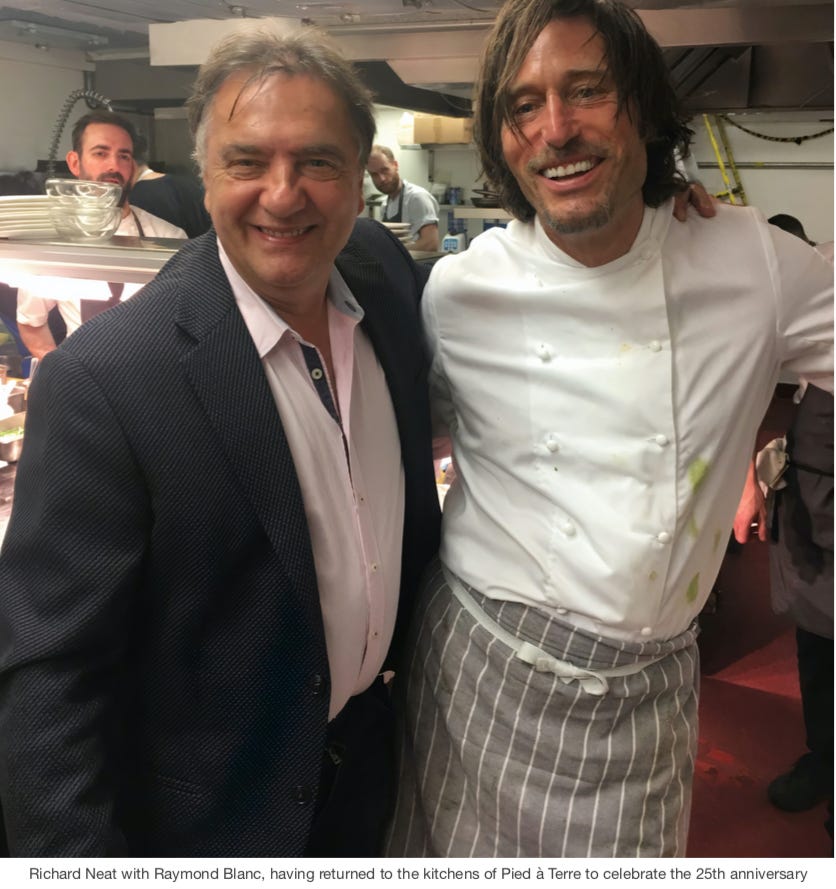
Richard was the youngest recipient of 2 Michelin stars for his establishment Pied à Terre in London’s Charlotte Street. His second recognition by Michelin in 1999 was for his restaurant in Cannes where he became the first Englishman to receive the honour in France. Richard honed his talents under the mentorship of Raymond Blanc at Manoir Quatre Saisons, Oxfordshire, Joel Robouchon at Jamin, Paris and Marco Pierre White at Harveys, London. He is currently on cheffing duties in the Park Café, San Jose, Costa Rica. Finally, Richard is an acomplished thinker, writer, philosopher, chess player and defender of Western Civilisation. Renaissance Man in other words.
His full and fascinating biography can be found at www.richardneat.blogpsot.com.
So without further ado, let the questioning begin….
THE INTERVIEW
Daniel: Describe your career to date in under 100 words.
Richard: Rather chaotic, rarely thought-through apprenticeship, meandering through various two and three Michelin starred restaurants in Europe before opening my own place, Pied-à-Terre, in London at the tender age of twenty five. I earned my first star eleven months later, a second three years on. Wanderlust and a fear of captivity led me to quit and head off on an adventure that continues to this day. India, south of France (another star there), Marrakech, Moscow and onto Costa Rica. Some great adventures, many dark days and a pinch of regret in having traded adventure for security. Seasoned with some wonderful memories and the belief that the ritual of eating well, being ‘à table’, in conversation, exchanging your dreams, desires and aspirations, while sampling artisanal wines and paying homage to the Disney cast, is a universally appreciated pastime. Just reopened my beloved restaurant here in San Jose in my girlfriend’s antiques store. Same rules apply. Be unique, be authentic, be interesting, try to be nice.
Daniel: You are one of those rare people that reaches the pinnacle of their profession. What are the secrets of your success? What's your advice for someone who wants to be truly successful in their field?
Richard: If I really thought about it, I would put any success down to a few characteristics that I have been privileged to possess. While serving apprenticeships under the iconic chefs Raymond Blanc and Joel Robuchon, the main qualities I needed to excel at were dutifulness and technical competence. I was working for someone else, so my own thoughts upon gastronomy were irrelevant. I was just a tool of a great chef and my job was to learn, absorb, turn-up-for-work and not damage the reputation of the house.
Once I opened the doors of my own place, everything changed, as I had earned the right to do what Frank so memorably sang: ‘My Way.’ Upon opening Pied-a-Terre, my partner and I quickly PhD-ed in Chaology and Finance and created a model that must of worked, as the restaurant is still there, owned and run by my ex-partner, thirty-four years later. Something along the lines of creativity, uniqueness and not offering a product that anyone else was presenting. Plus diligence, precision, long-hair and a little Rock ‘n’ Roll to demonstrate that gastronomy can be accessible and cool. Summarized as a T-shirt-y, nugget of wisdom, my advice would be: be truthful to yourself; honestly and brutally appraise your work, your conduct and your beliefs; and try not to do harm to others. And don’t forget laugh as much as possible.
A previous Richard Neat article for paid subscribers:

Daniel: Throughout your career, you've followed the pattern of opening a successful restaurant, then moving to another country and opening another. What motivates you to continue to seek out such difficult challenges? Does there come a point when you say that you've reached the top of the mountain and are "satisfied"?
Richard: Grateful that you see a pattern, though it seemed at the time as though I quit Pied-à-Terre through exhaustion and left India due to expiration of a contract. We were expelled from our property by a malicious landlord in Cannes and I got divorced in Marrakech before meeting Louise and moving to Costa Rica. The only common theme being that my greatest enemy is boredom. Despite being an arch conservative, I hate predictability and sameness, or as Joyce wrote in The Portrait of the Artist as a Young Man, “Repetition is, in its monotony, variety and intensity, the rhetoric of hell."
Everything is so contradictory. I’m incredibly disciplined, love eternal, objective truths and adore rules and customs, yet, at the same time, I despise protocols, procedures and formulas that restrict and constrain the freely constructed expression of my own truth. I’ve tried to learn from thousands of years of other people trying to get things right.
I’m not even particularly competitive. I love to be challenged, to have ‘played the game well’, but I’m not sure if I even understand what other people, our society and my culture mean when they/it defines winning. I read about Sartre’s The Gaze, being objectified by others, belonging to others, being the impression of how you’re perceived by them. It could be true, yet despite this, I try to appraise myself, be honest with those appraisals and have a little integrity.
Are you interested in being interviewed for Guerre and Shalom? Signing up as a paid gives you the right to submit your own material for possible publication:
Daniel: You’re not merely interested in food. You are also passionate about writing, politics and chess amongst other things. Do you believe that you could have been a Chess Master if you had worked hard enough or are we born with natural talent?
Richard; What you’re probably describing is everyone’s need, nay, duty, to retain a curiosity throughout their life. I hope I’m able to pose questions and demand answers, usually from myself and my long dead heroes, until I shuffle off this mortal coil. Luckily I grew up in a house where the acquisition of knowledge was considered important. I read the books that belonged to my parents, usually history books, which were an aperture through which I was exposed to so much that is admirable and sublime, at least when Western history books used to celebrate the remarkable achievements of our Judeo-Christian heritage.
Was always very impressed by dear Rene’s cogito, as it is one of the few things that differentiates us from something else, something not us. Only thinking, using our minds, will save us.
At least as individuals, we can imagine better lives for ourselves. I think the present malaise we are living through should be a humbling experience for our elites who believed that they had a vision of a world that was better than that imagined by the individual.
Globalization, post-industrialism and the gutting of blue-collar manufacturing jobs; AI and the gutting of everyone else’s jobs; the environmental crisis, mass immigration, a shitty vacuous consumerist culture, the worshiping of material objects and the cult of the expert has demonstrated that most learned individuals don’t have a clue about something so basic as action and consequence.
Back to chess, I’ve played the game since I was four. It’s pure escapism, though I probably have too chaotic a mind to have been great at it. Louise, my girlfriend, bought me for a birthday present some lessons with a Grand Master. It was like being in the presence of God. Concluding the sessions, he suggested I spend three hours a day studying classic games, then three hours a day playing my own games. I asked him if he was in a relationship?!
There are other things that require my time, especially my girlfriend, though also my pals, books and reading to retain those pals, my puppies, the restaurant. It seems as though Caïssa did not choose me. Anyway, the level I play online, or with my friends, is good enough —and still a pleasure. Last week I beat a bot at 2561. I did cartwheels and then the same afternoon, I lost three consecutive games to a pal who’s only beaten me twice before. You have to have your head screwed on to play top level chess.
Daniel: It has always seemed to me that professional cheffing is one of the most stressful career choices available. How do you cope with the difficulties of constant pressure and the unsociable hours? How - if at all - do you alleviate the pressure on your employees?
Richard: Somebody described me in an article as a hyper-perfectionist, which I thought was funny, though sadly true. I have absolutely no idea where this fanaticism came from. Of course its made me incredibly unhappy, though occasionally elated. I suppose you just want to do something beyond reproach. Not suffer the ignominy of suffering someone’s else’s criticism or having a bad impression of yourself. Back to Sartre’s The Gaze.
In the gastronomic world, there are other dynamics where the market is small and pretty much saturated. There are many technically accomplished cooks, many beautiful furnished rooms, lots of nice crockery. Even a few places where the chef throws salt in a wacky manner, which momentarily becomes a vibe, taking bodies away from the finite pool of potential diners. Simply, you have to make your product exceptional.
I was too shy in London, but by the South of France I had learnt that gastronomy was pure theatre: Cook something remarkable, be original, develop ideas that you can share with your guests, so that the dinner is no longer just about food, but a whole evening of entertainment. It’s a very French thing: the table as a place to talk, argue, share ideas, create as many perspectival lines, as a reason why one of those finite amount of diners should go back to your place.
The pressure merely adds to the allure, for yourself, your customers, your staff. Personally, I think the pressure of needing to perform and be the best is like a drug, one that makes life worth living, or at least a justification for dragging yourself away from the latest Netflix binge watching series. There are enough people, like moths to a lamp, who are attracted to something unusual, something real and authentic. That such a small (real and authentic) business doesn’t have a Procrustean corporate structure is the point in itself. As a patron, a member of staff, as a customer, you matter. Your presence at or in the product actually makes a difference. How good does that sound?!
Happily, it seems as though the whole bland, revolting corporate model is being rejected across the Western world as they have been exposed as entities who destroy lives, whether with their soulless products, their disingenuous corporate mantras, or in the food industry, their often (literally) poisonous things and stuff. Week after week, there are stories in the press where food or drink products are recalled because there’s rat droppings in the product (despite the PR people claiming the recipe called for it) or something’s more carcinogenic than licking the walls of the Chernobyl reactor or where the CEO cuts quality and staff costs to drive up the share price —all so he can spend his morally objectionable salary on cocaine orgies with prostitutes.
Independent businesses are back in vogue, and the pressure and need to personalize your business are the price we must pay if we want to be saved from corporate humiliation and death. The hours don’t matter —I’ve always made my restaurants the focal point of my social life. My customers have become my friends. And anyway, if I’ve given someone an exceptional dinner, they have to indulge me as I express my questionable opinions.
As for alleviating the pressure on my employees, or creating an enjoyable environment, I actually think the worst, the most despicable thing I could do to my staff is oblige them to work in a mediocre environment, a crime they should despise me for. Whether it’s the pointlessness of the work or the risk of them losing their jobs, they wouldn’t thank me as the place closes down when nobody wants to eat there.
Richard recommends this recent Guerre and Shalom article:

Daniel: It is almost de rigueur for high profile chefs to head to the TV studios and become a celebrity. What is your view of celebrity chefs and how / why did you resist the temptation to enter that world?
Richard: It does seem as though the food industry has enjoyed a California 1849 moment, where everyone from Brooklyn Beckham to Meghan Markle are peddling their grannies recipes as they battle for whose inedible product gets to be sold in Walmart. However, I’m in the business and should therefore be grateful for the increased interest and recognition of my trade this has provided. And I am. I just hope the subsequent over-analysis and our usurpation by foodies, dilettante critics, PRs and marketeers hasn’t destroyed the elemental pleasure that’s derived from the simple ritual of executing and eating fine produce.
It’s about artisanal skills; it’s about conversational skills; it’s about people sitting opposite each other appreciating another persons efforts, authenticity and passion. As long as it’s within these boundaries, I suppose I can get behind the movement.
When David and I opened P-à-T in the 90’s we were approached by some company to appear on one of these foul cookery shows. We gave a tentative yes, but then discovered that I’d have to go to Birmingham to film….
Like the ingénue I still am, I said to David that that would mean me leaving my kitchen in London. I would have to be an absentee chef. Yuk. We declined and I’ve been poor and bitter ever since.
Daniel: Are all styles of cuisine "equally" good if prepared to a high level or are some cuisines objectively better than others? Put simply, is food a question of taste?
Richard: Gosh, what a question, one that I, or I suspect anyone else, would be foolish enough to grapple with. From my own travels and experiences, my favourites are obviously French as the produce is exceptional and the craftsmanship exemplary. Whether a no star restaurant, a three star restaurant, or a regular French person's home, you will probably eat and drink exceptionally well. They’ve simply grownup surrounded by a culture of regarding food and the ritual of eating as a crucial element of their existence. Ditto Italy and Spain. We spend a lot of time in these two countries and the restaurants and piazzas are alive with people experiencing food as something other than sustenance.
In a non-pejorative sense, I’m privileged in having travelled quite a bit and having enjoyed the fare of many countries —even avoiding eating Spaghetti Carbonara in Delhi or Istanbul! I’ve eaten incredibly well in Mexico, Bali Indonesia, Turkey, Israel, India and Morocco. I’ve also eaten in really enjoyable restaurants in Peru, Costa Rica, the US, the UK, Belgium, South Africa and many more countries besides. Again, its about integrity and authenticity. If a cook in any town, city or country cares about what he or she is doing, then I hope I stumble upon their doorstep and enjoy their efforts.
Daniel: In my writing, I've spoken a great deal about the "West". The West can be defined culturally and geographically (which includes the elegant food/dance/art of European, especially French, origin) or it can be defined politically (democracy etc). As a political-minded chef, which West is the most important to you and to civilisation as a whole?
Richard: As a historian manqué, I’ve retained my love and admiration of Western civilization, and am eternally in awe of the myriad triumphs and achievements of the West and its people. In art, ideas, architecture, writing and philosophy; notions of duty, rights and obligations; our relationship with ourselves, other individuals, the State and in broader political discourse, the history of the West and the Jewish world from which we emerged has been a really remarkable story.
Of course, this doesn’t mean there haven’t been some hateful episodes, some dreadful individuals, some truly dumb ideas. There have, and equally -tu quoque- have other cultures and peoples produced some historically awful stuff. Acknowledging there have been many dark pages in our history is one of the qualities of the Western model, which has always had the ability for introspection and self-analysis. I quote at length:
“That civilization is rooted in Christianity, and in the Christian tradition the primary acts of sacrifice are confession and forgiveness. Those who confess, sacrifice their pride, while those who forgive, sacrifice their resentment, renouncing thereby something that had been dear to their hearts. Confession and forgiveness are the habits that made our civilization possible.”
Simply we are not the monsters that Guardian churnalists - sorry, journalists - or other Leftists portray us as being. There has been quite a bit of history since we stopped hunter-gathering and settled for a more sedentary existence, built permanent structures and started accumulating things. Some of that history has been sublime, some pretty decent and a lot quite mundane, though, unfortunately, there have been bits that have been simply horrible. That the latter has happened is no reason for a dismantling of the whole edifice. Everyone should feel as though they are privileged to have emerged from their own remarkable culture, one that provides answers to their most profound questioning. Yet, they shouldn’t feel obliged to demand too much from other people.
Don’t forget to sign up today as paid (£45/$60). You get full access to all new serialised books:

Daniel: How do you separate your politics from your work, if at all?
Richard: I love conversation, and am aware that many of my customers want a combative discussion, like a spicy sauce, on their evening out. However, gastronomy is basically incommunicable. You just do it, so if you don’t want to sound trite and talk about the weather, you are left with the world around you. The latter is politics, with the only requirement being to be properly prepared, to read reputable sources, to construct your own positions and have the courage to defend them. As the French do, don’t personalize an argument. Just consider it as a few hours entertainment, especially as Man as a species seems incapable of voluntary reform. Worse, as there are so many extraordinarily marginal characters holding political office, it will inevitably require a Malthusian solution for the challenges we presently face.
Daniel: What is your view of the swearing culture in the food world? Is the opposition to swearing moralistic paternalism or is it genuinely important? What is your experience of it in the kitchen?
Richard: D.H. Lawrence was one of the 20th century’s great writers, yet the prosecution in his trial railed against the almost hundred instances of swear words he included in Lady Chatterley's Lover. Modern rappers include almost as many just in the titles of their oeuvre. Obviously not something to be proud of as the English language provides us with so many alternative words to describe our experiences, thoughts and the world around us.
Saying that, the mind-numbingly stupid utterances of the perennially angry, the insincere platitudes of the socially conscious celebrity as they try to shore up their popularity, and the banalities and velleities of politicians desperate to continue in office, makes one painfully aware that words - and our use of them - are rarely the best articulations of our thoughts and intentions.
Sorry, I digress. Yes, sadly, I do swear in the kitchen, although I try to ensure that such flaws and indiscretions do not follow me outside of its doors. I suppose that I could try to excuse myself with overwork, some new medication and/or some obscure ailment —or I could just apologize for my conduct and say that I’m just trying to do something that we’re all proud of and sometimes, certainly not all the time, the urgency of getting that sauce reduction just right or that that piece of fish or meat will omit juices for a painfully brief moment mean I haven’t been able to construct in my horribly flawed mind a more reasonable and polite manner of asking for something quickly.
Don’t forget to sign up today as paid (£45/$60). You get full access to all new serialised books:

Daniel: What is the meaning of life?
Richard: Over a particularly drunken dinner at our rented house in Ostuni (Southern Italy), where we played court to our Brit-pals, we developed the formula of FICD. Funny, Intelligent, Creative, Decent.
Try to be all those things. Can’t think of anything else.
Daniel: You are a regular reader of Guerre and Shalom. What attracted it to you in the first place and why would you recommend it to others?
Richard: Can’t remember the actual article that came across my screen, but I loved your prose style and your manner in developing a theme, analyzing it and offering an explanation. I really appreciate your grasp of history and use of it as a tool for making sense of any present dilemma. That for me is great writing. And how valuable that is in our current climate!
With the radicalization and lobotomization of many mainstream journalists and media personalities, bad people who peddle facile solutions for the complex and multitudinous problems we face, garnished with their repulsive antisemitism and their casual endorsement of a corporate state, I genuinely believe that there is a greater quality of insight and commentary within the Substack community.
VIDEO: Richard returns to Pied-à-Terre, Charlotte Street, London.
ADDITIONAL READER QUESTIONS:
Nathan Brown asked:
I have such fond memories of how the UK, mainly London, evolved from boring appetiser dishes like parma ham / melon, avocado vinaigrette, smoked salmon, half a grapefruit, and main dishes like chicken Kiev, steak Diane and veal Holstein.
Long standing restaurants like Elena’s L’Etoile, Neal St Restaurant were joined by 192, Alistair Little in Frith St, the first gastropub The Eagle etc .
The original Ivy in the mid 1990s was such a joy. I was quite a regular there from the late 1990s and sharing my most memorable moment at the Ivy. It was a bustling evening as usual, my favourite dish being the Poulet de Landes stuffed with foie gras and a Madeira sauce. The night in question, there was a sudden silence and all eyes turned to a departing diner. Margaret Thatcher had stood up from her table and was leaving the restaurant. The sudden silence was deafening, as the diners gazed upon her. A moment I will never forget.
I enjoy reading Jay Rayner’s books about food, so if you have any experiences worth sharing, I would be most interested.
Richard replied:
It was incredibly exciting to open a restaurant in central London in the early 90’s. A vanguard of French chefs - Koffmann, Blanc, the Roux brothers - had arrived in the seventies and recognized not only the business potential of the country, but also its first rate produce. Best fish from the island’s cold waters, world-class beef from Scotland, same for Welsh Lamb and, of course, our exceptional game production. Their restaurants were obviously offering an unparalleled product and newspapers started highlighting their work. A generation of young English cooks - me included - were captivated by their work and served apprenticeships in their kitchens. Raymond Blanc at Le Manoir aux Quat’ Saisons was a veritable factory line of aspirant young cooks; Marco Pierre White, Bruno Loubet, John Burton-Race and myself all passed through the doors of Le Manoir.
One of the advantages we enjoyed in the UK, particularly this generation of young English cooks, was the fact that we were not crushed beneath the definitions and assumptions of an established restaurant industry as was the case in France, Italy and Spain. For example, my ex-wife, a French lady, ate at her first three-star restaurant when she was nine years old. Good food was something you simply grew up with. For the English, by comparison, everything was to invent.
Of course mistakes were made, I remember the monstrous excesses of ‘nouveau cuisine’ around the end of the 80’s. However, the business environment and conditions allowed a degree of flexibility in our evolutions. I remember empty nights in our first year that, whilst morally draining, were not financially ruinous as otherwise the business year seemed quite predictable.
What the second generation restaurants all dreamt of was a national food review, or a fabled star, as these raised your profile above the myriad other establishments in the city. The most important critics were Jonathon Meades of the Times and Fay Maschler of the Evening Standard. A positive review from either, or preferably both of them, would guarantee a huge up-tick in interest in your restaurant, and thereafter the restaurants responsibility to keep those new faces. This was nothing in comparison to the frenzy of speculation around November each year, where trade conversations focused on the Michelin Guide, who was winning a star and which unlucky souls were losing one.
There were so few starred restaurants in the UK at the time that the guide had an enormous impact upon the anointed ones. This meant that there was a great deal of competition amongst the starred restaurants, and also a great deal of jealousy and shenanigans towards your competitors. For example, when word spread in the fall of ‘95 that Pied-à-Terre was going to move from one star to two, some horrible rumors started circulating in town that the chef (me) was not in his kitchen as he was in a drug rehabilitation program! I never missed a day or service in five years, so it was obviously a fabrication in the hope that the people of Michelin would reconsider promoting Pied-à-Terre. We tracked the rumor back to its source which was a very fragile and deranged chef who was jealously guarding his ‘youngest chef with stars award.’ Nasty.
Otherwise, much of the time, the competition was actually quite friendly. Monsieur Blanc at Le Manoir was not only a share-holder of Pied-à-Terre, but a reasonably regular customer. Also, I became quite friendly with Pierre Koffmann through our shared love of gastronomy. Most chefs could be relied upon to share their supplier contacts and even lend you a chef or some products if you were caught short.
As for your mention and recollection of the Ivy, for me this was the greatest restaurant in London at the time. The owners Jeremy and Chris were friends and I used to have lunch there religiously every Sunday. Bloody Mary, Steak Tartare with Chips, Sticky Toffee Pudding. Just such a comfortable place to pass the day. Anyway, from being a gastronomic backwater, London at last had been propelled to being considered ‘The Food Capital of the World’, at least according to the dozens of newspaper and magazine articles that wrote about such things. All in all, a very exciting time.
It was incredibly exciting to open a restaurant in central London in the early 90’s. A vanguard of French chefs, Koffmann, Blanc, the Roux brothers had arrived in the seventies and recognized not only the business potential of the country but also its first rate produce. Best fish from the islands cold waters, world-class beef from Scotland, same for Welsh Lamb and of course our exceptional game production. Their restaurants were obviously offering an unparalleled product and newspapers started highlighting their work. A generation of young English cooks -me included- were captivated by their work and served apprenticeships in their kitchens. Raymond Blanc at Le Manoir aux Quat’ Saisons was a veritable factory line of aspirant young cooks; Marco Pierre White, Bruno Loubet, John Burton-Race, myself, all passed through the doors of Le Manoir.
One of the advantages we enjoyed in the UK, particularly this generation of young English cooks, was the fact that we were not crushed beneath the definitions and assumptions of an established restaurant industry as was the case in France, Italy, Spain. For example, my ex-wife, a French lady, ate at her first three-star restaurant when she was nine years old. Good food was something you simply grew up with. For the English by comparison, everything was to invent. Of course mistakes were made, I remember the monstrous excesses of ‘nouveau cuisine’ around the end of the 80’s. However, the business environment and conditions allowed a degree of flexibility in our evolutions. I remember empty nights in our first year, that whilst morally draining, were not financially ruinous as otherwise the business year seemed quite predictable. What the second generation restaurants all dreamt of was a national food review, or a fabled star as these raised your profile above the myriad other establishments in the city. The most important critics were Jonathon Meades of the Times and Fay Maschler of the Evening Standard. A positive review from either, or preferably both of them, would guarantee a huge up-tick in interest in your restaurant, and thereafter the restaurants responsibility to keep those new faces. This was nothing in comparison to the frenzy of speculation around November each year, where trade conversations focused on the Michelin Guide and who was winning a star, which unlucky souls were losing one. There were so few starred restaurants in the UK at the time that the guide had an enormous impact upon the anointed ones. This meant that there was a great deal of competition amongst the starred restaurants, and also a great deal of jealousy and shenanigans towards your competitors. For example, when word spread in the fall of ‘95 that Pied-a-Terre was going to move from one star to two, some horrible rumors started circulating in town that the chef -me- was not in his kitchen as he was in a drug rehabilitation program! I never missed a day, or service in five years, so it was obviously a fabrication in the hope that the people of Michelin would reconsider promoting Pied-a-Terre. We tracked the rumor back to its source which was a very fragile and deranged chef who was jealously guarding his ‘youngest chef with stars award.’ Nasty.
Otherwise, much of the time, the competition was actually quite friendly. Monsieur Blanc at Le Manoir was not only a share-holder of Pied-a-Terre, but a reasonably regular customer. Also, I became quite friendly with Pierre Koffmann through our shared love of gastronomy. Most chefs could be relied upon to share their supplier contacts and even lend you a chef or some products if you were caught short.
As for your mention and recollection of the Ivy, for me this was the greatest restaurant in London at the time. The owners Jeremy and Chris were friends and I used to have lunch there religiously every Sunday. Bloody Mary, Steak Tartare with Chips, Sticky Toffee Pudding. Just such a comfortable place to pass the day. Anyway, from being a gastronomic backwater, London at least had been propelled to being considered ‘The Food Capital of the World’ at least according to the dozens of newspaper and magazine articles that wrote about such things. All in all, a very exciting time.
Really looking forward to reading this article .. apart from being a fervent zionist and proud Jew, one of my other passions is 'food' .. and Pied a Terre has been an iconic restaurant in London's food scene for nearly 30 + years.