



[Image: Retrieved from Reddit.com. Judge Julia Sebutinde of the ICJ has ruled against the policy of the Ugandan government. Twice.]
Published to celebrate the probable elevation of Justice Julia Sebutinde to the presidency of the ICJ.
However, we note with concern the nomination of current ICJ President Nawaf Salam to the premiership of Lebanon1. It is improper for a judge to be appointed so soon to political office. It is an offence to the concept of the separation of powers and it puts into question the impartiality of his previous court judgments.
To become a paid subscriber, press this link!
“Judicial Pioneers: Gascoigne of England; Sebutinde of Uganda” by Daniel Clarke-Serret
“Happy is the King that has a magistrate endowed with the courage to execute the laws upon such an offender, still more happy in having a son willing to submit to such a chastisement!" (King Henry IV of England)
In the West, India and throughout the free world, we take the separation of powers for granted. We accept unthinkingly that absolute power should not reside in hands of an overmighty executive. Yet all our nations began as tyrannies with subservient judges cowering before the might of an absolute King. It took brave judicial pioneers, in fear of the consequences but with the strength that only justice can provide, to refuse the demands of their political masters. And it took monarchs, with a clear sense of what history demanded, to accept the rulings of their rebellious judges.
Today we meet two judicial pioneers, one historical and one in the present day, one English and one Ugandan, who have placed a stake in the ground and said: Today we make our stand! We, the judiciary, will protect the freedom of society by standing up for our own freedom.
Judicial Hero 1: Sir William Gascoigne. The story of the Aragonese bookshop and the Prince in the prison.
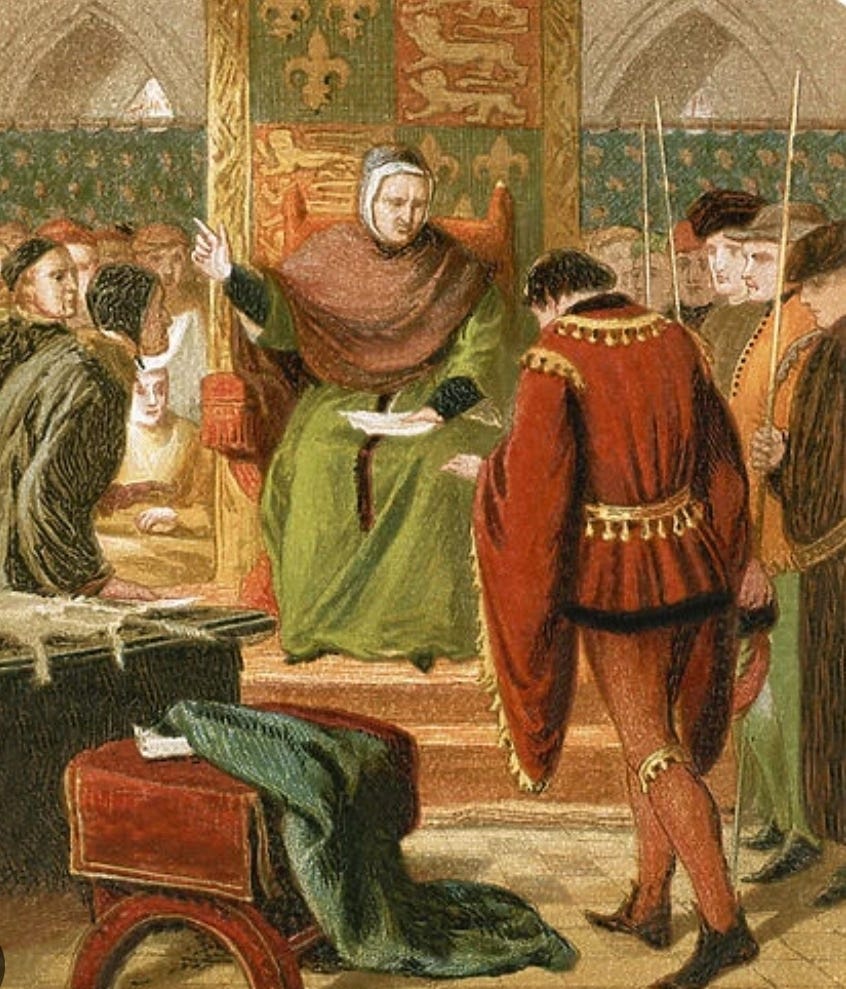
[Image: Prince Henry before Judge Gascoigne. Credit: Fine Art Finder Copyright: Look and Learn / Bridgeman Images]
In a March 2023 that seems long past, I met with two coincidences. Or if you are more religiously inclined, I met with two divinely-prescribed rendez-vous with fate.
On that weekend - when the Israeli legal crisis2 was reaching its crescendo, an Indian Member of Parliament had been suspended for his exercise of freedom of speech3 and (with rather less fanfare) the Zaragoza festival of "old literature" had come to the Aragonese capital - I came across a near-200 year old book written in English. The only non-Spanish language book that was on sale. A book published in 1852 entitled "Goldsmith's History of England”. Beautifully and rather poetically written by the standards of modern history books, it was purchased for a well-spent 15 euros.
Coincidence 2. Without intention, I opened up the book at the reign of Henry IV (1399 to 1413 CE). And what should I find? Nothing less than the origins of the rule of law in England and by extension the English-speaking world. For what is the rule of law? To paraphrase Lord Denning: that all people,be they ever so low or be they ever so mighty, be subjected to the same law. From Kings to peasants, the law rules supreme.
About the wrongdoings of Prince Henry (later Henry V of Agincourt fame4) and the reaction of the his father the King, it is written:
"The King was not a little mortified at (the) degeneracy in his eldest son, who seemed entirely forgetful of his station...Such were the excesses into which he ran, that one of his dissolute companions having been brought to trial before Sir William Gascoigne, chief justice of the King's bench, for some misdemeanour, the prince was so exasperated at the issue of the trial, that he struck the judge in open court. The venerable magistrate, who knew the reverence that was due to his station, behaved with a dignity that became his office, and immediately ordered the prince to be committed to prison.
When this transaction was reported to the king, who was an excellent judge of mankind, he could not help exclaiming in transport, "Happy is the king that has a magistrate endowed with the courage to execute the laws upon such an offender, still more happy in having a son willing to submit to such a chastisement!" This, in fact, is one of the first great instances we read in English history of a magistrate doing justice in opposition of power; since, upon many former occasions, we find the judges only ministers of royal caprice.5"
King Henry and his son the Prince led the way in showing us that power submits to justice. Over 600 years later, we are called upon to reaffirm this principle of liberty once more and to protect the law and her courts from the whims of our rulers.

[Image: Israelis marching against planned judicial changes by Prime Minister Benjamin Netanyahu6, March 2023. Hazem Bader/AFP via Getty Images. Does power submit to the law?]
Judicial Hero 2: Julia Sebutinde. The Ugandan judge who defined the government of an unfree country
“In my respectful dissenting opinion, the dispute between the State of Israel and the people of Palestine is essentially and historically a political one. Calling for a diplomatic or negotiated settlement, and for the implementation in good faith of all relevant Security Council resolutions by all parties concerned, to find a permanent solution whereby the Israeli and Palestinian peoples can peacefully coexist.” (Dissenting opinion of Judge Julia Sebutinde in the case South Africa v Israel)
And so we move up to the present day with the inspirational story of Julia Sebutinge, the first African woman to serve on the International Court of Justice. She achieved a well-deserved level of fame in January 2024 by being the only judge to fully recognise the Israel-Palestine dispute for what it is: political. I am not a woman, the sky is blue, apples are distinct from oranges and yes…there is no genocide happening in Gaza. An absurdity wrapped in a travesty tied with a bow of dishonest blindness; Judge Sebutinde saw the South African case7 for what it was and acted accordingly.
However, it is not her substantive decision in this case that makes her a hero. It is that unlike the ICJ judges from the Russian and Chinese tyrannies, Judge Sebutinde had the courage to defy her government. Leaving aside the issues of the rights and wrong of this particular case, what is extraordinary is that the Ugandan judge dared to rule in contradiction to the policies of her authoritarian government.
The response of the Ugandan government to her ruling was instructive:
“Justice Sebutinde ruling at the International Court of Justice does not represent the Government of Uganda’s position on the situation in Palestine. She has previously voted against Uganda’s case on DRC. Uganda’s support for the plight of the Palestinian people has been expressed through Uganda ‘s voting pattern at the United Nations.” (Adonia Ayebare, Ambassador and Permanent Representative of Uganda to the United Nations)
Mr Ayebare, in noting that Judge Sebutinde’s ruling doesn’t represent the position of the Ugandan government, implies that the role of the judicairy, in particularly when acting in international fora, is to ractify official policy. He complains that both in this case and in a previous ruling related to the DRC, that the honourable judge failed in her duty by ruling unpatriotically. Uganda takes the position of English governments prior to Henry IV, namely that the court system is purely an arm of the executive.
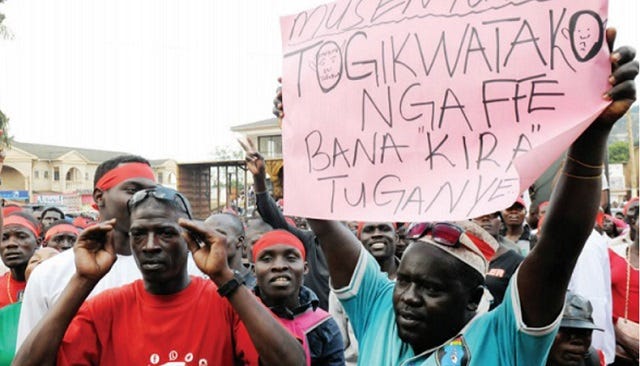
[Image: Democracy in decline in Uganda. Retrieved from the Uganda Independent newspaper https://www.independent.co.ug/uganda-democracy-in-decline/]
With all due respect to Mr Ayebare, such sentiments betray his ignorance of the role of the courts in a democractic society. Unsuprising one may think as Uganda - an autocratic, unfree country8 - is a democracy in name only. However his tweet should give us pause for thought. If Mr Ayebare's views represent those of Russia, China and other autocratic nations towards their judges on the ICJ, then how can those nations be represented on the international bench? If their judges are expected to merely represent their governments, then how can the free world act as if their judgments are binding? Uganda, which has since “disowned” Judge Sebutinde for acting independently, has inadvertedly shown the ICJ for what it is: a circus of unindependent-minded judges whose corrupted rulings and lack of respect for their positions of responsibility would make a 600 year old Henry IV embarassed. I repeat: Why are the British and Israelis, whose legal traditions are 600 years more advanced that those in Uganda and other countries, to be subjected to ICJ judgments?
What makes Judge Sebutinde so remarkable is that on two separate occasions she stood up to Ugandan tyranny. She is to Uganda what Judge Gascoigne was to England. But with one fundamental difference. When faced with a judge who stood his ground, Henry IV accepted the independence of the judicial bench and thereby changed the fate of the English nation (and the World) forever. But when faced with a similar situation, hundreds of years later, the Ugandan governement reasserted its own total power.
Which is why while England is a free country from which I am proud to be a citizen, Uganda is a despotism9 which has barely evolved from the days in which it expelled Asians from its borders and allowed Israelis to be taken hostage at Entebbe. As the self-declared leader of its continent, perhaps - just perhaps - this is something about which South Africa’s government should dedicate a little more of its time….

Malek Fouda(14/1/2025), “Head of ICJ Nawaf Salam named as Lebanon's new prime minister”, Euro News.
https://www.euronews.com/2025/01/14/lebanons-new-president-names-president-of-the-international-court-of-justice-as-new-prime-
March 2023 saw mass protests in Israel related to the “judicial reforms” of Benjamin Netanyahu's government which critics say are designed to reduce the independence of the judiciary.
Arpan Chaturvedi (24/03/2024), “How Rahul Gandhi's disqualification from Indian parliament works”, Reuters
https://www.reuters.com/world/india/why-indian-opposition-leader-rahul-gandhi-may-lose-his-parliament-seat-2023-03-23/
See also Shakespeare's Henry IV and Henry V
Oliver Goldsmith's History of England (1852)
According to Globes, between 150,000–240,000 people protested in Tel Aviv against the reform on 11 March 2023, alongside smaller protests in other cities. A weekly protest that took place on 18 March was attended by over 260,000 people.
South Africa v Israel, ICJ 2024. Judge Sebutinde was the only judge other than Israeli justice Aharon Barak to give a dissenting judgment.
Uganda Independent newspaper, “Democracy in Decline”: https://www.independent.co.ug/uganda-democracy-in-decline/
For the state of Ugandan democracy, read this report: https://www.v-dem.net/media/publications/country_brief_uganda.pdf
Excellent analogy!
A fascinating tale of two heroes who exemplify what courage looks like! Sir William Gascoigne and Justice Julie Sebutinde both showed integrity and courage! Sir William Gascoigne sent the future King Henry V to prison despite the severe backlash he could’ve received for it. But he was principled and had integrity, and stuck to his guns. A crime is a crime, a lawbreaker is a lawbreaker. King Henry IV to his credit, accepted Sir Gascoigne’s ruling thus unknowingly gifting humanity with the rule of law. This means that no matter who you are or how much money, fame or influence you have, the law applies to you too. Benjamin Netanyahu found this out the hard way in Israel. Justice Sebutinde unlike her colleagues who are owned by Russia and China, dared to stand up for what’s right and disagree with the ICJ ruling. She stood up for Israel and it’s right to defend itself against a genocidal terrorist group run by Islamist rapists. She is a modern day righteous among the nations. She also went against her own country in doing so. Uganda’s dictatorship releasing a public statement disowning her doesn’t surprise me. Their no paragons of virtue themselves given as you mentioned Daniel, their expulsion of their Asian population and allowing PLO and leftist German terrorists to hold Israelis and internationals as hostages and use their country to hide out in. Not to mention their brutal treatment of LGBTQ+ people. Remember, this is the country that tried to pass a law making homosexuality a death penalty offense. Only international pressure stopped them from doing so. I’m glad Justice Sebutinde will be elevated to Chief Justice of the ICJ. I hope she will reform it and take it in a better direction where it actually does what it was created to do and hand down justice to those who’ve actually committed war crimes! Uganda has no room to talk considering their past and present. Furthermore, they have no genuine concern for Palestinians at all. Their position is purely a political one. You don’t get to pal around with Russia and China and pretend you care about human rights. By the way, Great Britain and Israel have the rule of law, it’s nonexistent in Uganda. There is no genocide in Gaza. The people of Gaza do suffer very real hardships, but that is purely the fault of Hamas. Hamas has terrorized the people of Gaza and ruled over them with an iron fist for fifteen years. Genocide in Gaza? No, Israel’s civilian to combatant killed ratio is the lowest in the history of warfare. October 7th, now THAT was genocide! Oh yes, Uganda you should be so proud of standing up…for Hamas. Islamist fanatics who steal foreign aid, use their own people as human shields, commit mass murder and mass rape, behead babies, loot and ransack civilian homes, shoot dogs in the head because they feel like it, enslave black Africans, burn whole families alive, kidnap innocent people including women, children, babies, old people, Israeli Arabs, Holocaust survivors, foreign nationals, and tourists, and sexually harass teenage girls while their in captivity. Way to go Uganda! Oy vey! I can’t wait for the British to come back and liberate Uganda’s people from their idiotic leaders! Three cheers for British colonialism in Africa! Hip, hip, hooray!