

Editor’s Foreword (from Daniel Clarke-Serret):
“(These Arabic translations) enable Arab readers to engage directly with the richness of Jewish thought and culture—rather than encountering Judaism solely through the lens of media or political conflict.”
Rabbi Dr. Yakov Nagen
Rabbi Jonathan Sacks believed in hope, the Hebrew concept that revolutioned the world. For the Jew, time is neither circular nor tragic, rather it is covenantal and linear, beating out a progression towards a better future. No matter how tear-strewn the story may be, it will end in hope. Moses died before entering the Promised Land, but he did so in knowledge that the Covenant would be fulfilled. The Holocaust cruelly brought us “eyeball to eyeball” with the Angel of Death, but it was followed by the miracle of the State of Israel.
Here on Guerre and Shalom, we will now follow the same progression. Though the reality exposed by “Anti-Israel Media Bias Fortnight” may have saddened us, it must be concluded with hope. Today, we invite Michal Reznic, Founder and Project Manager of The Connecting Hamza, to address you about her NGO’s groundbreaking project: to reclaim the Jewish voice in Arabic. So many of the great Jewish works from the Guide to the Perplexed to The Duties of the Heart were originally written in the Arabic tongue, but today this indigenous Middle Eastern perspective is absent from Arab discourse. The Connecting Hamza seeks to rectify that by translating a whole raft of important Jewish works into Arabic. Among these are - and will continue to be - the writings of Rabbi Sacks, whose presence in Arab discourse will surely bring about the hope of which he so often spoke.
This remarkable NGO is working in partnership with the Dangoor Centre for Universal Monotheism at Bar Ilan University and with the support and collaboration of esteemed institutions, foundations and individuals — including the Shalom Hartman Institute, the Shalva National Center (one of the world’s leading organizations for disability inclusion), Dr. Einat Wilf and the Koby Mandell Foundation. Each of these partners has contributed not only meaningful content, but also have supported and co-funded the translation and promotion of their respective titles.
The Connecting Hamza is looking for the support of Jewish philanthropic foundations cultural institutes and donors who understand the long term import of this project and who are able to give generously. Please spread this article far and wide.
Misinformation, hate and post-truth have assailed us, but we must not weep. We must rectify them. And The Connecting Hamza is doing just that. Mazal Tov.
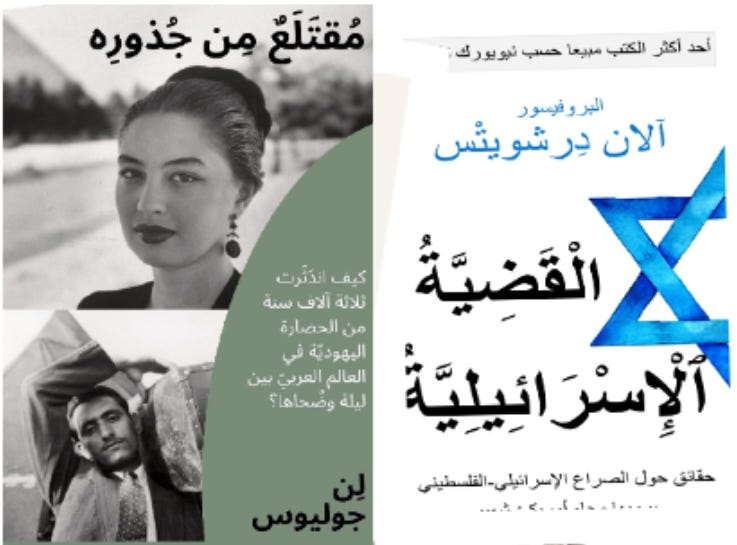
[Image: Book covers from ‘The Connecting Hamza: Jewish Voices in Arabic’]
“Jewish Thought in Arabic: A Voice, Not an Apology” by Michal Reznic, Founder and Project Manager, The Connecting Hamza
If the Abraham Accords cracked open a diplomatic door between Israel and parts of the “Arab world”, then October 7, 2023, blew it off its hinges.
In the aftermath of Hamas’s massacre and the war that followed, we did not just witness rivers of blood, we saw the floodgates open on something else, something that was already there: the hatred, the glorification of violence, the deepening of old lies.
And once again, we Jews were spoken about, shouted over, weaponized, but rarely heard.
Long before October 7, I knew I did not want to be silent and I did not want my people’s words to be silent either. This is why I decided to focus The Connecting Hamza, the NGO I founded in 2018, on making Jewish thought accessible in Arabic. Not filtered. Not softened. Not translated by those who hate us. Just Jewish books, in clear Arabic, speaking for themselves.
And no, this is not about “building bridges,” that phrase so overused and often meaningless, this is about Presence. About reclaiming the Jewish voice in a language where it’s long been erased, mistranslated, or shouted down.
What We Have Done
Since 2018, we have been translating books written by Jewish authors into Arabic. Later, in partnership with Dr. Danielle Gurevitch, director of the Dangoor Centre for Universal Monotheism, at Bar Ilan University, we launched the first Online Jewish library in Arabic.
This growing initiative has also been supported through collaboration with the Shalom Hartman Institute, the Shalva National Center — one of the world’s leading organizations for disability inclusion, Dr. Einat Wilf, and the Koby Mandell Foundation. Each of these partners not only contributed content, but also helped sponsor the translation and promotion of their respective titles.
Here is a selection of works we have translated:
Letters to My Palestinian Neighbor by Yossi Klein Halevi
Uprooted by Lyn Julius
The Case for Israel by Alan Dershowitz
The War of Return by Dr. Einat Wilf & Adi Schwartz
Healing The Abrahamic Community by Rabbi Yakov Nagen
Dreams Never Dreamed by Kalman Samuels
The Blessing of a Broken Heart, by Sherri Mandell (in the process of proofreading)
In addition, we are the first, and so far, the only team to translate the works of the late Rabbi Jonathan Sacks, former Chief Rabbi of Britain and the Commonwealth, into Arabic. His book Studies in Spirituality is already available online, including a page for Parashot Shavua (his commentary on the weekly Torah Reading), and we are currently working on Lessons in Leadership.
We have reached out with subtitled videos, created social media campaigns and received responses from Arab readers: some downright furious and some grateful.
That is what happens when real dialogue begins, not the sanitized kind, but the messy, soul-level kind.
When people truly encounter the “other,” it shakes something loose. And that’s exactly the point, especially when that “other” has, for so many years, been perceived as the enemy, the occupier, or the eternal villain. That’s how Israel is often portrayed in large parts of the Arab world.
And our team? We have worked with Arabs from Israel, Morocco, Iraq, Egypt, Jordan, and Palestine, those who are willing to help tell Jewish stories in the language of their own people.
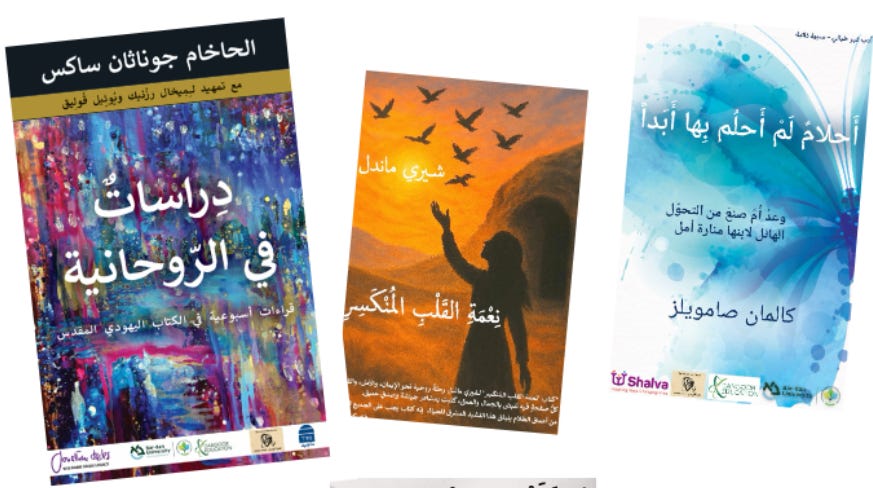
[Image: Book covers from ‘The Connecting Hamza: Jewish Voices in Arabic’]
Why Books, and Why Arabic?
We are often asked this question.
Because books do not argue. They invite.
Because in a region where so many are raised to fear or hate Jews, the first thing they need is not confrontation, but a space that does not threaten.
James Clear put it perfectly in his essay Why Facts Don’t Change Our Minds:
“Convincing someone to change their mind is really the process of convincing them to change their tribe... And the best place to ponder a threatening idea is in a non-threatening environment... Books resolve this tension... Arguments are like a full-frontal attack on a person’s identity. Reading a book is like slipping the seed of an idea into a person’s brain and letting it grow on their own terms.”
In Arabic, that kind of “non-threatening space” barely exists when it comes to Jewish thought.
In fact, there is almost no credible, nuanced information about Jews, Judaism, or Israel available in Arabic. One of our former proofreaders, an Egyptian, once shared examples of Jewish scholarship being translated in his country but published with disclaimers warning readers not to trust what the Jews write.
That kind of deep-seated suspicion is exactly what we are working against.
What Our Authors and Partners Say About Us
Those who have worked with us, authors, scholars, and institutional partners, have spoken clearly about the urgency and integrity of this work.
Rabbi Dr. Yakov Nagen, a leading voice in Jewish-Muslim interfaith dialogue, called The Connecting Hamza “a vital effort to build bridges between Jewish/Israeli and Arab/Muslim cultures and societies.” He wrote that our Arabic translations “enable Arab readers to engage directly with the richness of Jewish thought and culture—rather than encountering Judaism solely through the lens of media or political conflict.”
Dr. Danielle Gurevitch, director of the Dangoor Centre, emphasized our team’s professionalism, cultural sensitivity, and vision: “Through its initiative, The Connecting Hamza has created the first comprehensive online Jewish library in Arabic... a testament to Michal’s unwavering commitment to fostering cross-cultural understanding through scholarship and education.”
Yossi Klein Halevi said that “people throughout the Arab and Muslim worlds are hungry for insight into the Jewish people,” and that The Connecting Hamza’s work is “a matter of urgency for Jewish well-being.”
Kalman Samuels, founder of Shalva, described our Arabic edition of Dreams Never Dreamed as “truly extraordinary,” written with excellence and completed despite “seemingly insurmountable obstacles.”
Lyn Julius, author of Uprooted, praised the meticulous care taken with every line: “The love of the Arabic language shines through [...] The Connecting Hamza saw through the project from beginning to end, setting up the website uprootedjews.com and social media to promote the book. I found Michal’s dedication to the task admirable. I would not hesitate to recommend her to potential sponsors for future projects. She is professional, reliable and conscientious.”
And Dr. Einat Wilf summed it up this way:
“Their work is not about seeking agreement, but about ensuring access. Making these works available to Arabic-speaking audiences is not only an act of intellectual courage — it is a necessary step toward broadening access to ideas and perspectives that are often silenced or excluded.”
Why We Need Your Help: The Price of Meaningful Translation
Translation is not that expensive. Not if enough people care. What we are doing here is a form of cultural resistance.
We are a non-profit. Every single book we translate is offered for free on the Dangoor Centre’s website. No paywall. No agenda. Just universal access.
But high-quality translation requires a team: expert translators, linguistic editors, proofreaders. People who know both languages, and who know both worlds. This is not about converting words. It is about precision faithfulness, and depth.
That takes time. That takes effort. That takes resources.
And that is why we need your help.
We’ve thought about launching a crowdfunding campaign and perhaps we still will. But the truth is, what The Connecting Hamza needs most isn’t a one-time push but, rather, sustainability.
We’re looking for something deeper: a stable, reliable annual budget that allows us to plan, to hire, to grow, and to translate consistently and professionally. not just when we get a donation, but because it’s our mission. That kind of work deserves the support of Jewish philanthropic foundations, cultural institutes, and donors who understand the long term.
This isn’t a feel-good side project. It’s strategic infrastructure for Jewish presence in the Arabic-speaking world - educational, cultural, spiritual. We’re planting seeds and seeds don’t just need water once, they need care over time to grow into something lasting.
If you believe in this vision, help us secure the future of this work.
Please contact us here: theconnectinghamza@gmail.com
Help Us Speak
If you believe Jewish voices belong in any language and especially in Arabic:
Please support our work and help us expand this library.
Help us respond not just with policy, but with presence and education.
We are not explaining ourselves.
We are not apologizing.
We are simply speaking.
In Arabic.
Finally.
To see some of the NGOs activities, please visit: https://theconnectinghamza.org/programs-and-activities/
Editor’s Afterthought:
Our “Anti-Israel Media Bias Fortnight” began in tears, but it has ended in hope. We have finally arrived at Sinai. We wish you "Chag Shavuot Sameach!"

To upgrade your subscription on Guerre & Shalom, please click here:
To see Guerre & Shalom’s recent and well-received article on Rabbi Sacks, hit the link below:
The Lonely Citizen of Faith

Europe owes the Jews no small thanks for making people think more logically and for establishing cleanlier intellectual habits… Wherever Jews have won influence they have taught men to make finer distinctions, more rigorous inferences, and to write in a more luminous and cleanly fashion; their task was ever to bring a people “to listen to raison.” (Frie…
A beautiful reply Michal.
A great initiative. I will try and make it known here in the U.S.