


Jacob’s Voice, Esau’s Hands: A Zionist Polemic
by Eli Kavon
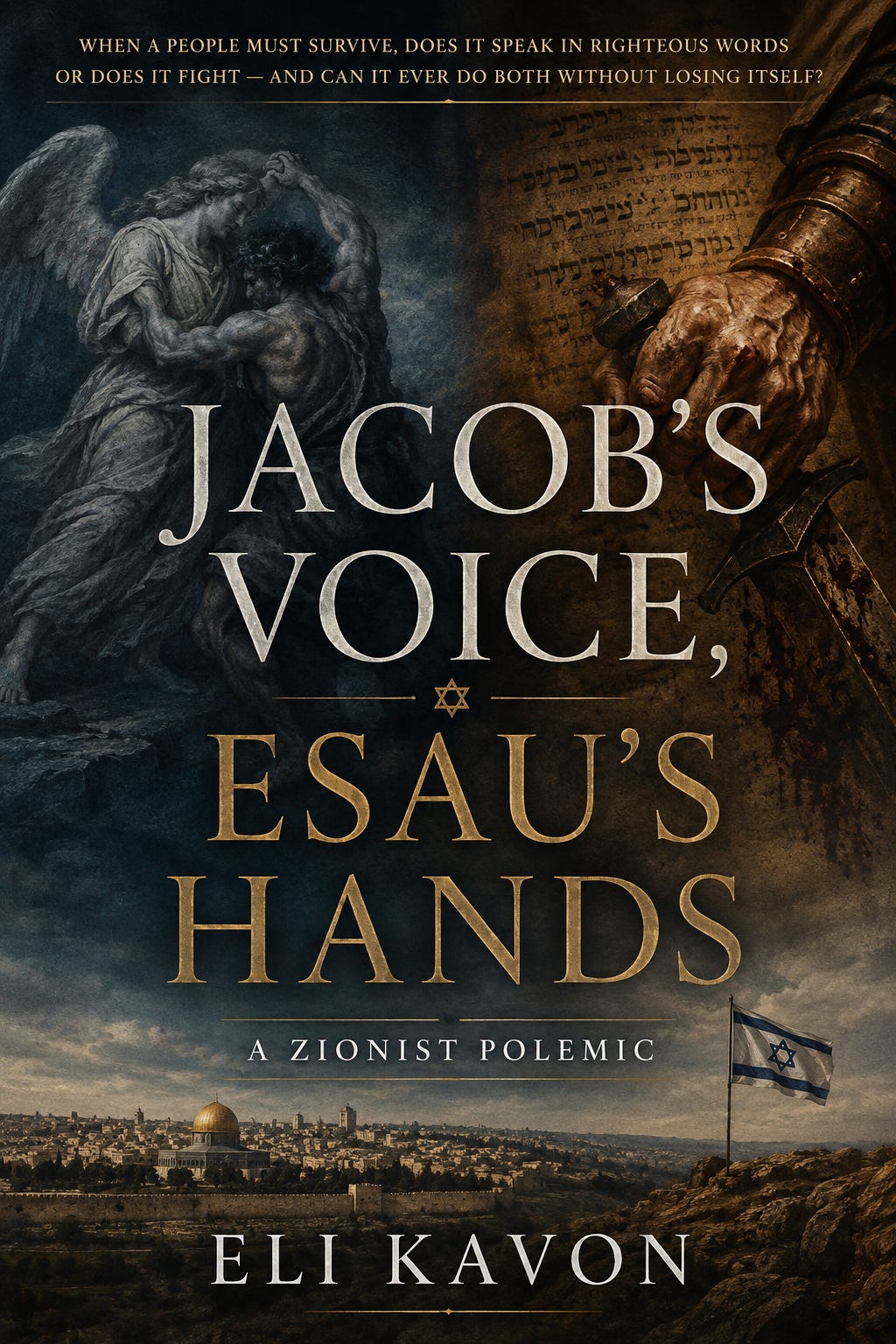
About the book:

Introduction: Birth of a Nation

PART 1] Foundations: The Claim of Continuity
This section moves in four steps: a close reading of Jacob's own transformation from scholar to statesman, an account of Zionism's inheritance of Jewish exceptionalism, a test of that exceptionalism against Jews who lived fully inside a foreign culture without losing themselves to it and, finally, a reckoning with what history and memory owe each other.
Chapter 1: Jacob’s Journey: Evolution of a Patriarch
When we first encounter the young Jacob in the Torah, he is “a mild man who stayed in camp.” In contrast, his older twin brother Esau whose heel he grasped as they emerged from Rebekah’s womb was “a skillful hunter, a man of the outdoors.” Yet, only chapters later in Genesis, Jacob is wrestling and overcoming a mystery man, and demands that he be blessed by this manifestation of God on Earth. God gives him the name Israel—”for you have striven with beings divine and human and have prevailed.” This transformation of Jacob from bookworm to wrestler can only be understood if we examine the patriarch’s life in more detail. It certainly is a remarkable metamorphosis.
Jacob’s education in the ways of the world begins with Rebekah, his mother. Rebekah is the sister of Laban, a man immersed in the politics of duplicity and tricks. While the passive Isaac preferred Esau to Jacob—Esau was the man of action that his father never could be—Rebekah realized her younger son had to get out of the tent, muddy himself in the real world and seize the birthright from his older brother. If that meant deceiving his father, so be it. It was time to leave the yeshiva of Shem and Ever, as it was millennia later, when scholars left the Volozhin yeshiva to fight for survival and sovereignty.
