


We still have the epilogue to come, but this is a marvelous conclusion to a marvelous piece of work. In simple terms, Israel is “Never Again” in practice and its determination to survive, live and thrive needs no apology. In Uri’s own words:
“The message is not complicated. Without guardians, what you cherish will perish. Israel did not become a fortress because it likes walls. It became one because history kept knocking at the door at 3 a.m.
The West can treat that as an Israeli quirk, or it can take the hint. Keep your army ready. Tell the truth about the enemies of freedom. Teach your children where they come from. And when the siren sounds, do not argue with it. Run. Then turn and face what set it off.
Israel is small. Its lesson is not.” - Daniel Clarke-Serret (Editor)
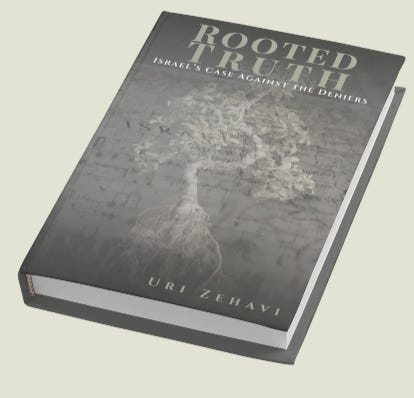
Rooted Truth: Israel’s Case Against the Deniers
by Uri Zehavi
Preface & Introduction: The Return of the Lie // Chapter 1: Setting the Record Straight // Chapter 2: From Balfour to Independence // Chapter 3: By Right, Not Permission // Chapter 4: Apartheid as Propaganda // Chapter 5: Colonialism and the Great Erasure // Chapter 6: The Genocide Libel // Chapter 7: The UN Assembly Line // Chapter 8: Campus Catechism // Chapter 9: NGO Lawfare // Chapter 10: The Jewish Right to Return // Chapter 11: Sovereignty is Not Theft
Part Four (continued): Answering the Deniers
Chapter 12: The Non-Negotiable Nation
Peace is not the human default. It is an achievement, fragile, defended, never self-maintaining. Jews learned that the hard way. Israel lives it by necessity.
On the morning of October 7, 2023, that truth ripped through our sleep—both literal and metaphorical. At first light, hundreds of Hamas gunmen blew gaps in the fence around Gaza and poured into Israel. They turned kibbutzim and border towns into slaughter sites, burned houses, hunted families, dragged children and grandmothers from safe rooms. They gunned down hundreds of people at a music festival. The dead, the abducted, the footage streamed in real time. President Joe Biden called it “the worst massacre of the Jewish People since the Holocaust,” and he was right.
The shock had two edges. The first was the savagery. The second was the realization that a lapse in vigilance had opened the door.
Warnings were missed or waved away. The perimeter we had come to take for granted was thin. The lesson, old as Jewish history, reasserted itself in blood. Peace exists because people keep watch. When those who keep watch fail or are told to stand down, evil moves fast.
The habit of watchfulness runs deep. In our oldest text, the Holy One is called the “Guardian of Israel” who “neither slumbers nor sleeps.” A people that hears those words learns to keep its eyes open. In the long centuries without a state, Jews did what they could to protect their communities, but they were always at the mercy of others—unfortunately, often to their detriment. With the return to Zion, watchfulness had to become a civic duty.
By the late nineteenth century, a Hebrew farmer in the Galilee or the sands south of Yafo learned quickly that ploughing by day meant patrolling by night. At first, some hired local guards. When that proved unreliable, they formed their own watches. In 1907, a handful of young men led by Israel Shochat organized Bar-Giora, a secret band with a grim motto: “In blood and fire Judea fell; in blood and fire Judea shall rise.”
Two years later they founded HaShomer, the Watchman, to protect Jewish farms across the land. They rode out in twos, in rain and heat, circling fences, sleeping with rifles by the door.
That posture carried into the institutions of state. The underground defense organization formed in 1920 called itself the HaGanah, “Defense.” It did not wait for the British to show up in time.
When Israel declared independence in 1948, the HaGanah became the Israel Defense Forces. The name clearly shows this was not an army of conquest. It was a shield. The day after the Declaration, Arab armies invaded. The question was simple, and it was not theoretical. Fight, or die.
Keeping watch is not only a matter of sandbags and sentries. It is a culture. In Israel, memory is not for museums. On Yom HaShoah, the Holocaust Remembrance Day, sirens howl across the country. Traffic halts. People step out of cars and stand, heads bowed, on highways and sidewalks.
A week later, on the Memorial Day for Fallen Soldiers, the sirens sound again. These are not displays for tourists. They are a public lesson plan. A twelve-year-old on a Tel Aviv balcony watches his parents stiffen in silence. He understands that his life rests on someone’s readiness to serve. A teenager in Jerusalem hears the same siren and knows it may one day be hers.
There is a line that runs from the watch-fires on a hillside in 1910 to the drones over Sderot in 2023. It is the line of a people that will not leave its safety to others. Zionism made that a norm. Ze’ev Jabotinsky, who organized Jewish self-defense after the Kishinev pogrom of 1903, called it dignity. David Ben-Gurion boiled it down to the “three S’s”: self-help, self-rule, self-respect.
After Rome’s expulsions and Europe’s pogroms and the Germans’ gas, these were the price to breathe.
It is fashionable in safe capitals to intone that “security can’t be an excuse.” In Israel, security is the boundary between neighbors and mourners.
Watchfulness does not mean cruelty. Israel’s army is called what it is for a reason. The goal is not to dominate others. It is to preserve a space where Jews can live as a free people and where Arabs who share that goal can live in peace.
The insistence on maintaining control in parts of Judea and Samaria until there is a serious peace is not a theological tic. It is a sober reading of experience.
We left Gaza in 2005 and were told to wait for the dividends. The dividends arrived as Qassams. We offered a state in 2000 and 2001; the answer was “no,” then suicide bombings. That is not a script that argues for standing down.
Those who seek to undo Israel know they cannot defeat its soldiers in the field. They wage a different war. They use vocabulary as a battering ram. Call Jews in Judea “settlers,” call their neighbors “indigenous,” and you have smuggled a verdict into the grammar. Say “occupation” without context and you have implied an original theft. Repeat it often and the history under your feet disappears.
Do not play along. The moral and legal case has been made in these pages. The rights of both peoples must be reconciled by agreement. But a precondition of any agreement is a shared language that does not start with a lie.
There is a kind of dry Israeli humor that makes sense only in a place that lives on a knife-edge. A farmer in the 1930s, asked why he slept with a rifle under the bed, shrugged and said, “The roosters crow. The jackals prowl. I prefer to be awake.” That ethos rightfully permeates Israeli culture. Pray for rain and dig a reservoir while developing desalination technology. Teach your children poetry and teach them to shoot. Hope for calm and check the fence.
The world often mistakes that posture for belligerence. In truth it is the posture of a people that has read its own history and decided not to repeat it. Israel’s insistence on its right to exist, to defend itself, to plant vineyards in Judea and teach Hebrew in Jerusalem, is not a demand for special treatment.
The paratroopers who put their hands on the Wall in 1967 did not think of charters or maps. They thought of fathers and grandfathers, of prayers whispered in cellars and camps, of a city that carried their name. They cried because they had come home and because they knew, in their bones, that coming home comes with work. To keep a home, you lock the doors, you fix the roof, you get up when the dog barks at 3 a.m. That work will never end. It does not have to. It is the price of living as a nation rather than pleading as a remnant.
The world is not owed an apology for this. In a century that tries to dissolve facts into slogans, we say: some things are not for barter. The Jewish People’s place in the land where they became a people is not a negotiating chip. It is the floor on which any real peace must be built.
Also from The Guerre and Shalom Publishing House:


Never Again, In Practice
Golda Meir once put the matter without embroidery: “If the Arabs put down their weapons today, there would be no more war. If the Jews put down their weapons today, there would be no more Israel.” As true today as it was then. From Nasser to Khomeini to Hamas, our enemies have said out loud what they intend to do. The Jewish state is what they cannot abide. Laying down our defenses would not be noble. It would be suicide.