


If the chapters released to date were just warm up, today’s offering is la pièce de résistance. It is an unmissable, compelling piece of work that places the legal case for Israel on an incontestable footing. Sign up as paid to read Rooted Truth in full as well as all other titles from the Guerre and Shalom Publishing House.
(Also sign up to Uri Israel Brief where my very own Pax Arabica will soon be reserialised behind a paywall.)
- Daniel Clarke-Serret (Editor)
Other titles from the Guerre & Shalom Publishing House:


ROOTED TRUTH (Contents, to date)
Preface & Introduction: The Return of the Lie
Chapter 1: Setting the Record Straight // Chapter 2: From Balfour to Independence
BLURB: What if the world’s oldest hatred didn’t disappear—only learned new grammar? What if antisemitism no longer arrives as theology or race science, but dressed up as “human rights,” “decolonization,” and the moral language of the age? Rooted Truth exposes the continuity of the lie—and why Israel became its preferred target.
With historical depth and briefing-grade clarity, Uri Zehavi traces the Jewish people’s unbroken connection to the Land of Israel—from covenant to exile, from Balfour to Ben-Gurion—and shows how history, law, and identity converge in one stubborn fact: the Jews are home. Across four parts, he dismantles the propaganda that now passes for analysis: the myth that Jewish indigeneity is metaphor, the weaponization of “apartheid/colonialism/genocide,” the bureaucracies of denial that launder bias into legitimacy, and the moral case for sovereignty and survival.
Clear. Disciplined. Unapologetic. Not a plea for sympathy, Rooted Truth is a legal brief, a moral argument, and a warning. The campaign to turn Israel into a question mark is a campaign against truth itself.
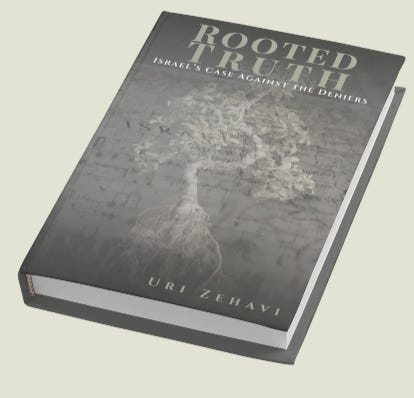
Rooted Truth: Israel’s Case Against the Deniers
by Uri Zehavi
Chapter 3: By Right, Not Permission
Israel exists by right, not indulgence. That truth was spoken aloud in Tel Aviv on a Friday afternoon in May 1948 when David Ben-Gurion read the Declaration of Independence. The text invoked an ancient bond and a modern promise and affirmed “the natural right of the Jewish People to be masters of their own fate, like all other nations, in their own sovereign State.” Ben-Gurion did not ask for a favor. He exercised a right that history sustained and law affirmed. In that moment, the Jewish nation reentered the family of nations by justice, not sufferance.
Of course, self-determination did not begin as a Jewish claim. It entered modern statecraft after the First World War and hardened into global doctrine after the Second. The League of Nations spoke of preparing peoples for independence out of collapsed empires. The United Nations Charter then put “equal rights and self-determination of peoples” among its core purposes in Article 1 and tied peace itself to that respect in Article 55. In plain language, a people has the right to shape its political life. Poles claimed it. Czechs claimed it. Arabs claimed it. Jews, rightly, claimed it too.
The Jewish People qualify in every serious sense. A shared origin in the Land of Israel. A language revived in daily use. A continuous culture, law and memory. A recorded, uninterrupted bond to a specific place. The League of Nations said so in 1922 when it recognized “the historical connection of the Jewish People with Palestine” and the “grounds for reconstituting their national home in that country.” That sentence was not a Shabbat poem. It was the preamble of the Mandate for Palestine, an instrument of international law.
The record also answers a favorite anti-Israel trope, the one that paints Israel as a guilt project or colonial indulgence. When the Ottoman Empire fell, Arab leaders pressed for independence and received new states in Syria, Iraq and the Arabian Peninsula.
No one at San Remo in 1920 thought it outlandish that the Jews should seek the same right in their homeland. The Balfour Declaration of 1917 voiced British support for a Jewish national home. San Remo gave that policy international force.
The League’s Mandate charged Britain (even though they abandoned their responsibility when the winds at home shifted) with facilitating that national home while safeguarding the civil and religious rights of others. Read the text. The assignment is explicit. The point of the Mandate was to realize Jewish self-determination in that land.
Nothing in the League or early UN archives suggests that Jews were anything less than a people entitled to sovereignty. There is plenty of debate over lines on maps and the timing of institutions, but there is no serious claim that Jews were a mere religious interest group waiting on imperial charity. The framework was self-determination. The expectation was statehood.
When the United Nations assumed the question in 1947, it did so with two realities in view. First, the Charter’s promise of self-determination. Second, the facts on the ground: a Jewish national society already functioning with towns, councils, schools and defense.
The UN Special Committee visited the land - and displaced-persons camps in Europe - and concluded that two peoples claimed the territory. The General Assembly then recommended partition in Resolution 181. The vote was 33 in favor, 13 against, 10 abstaining. The resolution spoke of creating “independent Arab and Jewish States.” The word independent matters. It recognized a Jewish claim equal to the Arab claim under the Charter’s own logic.
Yes, the General Assembly could recommend and not command, but that does not gut the principle. The nations acknowledged that the Jews of Palestine were a people with the right to statehood. The Zionist leadership accepted the plan, with all its painful sacrifices. The Arab League rejected it and promised war. That choice tells you everything you need to know about the later rhetoric. When “Pro-Palestinian” spokesmen chant about illegitimacy, they are not debating law. They are denying a people’s right to be.
Statehood by Right, Not by Permission
On May 14, 1948, the Jews of the land declared the State of Israel. They timed it to the hour the British Mandate ended so there would be no gap in lawful authority. The Declaration cited the UN’s partition recommendation and the League Mandate’s recognition of the Jewish bond to the land, but its core claim ran deeper. It affirmed the natural and historic right of the Jewish People to sovereignty in their own country. That is the grammar of nationhood everywhere. Rights first. Recognition follows.