


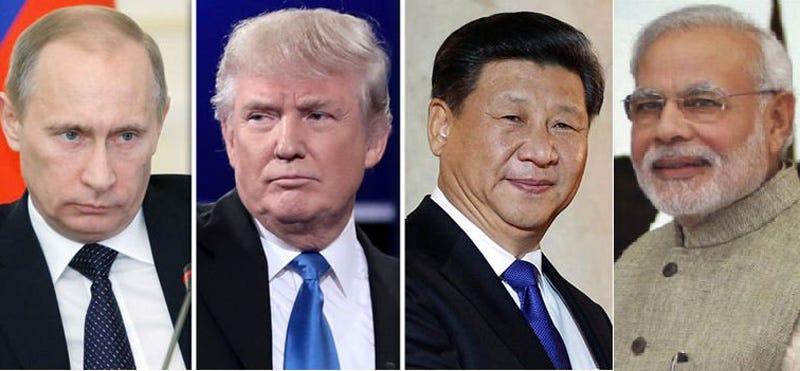
It’s time to bring back the British Empire. Or rather the British Commonwealth. Or rather the Commonwealth of Nations with teeth. There needs to be a global power bloc, based on the nations of the old Empire, that can defy the Axis of Autocrats. In a world of Oceania (the US), Eurasia (Russia) and East Asia (China), we need Team Airstrip One to re-establish the international order.
Let me break this down a little bit. We currently live in a world of pan-continental empires. Some are hidden in plain sight. Some are barely hidden at all. The most blatant are the Russian Federation, China, Pax Arabica and “The Western Hemisphere”.
The first two are considered to be “countries”, but that, as we know, is mere politically correct window dressing. Tibet, Inner Mongolia and Xinjiang are about as (Han) Chinese as my aunt, while Russia is a European country that mysteriously found its way to Manchuria. If they had stopped trying to invade their neighbours, we may have forgiven them their historic expansionism, but alas Ukraine, Taiwan, the India border regions, Myanmar…
As for Pax Arabica, I might have to write a book about that one.
“The Western Hemisphere”, of course, refers to America’s ‘Sphere of influence’ under the Monroe Doctrine. Although she desists from physically controlling other countries, her local, imperial ambitions are clear. In a less than blemish free past, the US of A has invaded Panama, Cuba and even the Commonwealth member of Grenada. As we speak, her president has floated annexing Canada, blockading Venezuela and wresting Greenland from Danish hands.
The issue here isn’t the decency of Maduro’s government. It’s that, like Russia, China and the “Arab World”, the United States thinks (particularly now) in terms of Spheres of Influence. When the MAGA mob state that they wish no new involvement in foreign campaigns, some are simply parroting the traditional American penchant for isolationism. Others, however, are reverting to the typical “continental approach” to Empire: of trying to control one’s own backyard, of eviscerating any possible Great Power neighbours, of creating instability on one’s borders, of privileging an ideology of expansion (ideally without overt force).
All these great power blocs speak in terms of anti-imperialism, anti-colonialism and national independence. What they really mean, however, is an aversion to global empire — a rejection of the British approach to which we shall shortly return. They look with nostalgic admiration at the good old days of the Romans, Persians, Ancient Chinese, the Caliphate and even the Mongols, who ruled contiguous territory so as, in effect, to create one uninterrupted, continental country.
The 19th and 20th centuries were no stranger to continental empires too. Who can forget the ”glories” of the Austrian-Hungarian Empire, the German Empire and of course the American Empire which gobbled up ever greater chunks of what we now call the United States? These empires, where successful, were rebranded as “countries” and so, somehow, avoided all that “troublesome decolonisation” that the British and French had to endure.
Empire’s meaning was conveniently changed by these Great Powers to mean global empires, principally the one run from London. Apparently, territorial contiguity is kosher, while globe-trotting adventurism is treif.
But here’s the thing: with the exception of the United States, every other continental spanning empire has been an aggressive, expansionist disaster. The British, by contrast, laid the groundwork for a better world — the international order that the 1984 trio are trying to dismantle.
A better world? How so? Well, what needs to be understood is that British global empire bested continental empire (sorry “big countries”) in three important respects:
In the first place, the very fact of physical distance between the mother country and its colonies created a firewall such that malpractice in foreign shores rarely rebounded back into the democratic polity. The home nation and the foreign colonies remained distinct in character and political organization.
Let’s take the example of slavery before its famous abolition. The abhorrent practice, widespread in the sugar islands of the Caribbean, never made landfall in the United Kingdom. The enslavement of other human beings was never to be permitted on that Sceptered Isle, for the British Island was considered a Holy of Holies to which foreign immorality could never enter. Unlike in its continental peers, where empire and its evils became the new country, the United Kingdom remained relatively unblemished. Indeed, it was her own parliamentarians, journalists and Quakers who spoke up for the suffering native peoples.
This worked both ways. Britain’s own foreign conquerors took the nation’s values with them, if only imperceptibly. Although we would never wish to emulate Lord Cromer’s arbitrary bureaucracy today, replete with its manifold abuses and disrespect for the rule of law, we recognise that he avoided the worst possible excesses of empire. His Egyptian rule led to no Congo-style extermination nor Xingjiang-style genocide. And why? Because he had a conscience called home. Although he was far from Norfolk, neither he - nor his testosterone-filled fellow adventurers - were quite capable of entirely jettisoning British constitutional values. Through the firewall, made possible by global separation, the essence of English wholesomeness remained. No such thing can be said for the historic wastelands wreaked by pan-continentalism.
The final consideration is the effect of the firewall on educated indigenous peoples. When Gandhi, Jinnah and Nehru were educated in the British Homeland, they not only earned degrees, but a respect for British values. Far from leaving them on the shore in Southampton, they applied them in India. They asked why democratic British principles didn’t apply there also. It was a powerful argument to which there was no rebuttal. Their call to spread democracy and constitutional liberalism around the world felled the very empire which spread them.
Beyond the firewall, a further line of division is represented by culture. When the British arrived in India, they were to find Hindus, Muslims and Sikhs. Upon departure, they left the country in the same diverse, cultural condition. Anglican, it was not.
The result? Decolonization was relative child’s play, for upon the subcontinent and throughout the world, clear, national divisions were evident. Empire - ironically - prepared foreign territories for statehood.
Continental decolonization would be a far more challenging matter —to the point of near impossibility. Wherever the Arab spread, Arabisation was to follow –and assimilation expanded along with the Americans. How would decolonisation even be possible?
As for Eastern Europe, she really struggled to find her borders. Where was Poland exactly? Who were the Czechs? Were Germans in Hungary Germans or Hungarians? A bloody mess. Literally. That is the legacy of continental empire: nobody knows what country they are in! WWII was followed by mass ethic cleansing — the “only way” for everyone to live in the “correct” country. Is that decolonisation?
The Russians maintained separate nations within her vast Empire. Well kind of —for Russification was always the watchword. But though folk dancers were no disguise for tokenism, the maintenance of different nationalities led to Soviet disintegration. The Republics followed where culture led. Ever watching, the Chinese have learned from Russian “errors”, hence the extreme sinification of Xingjiang and the crushing of Tibet. As with the Arabs and Americans, the Chinese need complete, national, cultural hegemony to stave off decolonisation.
Global empire led to the national firewall, while continental empire led to an imperial “big country”.
Global empire maintained unique cultures, while continental empire crushed difference.
So now we turn to the third - and most significant - case of distinction between the British global empire and continental offerings of the 1984 trio. This is a difference born in globalism itself. The mere fact of presence in multiple global locations necessitated global rules of conduct. Proto-international law in other words.
Let us consider a simple case. India have raw materials the British wish to use in manufacturing. The Indians have textiles they wish to sell in Manchester. But India and Britain are on opposite sides of the world and their goods need transport. So what are the implications? Put simply, the oceans must be safe. Piracy must be eliminated. International waters must be free. Trade needs to be protected and canals must be wide open. Whereas before there was chaos, now there was law. International standards. Freedom of the high seas.
In a system of spheres of influence, internationalism is a dead letter. Where the Soviet Union and the United States run parallel economies, there is no need for common rules. So long as both sides can agree not to nuke one another, they can leave each other well alone. Yet in a British global world, the rules of trade and international behavior must be for all.
It is no use retorting that this was (and is) in Britain’s interests. Of course it was in Britain’s interest. But the question we need to ask ourselves is, “Isn’t it ultimately in all our interests?” Isn’t a global world of rules-based order an unalloyed good? For my part, I say yes.
Spheres of influence thinking allows international, great powers to cause havoc: to destroy their neighbours, to crush native cultures, to engage in an orgy of never-ending expansionism. So long as the great powers leave one another alone, they are free to create a world of desperate violence. Decolonisation becomes meaningless. Sovereignty a badly-told joke.
It was the British Global Empire that laid the path to sovereignty —nationhood and meaningful decolonisation. It gave us international rules, free trade and an ordered world.
We could travel the high seas in security, with slavery a navy-enforced thing of the past. The world was a global village, separated by sovereignty and culture.
****
The title of this piece is provocative. So let us be clear. I am, clearly, not asking for a return to the past —for Britain to lord it over India and Jamaica. The British Empire as was has definitely finished. But what I am asking for this is: a strong, united Commonwealth alliance to join together as a bloc (a country?) to defy the 1984 trio. Oceania, Eurasia and East Asia - not forgetting Pax Arabica and perhaps India - want nothing more than a return to continental spheres of influence, a world where the gains of British imperialism are no more. We will split into (at least) 3 Earths occupying one planet where ne’er the twain shall meet. The Baltics will be lost. Taiwan (and more) will be overcome. The Kurds will be crushed. And - who knows - Canada may speak American?
Those of us who believe in trade cannot accept this.
Those of us who believe in sovereignty shudder in fear.
Those of us who value stability look on in horror.
Those of us who value democracy collapse in despair.
British colonialism was the empire that birthed freedom. It educated Gandhi to argue against it. It forced the world to abandon slavery. It spread democracy, liberty and the rule of the law. In short, it planted the seeds of its own demise so that we could live together as free men and women.
What I’m mourning today is the unrealised fruits of that demise. Not the gift, but our failure to accept it. We obviously weren’t ready. For that same decolonisation that gave the world freedom is leading that world to imprison itself once more –-this time, and once again, in pan-continental tyranny.
It’s all too easy to be “against the British”. To mock our history. To disregard our legacy. To claim - ridiculously - that we ruined the Middle East, when (obviously) it was totalitarian, continental, Arab imperialism.
Well we’ll see how much you’re mocking us soon, when you return to the 1984 world that Trump, Xi, Putin, Erdogan and even Modi are leading us. The European Union isn’t going to save you. And as for the Mamdani’s Democrats –bloody hell!
Only the values of the British Commonwealth have the power to renew this planet.
Only us, the members of the British Commonwealth, can hold the line against entropy.
Spread throughout this Earth, far from anyone’s sphere of influence, we are the truly global players.
To all those that value democracy, freedom and a global world of genuine sovereign states, I make this call. To all members of the real free world, I make this plea. Join us now, before it’s too late. Join the democratic sphere of influence.


Want to learn more about the glory of the British Empire? Have I got the reading list for you!
• The Politically Incorrect Guide to the British Empire by H.W. Crocker III
• Empire: How Britain Made the Modern World by Niall Ferguson
• The Rise and Fall of the British Empire by Lawrence James
• The Last Imperialist: Sir Alan Burns’ Epic Defense of the British Empire by Bruce Gilley
• Defeating Mau Mau, Creating Kenya: Counterinsurgency, Civil War, and Decolonization by Daniel Branch
• Raj: The Making and Unmaking of British India by Lawrence James
• The Last King of America: The Misunderstood Reign of George III by Andrew Roberts
• Churchill: Walking with Destiny by Andrew Roberts
• Malayan Emergency: Triumph of the Running Dogs, 1948-1960 by Gerry van Tonder
• Mountbatten’s Samurai: Imperial Japanese Army and Navy Forces Under British Control, 1945-1948 by Stephen B. Connor
• Bury the Chains: Prophets and Rebels in the Fight to Free An Empire’s Slaves by Adam Hoschild
A truly stupendous and well-argued piece, Daniel! It is definitely time to revive the British Empire! A multipolar world has only led to chaos and disorder. If we want law and order as an international community we need one powerful hegemon who can using its extensive reach, resources and military power enforce international law, spread liberal democracy, free-market capitalism, free trade, pluralism, human rights, the rule of law, racial equality, gender equality, LGBTQ+ rights, disability rights, animal rights, environmentalism, due process, religious freedom, free speech, freedom of the press, and much more around the world, combat sex and child trafficking, snuff out piracy on the high seas, help protect Israel’s security, and keep Russia, China, Iran, North Korea, Islamist groups, and other bad actors in check. The British Empire warts and all, did a great deal of good for the counties it ruled over and prepared them for self-government. It also kept the global order running like clockwork and in an orderly fashion. It wiped out slavery, combated piracy on the high seas and hung pirates, put down communist insurgencies, stopped the evil Mau Mau Uprising which slaughtered British settlers and Kenyans alike, defeated Nazi Germany, Italy and Japan in WWII, defeated Imperial Germany in WWI, the Royal Navy was both respected and feared as it patrolled the world’s oceans, and defeated, toppled and exiled the great Napoleon.
There are NO other candidates to be the global hegemon other then the new British Commonwealth Daniel suggests. The United States? Well, we have a history of interfering in Latin America and Donald Trump love him or hate him, is always talking about the United States expanding by doing things like annexing Canada, wresting Greenland from Denmark and taking back the Panama Canal. Russia rules over a vast empire and we’ve seen what they’ve done in Ukraine. China brutally conquered and occupies Tibet and Xianjing and have aggressively forced Chinese culture on both peoples. Pax Arabica…well Daniel might need to write a book on them. 😉 The European Union has potential but is currently too weak to exercise global leadership. So a new British Commonwealth is the answer. I called for this a while back but now I second it, a Global Defense Force (GDF). The new British Commonwealth will include Great Britain, Canada, Australia, New Zealand, Jamaica, St. Kitts and Nevis, Barbados, Singapore, and India. Once they get their GDP up and the ANC is toppled from power, South Africa will also be eligible to join. The GDF will consist of the same countries.
The GDF will coordinate together to enforce order throughout the world and the Royal Navy will challenge the U.S. Navy for dominance on the high seas. The Commonwealth with the permission of local governments will open charter cities in former British colonies. Britain in exchange for relief from American tariffs will get Hong Kong back from China. Britain will have charter cities in India, Pakistan, the Palestinian Territories, Jamaica, Barbados, South Africa, Kenya, Ghana, Nigeria, Zimbabwe, Uganda, Iraq, Jordan, and Egypt. France, Germany and Italy will be eligible to join the GDF only if they meet the following criteria:
1) They increase defense spending and the size of the militaries.
2) Sign defense pacts with Israel and refuse to recognize a Palestinian state under Fatah and Hamas.
3) Show significant progress in raising birth and marriage rates.
4) Pass a first amendment in their respective parliaments guaranteeing free speech.
5) End mass immigration immediately and reform their asylum claims process.
6) Do much, much more to protect Jewish communities.
Israel will also be eligible to join the GDF as well. Britain will distance themselves from Ireland and build strong ties with their Protestant brothers in Northern Ireland and once and for all get the Unionists back into the Good Friday Agreement. The GDF will push for an independent state for the Kurds and West African Christians and the partition of Syria and will take action to fight the genocide in Sudan. Each Commonwealth nation will take a set number of Sundanese refugees who will be throughly vetted. Refugees will receive permits to work, a green card, their children will attend the local schools, and they will receive a housing unit in a designated city. London will be cleaned up and the police presence in British cities will be quadrupled and stop and searched revived. Mass immigration to Britain will be ended. Britain will prioritize only certain types of immigrants like Indians, Kenyan Asians and nomadic groups. Britain will declare itself a save haven for Jews looking to get away from antisemitism. High-skilled labor will be the focus of Britain’s immigration policy. Justin Welby will be sacked and the Church of England will make a huge comeback. The Church will declare sanctuary for British Jews who are being persecuted.