



[Image: What happens in the bedroom stays in the bedroom. So did anything happen at all? And why should they be obliged to “prove” anything?]
PROLOGUE: Today is part 2 of God Fortnight. There are 3 more essays to come which I hope will change the way you think about this issue. This isn’t an arcane matter, but, as we will see in future installments, the very foundation of our political sovereignty and freedom. How we view God, at least conceptually, is completely bound up with the stability of Western civilisation and political philosophy in general.
In this first essay we explore (in an accessible way) how we can “prove” the existence of God and whether this is even an appropriate question. What are the problems with the scientific method in considering this question? Is “empiricism as truth” compatible with the existence of private evidence? And what the devil has this all got to do with sex?
Please note that the author is currently unemployed, so if you are able to afford a paid subscription, then this week would be the time to invest in Guerre and Shalom, a public service to defend Western civilisation. Paid subscriptions will allow you to access the linked articles in this essay. Thank-you.
“In the end the Party would announce that two and two made five, and you would have to believe it. It was inevitable that they should make that claim sooner or later: the logic of their position demanded it. Not merely the validity of experience, but the very existence of external reality, was tacitly denied by their philosophy.” (George Orwell, 1984, Chapter 7)
I’ve taken no prisoners in my war against post-modernism. So it’s only fair that I now turn my guns against Enlightenment modernism. Not to defeat it; nor even to wound it; but to point out its most glaring flaw. For despite the post-truth unreality promoted by the disciples of Michel Foucault, the postmodernists did verbalise one powerful critique of their modernist forebears that, not only bares deep examination, but demands agreement. Let’s say it plainly: Reason is an inappropriate method for determining the structure of reality. I am not speaking of the natural reality; the reality of the Earthy sphere which we inhabit and the near-infinity of space beyond. Rather I speak of the ultimate question: The existence of God and the meaning of life that follows from the analysing that question.
But though postmodernists are right to conclude that we are unable to (satisfactorily) determine the presence of a superior being through reason, it doesn’t follow that an answer to that question doesn’t exist; or that isn’t worthy of contemplation. It doesn’t mean that truth is an illusion or that human life can be reduced to power struggles between competing groups. It just means that the modernists went astray in how to answer metaphysical questions. The children of the Enlightenment fell into a trap. They failed to distinguish between personal direct experience and publicly-revealed empiricism; and they assumed that just because something cannot be outwardly proven to the satisfaction of sceptics that it therefore falls into the realm of superstition. The emotional detachment of the Enlightenment elite; the computer-esque way in which they approached the God question; succeeded in divorcing intellectual debate from the actual way in which believers - including intelligent believers - spoke of their faith.

Let me rewind one moment. Modernism in general, and the scientific method in particular, were an undoubted blessing for the human race. My use of technology to pen this article is resounding proof of that, if any be needed. So clear are the benefits of Enlightenment-inspired science and technology to our modern lives that it scarcely is worthy of the reader's time to ponder the question in the slightest detail. It is certain: we live longer, healthier and more choice-laden, prosperous lives due to the embrace of reason. A scepticism of authority helped us to break away from theocratic influences and make our own way through the labyrinth of the undiscovered. And the struggle against superstition has allowed us to work towards realising our collective and individual potential. Modernity hasn’t been a one-way street of motherhood and apple pie to be sure. Eugenics, absurd racial distinctions and ugly nationalisms have followed in the wake of the scientific age. But let the balance sheet make it clear: we live in a far better world than our 17th Century ancestors.

[Image: Did René Descartes really believe in God through the power of logic?]
BUT. The tools of the Enlightenment are laughably unsuited to tackling metaphysical questions. Let us first take the tool of logic. Many are the modernist disciples who have concluded that God exists. But it stretches credulity that they came to that conclusion through the power of deductive reasoning. Their “logical proofs” are little more than post-rationalisation. I defy anyone, including Rene Descartes, to honestly tell me that they believe in a Higher Being due to the Frenchman’s convoluted chain of reasoning. Speak truthfully now: Who has heard the cosmological argument and suddenly had a eureka moment? Who has listened in awe at the argument from design and has a Damascene conversion to the ways of religion? No-one! God is a matter that stirs the passion and gives the life of many meaning. To claim that the Almighty is nothing more than a neat conclusion to an intellectual exercise somehow doesn’t ring true. I think. Therefore I’m sceptical.

But here comes the rub. For even if Descartes inductions were unimpeachably correct - and even if God could be proved to be a “First Cause” through logic alone - what then? Who would care? Would you worship a First Cause? Would you wake up in the morning to thank a First cause; and pray to First Cause five times a day? Would a First Cause form the backbone identity of a living, breathing, real person? Indeed I would go further. If somehow that First Cause were more than a mere scientific phenomenon, and had sentience and personality, what claim would “it” have over your moral action? Plato’s Last Days of Socrates had it right. In the classic “Euthyphro dilemma”, the Socrates character stated "Is (an action) holy/correct/moral because it is loved by the gods or loved by the gods because it is holy/correct/moral?" Ultimately a sentient First Cause has no claim to obedience through its power. Might doesn’t mean right. Coming first doesn’t make one indigenous to the realm of morality. Proving a First Cause is thus of no moral or emotional power. It is a scientific curiousity. In short, it is irrelevant.

[Image: A philosopher thinking. But is he thinking as a theist would?]
Philosophical debates on metaphysics tread a fine line between incredulity and purposelessness. The discussions of Descartes and his disciples speak of God in a way detached from the reality of a theist. For why do people believe in God? Why do people feel such passion about this topic? And why does it animate their action - be that good or bad action - with such vital immediacy? In some cases, it may be deference to authority. And the Enlightenment was right to criticise such sheepish behaviour. In some cases it may be a result of living in an unfree society and the desire to conform. In some cases it may be a lack of intellectual curiosity. And lest we forget the comfort of a promised Heaven or the fear of the consequences of sin. But no-one who proclaims fealty to the Divine through the sociological processes just enumerated really believes in God. They have a materialistic motive. A fear of reward and punishment at the hands of the human or heavenly police force. For such “believers”, God is less of a reality and more of a psychological need come societal necessity. For scholars studying religious law day and night, God may simply be an afterthought.
But what about the intelligent people living in secular societies who genuinely believe in God? People who see a Divine Being as a Prime Mover that forms the essential element of the very nature of reality. Why do such people - for whom societal impulses and the pronouncement of self-declared authorities are little more than unwelcome background noise - feel such passion about this topic? Why does it animate the actions of THESE people with such vital immediacy? It sure as hell isn’t deductive reasoning. Sermons and societal pressure have never swayed them. Nor tradition; their parents’ views were invariably ignored. These people believe for one reason and one reason alone: they have a REASON TO BELIEVE. They may not want to share it with you. They may be uninclined to prove it to you. But a reason, they most undoubtedly have.
God cannot be proved through scientific experiment. Of course He can’t! Let us reason. Science reveals the truths of nature. God - in the monotheistic understanding - is beyond nature. Ergo science cannot prove the existence of God. So the modernists, including those that were unmotivated by scepticism, concluded that God could only be proved through logic. Logic, even if one accepts the lines of reasoning followed to possibly prove God, gets us only so far. At best one gets to a coldly unemotional First Cause conclusion which is a million light years away from the passionate faith of pre-modernist theists. Hence the modern, secular reality where even those that proclaim God’s existence do so from distant ivory towers. God, whether He exists or not, is an irrelevance from them. A “being” that created us that neither affects our lives nor plays any role in our purpose. A curiosity, but a matter unworthy of further consideration. An argument from past times that is best left forgotten. God or no God, WE are the centre of the universe. Or so say the modernists.

But by going down this logical blind alley, the Enlightenment modernists made a fatal mistake. Indeed one may say that they made an elephantine error of reasoning. For they departed from the premise that statements of reality needed to be proved demonstrably in order for them to be true. And whilst this was understandable following centuries of superstition, this was a conclusion too far. Because whilst to be confirmed true a statement must be proven, (arguments from mere authority, revelation and hearsay being insufficient), why should truth statements be proven publicly and demonstrably? Why isn’t something I personally experienced, an occurrence which is faithfully reported and was experienced with my own senses, a real and truthful experience? Why is empirical and peer-reviewed data required? Why is it necessary to prove the existence of God, when the subject of an experience reports that he or she has relationship with God and/or has had a religious experience? The person in question is not repeating dogmatic statements. It happened to them. Why does something have to be public to be (potentially) true? Aren’t reports of actual occurrences on Planet Earth at the very heart of the scientific worldview? Indeed aren’t eyewitness accounts accepted as evidence (crucial, game-changing evidence!) in criminal trials? If we are going to question everything experienced by one person, then the criminal justice system is in trouble.
Now naturally one is permitted to be sceptical about reports of religious experiences. Indeed one is almost obliged to be. But that doesn’t mean that those experiences are definitely untrue. If someone declares themselves to be a modern prophet or Jesus in disguise, you can safely dismiss them as delusional lunatics. Warning: Don’t join their cult! But if someone, having experienced the touch of the Divine in their lives, acts humbly and walks discreetly in the path of God, they may well - for all the outside observer knows - be entirely correct in their evaluation of events. They may well be genuine. God may well exist. And their experiences may well be animating their genuine passions, their sense of purpose and their Earthly actions. I say “may”, not because I disbelieve those that have experienced religious ephipany, but simply because if a fact cannot be demonstrated publicly through a process of mass observation or experiment, we cannot declare it true as an intellectual community. And we most certainly cannot make public policy on its basis. But by the same token, it may be correct. And therefore, experiment, mass observation and logic are not pre-requisites of saying that something is true.
Now one may counter as follows: if someone is so confident in their beliefs, why don’t they submit it to examination? Are they scared that they will be proved wrong?
A retort may be that missionaries aren’t exactly shy and are more than willing to share their beliefs whether asked for or otherwise. And how could you disprove a unprovable claim about personal experience anyway? And wouldn’t the recipient of a religious experience be understandably worried about being accused of insanity? Ultimately, it comes down to trust in the word of others just as with criminal witnesses.

[Image: An eyewitness takes the stand. Can we believe the evidence of a sole eyewitness in the dock? Is what he says proven to have happened if only he saw it? And does something need to be proved beyond reasonable doubt to say that it actually happened?]
But leaving that aside, isn’t it the reason for non-publicity of personal religious events obvious? To give an analogy, would you publicise your love life? Would you speak about how often you have sex with your partner and how it is as an experience? Would you spread all the minute details about what you do and how you do it? No you wouldn’t! And why not? After all, if you don’t tell me about your personal experience, it “obviously” didn’t happen. “You’re just a charlatan who claims to be Casanova but makes out like a fantasist”. “You’re a wannabe lover determined for a following”.
Or could it be that these matters are private? Just like the sexual relationship between a husband and wife is private, so are the (claimed) loving relationships between God and those open to His influence. One would no more want to divulge the nature of your experiences of Divine love than you would your experiences of human love. Indeed isn’t the nature of God in the eyes of genuine believers Love itself?

[Image: It’s true! They’re in love. Or are they? Prove it!]
I’ve not finished. For isn’t Love a concept as empirically unprovable as God? And don’t we base our belief on the existence, power and goodness of love based on the numerous (and scientifically unprovable) accounts of humans around the world? And do we conclude from the shaky public evidence that love is a fraud? Or do we believe that it is part of the fabric of reality?
So does Love exist? Does God exist? Does anything strictly personal exist? It may.
If it probably doesn’t? It may. If it definitely does, but it cannot be shared openly? It may. “May” isn’t a statement of doubt. It is a statement of the limits of reason. And the disciples of Enlightenment thinking need to be humble enough to admit that.
So what should we conclude? Not that modernism is wrong! God forbid. And certainly not that post-modernism is right. If something cannot be proven empirically or logically - be that God, love or God as love - we may not say that it is true in the square of public discourse. But neither may we say that there is no truth; nor that truth is unknowable or an irrelevance. What we may say is that I think that I know x to be true because it happened to me. But I may be wrong. And even if I’m not wrong, I cannot - indeed by the knight’s honour of a lover’s discretion, I may not - prove it or even talk about it to others.
There is demonstrable truth. There is demonstrable falsehood. And there is a personal truth known only by those that enter the bedchamber. And it’s none of your business!

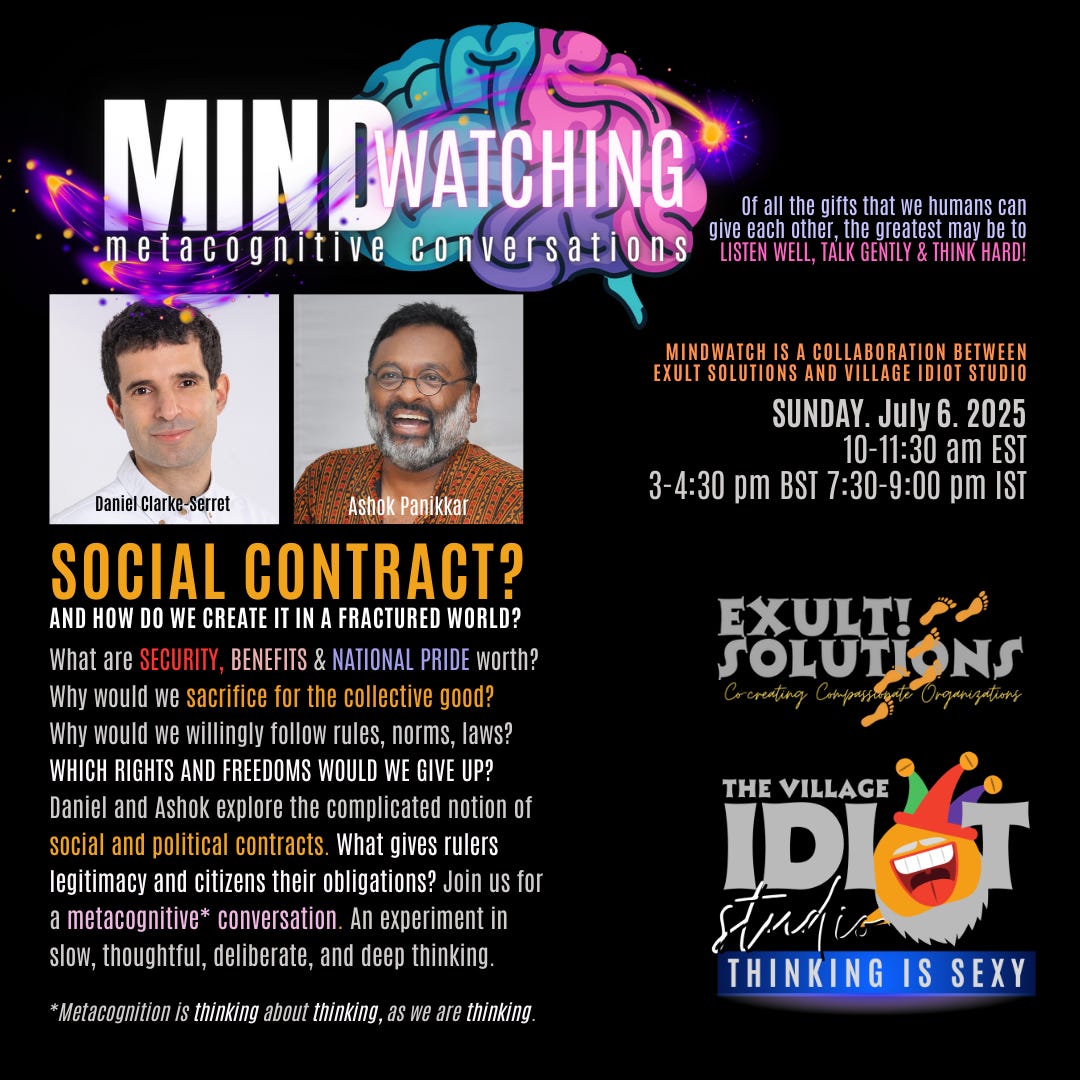
Join Ashok and Daniel LIVE this Sunday to discuss the Social Contract!
Sunday, 6 July 2025 10–11:30 am EST | 3–4:30 pm BST | 7:30–9:00 pm IST
Zoom: https://bit.ly/43E3Aa3
Ashok’s blurb:
After taking democracy for granted for decades, today everyone - including the apolitical- is terrified about it breaking down.
Everyday brings a new protest: Palestine, Trump, Taxes, Race, Gender, Sexuality, Climate.
As the rest of the world looks at the US, UK, Germany, or France, they can't figure us out. Why are the most prosperous and privileged people in the world fighting with their governments and amongst themselves? Why are Westerners so miserable and even confused about who they are and what they want to be?
Rukmini Iyer is busy this week. So we are honored to have Daniel Clarke-Serret, political thinker and Senior Fellow & Democracy Analyst at the NGO Section 1, join Ashok Panikkar on a vital conversation about changing expectations about rulers and the ruled.
As always we will endeavor to talk about the topic at hand- as well as our own cognitive process as we think through it. Think of MINDWATCHING as a conversation about the inner mechanics of conversations. This will not be a debate even if we disagree with each other. No opinions will be traded, no positions defended; just the long, slow discipline of shared reflection.
Dear readers the next part of God Fortnight is out: https://danielclarkeserret.substack.com/p/science-and-the-inductive-challenge?r=2bk821
I’ve always said that the only honest view of God is that I don’t know if he/she/it exists. I can never prove it either way and I don’t study to try. Some days, I think I believe; other days, I don’t. But definitive scientific evidence either way is impossible, as it should be. It would impoverish religion, and remove faith, if it could be proven. Faith is necessary to religion.