


Benjamin Kerstein’s new book, Self Defense: A Jewish Manifesto, is now available at Amazon via Wicked Son Books and the Z3 Project. For an extract, please hit this link.
Thanks to Benjamin for his kind review of PAX ARABICA below. If the reader would like to publish a review of their own, please direct message me.
Fun fact: In the review, Benjamin references Edward Said and how PAX ARABICA acts as a “polemical and ferocious response” to his defence of Arab Imperialism. Interestingly, an alternative working title to Pax Arabica was Occidentalism….
“Hypocrisy and Arab empire: A review of PAX ARABICA” by Benjamin Kerstein
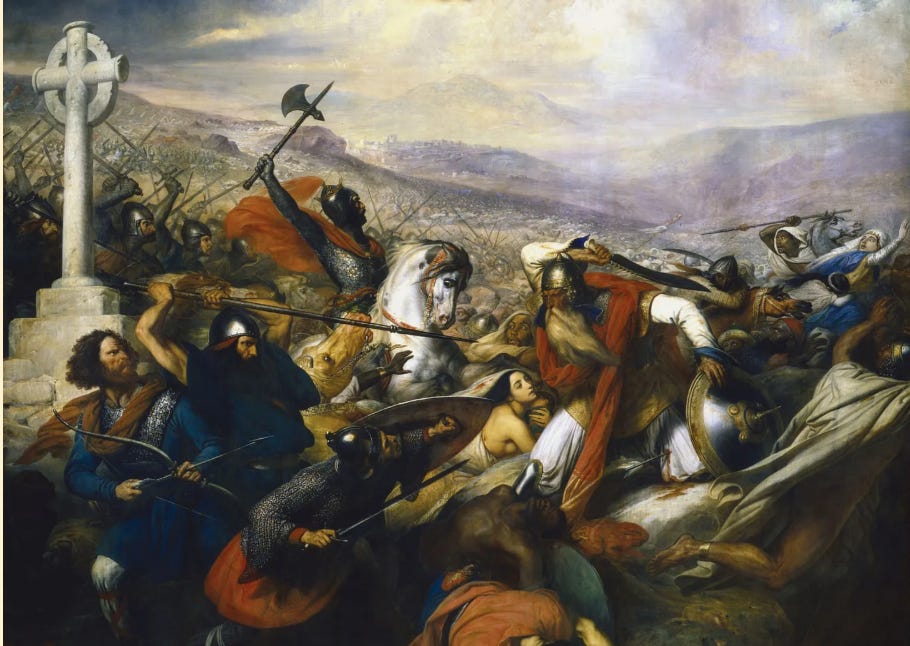
Clarke-Serret states a simple but too often silent truth: Morality is reciprocity. If the West must face history and itself, so must everybody else. As long as the partisans of Arab imperialism do not, no one in the West is obligated to listen to a single word they say.
Benjamin Kerstein
There comes a time when societies must face the reality of what they’ve done. That is, they must acknowledge and struggle with their history and, often, their historical crimes.
All the nations of the West and, of course, Israel are regularly admonished on this point, usually by those who refuse to reciprocate in any way. In his new book Pax Arabica, Daniel Clarke-Serret takes on perhaps the most prominent of these hypocrites: the Arab world.
In the process, Clarke-Serret holds a mirror up to the Arab world’s constant claims of victimhood and thus reveals the true victimizer. As he puts it, “The so-called Arab world is not oppressed. They are not suffering from genocide, ethnic cleansing, or apartheid, at least not from foreign hands. Rather, they are the oppressors who are audaciously and shamefully causing all these ills.”
Accusations of Islamophobia and racism will no doubt immediately follow, but Clarke-Serret points out in short order that his assertion is not fomenting hate but represents a return to historical truth.
“Which foreign power was it that invaded the entirety of the Levant and North Africa?” he asks. “Which distant people is it that imposed its religion on the unwilling at the barrel of the gun? And which racist interlopers have deemed it their God-given right to slowly but surely cleanse all non-believers from the indigenous lands of others?”
Indeed, whatever the virtues of Arab society, its constant execration of other societies—and racist assaults on Jews—usually appear to be little more than projection. Amidst the cries of racism, settler-colonialism, imperialism, and so on, we are faced with the history of an Arab world that only exists because of racism, settler-colonialism, imperialism, and innumerable other crimes.
Clarke-Serret makes his points in order to posit that the Arab world and thus the Middle East—with the sole exception of Israel—is an empire by any other name. It is one in which only one people with one religion is permitted to dominate an entire region, denying sovereignty to Kurds, Maronites, Yazidis, and numerous other, smaller peoples that it often relentlessly persecutes in the cruelest manner.
“Both the Mongols and the British are overshadowed by the most successful Empire of all time,” he writes. “An Empire that exists to this very day. An Empire so insidious that it has gaslit the world into believing that it is no empire at all. That they are the native people of all of the Middle East and North Africa and most audaciously of all that they are at the forefront of the fight against ‘Western imperialism.’”
The response to this, Clarke-Serret admonishes, should be the “de-colonization” of the Middle East by fostering the creation of nation-states for all its peoples. He states: “We do need unity in this world, but not Arab unity. We need the unity of free peoples coming together in liberty with respect and understanding for the other. We need a Middle East of different, but mutually respecting, nations.”
“There needs to be an independent Israel, an independent Kurdistan, an independent African Western Sudan, and an independent Christian state in Lebanon,” he urges. “Pan-Arabism—the remnant of medieval Islamic Jihad—needs to retire into the history books for good.”
Using examples from Sudan, Nigeria, and elsewhere—where non-Muslims and non-Arabs are being brutally slaughtered, enslaved, and otherwise abused—Clarke-Serret exposes the Arab world’s imperialist hypocrisy, saying, “The Arab Empire is an expression of all that we must set our face against: Superiority, slavery, submission, theocracy, expulsion, ethnic cleansing, and inequality.”
The vanguard of this empire, he posits, is currently “Palestinianism,” which he sees as a fundamentally imperialist and colonialist ideology.
He asserts that Palestinian “nationalism” is not, in fact, “a national movement for self-determination. … As clearly set out in the PLO Charter, Palestinianism is the Vanguard of the Pan-Arab Empire. It is a temporary identity that must be maintained until the non-Arab Jews are expelled from the Middle East and or at least denied their sovereignty as a free, indigenous, Middle Eastern people. It is more an agent of Jewish non-self-determination than a vehicle for Palestinian national actualization.”
In such a situation, Clarke-Serret posits that genuine national self-determination is the only thing that can roll the empire back. Quite rightly, he points out that “If self-determination has any value, it is to create power structures for the powerless.” And it is the Kurds, the Maronites, the Yazidis, and others who are powerless; while the non-Arab and non-Muslim Nigerians, Sudanese, and Israelis are the ones facing the robbery of their power by those who already possess more than enough to be satisfied by any rational measure.
Along with this, Clarke-Serret points to the hypocrisy of the Western left, for whom Islam is the only beautiful empire, the glorious exception to all their professed values. He writes, “Progressive organizations are infected by an absolutist anti-imperial ideology that colors all their geopolitical and historical interpretations,” but this ideology is not, in fact, anti-imperialist. The left’s ideology posits, rather, that some empires are more equal than others, and has thus become a collaborator in the modern continuation of the ancient Arab conquests.
Pax Arabica is a welcome antidote, insightful and ferocious in equal measure. It is, at times, a bit too ferocious, running to the polemical and exhortatory in a manner that lacks proper sobriety. There are also moments of excess, such as Clarke-Serret’s proposal that the Palestinians be placed in a non-sectarian state called “Levantia,” which is at best a fantasy.
Nor could a true “de-colonization” of the Middle East, however desirable, occur without enormous regional upheaval and war. As a result, it is likely that slow liberalization, such as is occurring in some Arab states, is preferable to grand gestures toward total liberation.
Moreover, one cannot ignore the fact that many Arab states are moving away from the ancient belief in conquest. The Abraham Accords, which have held despite a bloody war in Gaza, are proof enough of this, and there is the possibility that, if the Accords expand, Arab imperialist ambitions will come to an end by sheer force of history. Clarke-Serret does not consider this at sufficient length.
Nonetheless, there are plenty of ferocious and polemical defenses of Pax Arabica by innumerable apologists for imperialism and terrorism like Edward Said and Rashid Khalidi. A ferocious and polemical response to them is long overdue. In writing one, Clarke-Serret is stronger in history and logic than the apologists, and certainly possesses a moral clarity and historical accuracy they would never dare embrace.
More than anything else, however, Clarke-Serret states a simple but too often silent truth: Morality is reciprocity. If the West must face history and itself, so must everybody else. As long as the partisans of Arab imperialism do not, no one in the West is obligated to listen to a single word they say.
Paid subscribers have full access to all chapters of Pax Arabica.
Founder members (“Patrons”) have the right to receive a PDF manuscript of the chapters for an easier read.
PAX ARABICA
Introduction: The time to change the narrative is now!
PART 1: BABEL
Chapter 1: On Arab Imperialism // Chapter 2: On the Vanguard //Chapter 3: On Dictatorial Oppression // Chapter 4: On Islamist “Freedom” // Chapter 5: On Islamist Misery // Chapter 6: On Arab Apartheid // Chapter 7: On Middle Eastern Minorities // Chapter 8: On the Masters of Ethnic Cleansing // Chapter 9: On Genocide, Slavery and Racist Indifference //Chapter 10: On Unjust “Justice” and the Inversion of Language // Chapter 11: On Appeasement // Chapter 12: On the Man who stood against Pax Arabica
PART 2: EDEN
Chapter 13: On Nations, States and the Nation State // Chapter 14: On Sykes-Picot // Chapter 15: On Zionism and the duty to protect // Chapter 16: On the New Regional Sheriff // Chapter 17: On the Psychology of Strength // Chapter 18: On the Paradigm Shift // Chapter 19: On the Post-Imperial Two State Solution // Chapter 20: On the End of the Great Game
JOIN THE DEBATE ON “LEVANTIA”! (Chapter 19)
You have read Benjamin’s comments on Levantia above.
By contrast, Steven Spelledright (a newly paid subscriber) said: ‘In a recent interview with 18Forty, Einat Wilf noted “a colleague of mine recently wrote a nice little thought experiment. He called it Levantia.” You should ask that she cite you by name. Save others the time I had to spend Googling.’
This chapter is starting to cause waves. Join the debate.


For the most part, I’d agree with this mostly excellent review of Daniel Clarke-Serret’s book but I do have a few disagreements here and there, Benjamin. But I’ll get into that later. I think you sum up Daniel’s arguments and points pretty well. Indeed, the Arab Empire is one of the few true empires left on Earth besides Russia. Now let me be clear, did Arabs face paternalistic racism, injustices, atrocities, exploitation, plundering, and corruption under European colonialism? Yes, of course. But by in large, it’s been they who’ve done most of the oppression throughout Middle Eastern history.
Furthermore, whatever it’s flaws, European colonialism was nowhere near as bad as Arab colonialism. When colonial officials committed atrocities European officials condemned them and held them accountable. Brutality and mass murder was not only never condemned in the Arab Empire, it was encouraged and celebrated. European colonialism also brought innumerable benefits to the peoples of the developing world. Just to name a few: parliamentary democracy, free-market capitalism, human rights, the rule of law, free trade, the Christian Church, expanded education, improved public health, women’s rights, the enfranchisement of untouchable or historically excluded groups, the abolition of slavery, fair taxation to capital, access to capital, improved administration, creation of basic infrastructure, widened employment opportunities, the generation of historical and cultural knowledge, national identity formation, and the end of tribal warfare among other things.
Arab colonialism came with no benefits at all for the minorities of the Middle East. The Arabs did nothing at all to improve the lives of the Jews, Kurds, Persians, Africans, Berbers, Druze, Assyrians, Bedouins, Arameans, Copts, Samaritans, Mandeans, Maronites, and Yazidis they ruled over. Indeed, Pax Arabica has bamboozled the world by casting themselves as not an empire and purely as the victims of Middle Eastern history. They also blatantly gloss over how they oppressed the Jewish people and treated them as dhimmis for centuries. The PLO was indeed all about destroying Israel. It was ever about actually creating a Palestinian state. Now, to address the things you said I disagree with.
I don’t think Levantia is a fantasy. It may be at the moment but that doesn’t mean it couldn’t happen in the future. Much more impossible things have happened in human history such as the creation of Israel itself. I don’t think widespread de-colonization of the Middle East would necessarily mean widespread bloodshed or that one would have to settle for slow liberalization. It could be done peacefully as Morocco for example has left Pax Arabica peacefully and the Kurds were granted a degree of autonomy in Iraq. It could be done peacefully and gradually by a reformed United Nations and if the United States and the Western allies provided oversight and gave security assurances to these new states. I could see something like the Treaty of Westphalia or Good Friday Agreement being worked out between Arabs and Middle Eastern minorities. Sworn enemies have made peace before and coexisted it’s not at all impossible. Lastly, the Abraham Accords are a step in the right direction but they hardly signal an end to Arab imperialism but rather a recalibration of it. Not a single Indigenous Middle Eastern people has been liberated because of the Abraham Accords.
Benjamin Kerstein’s review of Pax Arabica hits on something essential: Daniel Clarke-Serret is saying what too many scholars, journalists, and diplomats refuse to say: Morality is reciprocity. If the West is expected to confront its sins honestly, then the Arab world must be held to the same standard. That is the core of Kerstein’s argument, and it is exactly where Clarke-Serret hits home.
In many ways, Clarke-Serret is applying moral language to what Bernard Lewis demonstrated with historical scholarship. Lewis showed that the Arab-Islamic conquests created one of the most sweeping and enduring empires in human history - an imperial project so thorough it erased entire nations, languages, and cultures. Clarke-Serret pushes the implication further: an empire so vast and lasting does not become morally invisible simply because it is politically convenient to pretend it never existed. You cannot claim eternal victimhood while standing atop an imperial legacy of your own.
That is why Clarke-Serret’s argument feels so bracing. He confronts the grievance narrative head-on and forces us back to the actual historical ledger: Kurds denied a homeland, Copts and Maronites living under permanent siege, Yazidis nearly exterminated, Jews expelled from every Arab country. None of this is “Western mythmaking”; it is the reality of peoples who suffered under Arab domination. Lewis mapped the history; Clarke-Serret delivers the indictment; and Kerstein deserves credit for pointing out how overdue this moral correction is.
Where Clarke-Serret is most controversial is his critique of “Palestinianism,” which he presents not as genuine self-determination but as the vanguard ideology of pan-Arab imperial identity. One may debate the rhetoric, but the PLO’s early documents speak for themselves. Clarke-Serret’s broader point is simply that self-determination only matters if it applies to actual marginalized peoples - such as the Kurds, Maronites, Yazidis, African Western Sudanese - not solely to those whose cause happens to align with Arab political convenience.
His prescription is straightforward in principle if difficult in execution: de-colonize the Middle East the same way the West de-colonized itself. Replace pan-Arabism - which Clarke-Serret sees as a euphemism for enforced Arab supremacy - with a regional order of sovereign, mutually respecting nations.
And here again Kerstein’s review makes an especially important observation: the Middle East is already moving in that direction through the Abraham Accords. These agreements between Israel and the UAE, Bahrain, Morocco, and Sudan shattered the old dogma that the Arab world had to remain in permanent, monolithic opposition to Israel. They opened embassies, established direct flights, expanded trade, and created real cooperation in technology, energy, and intelligence. Kerstein is right: the Accords show that the region can evolve past imperial ideology through pragmatism and national interest, not just through upheaval.
If anything, the Abraham Accords vindicate Clarke-Serret’s larger point. Once Arab states step out from under the shadow of pan-Arab grievance, the old narratives collapse. Peace becomes possible not because Israel changes, but because Arab nations finally act like nations rather than like foot soldiers of a mythic “Arab world.” Clarke-Serret doesn’t explore this enough, and Kerstein fairly calls him out on that omission.
Clarke-Serret is undeniably polemical, and his rhetoric occasionally overshoots. But after decades of romantic mythology from the Said/Khalidi camp - where Arab political failure is always someone else’s fault and Arab imperial history remains taboo - a forceful corrective isn’t a flaw. It’s a necessity.
If the West is expected to face its history with honesty, then the Arab world must be held to the same standard. Reciprocity isn’t prejudice. Until the champions of Arab grievance confront their own imperial past with the same moral seriousness they demand of others, their lectures carry no weight.