


So pleased to announce that Michelin-starred chef turned philosopher Richard Neat is Guerre and Shalom’s new “Society and Culture” correspondent. This is just one more way in which we earn our tagline “The World’s Intelligent Journal”. Today Richard asks: What became of the Western self? - Daniel Clarke-Serret (editor)
Consider a paid subscription for the full “Guerre and Shalom” experience:
Previously from Richard on Society and Culture:


Growing up—a period which, for a male, apparently lasts well into his fifties—I was nurtured on a diet of timeless English literature: Swallows and Amazons, The Famous Five, Winnie-the-Pooh, Alice in Wonderland, The Lion, the Witch and the Wardrobe. The stories were exciting, the writing beautiful, the characters often exemplary. Only much later do you realise that, all the while, you were being formed and moulded by a culture that had an interest in you emulating these figures and their thoughts and deeds.
This was moral instruction without the heavy-handedness, the Tammy Faye & Jim deviancy, or the shuffling feet beneath public lavatory cubicles which is often associated with self-righteous moral instruction. Nobody interrupted Swallows and Amazons to explain the virtues of courage, resourcefulness, loyalty or self-reliance. They simply made those qualities attractive. The characters we admired provided models of desirable behaviour. Society benefited if we all went off and behaved like them.
Ransome’s children are remarkably autonomous. They organize themselves, make plans, accept responsibilities, solve practical problems, take risks, quarrel, reconcile, cooperate and experience consequences. Adults exist, but the children’s world isn’t continuously administered by them.
Blyton similarly presents children forming their own miniature society: friendship, loyalty, courage, ingenuity, independence, suspicion of illegitimate authority, keeping one’s word, protecting one’s friends. Nobody had to tell the young reader that these qualities were admirable. The narrative made them admirable.
Every culture produces characters; every generation chooses which of them to imitate; and somewhere between imitation and habit, we become ourselves.
The Latest Chapter of The Genocide of Truth:

Aristotle insisted that character isn’t simply something at which we arrive fully clothed. Character is formed through habituation. We become just by doing just things, courageous by practising courage, temperate through temperate action. Virtues become dispositions through practice. In the Poetics, mimesis—imitation or representation—is fundamental both to human beings and to learning. We learn, in part, by observing and representing human action.
The West became very good at creating characters who might be useful to the survival of its civilisation.
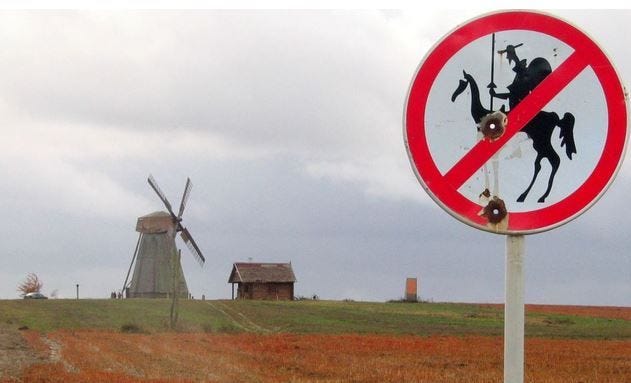
Cervantes gave us Don Quixote, a man who reads stories and then constructs a personality from them. Alonso Quijano consumes stories of chivalry until their values, vocabulary, gestures, expectations and heroes provide him with a model of the person he wishes to become. He doesn’t merely enjoy literature. He performs it.
Hannah More grasped this more than two centuries ago. Her Shepherd of Salisbury Plain didn’t merely tell working people to practise thrift, industry, piety and familial responsibility. She embodied those virtues in a family and made their way of life admirable. The Shepherd’s material poverty is contrasted with a kind of moral abundance: order, affection, gratitude, self-command and usefulness. She was deliberately creating a model of desirable behaviour.
Of course there is an important caveat. More’s project wasn’t politically innocent. The Cheap Repository Tracts appeared amid the social and political anxieties of the 1790s, and More explicitly wanted popular reading that would counter radical and revolutionary literature. Character formation and social order were thus intertwined.
Schiller arrived at a related position in his Letters on the Aesthetic Education of Man. Political freedom could not simply be imposed institutionally; human beings themselves had to become capable of freedom, and aesthetic cultivation had a role in forming such people.
Such writers and many more understood that if you wished to preserve a particular kind of society, it was not enough to defend its institutions. You had to reproduce the kind of character upon which those institutions depended.
With so many great teachers, perhaps the modern Self, convinced of its own uniqueness, is actually one of Western civilisation’s greatest composite works: assembled from thousands of years of other human beings imagining, examining and performing different ways of being human.
There is a delicious paradox here. The modern Self is encouraged to believe that it is sovereign, authentic and unprecedented—my identity, my truth (or at least Meghan or Oprah’s) my journey. Yet it is also indisputiable that this supposedly autonomous modern Self is actually thrown into an inherited world—language, stories, moral categories, archetypes, manners, conceptions of courage, beauty, success, love, masculinity, femininity, virtue and rebellion. We project ourselves forward by selecting among inherited possibilities: this is the person I want to become. In the present we imitate, practise, discard and modify them. The great conceit of the modern Self is that it confuses selection for creation: because I have chosen the pieces, I imagine that I made them.
This is why culture and history matter and this why the Progressives find tradition so dangerous to their ambitions.
Anyway, the question, therefore, isn’t whether human beings are formed. They obviously are. The question instead is whether they are formed by a culture rich enough to inspire, self-govern and appreciate our timeless achievements, or by institutions with a collectivist vision, powerful enough to construct them in advance.
